Alternatives to PayPal in 2026: 10 Options Compared
By ToolNimba Editorial Team October 30, 2026 10 min read

- Top pick
 Stripe
Online businesses and developers
Starting price2.9% + $0.30 per transactionCheck out StripeRead our review - Runner-up
 Square
In-person and small business
Starting price2.6% + $0.15 per in-person transactionCheck out SquareRead our review - Also great
 Wise
International transfers
Starting priceVaries by route, from 0.33% in some comparisonsCheck out WiseRead our review
How we researched this
We compared official pricing and feature pages, app store listings, privacy policies and public user reviews. Prices change, so check the provider's site before you pay.
Key takeaways
- Stripe is the best all-round PayPal alternative for online businesses that need APIs, subscriptions and global checkout.
- Square suits in-person sellers, while Wise and Payoneer suit cross-border payments and freelancer payouts.
- PayPal checkout fees for US merchants are higher than Stripe or Square online rates in recent published comparisons, but buyer familiarity can still help conversion.
- No single alternative covers every use case, so match the tool to checkout, in-person sales, payouts or international transfers.
- Fees, currency conversion and payout timing vary by country and account type, so confirm the rate for your sales mix before you switch.
Quick comparison
| Name | Best for | Starting price | Free plan | |
|---|---|---|---|---|
| Stripe | Online businesses and developers | 2.9% + $0.30 per transaction | No | Visit |
| Square | In-person and small business | 2.6% + $0.15 per in-person transaction | Yes | Visit |
| Wise | International transfers | Varies by route, from 0.33% in some comparisons | Yes | Visit |
 Payoneer | Freelancers and global payouts | Varies by payment type | Yes | Visit |
 Paddle | SaaS billing and tax handling | See website | No | Visit |
 Adyen | Large global merchants | See website | No | Visit |
 Skrill | Wallets and gaming payments | See website | Yes | Visit |
 Amazon Pay | Ecommerce checkout | See website | No | Visit |
 Venmo | Person-to-person payments in the US | Free for many personal transfers | Yes | Visit |
 GoCardless | Recurring bank payments | See website | No | Visit |
The best alternatives to PayPal
PayPal is familiar and widely trusted at checkout, but it is not the cheapest or most flexible option for every business. The alternatives below replace different parts of PayPal, from online checkout to in-person sales, subscriptions and cross-border payouts.
Stripe is our pick for most online businesses moving away from PayPal. Its standard US online card rate is 2.9 percent plus 30 cents, and it adds subscriptions, payment links, invoicing and a large integration library without a monthly fee on standard pricing. Developers get detailed docs and test tools, while non-developers can still use payment links and no-code checkout.
The catch is setup effort. A fully custom checkout takes engineering time, and add-ons such as advanced billing features can add cost. If you sell only in person, or you want a simple plug-and-play store, Square or a hosted platform may be faster to launch.
- Strong APIs and checkout tools
- Subscriptions, invoicing and fraud tools
- No monthly fee on standard pricing
- Needs developer help for custom builds
- Support is less hands-on than some rivals for small sellers
Square is the clearest PayPal alternative for shops, cafes, market stalls and service businesses that take payments face to face. You can start with the free app, add a card reader or terminal, and use the same account for online sales, invoices and appointments. In-person pricing at 2.6 percent plus 15 cents is competitive for small tickets.
Online sellers should check the full fee table. The free online rate is higher than Stripe for domestic cards, so a business that moves mostly online may save more with Stripe. Square still wins for mixed online and in-person sellers who want one system for both.
- Free point-of-sale app
- Hardware for counters and mobile sellers
- Online store and invoicing included
- Online rate on the free plan is higher, at 3.3 percent plus 30 cents in recent fee schedules
- Account holds can affect some sellers
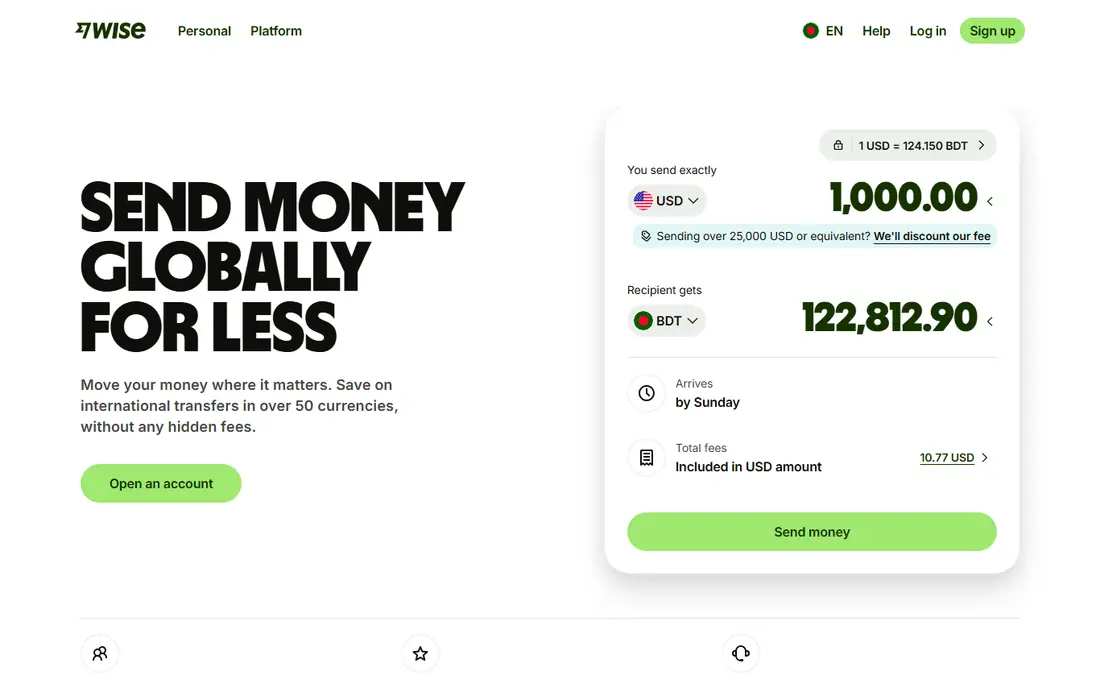
Wise, formerly TransferWise, is best for sending and receiving money across borders rather than for running a store checkout. You hold balances in multiple currencies, convert at a stated rate with a visible fee, and pay local recipients in many countries. Freelancers and small firms that invoice abroad often save most here compared with PayPal conversion markups.
It does not replace PayPal checkout for a typical ecommerce store. There is no customer-facing card checkout in the same way, and some currencies have receiving limits or fees. Use Wise for transfers and payouts, and pair it with Stripe or Square for customer checkout.
- Real exchange rate approach
- Multi-currency balances
- Transparent fee shown before you send
- Not a full checkout processor for online stores
- Receiving options vary by currency
Payoneer suits freelancers, agencies and marketplaces that get paid from clients and platforms abroad. You can receive funds through local bank details in supported currencies, withdraw to a local bank, and pay contractors or suppliers. That receiving-account model is a practical advantage over a wallet-only system for business payments.
Fees are less simple than a flat card rate. Receiving, conversion and withdrawal costs depend on the payment type and currency route, so model your actual corridor before you commit. For a freelancer paid monthly in dollars or euros, though, Payoneer is often cheaper and more business-friendly than PayPal.
- Local receiving accounts in several currencies
- Marketplace and client payouts
- Mass payout tools for businesses
- Currency conversion and withdrawal fees vary by corridor
- Account review can take time
Paddle is built for software and digital product sellers who want billing, tax and compliance handled together. As merchant of record, Paddle sells on your behalf, collects tax where required, and handles chargebacks and payment methods across countries. That removes a large admin burden for small SaaS teams selling worldwide.
The model is not free. Paddle charges a percentage of each transaction, which can cost more than a plain processor once volume grows. Physical goods sellers and in-person businesses should look elsewhere, but SaaS teams that dread tax work often find the trade-off worthwhile.
- Merchant of record model handles sales tax and VAT
- Subscriptions and checkout in one system
- Global payment methods
- Priced as a percentage of revenue, so costs rise with sales
- Less suited to physical goods
Adyen is the enterprise-grade alternative for brands that sell in many countries and channels. One platform covers online checkout, in-store terminals and mobile payments, with local payment methods and unified reporting. Large retailers and platforms that need that breadth often choose Adyen over patching together several processors.
Small businesses will find it harder to start. Pricing depends on volume and payment mix, and onboarding is built for larger operations. If your volume is modest, Stripe or Square will be faster and clearer on cost.
- Unified platform for online, in-store and mobile payments
- Wide payment method coverage
- Strong fraud and data tools
- Pricing is volume-based and not published as a simple flat rate
- Setup is geared to larger teams
Skrill is a digital wallet alternative for people who want PayPal-style wallet payments without using PayPal itself. You can send money, hold balances, and use a linked card where available. It is popular in gaming and international wallet payments, and it supports crypto transactions in supported regions.
It is not a direct replacement for a business checkout system. US businesses that need card processing, invoicing and subscriptions should choose Stripe or Square instead. Skrill fits personal wallet transfers and specific niches better than general ecommerce.
- Digital wallet for sending and receiving funds
- Prepaid card option in supported countries
- Crypto and gaming use cases
- Wallet and conversion fees vary
- Not a general business checkout processor in the US
Amazon Pay lets shoppers check out on your site using the payment and address details saved in their Amazon account. That familiarity can lift conversion for stores whose customers already shop on Amazon, since they do not need to type card details again. It works alongside, not instead of, a card processor in many setups.
The limit is audience. Shoppers without an Amazon account gain little, and Amazon Pay does not cover in-person sales, payouts or international transfers. Treat it as a checkout booster for ecommerce, not as a full PayPal replacement.
- Familiar checkout for Amazon customers
- Saved payment and address details speed checkout
- Fraud protection tools
- Only helps if your customers already use Amazon
- Fees are comparable to other checkout options, not the cheapest
Venmo, owned by PayPal, is still a useful alternative for personal payments and small US businesses that serve local customers. Splitting rent, paying a friend, or taking a payment from a regular customer is fast, and many US buyers already have the app. Business profiles add a more formal option for small sellers.
For business use, check the fee rules. Personal transfers from a bank or balance are often free, but business transactions and instant transfers carry fees, and Venmo is not a global checkout tool. It replaces the person-to-person part of PayPal, not the full merchant stack.
- Very familiar in the US for splitting bills and paying friends
- Social feed and simple app
- Business profiles available
- US-focused
- Business and instant transfer fees apply
- Not built for large global ecommerce
GoCardless is the pick for businesses that bill the same customers every month and want to cut card fees. It collects payment by direct debit from bank accounts, which suits subscriptions, memberships, rent and B2B invoices. Failed payments can be retried automatically, and the cost per payment is often lower than a card transaction.
Cards still win for one-off ecommerce and instant checkout, since bank debits take longer to clear and are not available in every country. If your model is recurring billing, GoCardless can sit alongside Stripe for cards, giving customers a cheaper recurring option.
- Direct debit for subscriptions and invoices
- Lower cost than card payments in many cases
- Automatic retries for failed payments
- Bank payments are slower than cards
- Coverage varies by country and scheme
How we picked these
We compared official pricing pages, fee schedules, payout and transfer features, app store listings and public reviews. We favored services that are actively available in 2026, that publish clear fee information, and that cover distinct PayPal use cases rather than repeating the same checkout tool. We did not claim hands-on testing of merchant accounts, and we noted where fees vary by route or volume.
How to choose a PayPal alternative for your business
Start with the job, not the brand. Online stores need checkout, fraud tools and subscription billing. In-person sellers need a terminal, a point-of-sale app and fast payouts. Freelancers need cheap receiving and conversion. SaaS teams need tax handling. No tool wins all four, so list your top two jobs first.
Then run your own numbers. Take last month's sales, split them into domestic and international, card and bank, one-off and recurring, and apply each provider's published fee for that mix. Add conversion costs, payout fees and any monthly plan cost. A tool that looks cheap on a headline rate can cost more once conversion and instant payout fees are included, so compare the total, not just the percentage.