Best AI Recruitment Platforms in 2026: 9 Platforms Compared
By ToolNimba Editorial Team October 30, 2026 9 min read

- Top pick
 Workable
All-in-one AI hiring for growing teams
Starting price$299 per monthCheck out WorkableRead our review - Runner-up
 Paradox
High-volume hourly and frontline hiring
Starting priceSee websiteCheck out ParadoxRead our review - Also great
 HireVue
Enterprise video interviews and assessments
Starting priceSee websiteCheck out HireVueRead our review
How we researched this
We compared official pricing and feature pages, app store listings, privacy policies and public user reviews. Prices change, so check the provider's site before you pay.
Key takeaways
- Workable is our pick for most small and mid-size teams, combining an applicant tracking system with an AI agent for sourcing and screening.
- Paradox (Olivia) is the best choice for high-volume hourly hiring, with conversational screening over text and chat around the clock.
- HireVue leads for enterprise video interviews and assessments, though pricing is quote-only.
- Manatal is the best budget AI ATS, with AI matching from 15 dollars per user a month.
- AI scores should support human decisions, not replace them: check bias audits and keep a human in the final hiring call.
Quick comparison
| Name | Best for | Starting price | Free plan | |
|---|---|---|---|---|
| Workable | All-in-one AI hiring for growing teams | $299 per month | Free trial | Visit |
| Paradox | High-volume hourly and frontline hiring | See website | No | Visit |
| HireVue | Enterprise video interviews and assessments | See website | No | Visit |
 Manatal | Budget AI applicant tracking | $15 per user per month | Free trial | Visit |
 Greenhouse | Structured hiring at scale | See website | No | Visit |
 Ashby | Data-led in-house recruiting teams | $400 per month | No | Visit |
 Fetcher | Automated outbound sourcing for lean teams | $115 per month | No | Visit |
 Juicebox | Natural language people search | $99 per seat per month | Yes | Visit |
 Zoho Recruit | Budget hiring inside the Zoho ecosystem | $25 per recruiter per month | Yes | Visit |
The best AI recruitment platforms
AI recruitment tools now cover every stage of hiring, from finding candidates to screening interviews and scheduling. The nine platforms below differ in where they automate and what they cost, and we compared pricing, AI features, and the size of team each one fits.
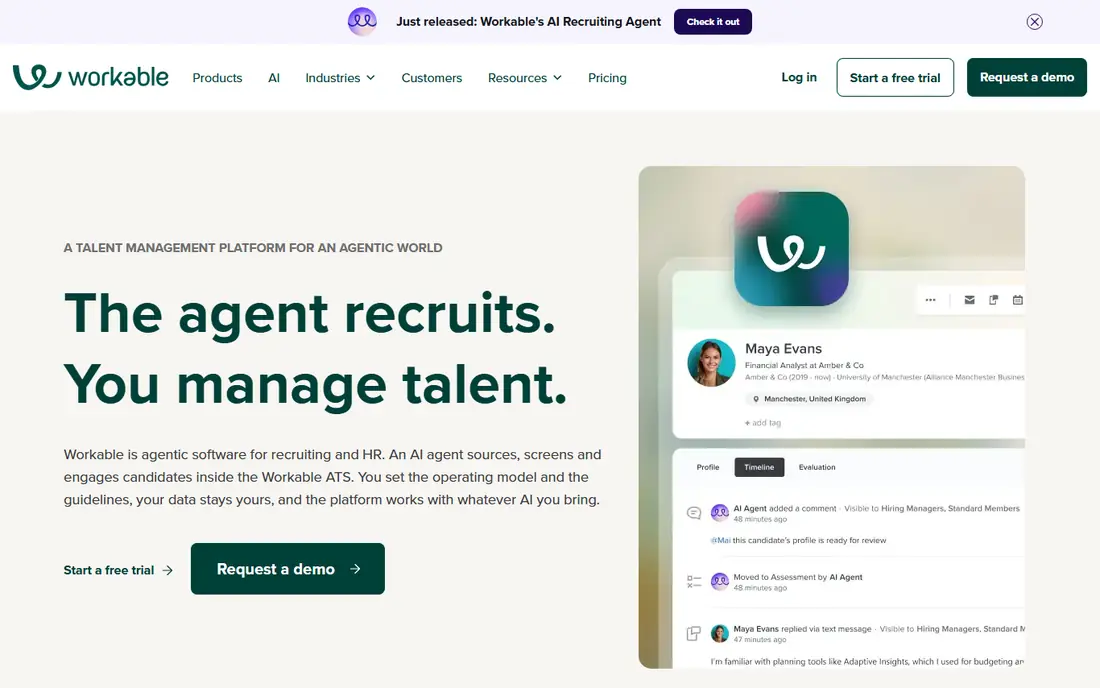
Workable is the most complete package for teams that want one system for hiring. Its applicant tracking covers job posting, pipelines, and collaboration, and its AI agent helps with job intake, sourcing, and screening. HR features like onboarding and time off sit in the same platform, which suits small and mid-size companies that do not want five separate tools.
The entry price of 299 dollars a month is a real commitment for a tiny team, and some AI features consume separate agent credits. But for a company hiring regularly across several roles, Workable's breadth makes it the best all-round pick here.
- ATS plus AI agent in one system
- Job board distribution
- HR tools included
- Entry price is high for very small teams
- AI features use separate credits
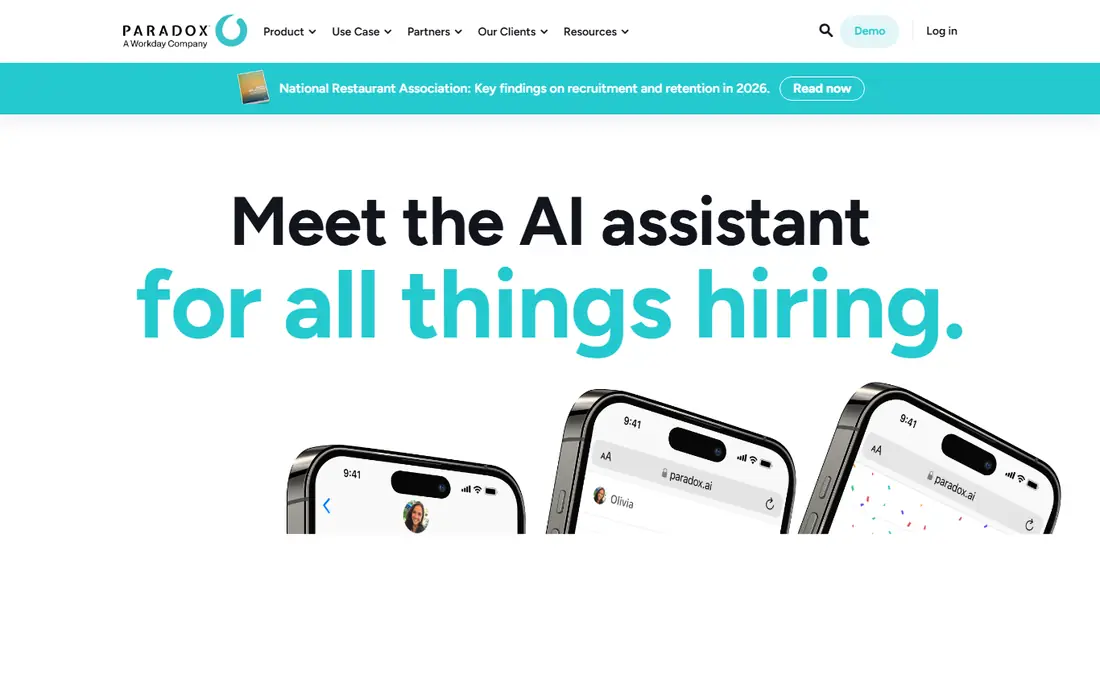
Paradox, through its Olivia assistant, is built for employers hiring hundreds of hourly workers: retail, hospitality, health care, and logistics. Candidates apply by text or chat, answer screening questions conversationally, and book interviews without waiting for a recruiter. That speed matters when candidates accept the first offer they get.
Pricing is quote-only and aimed at larger employers, so small teams may find it out of reach. Paradox was acquired by Workday in 2025, which strengthens its enterprise integrations. If your problem is screening volume rather than finding rare specialists, Paradox is the strongest tool here.
- Olivia AI screens and schedules by text and chat 24/7
- Over 100 languages
- Fast time to interview
- Quote-only pricing
- Best for volume hiring, not executive search
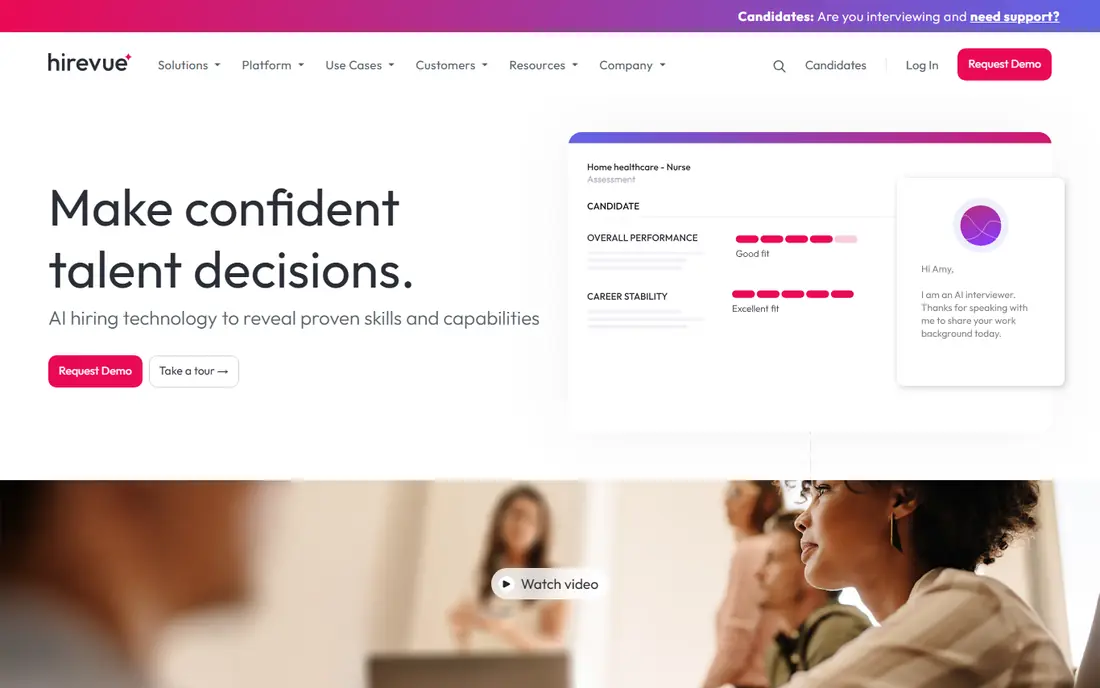
HireVue leads enterprise video interviewing, with structured one-way video interviews, game-based assessments, and AI scoring that helps recruiters compare candidates consistently. It integrates with major HR systems and suits campus hiring and high-volume professional roles where consistency matters.
Pricing is enterprise-only, and some candidates dislike recorded interviews: industry surveys report a share of candidates dropping out of processes that use AI interviews. Used carefully, with clear communication and human review, HireVue brings structure to hiring at scale that smaller tools cannot match.
- Structured video interviews
- Assessments and AI scoring
- Strong enterprise integrations
- Quote-only enterprise pricing
- Can feel impersonal to candidates
Manatal is the budget pick that still feels modern. From 15 dollars per user a month, you get an applicant tracking system with AI matching that ranks candidates against a role, plus social profile enrichment that fills in candidate details. For agencies and small teams hiring on a budget, that value is hard to beat.
Enterprise features like advanced analytics and deep integrations are thinner than Workable or Greenhouse, and its AI interviewer costs extra. But if your first need is an affordable ATS with real AI help, Manatal is the best starting point in this list.
- Lowest entry price here
- AI candidate matching
- Social profile enrichment
- Fewer enterprise features
- AI interviewer is a paid add-on
Greenhouse is the structured hiring standard for companies that want every interviewer asking consistent questions and scoring against the same criteria. Its interview kits, scorecards, and approval workflows reduce bias from gut-feel hiring, and its integration ecosystem connects to most HR tools. AI features assist with job posts, summaries, and screening.
Pricing is quote-only and typically enterprise-level, and setting up structured workflows takes real effort. But for companies that treat hiring quality as a strategic priority, Greenhouse's discipline is worth the investment.
- Strong structured hiring workflows
- Interview kits and scorecards
- Large integration ecosystem
- Quote-only pricing
- Implementation takes effort
Ashby combines an applicant tracking system with analytics that show where candidates drop off, which sources perform, and how interviewers score. That data focus suits in-house teams that want to run hiring like a measurable process rather than a series of ad hoc decisions. Its interface is modern and fast, and AI features assist with scheduling and screening.
Pricing starts around 400 dollars a month for smaller companies and scales with headcount, so costs grow as you do. Agencies may find it less tailored than Manatal or Loxo. For data-driven internal teams, Ashby is a strong, modern choice.
- ATS plus analytics in one platform
- Strong reporting
- Modern interface
- Entry price scales with headcount
- Less suited to agencies
Fetcher solves one problem well: finding passive candidates and emailing them for you. It builds candidate batches matching your criteria and runs personalized email campaigns, which suits small teams without a dedicated sourcer. Pricing from around 115 dollars a month makes it accessible to startups and small businesses.
It is a sourcing tool, not a full applicant tracking system, so you will still need somewhere to manage pipelines. Email outreach also needs careful targeting to avoid spammy impressions. If sourcing is your bottleneck, Fetcher automates it effectively.
- Automated candidate sourcing with email campaigns
- No sourcer needed
- SMB-friendly pricing
- Sourcing only, not a full ATS
- Email outreach needs careful targeting
Juicebox, built around its PeopleGPT engine, lets recruiters search for candidates in plain English instead of Boolean strings. Ask for a security engineer with fintech experience in a city, and it returns ranked profiles from a large database, with agentic workflows that can run multi-step sourcing for you. That natural language approach lowers the skill barrier to good sourcing.
Pricing starts at 99 dollars per seat a month, with AI agents as a separate add-on, so costs can climb. Search quality also depends on how well you describe the role. For teams that live in sourcing, Juicebox is one of the most interesting tools here.
- PeopleGPT search in plain English
- Large profile database
- Agentic sourcing workflows
- Per-seat pricing plus credits for AI agents
- Search quality depends on query skill
Zoho Recruit is the sensible pick for small businesses already using Zoho products. It covers job posting, pipelines, and candidate management from 25 dollars per recruiter a month, with a free tier for very small teams, and it connects naturally to Zoho CRM. That integration saves the manual work of moving candidate data between systems.
Its AI features are lighter than dedicated platforms like Juicebox or Paradox, and some users find the interface dated. But for a small business that wants affordable, integrated hiring without a big contract, Zoho Recruit delivers solid value.
- Low price
- Free tier available
- Integrates with Zoho CRM and other Zoho apps
- AI features are lighter than specialists
- Interface feels dated to some users
How we picked these
We compared official pricing pages, feature documentation, and public user reviews for AI recruitment platforms actively sold in 2026. We favored tools with published pricing where available and noted quote-only pricing honestly. We did not claim hands-on testing; our comparison rests on published specifications, pricing, and user feedback. AI hiring tools raise fairness questions, so we also weighed bias audit transparency and human oversight features.
How to buy an AI recruitment tool without regret
Start with one painful step, not the whole funnel. If resume screening eats your week, buy for screening. If scheduling is the bottleneck, buy for scheduling. A tool that automates everything often automates nothing well, and pilots on one real role will tell you more than any demo.
Check compliance early. Ask vendors for bias audit results, adverse impact reporting, and how candidate data is stored, since rules like New York City Local Law 144 require audits for automated hiring tools. Train recruiters to treat AI scores as suggestions, not verdicts, and log overrides. Finally, measure after 90 days: time to hire, cost per hire, and candidate response rates. If the numbers do not move, cancel.