Best AI Security Platforms in 2026: 9 Tools Compared
By ToolNimba Editorial Team October 30, 2026 11 min read

- Top pick
 Wiz
Cloud AI posture and inventory
Starting priceSee websiteCheck out WizRead our review - Runner-up
 Prisma AIRS
Full AI lifecycle security
Starting priceSee websiteCheck out Prisma AIRSRead our review - Also great
 HiddenLayer
Model protection
Starting priceSee websiteCheck out HiddenLayerRead our review
How we researched this
We compared official pricing and feature pages, app store listings, privacy policies and public user reviews. Prices change, so check the provider's site before you pay.
Key takeaways
- Start by listing what you actually run: models, apps, agents, cloud services and employee AI use, because no single tool covers all five well.
- Wiz and Microsoft Defender for Cloud are the strongest picks for cloud AI inventory and posture, while HiddenLayer and Protect AI focus on models themselves.
- Lakera is the most focused choice for prompt injection and LLM guardrails in a live app, rather than a broad platform.
- Cisco AI Defense and Cyera suit companies that need governance, policy and data controls across employee and enterprise AI use.
- Most enterprise AI security pricing is by quote, so budget for a sales conversation and a pilot, not a simple monthly subscription.
Quick comparison
| Name | Best for | Starting price | Free plan | |
|---|---|---|---|---|
| Wiz | Cloud AI posture and inventory | See website | No | Visit |
| Prisma AIRS | Full AI lifecycle security | See website | No | Visit |
| HiddenLayer | Model protection | See website | No | Visit |
 Lakera Guard | Prompt injection defence | See website | Free trial | Visit |
 Cisco AI Defense | Enterprise AI governance | See website | No | Visit |
 Microsoft Defender for Cloud | Microsoft and cloud AI posture | See website | No | Visit |
 CrowdStrike Falcon | AI workload protection | See website | No | Visit |
 Cyera AI Guardian | AI data security | See website | No | Visit |
 Mindgard | AI red teaming | See website | Free trial | Visit |
The best AI security platforms
AI security is a confusing label, because it covers different risks. One team worries about a model being stolen or poisoned. Another worries about an employee pasting customer data into a public chatbot. A third worries about an agent with too much access doing something it should not do. We compared official product pages and public documentation, and we grouped tools by the surface they actually protect.
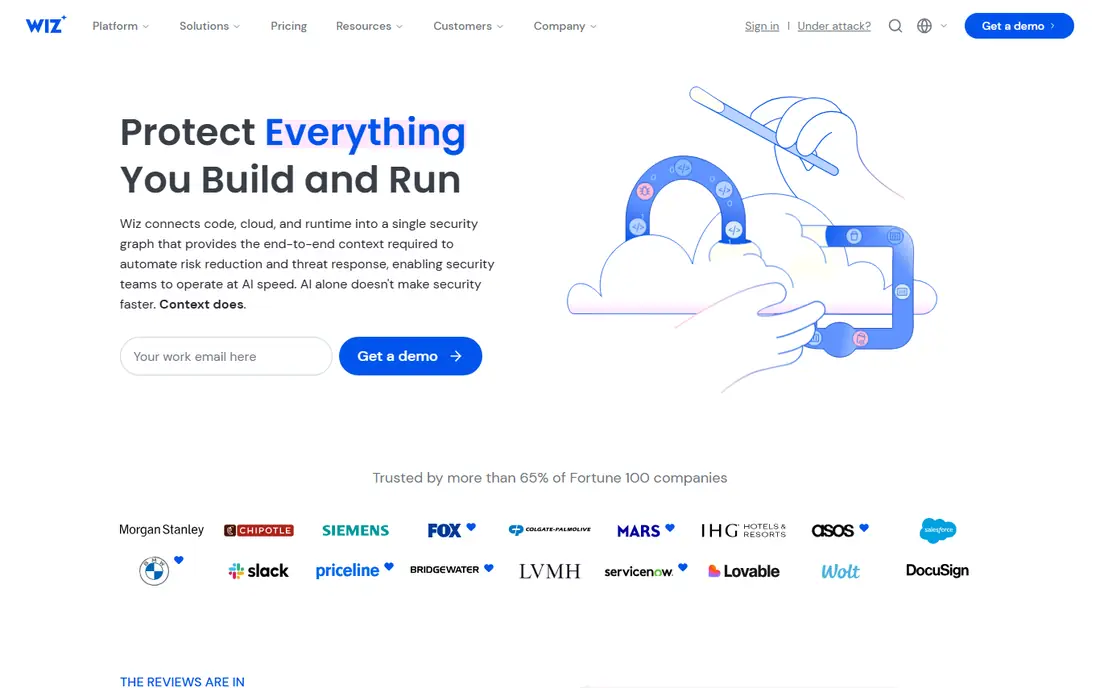
Wiz is the inventory-first pick for cloud AI. It discovers AI services, models, SDKs and pipelines across cloud accounts without agents, then maps how they connect to data and other services. That map, often called an AI bill of materials, is what lets a security team answer a basic question: where is AI actually running in our cloud, and what can it reach.
The platform also assesses misconfigurations, vulnerabilities and risky data access in AI pipelines, and it now covers services such as Azure OpenAI and AI Foundry alongside AWS and Google Cloud. The catch is scope and price. Wiz is a broad cloud security platform, so a small team with one LLM app may find it larger than needed, and pricing is enterprise and quote-based. For cloud-first companies with many AI workloads, that breadth is the point.
- Agentless cloud discovery
- AI bill of materials for models, data and services
- Attack path analysis across clouds
- Enterprise pricing by quote
- Strongest value is for teams already using cloud security tooling
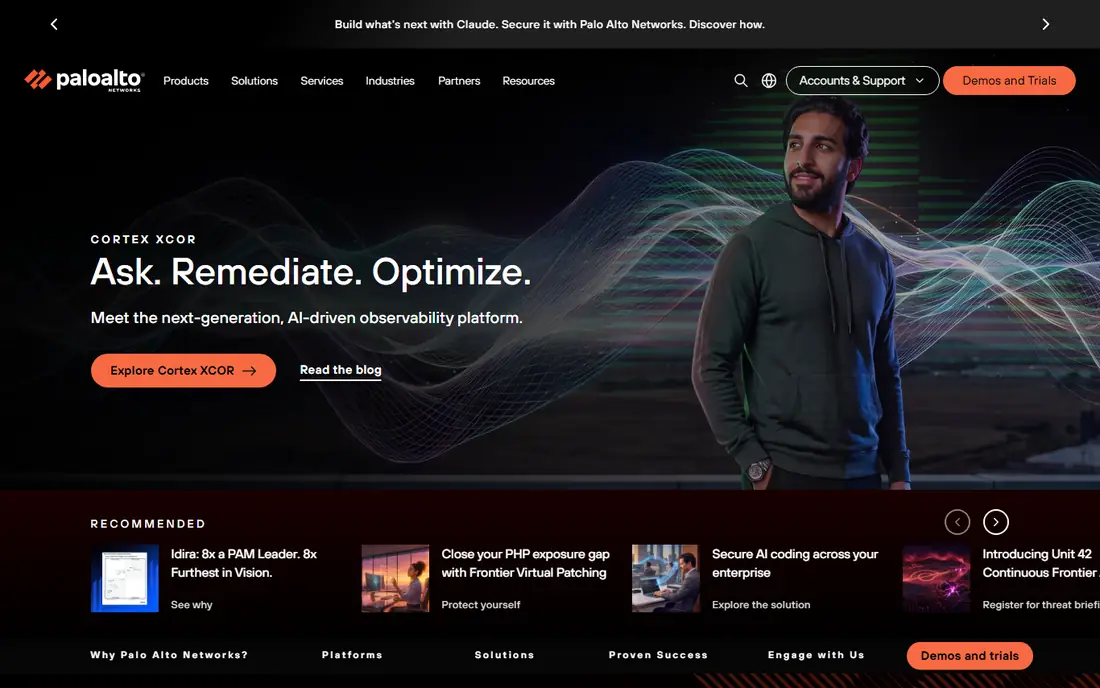
Prisma AIRS, from Palo Alto Networks, is built from Protect AI, which joined Palo Alto Networks in 2025. It aims to protect AI apps, models and agents across their full lifecycle, from discovery and security assessment through to runtime protection. That includes finding shadow AI, vetting AI apps and agents, and blocking prompt injection and data leaks in production.
The strength is breadth in one vendor stack. A team can move from inventory to model scanning to runtime guardrails without buying three separate tools. The weakness is the same breadth: pricing is custom, deployment is an enterprise project, and smaller teams may only need one slice of the platform. If you already use Palo Alto Networks for network or cloud security, integration is a real advantage.
- Covers discovery, assessment and runtime protection
- Built on Protect AI technology
- Strong for agents and apps
- Enterprise pricing by quote
- Best fit is for Palo Alto Networks customers or large security teams

Lakera Guard does one job well: it inspects prompts and model interactions in real time to block prompt injection, jailbreak attempts and data exfiltration through an LLM app. For a team shipping a customer-facing chatbot or agent, that is often the most urgent risk, because a single crafted prompt can change what the model does or reveal data it should not share.
The focused design makes it easier to test than a broad platform, and a trial lets a team measure false positives on real traffic before committing. The honest limit is scope. Lakera does not inventory your cloud AI estate, govern employee AI use, or scan model files. Treat it as a strong runtime layer, not as a complete AI security program on its own.
- Real-time prompt injection and jailbreak detection
- Focused LLM guardrail design
- Fast to test in a live app
- Narrower than a full platform
- Needs to sit alongside posture, data and model tools for full coverage
Cisco AI Defense is built for governance at enterprise scale. It helps large companies discover which AI applications employees and teams are using, enforce security policies on that use, and monitor AI traffic for risk. That includes the shadow AI problem, where teams adopt new tools faster than security can review them.
The appeal is control across a network the company already runs, rather than a point tool for one app. The trade-off is enterprise fit. Smaller companies without a Cisco estate may find deployment heavier than a focused guardrail tool, and pricing is by quote. For a large enterprise that needs consistent policy across many sites and teams, Cisco AI Defense is a practical governance choice.
- Discovery of AI apps and shadow AI
- Policy enforcement across enterprise networks
- Governance for employee AI use
- Enterprise pricing by quote
- Strongest for large Cisco customers
Microsoft Defender for Cloud
Best for: Microsoft and cloud AI posture
Microsoft Defender for Cloud adds AI posture management to a cloud security platform many Microsoft customers already use. It helps teams find AI workloads, assess their configuration and data risks, and track posture over time, with particular strength for Azure OpenAI, Azure AI Foundry and Microsoft Copilot Studio use.
The integration advantage is real. Alerts, posture scores and remediation can flow into the same Microsoft security workflow as other cloud risks. The limit is ecosystem. Companies centred on AWS or Google Cloud, or with little Microsoft tooling, will get less value than a cloud-neutral platform such as Wiz. Pricing is tied to Defender and Azure plans, so confirm the AI features included in your tier.
- AI security posture management in Azure
- Integration with Microsoft security tooling
- Coverage for Copilot and Azure AI services
- Weakest fit outside the Microsoft ecosystem
- Pricing depends on Azure and Defender plans
CrowdStrike Falcon is best known for endpoint protection, and its AI security work extends that visibility to AI workloads. It helps teams see where AI processes run, what they access, and whether behaviour looks malicious, within the same console used for endpoint and cloud threats. For security teams that already run Falcon, that single workflow is efficient.
The catch is that Falcon is not primarily an AI model or LLM guardrail tool. It will not replace a dedicated prompt injection guardrail for a customer app, or a model scanning tool for a proprietary model. Its value is in workload visibility and threat protection around AI systems, especially for teams that want AI risk inside their existing security operations rather than in a separate silo.
- Visibility into AI workloads
- Endpoint and cloud protection in one platform
- Mature threat detection
- Enterprise pricing by quote
- AI security is part of a broader platform, not a standalone AI tool
Cyera AI Guardian focuses on the data side of AI risk. It helps companies discover sensitive data, classify it, and control which AI systems and users can access it, which is essential when models and agents can read far more data than a single employee could. Compliance teams also get evidence for how data is used by AI, rather than a vague assurance.
That data-first angle is its strength and its limit. Cyera will tell you what is at risk and help you govern access, but it is not an inline guardrail for every prompt in a live app. Pair it with a runtime tool such as Lakera for customer-facing apps, or with a posture tool for cloud inventory, depending on where your biggest data exposure sits.
- Data discovery and classification for AI
- Compliance controls for sensitive data
- Focus on what AI can access
- Enterprise pricing by quote
- Needs to pair with runtime guardrails for live app protection
Mindgard is the red teaming pick. It continuously tests AI systems with adversarial attacks, showing how a real attacker might try to manipulate a model, extract data or bypass controls. That testing is more useful than a one-off audit, because models, prompts and data change often, and a fix in one release can be undone in the next.
The honest limit is that testing does not, by itself, stop an attack. Mindgard finds the weakness, but you still need runtime guardrails, access controls and model fixes to close it. Teams that ship AI features regularly should treat Mindgard as part of a loop: test, fix, retest, then protect in production. For teams that only need a one-time check, a point-in-time assessment may be cheaper.
- Continuous adversarial testing for AI systems
- Realistic attacker emulation
- Clear findings for fixing models and apps
- Testing alone does not block attacks in production
- Needs runtime controls alongside it
How we picked these
We compared official product pages, vendor documentation and independent roundups, and we selected tools that cover distinct AI security surfaces: cloud posture, model protection, LLM guardrails, governance, data security, workload protection and red teaming. We favoured tools that are actively sold in 2026 and that state a clear scope, and we avoided listing generic AI-powered security tools that do not protect AI systems themselves. We did not claim hands-on testing, and pricing is shown as quote-based where vendors do not publish a public price.
How to choose an AI security platform
Start with an inventory, not a vendor demo. Write down every AI app, agent, model, cloud service and employee tool you run, and note what each can read, write, execute and reach externally. That list usually points to one dominant risk, and that risk should decide your first purchase.
Match the tool to the surface
If the risk is cloud sprawl, start with Wiz or Microsoft Defender for Cloud. If the risk is a proprietary model, start with HiddenLayer or Prisma AIRS. If the risk is a live LLM app, start with Lakera Guard and add Mindgard testing. If the risk is employee data leakage, start with Cisco AI Defense or Cyera. Buying a broad platform before you know the surface often leads to paying for coverage you do not use.
Pilot on real traffic and real data
Ask for a pilot on your own traffic, prompts and data, not a vendor demo dataset. Measure false positives on guardrails, coverage on inventory, and time to fix on red teaming findings. Also check how the tool handles agents, because an agent with tool access needs stricter controls than a simple chatbot. A tool that looks strong in a demo can fail on your real prompts, data and permissions.
Budget for the full program
Enterprise AI security is rarely a single subscription. Budget for the platform, for integration work, for policy and compliance review, and for ongoing testing. Also confirm data handling: where prompts and model data are processed, how long they are retained, and whether the vendor trains on your data. Those answers matter as much as the feature list.
Sources
- https://www.wiz.io
- https://www.paloaltonetworks.com
- https://hiddenlayer.com
- https://www.lakera.ai
- https://www.cisco.com
- https://www.microsoft.com/en-us/security/business/cloud-security/microsoft-defender-for-cloud
- https://www.crowdstrike.com
- https://www.cyera.com
- https://mindgard.ai
- https://www.wiz.io/academy/ai-security/ai-security-tools
- https://aistoryland.com/best-ai-security-platforms-for-enterprises/