Best Freelancing Platforms for Beginners in 2026: 8 Services Compared
By ToolNimba Editorial Team October 30, 2026 11 min read

- Top pick
 Upwork
Largest client pool
Starting priceFreeCheck out UpworkRead our review - Runner-up
 Fiverr
Selling fixed-price services
Starting priceFreeCheck out FiverrRead our review - Also great
 Freelancer.com
Bidding on posted projects
Starting priceFreeCheck out Freelancer.comRead our review
How we researched this
We compared official pricing and feature pages, app store listings, privacy policies and public user reviews. Prices change, so check the provider's site before you pay.
Key takeaways
- Fiverr and Contra are the easiest first steps, since buyers find you and Contra charges freelancers no commission.
- Upwork has the largest client pool, but proposals cost Connects and competition for entry-level jobs is fierce.
- Freelancer.com and Guru reward careful bidding, while PeoplePerHour suits UK and European clients and repeat work.
- Fees matter more than headlines, since a 20 percent cut versus a 0 percent cut changes take-home pay on every project.
Quick comparison
| Name | Best for | Starting price | Free plan | |
|---|---|---|---|---|
| Upwork | Largest client pool | Free | Yes | Visit |
| Fiverr | Selling fixed-price services | Free | Yes | Visit |
| Freelancer.com | Bidding on posted projects | Free | Yes | Visit |
 Contra | No-commission portfolio work | Free | Yes | Visit |
 PeoplePerHour | UK and European clients | Free | Yes | Visit |
 Guru | Milestone projects with escrow | Free | Yes | Visit |
 SolidGigs | Curated leads without bidding wars | See website | Free trial (30 days) | Visit |
 99designs | Design contests and clients | Free | Yes | Visit |
The best freelancing platforms for beginners
We focused on platforms a new freelancer can actually join, get a first paid job on, and understand without a course in platform fees.

Upwork is still the biggest general marketplace, and that size is both the draw and the challenge. Clients post hourly and fixed-price jobs daily, from small admin tasks to long contracts, and the platform handles escrow, time tracking, and dispute help. A complete profile with a clear niche, a few strong samples, and a realistic first rate will get more replies than a broad profile that tries to cover everything.
Beginners should budget for Connects, which cost a small amount each and are spent on proposals. Sending ten generic proposals a day will burn money fast. A better start is to apply to a small number of jobs that match your skills closely, write a short proposal that names the client problem, and offer a small paid test task when it fits. Once you have a few good reviews, Upwork gets much easier.
- Huge range of jobs across writing, design, development, and admin
- Escrow and payment protection
- Strong profile and portfolio tools
- Proposals need paid Connects
- Entry-level categories are crowded
- Service fees vary by contract and can reach 15 percent
Fiverr flips the usual freelance model. Instead of bidding on jobs, you create a gig that describes exactly what you deliver, for what price, and in how many days. Buyers search, compare, and order. For a beginner who hates cold pitching, that structure is a relief, and it forces you to define a service narrowly enough to sell.
The price of that ease is the fee. Fiverr takes 20 percent of every order, so a $100 gig pays $80 before any withdrawal costs. New sellers also start near the bottom of search, so early orders often come from a low price, a sharp gig image, and fast replies. Treat your first ten orders as reputation building, then raise prices as reviews and repeat buyers grow.
- Buyers come to you, so no bidding
- Easy to package a clear service
- Good for design, writing, video, and marketing gigs
- Flat 20 percent commission on every order
- New sellers start with limited visibility
- Buyers expect fast delivery
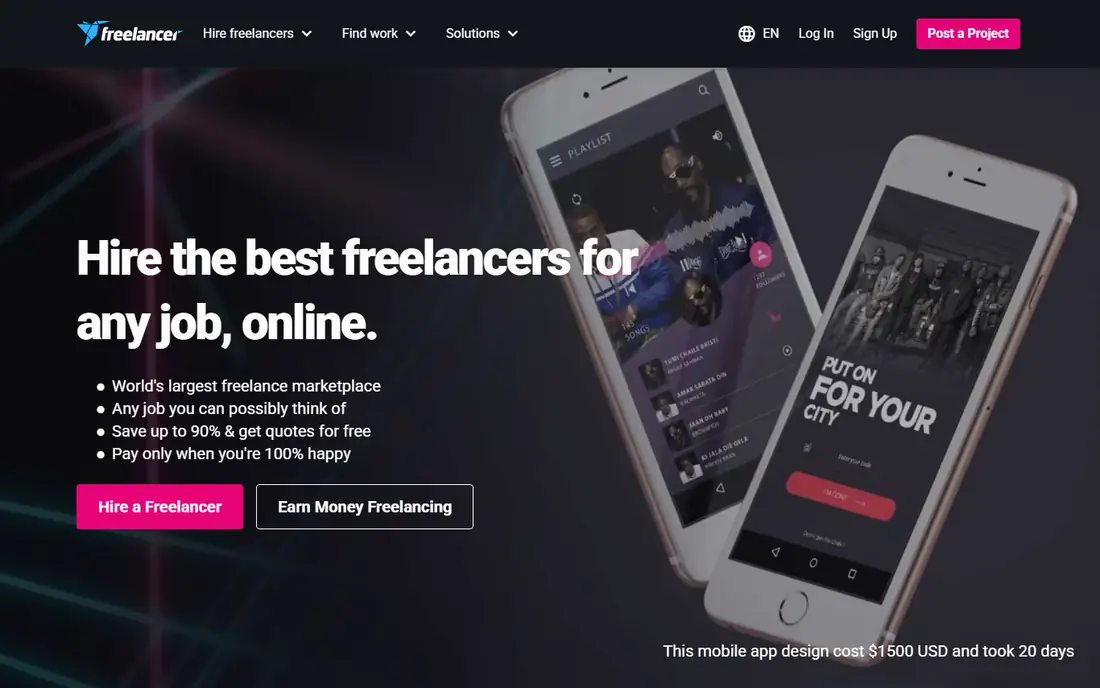
Freelancer.com works like Upwork in that you bid on posted projects, but its pool leans heavily toward development, design, data entry, and small business tasks. Contests are a useful beginner route for creative work, since you can submit an entry and win a project without a long proposal history, though unpaid contest work should be chosen carefully.
Competition is the main hurdle. Popular projects can attract dozens of bids, and low-ball bids are common. Beginners do better by bidding on smaller, clearly scoped jobs, asking one smart question in the proposal, and showing a relevant sample rather than a long life story. Watch the fee too, since 10 percent or a $5 minimum takes a bigger share of tiny jobs.
- Very large project pool
- Contests let designers and writers show work
- Milestone payments for larger jobs
- 10 percent project fee or $5 minimum, whichever is greater
- Many bids per project
- Some low-budget postings
Contra is the most beginner-friendly platform on fees alone. Freelancers pay no commission, and clients pay a flat payment fee, usually $2 to $29 depending on the amount, instead of a percentage cut. Your profile doubles as a portfolio site, which helps designers, writers, and web builders look credible before they have many platform reviews.
The trade-off is demand. Contra does not yet match the job volume of Upwork or Fiverr, so many freelancers use it to host their portfolio and invoice clients they find elsewhere, while also applying to posted opportunities. If you already get inquiries from social media or referrals, Contra lets you keep more of that income. Pair it with a larger marketplace while you build a client base.
- 0 percent commission for freelancers
- Portfolio-first profiles that look professional
- Clients pay a small flat payment fee instead
- Smaller client pool than Upwork or Fiverr
- Best for design, writing, and web work
- You still need to bring some clients
PeoplePerHour is worth a look if your clients are likely to be in the UK or Europe, or if you want repeat work to get cheaper over time. Fees start at 20 percent with a new buyer, then fall in steps as lifetime billings with that buyer grow, reaching 3.5 percent at higher levels. That structure rewards freelancers who keep clients rather than chasing one-off jobs.
For a beginner, the first jobs are the costly ones, since the 20 percent rate applies until you build history with each client. Hourlies, which are fixed-price offers similar to Fiverr gigs, can help you get found without bidding on every post. If most of your target clients are in the US, Upwork or Fiverr will usually bring more leads, but PeoplePerHour is a solid second platform for European work.
- Strong for web, marketing, and design work
- Fees fall with repeat billings per client
- Hourlies let you sell fixed services
- Fees start at 20 percent with a new buyer
- Smaller US client pool
- Proposal credits and paid plans affect visibility
Guru has been around for years and suits freelancers who prefer structured, milestone-based projects over tiny gigs. Clients post jobs, freelancers quote, and SafePay escrow holds funds as work passes agreed milestones. That structure helps on larger writing, programming, design, and consulting projects where payment timing matters.
Beginners should note the fee tiers. The free tier charges 9 percent, while paid memberships lower the fee toward 5 percent and raise bid limits. That only pays off once you win work regularly, so start free and upgrade only when volume justifies it. Guru also has fewer beginner jobs than Upwork, so it works best as a second platform alongside a larger marketplace.
- Lower fees than Fiverr on paid plans
- SafePay escrow protects milestone payments
- Clear work agreements and invoicing
- Fewer entry-level jobs than Upwork
- Free tier fee is 9 percent
- Paid membership needed for the lowest fee and most bids
SolidGigs is different from the platforms above, because it is a lead service rather than a marketplace. It scans job boards and sends a shortlist of freelance opportunities that match your skills, so you spend less time scrolling and more time pitching. That can help a beginner who feels overwhelmed by open marketplaces and wants a steadier stream of leads to review.
There is no escrow, no built-in payment protection, and no guarantee that a lead turns into work. You still write proposals, negotiate, and handle contracts yourself, and you pay a subscription whether or not you win jobs that month. Use the trial to judge lead quality in your niche. If the leads match your skills and you close even one solid project, the subscription can pay for itself, but it should not be your only source of work.
- Curated freelance leads sent regularly
- Less time spent searching job boards
- Useful templates and resources for new freelancers
- Subscription cost with no per-job guarantee
- Not a marketplace with escrow
- You still pitch and close clients yourself
99designs is the niche pick for designers, and it is included because design beginners often ask where to start. Clients run contests where multiple designers submit concepts, or they hire a designer directly after seeing a portfolio. Briefs are structured, feedback is public in contests, and a win can lead to repeat work with the same client.
The risk is unpaid contest time. Entering every contest is a fast way to work for free, so beginners should pick contests that match their strengths, limit entries per week, and use wins to build a portfolio for direct hires. Fees also take a real share, so price contest work with that in mind. For non-designers, this platform does not fit, and a general marketplace is the better start.
- Built for logo, branding, and web design
- Contests and direct projects both available
- Clear briefs and client feedback
- Contest work means unpaid effort if you do not win
- Platform fees of 15 to 20 percent in many cases
- Not for non-design freelancers
How we picked these
We compared official fee pages, help centers, sign-up flows, app store listings, and public reviews, and we kept only platforms that are live and open to new freelancers in October 2026. We favored platforms with a clear path to a first paid job, published fees, and payment protection or escrow where offered, and we excluded invite-only elite networks that do not suit beginners. We did not claim hands-on testing, and where fees vary by tier or client history, we described the range rather than a single flat rate.
How to get your first clients without burning out
Pick one skill and one buyer type for your first month. A profile that says you do writing, design, social media, and virtual assistance will lose to a profile that says you write email newsletters for small e-commerce shops. Narrow positioning makes proposals easier to write, samples easier to show, and referrals easier to earn.
Build proof before you chase volume
Create three strong samples even if they are self-made projects for a fictional client, and show the result, not just the deliverable. A landing page sample should note the goal and the structure, a writing sample should show the audience and call to action, and a design sample should explain the brief. Clients hire proof of thinking, not just proof of software skills.
Price for learning, then raise rates
Your first few jobs can be priced below market to earn reviews, but set a floor that respects your time and a date to raise rates. Track hours on fixed-price jobs, so you learn your real hourly rate after fees. Once you have five good reviews and repeat inquiries, raise prices for new clients and keep early clients only if they accept the new rate or offer steady volume.
Protect your time and payment
Use platform escrow or milestones for larger jobs, get scope in writing before you start, and define revisions clearly. A simple rule helps beginners a lot, such as two revision rounds included, then paid extra revisions. That one clause prevents many of the disputes that sour a first freelance year.