Best Language Exchange Apps in 2026: 9 Apps Compared
By ToolNimba Editorial Team October 30, 2026 11 min read

- Top pick
 Tandem
Focused one-to-one exchange
Starting priceSee websiteCheck out TandemRead our review - Runner-up
 HelloTalk
Large community and social practice
Starting priceSee websiteCheck out HelloTalkRead our review - Also great
 Speaky
Simple free text and voice exchange
Starting priceFreeCheck out SpeakyRead our review
How we researched this
We compared official pricing and feature pages, app store listings, privacy policies and public user reviews. Prices change, so check the provider's site before you pay.
Key takeaways
- Tandem suits learners who want a focused, long-term partner, while HelloTalk suits learners who want the largest community and many ways to practise.
- Free core chat is genuinely useful on several apps, but voice calls, unlimited matches, and advanced tools often sit behind paid plans.
- A language exchange works best when you agree on time split, correction style, and meeting frequency before the first chat fades.
- If exchange partners keep disappearing, a tutor marketplace such as italki can fill the gap with scheduled, paid lessons.
Quick comparison
| Name | Best for | Starting price | Free plan | |
|---|---|---|---|---|
| Tandem | Focused one-to-one exchange | See website | Yes | Visit |
| HelloTalk | Large community and social practice | See website | Yes | Visit |
| Speaky | Simple free text and voice exchange | Free | Yes | Visit |
 ConversationExchange | Free web-based partner matching | Free | Yes | Visit |
 italki | Paid tutor lessons beside exchange | Free | Yes | Visit |
 MyLanguageExchange | Detailed browser-based matching | Free | Yes | Visit |
 HiNative | Quick questions and corrections | Free | Yes | Visit |
 Lingbe | Instant voice calls | Free | Yes | Visit |
 Langmate | Meeting Japanese speakers | Free | Yes | Visit |
The best language exchange apps
The apps below cover one-to-one exchange, social communities, web-based matching, tutor lessons, and instant voice practice, so start with how you like to practise.
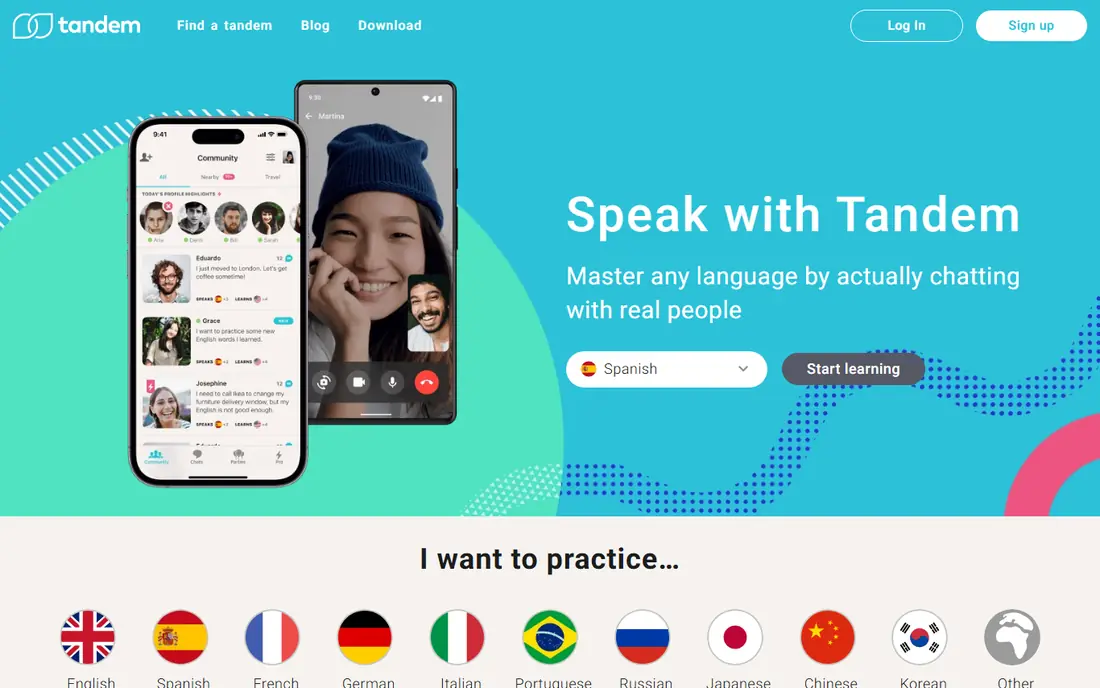
Tandem is the first app to try if you want one reliable partner rather than a feed full of strangers. New members apply with language goals and interests, which helps filter out casual browsers and keeps conversations closer to real exchange. In-chat correction tools let a partner fix your sentences without breaking the flow, and translation help covers gaps when you get stuck. The trade-off is patience. Application review takes time, and partner availability still depends on your language pair, time zone, and how complete your profile is. Tandem fits learners who will invest in a good profile, message a few people thoughtfully, and meet the same partner regularly. If you want instant chat with anyone online right now, Lingbe or Speaky may feel faster.
- Application-based profiles that filter for serious learners
- In-chat correction and translation tools
- Text, voice, and video options
- Application review can delay your start
- Partner activity varies by language pair
- Advanced features require a paid plan

HelloTalk is the largest language exchange community on this list, and that scale is its main strength. With millions of users and hundreds of languages, you are more likely to find partners for less common language pairs, and you can practise in several ways: one-to-one chat, a Moments feed for posts and corrections, voice messages, and live voice rooms. That variety helps on days when a partner is offline. Scale also brings noise. The interface packs in many features, and the social side can pull attention away from steady exchange. HelloTalk fits learners who enjoy a social app, want many partner options, and will set boundaries around who they chat with. Learners who prefer a quiet, focused exchange may prefer Tandem.
- Very large community across many languages
- Moments feed, voice rooms, and group practice
- Correction and translation tools in chat
- Busy interface with many features
- Social feed can distract from one-to-one exchange
- Some advanced tools need a paid plan

Speaky keeps language exchange simple. You set your native language and the language you are learning, browse matching profiles, and start text or voice chats without working through a long onboarding flow. For beginners, that low friction matters, because the hardest step is often the first conversation. The simplicity has limits. Speaky offers fewer community features, correction tools, and learning extras than its larger rivals, and partner replies depend on who is active in your language pair. Even so, Speaky is a strong free starting point, especially if you want to test whether exchange suits you before paying for anything or learning a complex app.
- Free core exchange with simple matching
- Text and voice chat without a complex setup
- Works on web and mobile
- Smaller feature set than Tandem or HelloTalk
- Partner quality varies
- Interface feels basic compared with larger apps
ConversationExchange is the web-first option for learners who prefer a browser to an app. You search for partners by language, country, and exchange type, then arrange face-to-face meetings, pen pal letters, or voice chats. The service is free, and it has served language learners for many years. The dated design and hands-off approach are the trade-offs. There is no built-in call system, so you move to another tool for voice or video, and profile quality varies more than on application-based apps. ConversationExchange fits learners who are comfortable arranging their own meetings and want a free, no-install way to find partners, including local face-to-face exchange.
- Free partner search on the web
- Options for face-to-face, pen pal, and chat exchange
- No app install needed
- Website design feels dated
- You arrange calls on other tools
- Less moderation and structure than app-based rivals
italki is not a pure exchange app, but it belongs on this list because it solves the most common exchange problem: partners who disappear. You can join for free, browse teacher profiles, book trial lessons, and pay per lesson rather than paying a monthly subscription. Professional teachers offer structured lessons, while community tutors offer cheaper conversation practice. The cost is the obvious difference. Free exchange costs time, while italki costs money, and prices vary by teacher, language, and lesson type. italki fits learners who want reliable, scheduled speaking practice, structured feedback, or help preparing for an exam or a trip. Many learners use it beside a free exchange app, with italki for weekly structure and exchange for daily chat.
- Large marketplace of professional teachers and community tutors
- Pay per lesson with no subscription required
- Free community features beside paid lessons
- Lessons cost money, unlike free exchange
- Teacher quality and price vary
- Scheduling across time zones takes planning
MyLanguageExchange suits learners who like to search carefully before they message anyone. Its browser-based profiles let you filter by language, location, age range, and interests, which helps when you want a partner with shared hobbies or a similar level. Built-in chat and voice tools mean you can practise without installing an app. The site design shows its age, and the mobile experience is not as smooth as Tandem or HelloTalk. Some advanced features also need a paid membership, so check what is free before you rely on a specific tool. For desktop learners who value detailed search over a slick app, MyLanguageExchange remains a useful free option.
- Detailed partner search by language, age, and interests
- Text, voice, and chat tools in the browser
- Long-running exchange community
- Website feels older than modern apps
- Some features need a paid membership
- Mobile experience is weaker than app-first rivals
HiNative answers a different question from the exchange apps above. Instead of finding a partner, you ask native speakers a specific question: does this sentence sound natural, how do you pronounce this word, or what is the difference between two phrases. Other users answer in text or audio, often with examples. That format is excellent for quick checks, but it does not replace conversation practice. You will not build a regular speaking routine on HiNative alone, and answer speed depends on how active your language community is. HiNative fits learners who already study or exchange elsewhere and want fast, native-speaker feedback on the details that textbooks miss.
- Fast answers from native speakers
- Audio clips for pronunciation questions
- Useful for phrases, nuance, and cultural context
- Not built for long one-to-one exchange
- Answer speed varies by language
- Some features need a paid plan
Lingbe is the pick when you want to speak now, not browse profiles for an hour. You request a call, connect with a native speaker who is online, and practise by voice, earning or spending credits as you help others and get help yourself. That instant format is excellent for building speaking confidence and getting used to real-time conversation. The limit is continuity. You may speak with a different person each time, which is great for variety but weak for building a long-term exchange routine. Free credits also limit how much you can practise without paying. Lingbe fits intermediate learners who want spontaneous speaking practice beside a main exchange app or tutor.
- Instant voice calls with native speakers without long profile browsing
- Credit system with free credits available
- Good for speaking confidence
- Calls depend on who is online right now
- Credit limits shape how much you can practise free
- Less suited to long-term partner building
Langmate is a specialist app for people learning Japanese or wanting Japanese friends. Most users are Japanese speakers, which gives learners of Japanese a much deeper partner pool than a general exchange app. Swipe-based matching, translation help, and correction tools make the first chat easy even at a lower level. The specialism is also the limit. If you are learning Spanish, French, or German, Langmate is not the right tool. Free chats with new friends are limited, with extra chats available through in-app credits or paid plans, so check current limits in the app. Langmate fits Japan-focused learners, travellers preparing for a trip, and fans of Japanese culture who want real conversations with local speakers.
- Large Japanese-speaking community
- Swipe and match style that is easy to start
- Translation, correction, and reply help in chat
- Focused mainly on Japanese, so less useful for other languages
- Free chats with new friends are limited
- Reports of spam accounts mean you should use blocking tools
How we picked these
We compared official feature pages, pricing pages, app store listings, privacy policies, and public reviews for exchange apps and services that were active in 2026. We favoured apps with real partner matching, usable free tiers, and current development, and we included italki and HiNative because learners often compare them with exchange apps even though they work differently. We did not claim hands-on testing, and in-app prices change often, so we point you to each app listing where a paid figure was uncertain.
How to make exchange actually work
Agree on the split before you start
Decide how much time goes to each language, how often you will meet, and whether you meet by text, voice, or video. A simple plan, such as 15 minutes in each language twice a week, beats vague promises to chat soon. Write the plan in your first messages so both sides know what to expect.
Agree on corrections early
Some learners want every mistake corrected at once, while others want a short note at the end. Ask your partner which style they prefer, and say which style helps you. In-chat correction tools on Tandem and HelloTalk make this easier, but the agreement matters more than the tool.
Build a routine around one partner
Many learners collect ten partners and speak to none of them regularly. Pick one or two partners whose schedule and level match yours, and meet at a fixed time. If a partner goes quiet for two weeks, send one friendly follow-up, then move on without taking it personally.
Stay safe with new contacts
Keep early chats inside the app, do not share personal details, money, or other social accounts too soon, and use blocking and reporting tools if a conversation feels wrong. Exchange apps attract genuine learners and, at times, spam accounts, so trust slow, consistent conversation over fast flattery.