Best Platforms for Microlearning in 2026: 9 Platforms Compared
By ToolNimba Editorial Team October 30, 2026 8 min read

- Top pick
 7taps
Frictionless mobile delivery without an app
Starting priceFreeCheck out 7tapsRead our review - Runner-up
 Axonify
Large frontline workforces
Starting priceSee websiteCheck out AxonifyRead our review - Also great
 TalentCards
Budget card-based learning
Starting price$0.80 per user per monthCheck out TalentCardsRead our review
How we researched this
We compared official pricing and feature pages, app store listings, privacy policies and public user reviews. Prices change, so check the provider's site before you pay.
Key takeaways
- 7taps is our pick for most teams, with card-based micro-courses delivered by link, SMS, or chat without an app download.
- Axonify is the best choice for large frontline workforces, with daily training on mobile, kiosk, and handheld devices.
- TalentCards is the best budget option, with card-based learning from around 0.80 dollars per user a month.
- SC Training, formerly EdApp, is the best free starting point for small businesses training a handful of staff.
- Microlearning works best for reinforcement and just-in-time knowledge, not as a replacement for deep skills training.
Quick comparison
| Name | Best for | Starting price | Free plan | |
|---|---|---|---|---|
| 7taps | Frictionless mobile delivery without an app | Free | Yes | Visit |
| Axonify | Large frontline workforces | See website | No | Visit |
| TalentCards | Budget card-based learning | $0.80 per user per month | Yes | Visit |
 SC Training | Free training for small teams | Free | Yes | Visit |
 eduMe | Frontline workforce success | See website | No | Visit |
 Qstream | Spaced reinforcement of knowledge | See website | No | Visit |
 OttoLearn | Adaptive microlearning for teams | $250 per month | No | Visit |
 Duolingo | Language microlearning for individuals | Free | Yes | Visit |
 Blinkist | Book summaries in 15 minutes | Free | Yes | Visit |
The best platforms for microlearning
Microlearning delivers training in short, focused bursts: a two-minute video, a flashcard set, or a quiz that fits between tasks. The nine platforms below serve both companies training staff and individuals learning on their own, and we compared delivery, authoring, and price.
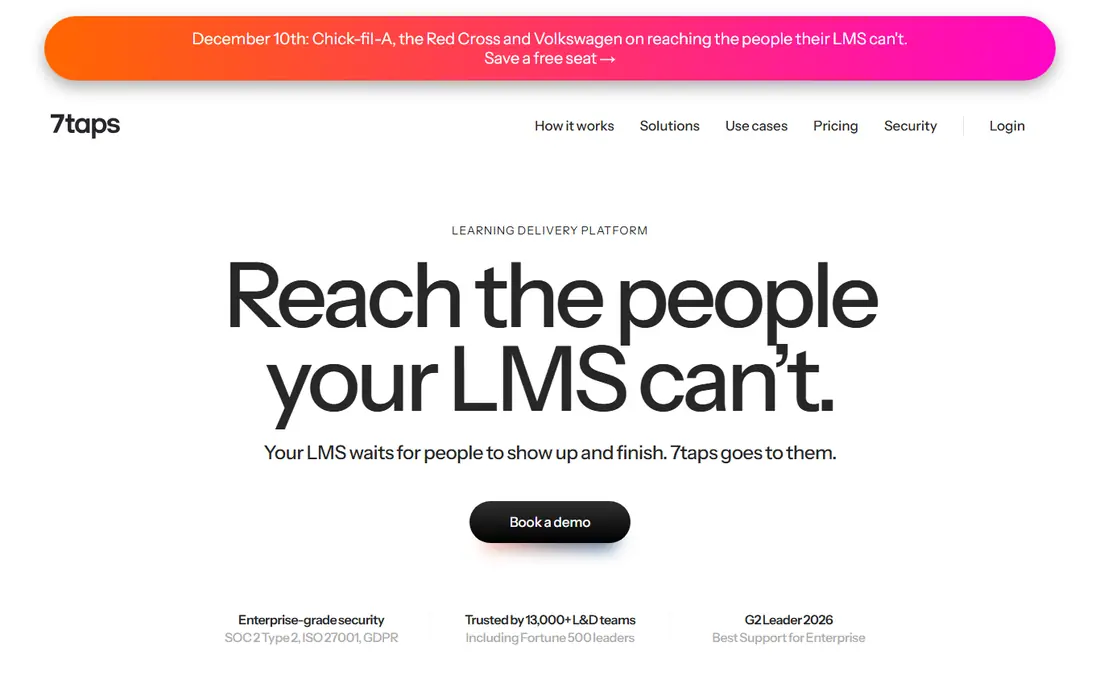
7taps challenges the idea that training needs a learning management system. You build a card-based micro-course in minutes, with an AI copilot to help draft it, and share it by link, QR code, email, SMS, WhatsApp, or Slack, with no app download and no LMS login for learners. That frictionless delivery suits frontline and deskless teams especially well.
The free tier covers basic use, but Starter plans run around 4,995 dollars a year, and advanced analytics need Enterprise. Still, for teams that need training to reach people who never sit at a desk, 7taps is the most practical platform here.
- Courses delivered by link, QR, SMS, or chat
- Card-based editor with AI copilot
- No app download needed
- Starter plan costs around 4,995 dollars a year
- Advanced analytics need Enterprise
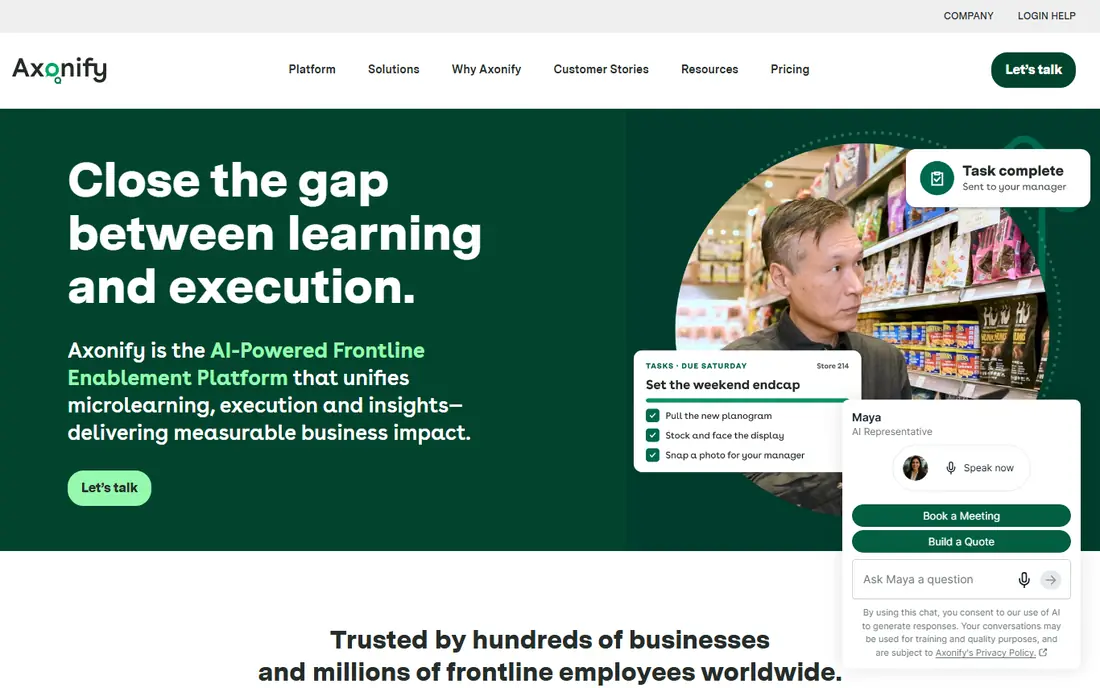
Axonify is the frontline enablement platform used by large retailers, grocers, and hospitality chains. It delivers short daily training and communications to mobile phones, tablets, kiosks, and rugged handheld devices, in more than 60 languages, with HRIS integrations to systems like Workday and SAP SuccessFactors. Employees access it with an employer code rather than an email signup.
Pricing is enterprise-level and not published, with feature-based tiers that suit large operations better than small businesses. But for a large distributed workforce that needs consistent daily training, Axonify is the most proven platform here.
- Daily training on mobile, kiosk, and handheld
- 60 plus languages
- HRIS integrations
- Enterprise pricing
- Less favorable for small businesses
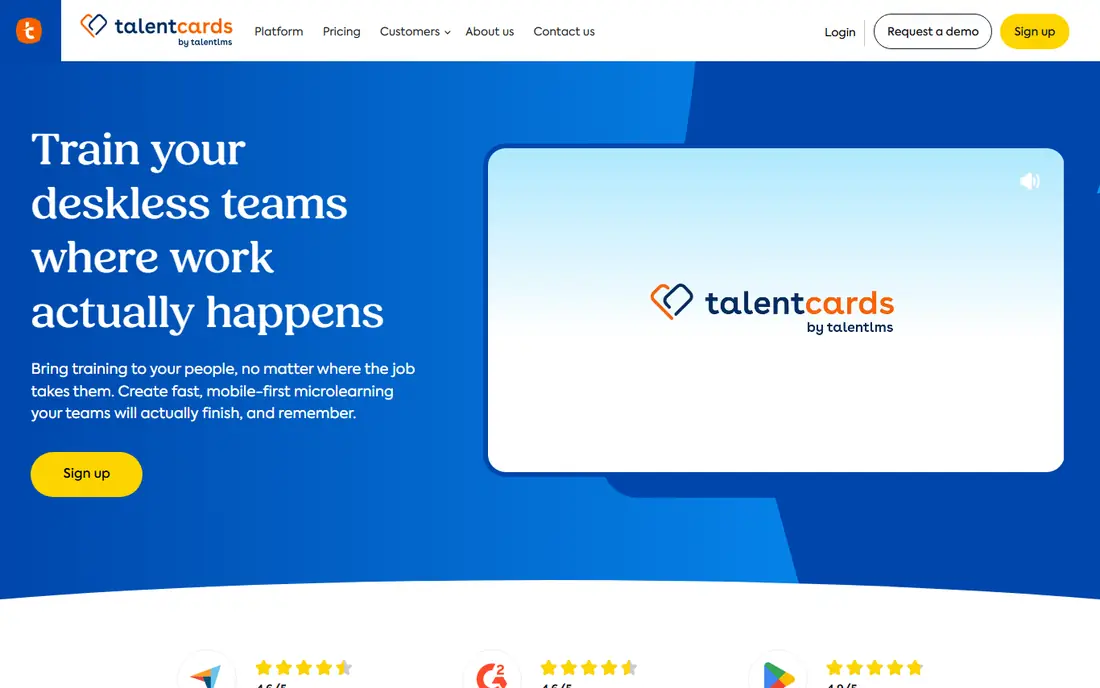
TalentCards is the budget pick for card-based microlearning, with pricing from around 0.80 dollars per user a month and a free tier for testing. Learners swipe through card sets on mobile apps with offline access, and managers track completion and quiz results. That simplicity suits small and mid-size teams that want microlearning without enterprise cost.
Analytics are simpler than Axonify or 7taps Enterprise, and there is no large built-in content library, so you create your own cards. But for affordable, mobile-first microlearning, TalentCards is the best value here.
- Very low price
- Card-based microlearning
- Mobile apps with offline access
- Simpler analytics than enterprise rivals
- Smaller content library
SC Training, formerly EdApp, is the best free starting point for small businesses. Its free tier covers small teams with no-code course authoring, templates, and mobile delivery, letting a manager build and ship a course without an instructional designer. That ease of authoring is why it has grown fast among mid-size teams.
Advanced features, analytics, and integrations need paid tiers, and its content library is general rather than specialized. But for a small business training a handful of staff, SC Training's free tier is usually the right place to start.
- Free tier for small teams
- No-code course authoring
- Mobile-first delivery
- Paid tiers needed for advanced features
- Content library is general
eduMe is a mobile-based training platform focused on frontline workforce success, covering onboarding, compliance, and performance for deskless workers in retail, hospitality, and logistics. Its short, mobile lessons fit into shift work, and its engagement features help managers see who has completed training.
Pricing is quote-based, and it suits frontline teams more than desk-based learners. For companies whose workforce rarely sits at a computer, eduMe is a strong, focused alternative to Axonify.
- Mobile-first frontline training
- Workforce success focus
- Good engagement
- Quote-based pricing
- Less suited to desk-based teams
Qstream is built around a specific science: spaced repetition. Instead of delivering a course once, it sends short scenario-based challenges over days and weeks, reinforcing knowledge until it sticks, and its analytics show managers exactly where knowledge gaps remain. That approach suits sales training, compliance, and product knowledge that must be retained, not just seen once.
Pricing is quote-based, and Qstream is narrower than platforms that author full courses. But for teams whose problem is forgetting rather than first exposure, Qstream's reinforcement model is the most evidence-based option here.
- Science-based spaced repetition
- Scenario challenges
- Analytics on knowledge gaps
- Quote-based pricing
- Narrower than full course platforms
OttoLearn offers adaptive microlearning that adjusts to each learner's mastery, serving cards and quizzes until a topic is truly learned rather than just completed. Its mobile apps and mastery-based progression suit teams that want measurable competence, not just attendance.
Pricing starts around 250 dollars a month, which puts it above TalentCards for small teams, and its brand is smaller than Axonify or 7taps. But for teams that want adaptive, mastery-driven microlearning at a clear price, OttoLearn is a solid choice.
- Adaptive learning paths
- Mobile apps
- Mastery-based progression
- 250 dollar monthly starting price
- Smaller brand than rivals
Duolingo is the consumer microlearning success story: short, gamified language lessons that build a daily habit, with a free tier covering core content and a paid tier removing ads and adding features. Its streaks, leagues, and bite-size lessons show how microlearning mechanics keep learners returning.
It is not a corporate training platform, and advanced learners will outgrow its depth. But as proof of what microlearning can do for individuals, and as a language learning tool in its own right, Duolingo belongs on this list.
- Free gamified language lessons
- Huge learner community
- Proven daily habit design
- Not a corporate training platform
- Limited depth for advanced learners
Blinkist condenses nonfiction books into 15-minute reads and audio summaries, letting busy professionals absorb key ideas from hundreds of titles. Its library covers business, psychology, and science, and its free tier lets you try a daily summary before subscribing.
Summaries cannot replace reading a full book or learning a skill deeply, and Blinkist is not a corporate training tool. But for managers and professionals who want a steady flow of ideas in microlearning form, Blinkist is the best consumer option here.
- Condenses nonfiction books into short reads and listens
- Large library
- Good for managers
- Summaries replace depth
- Not a skills training platform
How we picked these
We compared official pricing pages, feature documentation, and user reviews for microlearning platforms actively available in 2026. We favored platforms with clear delivery models and real mobile or chat-based access, and we included both enterprise and consumer options. We did not claim hands-on testing; our comparison rests on published specifications, pricing, and public user reviews.
How to make microlearning actually work
Keep lessons short and single-purpose. A micro-lesson should teach one idea, one step, or one decision, not summarize a whole course. Teams that cram hour-long content into a mobile format lose the benefit: learners skip, skim, and retain nothing.
Use microlearning for reinforcement and just-in-time help, not for deep skills. It excels at refreshing product knowledge, safety procedures, and compliance points, and at delivering answers at the moment of need. For complex skills that need practice and feedback, pair it with coaching, workshops, or longer courses. And measure retention, not completion: a quiz a week later tells you more than a completion checkmark.
A short pilot with one small group usually reveals more than a long vendor comparison, so test your chosen option with real users before rolling it out widely.