Best Sales Software in 2026: 9 Tools Compared
By ToolNimba Editorial Team October 30, 2026 10 min read

- Top pick
 HubSpot
Teams that want sales, marketing and service in one CRM
Starting priceFreeCheck out HubSpotRead our review - Runner-up
 Salesforce
Larger teams that need customisation and a huge ecosystem
Starting price$25 per user per monthCheck out SalesforceRead our review - Also great
 Pipedrive
Sales teams that live in their pipeline
Starting price$14 per user per monthCheck out PipedriveRead our review
How we researched this
We compared official pricing and feature pages, app store listings, privacy policies and public user reviews. Prices change, so check the provider's site before you pay.
Key takeaways
- HubSpot offers the most generous free starting point, while Pipedrive offers the clearest visual pipeline for sales-led teams.
- Zoho CRM and Freshsales give strong value at low per-user prices, with AI features included on affordable tiers.
- Salesforce suits larger teams that need deep customisation, but it needs more setup time and budget than small-team tools.
- The cheapest seat price can still be expensive at team scale, so price the full team for a year before you choose.
Quick comparison
| Name | Best for | Starting price | Free plan | |
|---|---|---|---|---|
| HubSpot | Teams that want sales, marketing and service in one CRM | Free | Yes | Visit |
| Salesforce | Larger teams that need customisation and a huge ecosystem | $25 per user per month | Yes | Visit |
| Pipedrive | Sales teams that live in their pipeline | $14 per user per month | Free trial | Visit |
 Zoho CRM | Value, automation and AI at a low price | $14 per user per month | Yes | Visit |
 Freshsales | Budget teams that want phone, email and AI in one CRM | $9 per user per month | Yes | Visit |
 monday CRM | Teams that already think in boards and workflows | $12 per user per month | Free trial | Visit |
 Close | Outbound sales teams that call and text all day | See website | Free trial | Visit |
 Capsule | Simple contact and deal management for small teams | Free | Yes | Visit |
 Less Annoying CRM | Small teams that want one flat price and no complexity | $15 per user per month | Free trial | Visit |
The best sales software
Sales software here means CRM and sales management tools that track contacts, deals, activities and follow-ups in one place. We compared official pricing pages, feature lists and public reviews for tools that work for small and growing teams in October 2026. Prices are per user per month on annual billing unless noted.
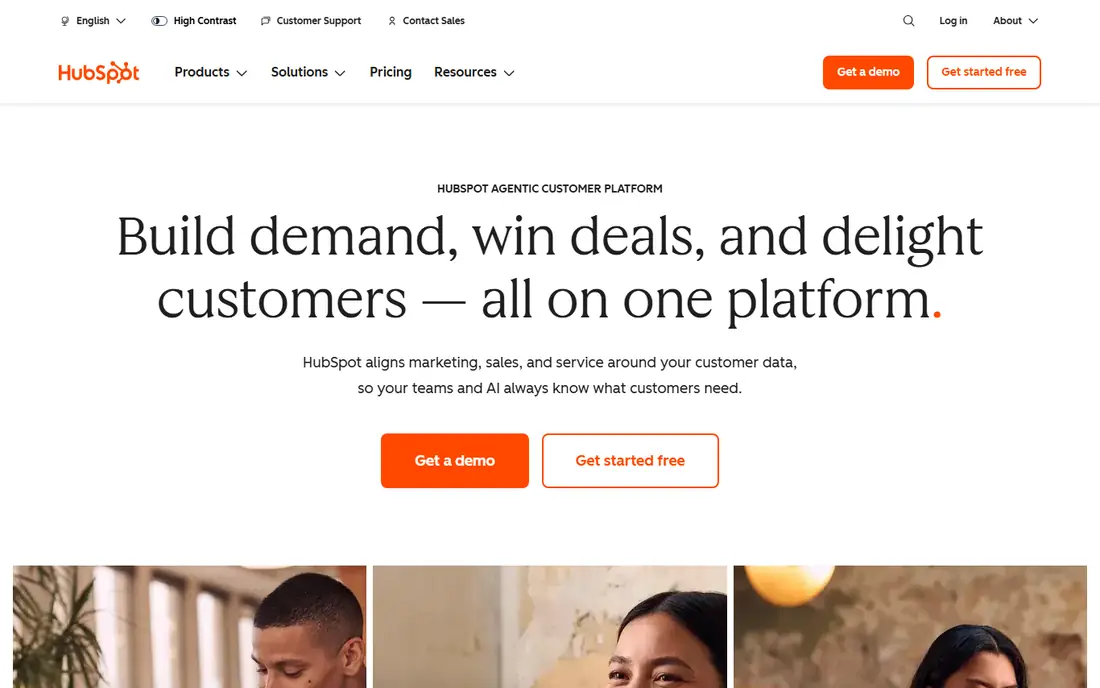
HubSpot is our pick for most small and growing businesses, because its free CRM already covers contacts, deals, tasks, live chat and email tracking with no time limit. Paid Starter plans add automation and more features from 20 dollars per seat per month on recent vendor pricing, and the platform scales into marketing, service and operations hubs as a company grows.
The catch is cost at scale. Professional and Enterprise tiers add mandatory onboarding fees and much higher seat prices, and the free tier has contact limits that growing teams will outgrow. HubSpot suits teams that want one platform for sales and marketing and are prepared to budget for upgrades as they grow.
- Generous free CRM
- Strong email tracking and automation
- Scales to enterprise
- Paid tiers and onboarding fees rise at Professional level
- Contact limits on free tier
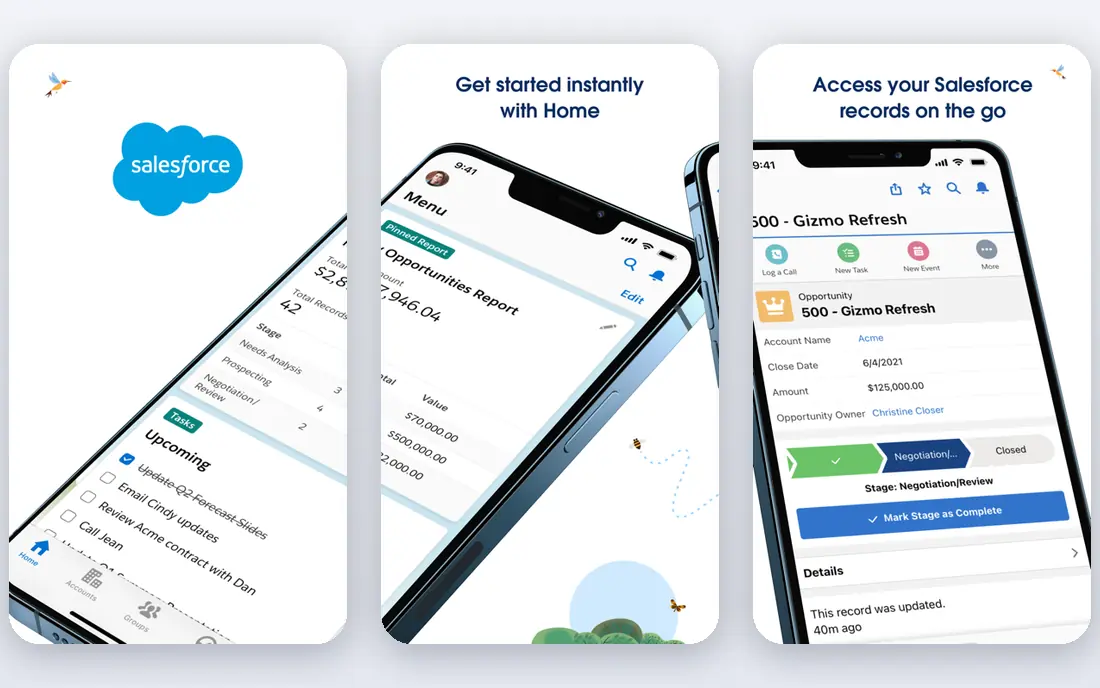
Salesforce, through its Sales Cloud and Agentforce Sales tools, remains the most customisable CRM on this list. It handles complex sales processes, territories, forecasting and integrations at a scale few rivals match, with a large marketplace of third-party apps. The Starter Suite starts at 25 dollars per user per month, with a free suite option for very small teams in recent vendor pricing.
That power comes with setup cost. Implementation can take weeks for a small team and months for a larger one, and the jump from Starter to Professional tiers is large. Salesforce suits teams with 50 or more reps, complex processes or a dedicated admin, rather than a five-person team that needs a pipeline this week.
- Deep customisation
- Huge app ecosystem
- AI features on higher tiers
- Setup can take weeks or months
- Price jumps sharply to higher tiers
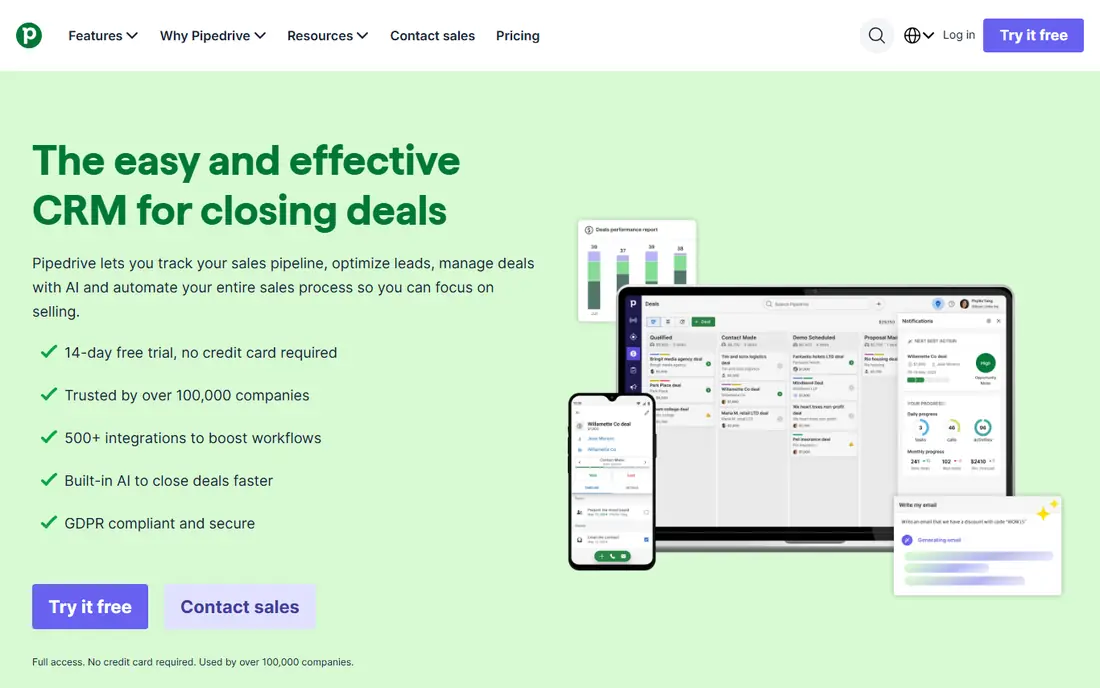
Pipedrive is built around one idea done well: a visual pipeline that shows every deal, its stage and its next activity at a glance. Drag-and-drop stages, activity reminders and deal rotting alerts help reps focus on deals that are stalling, and setup usually takes days rather than weeks. The Lite plan starts at 14 dollars per seat per month on annual billing in recent vendor pricing, with a 14-day trial.
There is no permanent free plan, and lead generation tools and deeper automation sit on higher tiers or add-ons. Pipedrive suits sales-led small businesses that want pipeline clarity above all else, and who do not need a full marketing platform in the same tool.
- Clearest visual pipeline board
- Fast setup
- Useful automation on Growth tiers
- No permanent free plan
- Lead tools and some automation cost extra
Zoho CRM gives small teams a lot for the money. The free plan covers up to three users, paid Standard plans start at around 14 dollars per user per month, and workflow automation, custom fields and hundreds of integrations are included far earlier than in many rivals. It also fits naturally into the wider Zoho suite for accounting, email and support.
The interface can feel busy compared with Pipedrive, and the most advanced AI features need higher tiers. Zoho suits budget-conscious teams that want automation and customisation without paying Salesforce prices, and who are willing to spend a little time learning the system.
- Free for up to three users
- Deep customisation
- Wide integration range
- Interface can feel busy
- AI features are gated to higher tiers
Freshsales, from Freshworks, stands out for giving small teams built-in phone and email plus meaningful AI features at a low entry price. Growth plans start at 9 dollars per user per month in recent vendor pricing, and a free plan covers basic contact and deal management. Setup is usually fast, which suits teams without a dedicated admin.
The free plan limits integrations, and deeper automation and forecasting need higher tiers. Freshsales suits budget teams that want calling, email and pipeline tracking in one place, without paying for a full enterprise platform.
- Low Growth pricing
- Built-in phone and email
- AI features at a low price
- Free plan limits integrations
- Advanced features need higher tiers
monday CRM turns sales work into boards, where deals, contacts and activities move through custom stages with automations behind them. Teams that already use monday for project work will find the interface familiar, and customisation is strong without coding. Pricing starts at 12 dollars per seat per month on annual billing, with a three-seat minimum and a 14-day trial.
The seat minimum and contact limits on lower tiers mean very small teams should check total cost carefully. monday CRM suits teams that want flexible workflows and visual boards, rather than a traditional CRM layout, and who value customisation over out-of-the-box sales depth.
- Flexible boards and automations
- Easy customisation
- Familiar interface for monday users
- Three-seat minimum on paid plans
- Contact limits on lower tiers
Close is built for inside sales teams that live on the phone. It combines CRM, a native dialer, email and SMS in one workspace, so reps can call, text and email without switching tools. That focus makes it fast for high-volume prospecting, with activity tracking and reporting built for managers who need to see outreach volume and outcomes.
Pricing varies by tier and by phone line needs, so check the vendor site for current plans, since published starting prices have changed over time. Close suits outbound teams that prioritise calling speed over marketing features, while teams that rarely call may get better value from HubSpot or Pipedrive.
- Native dialer, email and SMS in one inbox
- Fast for high-volume outreach
- Clear activity tracking
- No permanent free plan
- Phone lines and higher tiers add cost
Capsule is the pick for teams that find larger CRMs overwhelming. Its free plan covers two users and 250 contacts, with paid tiers from around 18 dollars per user per month, and it focuses on contacts, deals, tasks and timelines without a maze of settings. That simplicity means a small team can be running in a day.
The trade-off is depth. Automation, advanced reporting and marketing tools are thinner than in HubSpot, Zoho or Salesforce. Capsule suits freelancers, consultants and small teams that mainly need clean contact management and a clear pipeline, not a full sales automation platform.
- Free plan for two users
- Simple and fast to learn
- Clean contact timelines
- Less automation than larger CRMs
- Limited advanced reporting
Less Annoying CRM
Best for: Small teams that want one flat price and no complexity
Less Annoying CRM does what its name promises: one product, one flat price of 15 dollars per user per month, and a deliberately simple interface. Contacts, pipelines, tasks and calendars are easy to learn, and the 30-day trial gives small teams time to test it properly. There are no tier puzzles or hidden feature gates to decode.
It is not built for large teams or complex automation, and its integration range is smaller than HubSpot or Zoho. Less Annoying CRM suits small businesses that want a CRM their whole team will actually use, and who value simplicity over scale.
- Single flat price
- Very simple to learn
- 30-day trial
- Fewer integrations and automations than larger CRMs
- Not built for large teams
How we picked these
We compared official pricing pages, feature lists and public reviews for sales software that serves small and growing teams, not only enterprises. We favoured tools with a free plan or trial, clear pipeline views, contact management and follow-up automation, and we included both all-round CRMs and focused sales tools such as Close. Prices change often, so confirm current plans on the vendor site before buying, and price the full team for a year.
How to choose sales software your reps will actually use
Start with your sales motion. An outbound team needs a dialer and sequences, a pipeline team needs a clear board and activity reminders, and a marketing-led team needs email tracking and lead capture. Buying the wrong motion wastes money even if the tool is excellent in general.
Run a short trial with real deals
Import a small set of real contacts and deals, run a week of actual follow-ups, and check whether reps update the CRM without reminders. If they avoid it, the tool is too complex or too slow for your team, regardless of its feature list. Ask managers to check reporting during the trial, not just after purchase.
Watch for hidden costs at team scale
Multiply the seat price by your team size for a year, then add onboarding fees, phone lines, add-ons and integration costs. A 9 dollar seat for 20 reps still costs over 2,000 dollars a year, while a 25 dollar seat for the same team costs 6,000 dollars. That gap decides whether a premium platform is worth it for your stage.