The Exponential Growth Formula, Explained with Examples
 By Shihab Mia June 20, 2026 10 min read

Quick answer
The exponential growth formula is N = N0 x (1 + r)^t for growth that happens in discrete steps, or N = N0 x e^(rt) for continuous growth. Here N0 is the starting amount, r is the growth rate as a decimal, t is time, and e is about 2.71828. Each period the quantity is multiplied by the same factor, so it grows faster and faster.
Exponential growth describes anything that increases by a fixed percentage over each period rather than by a fixed amount. Money in a savings account, a spreading rumor, a bacteria colony, and website traffic can all follow this pattern. The key idea is that the quantity is repeatedly multiplied by the same factor, so the bigger it gets, the faster it grows.
What the exponential growth formula says
The most common version is the discrete formula N = N0 x (1 + r)^t. N0 is the amount you start with, r is the growth rate per period written as a decimal, and t is the number of periods that have passed. The term (1 + r) is the growth factor: it is the multiplier applied once per period. Raising it to the power t means you apply that multiplier t times in a row.
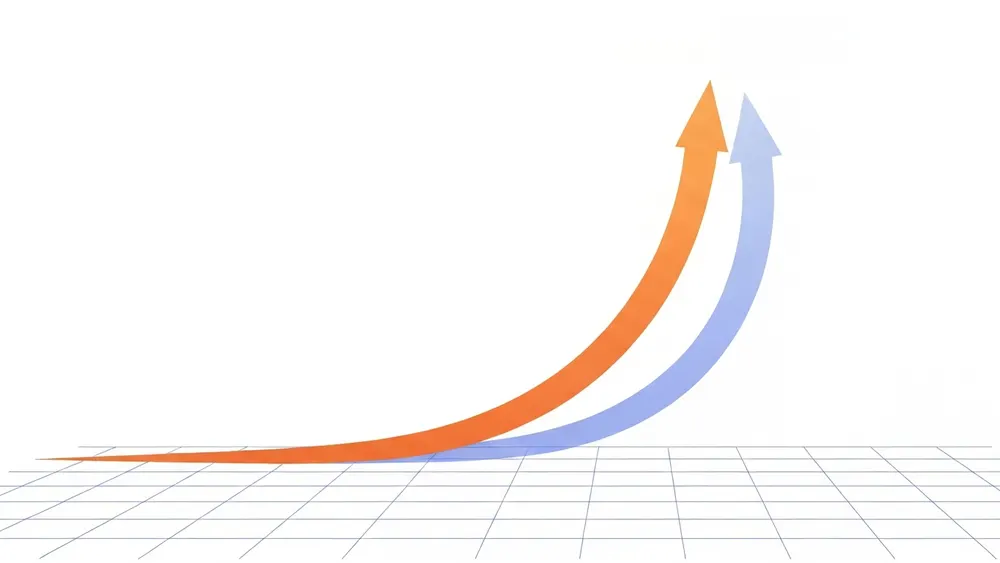
For example, a 5 percent yearly growth rate gives r = 0.05, so the growth factor is 1.05. After one year you have 1.05 times the start, after two years 1.05 squared, and so on. Because the exponent climbs, the curve does not rise in a straight line. It bends upward, getting steeper the further out you go. This bending is the signature of exponential behavior, and it is what separates it from simple linear increase.
Discrete versus continuous growth
There are two standard forms of the formula, and choosing the right one depends on how often the growth is applied.
- Discrete growth: N = N0 x (1 + r)^t. Use this when growth happens in clear steps, such as once per year, per month, or per generation. Annual interest paid once a year and a population that reproduces in distinct seasons both fit here.
- Continuous growth: N = N0 x e^(rt). Use this when growth happens constantly and smoothly with no gaps, like continuously compounded interest or radioactive change. The constant e (about 2.71828) is the natural base that describes growth happening at every instant.
The two forms are closely related. As you compound discrete growth more and more often, splitting the year into months, then days, then seconds, the result moves closer and closer to the continuous formula. That is exactly the link explored in our guide to compound interest, where the same r can be applied yearly, monthly, or continuously to the same starting balance.
How to use the formula step by step
Suppose a town has 10,000 people and the population grows 3 percent per year. How many people will there be after 5 years? Here is how to work it out with the discrete formula.
- Identify the starting amount. The population begins at N0 = 10,000.
- Convert the rate to a decimal. A 3 percent rate means r = 0.03.
- Find the growth factor. Add 1 to r: 1 + 0.03 = 1.03.
- Apply the time exponent. Raise the factor to the number of periods: 1.03 to the power 5, which is about 1.159.
- Multiply by the start. N = 10,000 x 1.159, which gives about 11,593 people.
- Read the result. After 5 years the town grows from 10,000 to roughly 11,593, an increase of nearly 1,600 people driven by the compounding effect.
Notice that the yearly gain is not constant. The first year adds 300 people, but later years add more because each year grows the already larger total. That accelerating gain is the heart of exponential growth, and it is closely tied to ideas like percent change measured over many periods.
A second worked example: doubling bacteria
Growth does not have to be a small percentage. A classic example is a bacteria colony that doubles every period, which means the growth rate is a full 100 percent, so r = 1 and the growth factor is 2. Suppose you start with a single cell and it doubles every 10 minutes. How many cells are there after one hour?
- Identify the starting amount. You begin with N0 = 1 cell.
- Set the growth rate. Doubling means a 100 percent increase per period, so r = 1.
- Build the growth factor. Add 1 to r: 1 + 1 = 2. Each period multiplies the count by 2.
- Count the periods. One hour holds six 10-minute periods, so t = 6.
- Apply the exponent. Raise the factor to the number of periods: 2 to the power 6, which equals 64.
- Read the result. N = 1 x 64 = 64 cells after one hour, all from a single starting cell.
This shows why people say things grow exponentially when they really mean fast. By two hours the colony would reach 4,096 cells, and by three hours over 262,000. The doubling never slows down, it just keeps multiplying a larger and larger base, which is the same engine behind the savings curve in our guide to compound interest.
What the exponential growth graph looks like
Plotting the formula reveals a few properties that hold for every exponential growth curve, no matter the rate. Recognizing this shape lets you spot exponential behavior on sight, before you ever touch the numbers.
- Always increasing. With a positive rate the curve only ever rises from left to right. It never dips or flattens out at the top, unlike a constrained logistic curve.
- Bends upward. The slope itself keeps getting steeper. Early on the line looks almost flat, then it sweeps upward sharply, which is why early exponential growth is so easy to underestimate.
- A horizontal asymptote, not a vertical one. Run time backward and the curve gets closer and closer to zero without ever touching it. There is no point where it crosses below the axis.
- Passes through the starting value. At t = 0 the formula gives N = N0, because any factor raised to the power zero is 1. That fixed starting point anchors the whole curve.
- One output per input. Each height on the curve happens exactly once, which is what makes the formula reversible so you can solve for the time it takes to reach a target.
How to find the growth rate from two data points
Often you do not know the rate yet, but you do know the value at two different times. You can work backward to find r. Say a channel had 8,000 subscribers and grew to 12,000 over 4 years. Divide the ending amount by the starting amount to get the total growth factor, 12,000 / 8,000 = 1.5. Then take the t-th root, here the 4th root of 1.5, which is about 1.107. Subtract 1 to get r = 0.107, or roughly an 11 percent yearly rate.
This reverse calculation is the same logic behind measuring percent change across a span of time, except you spread the total change evenly across every period to find the steady per-period rate. Once you have r, you can project the curve forward to any future year.
A growth reference chart
It helps to see how a single dollar or unit multiplies over time at different rates. The table below shows the growth factor (1 + r)^t for common yearly rates, so you can multiply your own starting amount by these numbers.
Growth factor for a starting amount of 1, by rate and years
| Years | 5 percent rate | 10 percent rate | 20 percent rate |
|---|---|---|---|
| 1 year | 1.05 | 1.10 | 1.20 |
| 3 years | 1.16 | 1.33 | 1.73 |
| 5 years | 1.28 | 1.61 | 2.49 |
| 10 years | 1.63 | 2.59 | 6.19 |
| 20 years | 2.65 | 6.73 | 38.34 |
Look at the 20 percent column. After 20 years the original amount has multiplied more than 38 times. That is the power of a high growth rate compounding over a long horizon, and it explains why small differences in rate lead to enormous gaps over time.
Exponential growth versus exponential decay
The same formula handles both rising and falling quantities. The only thing that changes is the sign of the rate, which flips the growth factor above or below 1. The table below lays the two cases side by side so you can see exactly what each piece does.
How growth and decay differ in the same N = N0 x (1 + r)^t formula
| Feature | Exponential growth | Exponential decay |
|---|---|---|
| Rate r | Positive, such as 0.05 | Negative, such as -0.05 |
| Growth factor (1 + r) | Greater than 1, such as 1.05 | Between 0 and 1, such as 0.95 |
| Curve shape | Rises and bends upward | Falls and flattens toward zero |
| Each period | Multiplies the total larger | Shrinks the total smaller |
| Real examples | Savings, viral signups, populations | Half-life, depreciation, cooling |
Because the structure is identical, learning one teaches you the other. A negative rate is the foundation of half-life, where a radioactive sample loses a fixed percentage of itself in every period and the curve eases down toward, but never quite reaches, zero.
The rule of 70 for doubling time
A handy shortcut tells you roughly how long an exponentially growing quantity takes to double. Divide 70 by the growth rate expressed as a percent, and the answer is the approximate doubling time in periods. At 7 percent growth, doubling takes about 70 / 7 = 10 years. At 2 percent it takes roughly 35 years.
This works because doubling depends on the natural logarithm of 2, which is about 0.693, and 70 is a convenient round version of that. The rule of 70 is an estimate, not an exact answer, but it is accurate enough for quick mental math and a great sanity check on any exponential projection.
Common mistakes to avoid
Exponential growth errors usually come from setup slips rather than hard arithmetic. Watch for these.
- Adding instead of multiplying. Exponential growth multiplies by (1 + r) each period. Adding the same fixed amount each time is linear growth, a completely different and slower pattern.
- Forgetting to convert the percent. A 6 percent rate is r = 0.06, not 6. Plugging in 6 makes the growth factor 7, which explodes the answer.
- Mixing up the rate and the factor. The rate r is 0.05, but the factor you raise to a power is 1 + r = 1.05. Raising 0.05 to a power shrinks the number toward zero instead.
- Using the wrong formula. Use (1 + r)^t for step by step growth and e^(rt) only for continuous growth. They give close but not identical results.
- Mismatched time units. If r is a yearly rate, t must be in years. Mixing monthly rates with yearly time periods produces a wildly wrong total.
Where exponential growth shows up
This single formula models a surprising range of real situations, which is why it is worth understanding well.
- Money. Savings, investments, and loans all grow by compounding, the financial face of exponential growth.
- Populations. Bacteria, animals, and people can grow exponentially when resources are plentiful and unconstrained.
- Technology and audiences. Viral content, user signups, and network effects often follow exponential curves early on.
- Decay in reverse. The same math with a negative rate describes shrinking quantities, the idea behind half-life in physics and chemistry.
Try it on a real balance
The cleanest way to see exponential growth in action is with money. Enter a starting amount, a rate, and a number of years below, and the calculator applies the growth formula for you and shows the final total. You can also open the compound interest calculator directly to compare yearly, monthly, and continuous compounding side by side.
📈 Try the free tool Compound Interest Calculator Free compound interest calculator with monthly contributions, daily to yearly compounding, charts, and the exact formula. See your final balance and interest earned.Exponential growth rewards a careful setup: identify the start, convert the rate to a decimal, build the growth factor (1 + r), and raise it to the number of periods. Choose the discrete form for stepwise growth and the continuous form with e for smooth, constant change. Once you internalize that growth multiplies rather than adds, the steep, accelerating curve stops being a surprise and becomes a tool you can predict and plan around.
Frequently asked questions
What is the exponential growth formula?
The exponential growth formula is N = N0 x (1 + r)^t for discrete growth, or N = N0 x e^(rt) for continuous growth. N0 is the starting amount, r is the growth rate as a decimal, t is time, and e is about 2.71828. Each period multiplies the quantity by the same growth factor.
What is the difference between exponential and linear growth?
Linear growth adds the same fixed amount every period, producing a straight line. Exponential growth multiplies by the same factor every period, producing a curve that bends upward and accelerates. Over time exponential growth pulls far ahead of linear growth, even when it starts out slower.
When should I use e^(rt) instead of (1 + r)^t?
Use N = N0 x e^(rt) when growth is continuous and happens at every instant, such as continuously compounded interest. Use N = N0 x (1 + r)^t when growth happens in discrete steps, like once a year or once a month. The two give very close but not identical results.
How do I find the doubling time?
Use the rule of 70: divide 70 by the growth rate written as a percent. At 5 percent growth, doubling takes about 70 / 5 = 14 years. It is an approximation based on the natural log of 2, but it is accurate enough for quick estimates and sanity checks.
What does r mean in the exponential growth formula?
In the formula, r is the growth rate per period written as a decimal. A 4 percent rate means r = 0.04. You add 1 to r to get the growth factor of 1.04, which is the number you raise to the power of time. Forgetting to convert the percent is a common error.
Can the exponential formula describe decline?
Yes. If the rate r is negative, the same formula describes exponential decay, where the quantity shrinks by a fixed percentage each period. This is how half-life, radioactive decay, and depreciation are modeled. The curve falls and flattens toward zero instead of rising steeply.
How do I find the growth rate if I only know two values?
Divide the later value by the earlier value to get the total growth factor, then take the t-th root, where t is the number of periods between them. Subtract 1 from that result to get r as a decimal. For example, going from 8,000 to 12,000 over 4 years gives a rate of about 11 percent.
Why does exponential growth seem slow at first?
Early on the base is small, so multiplying it adds only a little. A 10 percent gain on 100 is just 10, but the same 10 percent on 10,000 is 1,000. As the total grows, each percentage step adds far more, so the curve looks nearly flat at the start then sweeps upward, which is why early growth is easy to underestimate.