How to Calculate Square Feet: A Simple Step by Step Guide
 By Shihab Mia June 20, 2026 7 min read

Quick answer
To calculate square feet, multiply length by width, with both measurements in feet. A room that is 12 feet long and 10 feet wide is 12 x 10 = 120 square feet. For an L-shaped or irregular room, split it into rectangles, find the square footage of each, and add them together.
Square footage is one of the most useful numbers in everyday life. You need it to buy the right amount of flooring, paint or carpet, to compare the size of two homes, to price a rental, or to figure out how much sod your yard needs. The good news is that the math is genuinely simple. This guide shows you the formula, how to measure correctly, how to handle rooms that are not perfect rectangles, how to convert between units, and the small mistakes that trip people up.
The square footage formula
The formula for square footage is as plain as it gets: square feet = length (in feet) x width (in feet). Area is always two measurements multiplied together, which is exactly why the unit is square feet. One square foot is a square that measures one foot on every side, and the total tells you how many of those squares would tile the floor.
The only rule that matters is that both numbers must be in feet before you multiply. If you measure in inches, yards or metres, convert first. Get both measurements into feet, multiply, and the answer is in square feet every time. That single habit prevents almost every square footage error people make.
How to calculate the square feet of a room
To find the square feet of a room, measure its length and width in feet and multiply the two numbers together. For a standard rectangular room the process takes about a minute. Here is the full sequence using a room that measures 14 feet by 11 feet.
- Clear a straight path along one wall and measure the length of the room in feet, wall to wall. Say it is 14 feet.
- Measure the width of the room in feet along an adjoining wall, again wall to wall. Say it is 11 feet.
- Multiply the two numbers together: 14 x 11 = 154.
- Add the unit. The room is 154 square feet.
- If you are measuring more than one room, repeat the steps for each and add the totals at the end for the whole job.
That is the entire method for any rectangle or square. A square room is just the special case where length and width are equal, so a 12 by 12 room is 12 x 12 = 144 square feet. Use a rigid tape or a laser measure held level and flat against the baseboard so the reading is not stretched or angled, since a tape that sags or runs on a diagonal quietly inflates the length.
Converting inches to feet before you multiply
To convert inches to feet, divide the inches by 12 and add the result to the whole feet. Rooms rarely measure out to a tidy whole number, so you will often have a leftover number of inches. Since there are 12 inches in a foot, a wall that is 10 feet 6 inches becomes 10 + (6 / 12) = 10.5 feet. Always convert to decimal feet before multiplying, never after.
Common inch measurements converted to decimal feet
| Feet and inches | Decimal feet | Example used as width with a 10 ft length |
|---|---|---|
| 10 ft 3 in | 10.25 ft | 10.25 x 10 = 102.5 sq ft |
| 10 ft 6 in | 10.5 ft | 10.5 x 10 = 105 sq ft |
| 11 ft 0 in | 11.0 ft | 11 x 10 = 110 sq ft |
| 12 ft 9 in | 12.75 ft | 12.75 x 10 = 127.5 sq ft |
| 15 ft 6 in | 15.5 ft | 15.5 x 10 = 155 sq ft |
If you ever need to go the other way and turn square feet into square yards for a carpet order, divide by 9, because a square yard is 3 feet by 3 feet. To get square metres, divide square feet by about 10.764. A quick length converter can handle the unit swaps for you if mental math is not your favourite part.
Calculating square feet for L-shaped and odd rooms
To find the area of an L-shaped or irregular room, split it into separate rectangles, calculate each one, and add the results. Plenty of rooms are not simple rectangles. An L-shaped living room, a kitchen with a bumped out breakfast nook, or a hallway that turns a corner all need this one extra step.
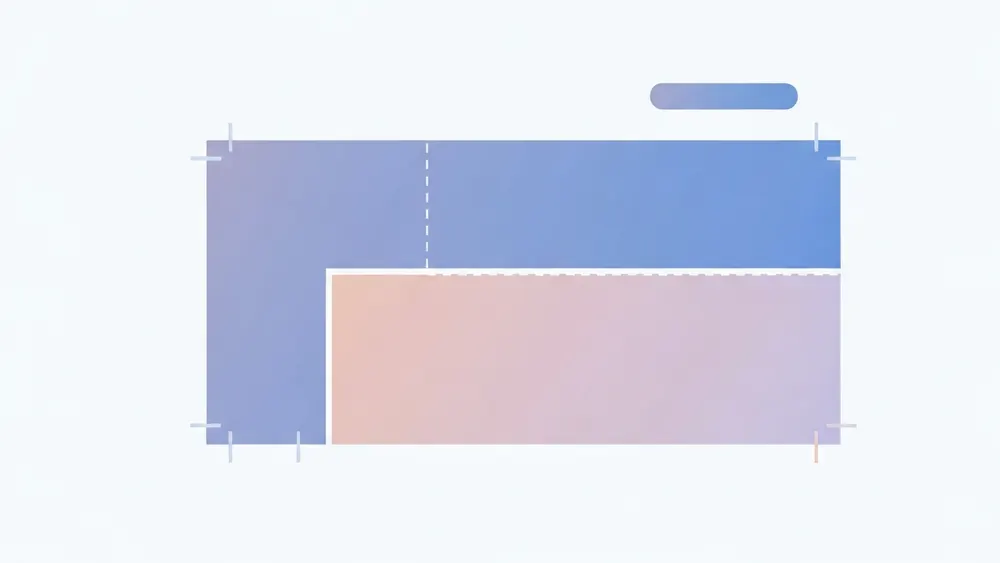
Imagine an L-shaped room. You draw an imaginary line to break it into two rectangles. Rectangle A is 12 feet by 10 feet, and Rectangle B is 6 feet by 5 feet. Work through it like this:
- Find the area of Rectangle A: 12 x 10 = 120 square feet.
- Find the area of Rectangle B: 6 x 5 = 30 square feet.
- Add them together: 120 + 30 = 150 square feet.
The whole L-shaped room is 150 square feet. The same approach works for any irregular shape. Break it into the fewest rectangles you can, measure each, and sum the areas. For triangular nooks, find the area as half of base times height, then add that in too. For a rounded bay or a circular room, the area is pi times the radius squared, and our guide on the area of a circle walks through that in full. The principle never changes: total square footage is the sum of the parts.
Which measuring method should you use?
The right measuring tool depends on room size and how precise you need to be, but all three below feed the same length-times-width formula. A tape measure is fine for a single room, a laser measure saves time across a whole house, and a floor plan app is handy when you already have digital dimensions.
Comparing three ways to measure a room
| Method | Best for | Typical accuracy | Watch out for |
|---|---|---|---|
| Tape measure | A single room or a quick check | High if held flat and level | Sagging tape and diagonal runs inflate the length |
| Laser measure | A whole house or high ceilings | Very high, to a fraction of an inch | Aim at a flat surface, not furniture or trim |
| Floor plan app | Existing digital plans or listings | Only as good as the source data | Verify the scale before trusting the numbers |
Common mistakes to avoid
The most common square footage mistakes come from mixing units, converting inches at the wrong step, or forgetting to split odd shapes. Square footage math is easy, but a few habits cause most of the wrong answers. Check yourself against this list before you trust a number.
- Mixing units. Measuring length in feet and width in inches gives a meaningless answer. Convert everything to feet first, then multiply.
- Converting inches after multiplying. A 6 inch leftover is half a foot, not 6 hundredths of a foot. Divide inches by 12 and fold them into the measurement before you multiply.
- Forgetting to split odd shapes. Treating an L-shaped room as one big rectangle overcounts the missing corner. Always break it into rectangles.
- Rounding too early. Round only at the very end. Rounding each measurement first lets small errors stack up across a large room.
- Confusing perimeter with area. Adding the wall lengths gives the distance around the room, not the floor space. Square footage needs multiplication, not addition.
- Ignoring waste. When buying flooring or tile, add extra for cuts and mistakes on top of your exact square footage, as covered below.
Good to know: where square footage matters
Square footage shows up far beyond the classroom. Flooring, carpet and tile are all sold and priced by the square foot, so an accurate measurement keeps you from over or under buying. Paint coverage is guided by the same number: Sherwin-Williams advises that one gallon of paint covers roughly 350 to 400 square feet of wall, so dividing your wall area by that figure tells you how many cans to grab. Landscapers use square footage for sod, mulch and seed, and knowing it up front stops you buying the wrong quantity.
In real estate the number carries extra weight, and it is more standardised than most people realise. In the United States the ANSI Z765 standard defines finished square footage as the heated, livable area measured to the outside of exterior walls, which is why a listing's square footage may not match the sum of your interior room measurements. Landlords often set rent per square foot on top of that figure, so an accurate area affects pricing on both sides of a deal.
Once you are comfortable with area, related measurements come easily. If you need to know how much a space can hold rather than how much floor it has, how to calculate volume extends the same idea into three dimensions. And when you are working with land rather than rooms, it helps to know how many square feet are in an acre so large areas stay in perspective.
Calculate square footage instantly
Rather than do the arithmetic by hand, enter your length and width below and let the tool return the square footage right away. It handles rectangles directly, and you can add up several rooms to get a whole project total in seconds. For shapes beyond simple rooms, the area calculator covers circles, triangles and trapezoids too.
📐 Try the free tool Square Footage Calculator Free square footage calculator: enter length and width in feet or meters to get area in sq ft and sq m. Add multiple rooms, handle L-shapes, and estimate cost.Square footage really does come down to one move: get both measurements into feet and multiply. Split anything irregular into rectangles and add the pieces. With that habit in place, you can size a flooring order, price a room, or compare two homes with confidence and never second guess the number again.
Frequently asked questions
How do you calculate square feet?
Multiply the length by the width, with both measured in feet. A room that is 12 feet long and 10 feet wide is 12 x 10 = 120 square feet. The answer is always in square feet because you are multiplying two measurements that are both in feet.
How do I calculate the square footage of an L-shaped room?
Split the room into two rectangles by drawing an imaginary line. Calculate the area of each rectangle by multiplying its length by its width, then add the two results. For example, a 12 by 10 section plus a 6 by 5 section gives 120 + 30 = 150 square feet.
How do I convert inches to feet when measuring a room?
Divide the number of inches by 12, since there are 12 inches in a foot, and add the result to the feet. A wall that is 10 feet 6 inches becomes 10 + 6 divided by 12, which equals 10.5 feet. Always convert before you multiply, not after.
How many square feet is a 12x12 room?
A 12 by 12 room is 144 square feet, because 12 multiplied by 12 equals 144. Any square room is just length times width where both numbers are the same, so you square the side length to get the total floor area.
Is square footage the same as perimeter?
No. Square footage is the floor area, found by multiplying length by width. Perimeter is the distance around the room, found by adding up the wall lengths. Square footage uses square feet, while perimeter uses plain feet, and the two are calculated very differently.
How much extra flooring should I buy for waste?
Add about 10 percent to your exact square footage to cover cuts, mistakes and pattern matching. For a 150 square foot room, that means ordering roughly 165 square feet. For complex layouts or diagonal patterns, increase the buffer to about 15 percent.