Best Alternatives to Nearshore Software in 2026: 9 Services Compared
By ToolNimba Editorial Team October 31, 2026 9 min read

- Top pick
 Toptal
Vetted freelance experts for short projects
Starting priceSee websiteCheck out ToptalRead our review - Runner-up
 Turing
Global remote developers at scale
Starting priceSee websiteCheck out TuringRead our review - Also great
 Andela
Long-term global engineering teams
Starting priceSee websiteCheck out AndelaRead our review
How we researched this
We compared official pricing and feature pages, app store listings, privacy policies and public user reviews. Prices change, so check the provider's site before you pay.
Key takeaways
- Our top pick for most readers is Toptal, because it covers the core need well without forcing a complex setup.
- If budget matters most, start with Turing and test it on a real task before paying for a wider tool.
- The biggest difference between these options is not the feature list, it is how well each one fits your team size, workflow, and existing tools.
- Check pricing, free plan limits, and contract terms on the vendor site before you commit, since plans change often.
- A short trial with your own content or contacts will tell you more than any comparison table can.
Quick comparison
| Name | Best for | Starting price | Free plan | |
|---|---|---|---|---|
| Toptal | Vetted freelance experts for short projects | See website | No | Visit |
| Turing | Global remote developers at scale | See website | No | Visit |
| Andela | Long-term global engineering teams | See website | No | Visit |
 Upwork | Flexible freelance hiring for any budget | See website | Yes | Visit |
 Gun.io | US-based vetted freelance developers | See website | No | Visit |
 Thoughtbot | Onshore product design and development studio | See website | No | Visit |
 Bubble | No-code web apps without hiring developers | Free | Yes | Visit |
 Deel | Hiring and paying global employees and contractors | See website | No | Visit |
 Arc.dev | Pre-vetted remote developers for hire | See website | No | Visit |
The best alternatives to nearshore software apps
We compared official feature pages, engagement models, and public pricing notes for global talent platforms, studios, and no-code tools, then grouped them by the model they replace, not just by their marketing claims.
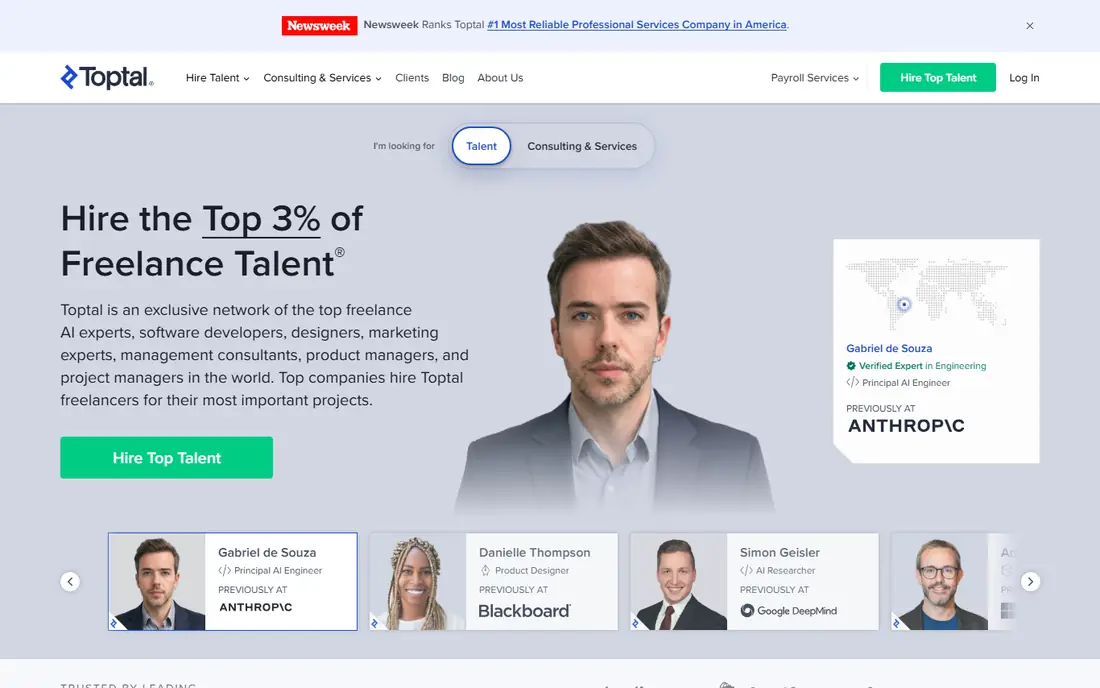
Toptal suits teams that need one senior developer or designer, not a whole delivery department. Its screening process is the main selling point, and that matters when a bad hire can stall a product for weeks. You post a role, review a shortlist, and start with a trial period in many cases.
Cost is the honest trade-off here. Toptal tends to sit above general freelance marketplaces, so it fits best when quality and speed matter more than the lowest hourly rate. Plan the scope tightly, agree on deliverables early, and keep a single internal owner for the work.
- Screened talent pool
- Fast matching for senior roles
- Flexible engagement lengths
- Premium rates
- Screening can slow very niche hires
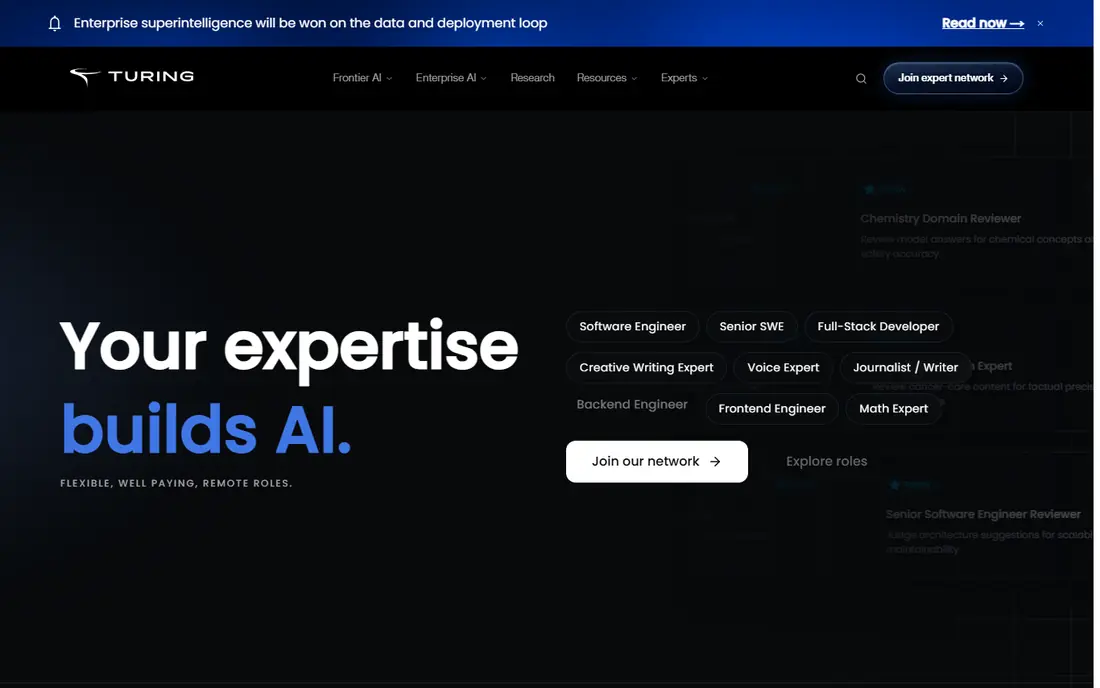
Turing takes a different route from nearshore staffing by drawing on developers across many countries and matching them to your stack. That wider pool helps when you need a rare skill or a larger team quickly, and Turing handles much of the hiring admin around the engagement.
The model works best when your internal team can onboard remote engineers well. Clear documentation, regular check-ins, and a defined code review process make the difference. Without those habits, even strong engineers can drift from the product goal.
- Large vetted global pool
- AI-assisted matching
- Managed payroll and compliance
- Less direct control than hiring in-house
- Time zone planning still needed
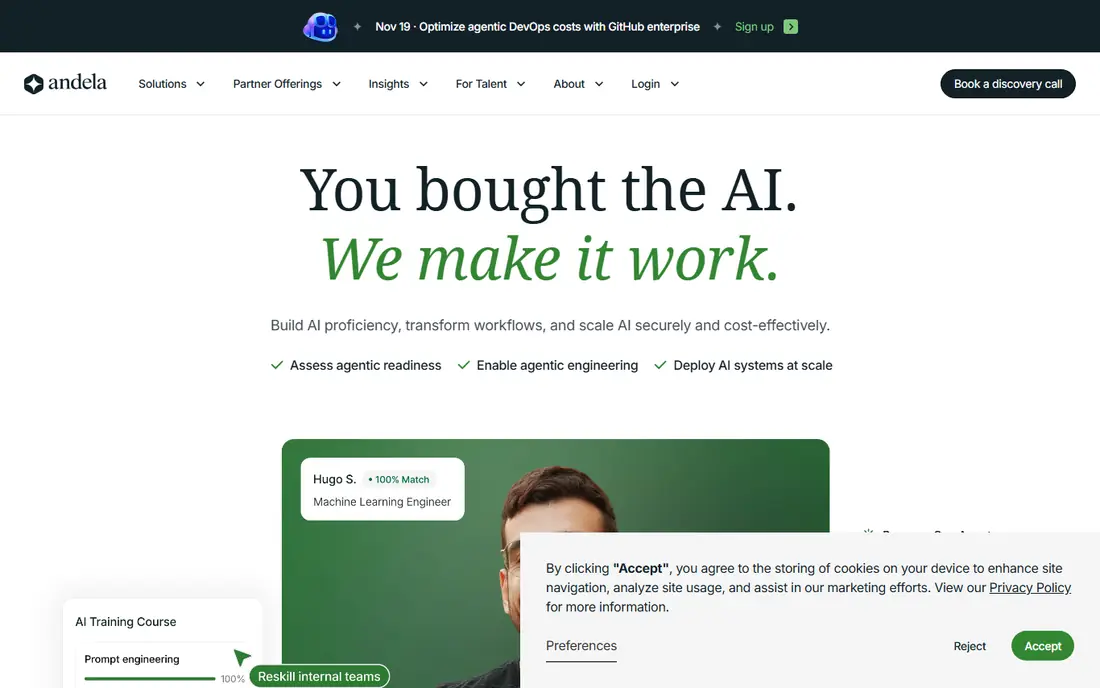
Andela focuses on building longer relationships between companies and engineers, rather than one-off gigs. That focus shows in its vetting and support model, which is built around engineers joining a team for months or years. It is a useful option if you want continuity.
Pricing is quoted per engagement, so compare the total cost, including management time, against a nearshore quote. Ask how replacements are handled if an engineer leaves, and how quickly a new hire can be ramped up. Those answers matter more than any headline rate.
- Strong focus on long-term placements
- Talent across Africa, Latin America and beyond
- Support for scaling teams
- Enterprise-leaning process
- Smaller one-off projects may be a weaker fit
Upwork is the open-market alternative. You can hire a single developer for a bug fix, a small team for a prototype, or a specialist for a short audit. The range is the appeal, and the risk is that range too, because profiles and reviews need careful reading before you commit.
Treat the first job as a paid test. Start with a small, well-defined task, check communication speed and code quality, and only then expand the scope. Teams that skip that step often pay twice, once for rushed work and again for the fix.
- Huge range of skills and rates
- Escrow payment protection
- Easy to start small
- Quality varies widely
- You must screen and manage freelancers yourself
Gun.io positions itself between a freelance marketplace and a staffing firm. Freelancers are screened before they reach clients, which saves time for teams that do not want to sift through dozens of applications. The US focus also helps when real-time collaboration matters.
The trade-off is choice. A smaller, curated pool can mean fewer options for very specialised stacks, so check availability for your exact tools before planning a start date. For common web and mobile stacks, the fit is usually straightforward.
- Vetting focused on senior engineers
- US time zone alignment
- Project-based or ongoing work
- Smaller pool than global marketplaces
- Pricing is quote-based
Thoughtbot is an onshore studio option for teams that want a partner to own design and build together. Instead of hiring individuals, you work with a small product team that plans, designs, and ships in short cycles. That structure suits founders who need guidance as well as code.
Expect to pay for senior time and a structured process. The value shows up in fewer false starts, cleaner product decisions, and a codebase your own team can take over later. Ask for a sample engagement plan and a handover process before signing.
- Senior product team under one roof
- Strong design and engineering process
- Clear weekly delivery rhythm
- Higher cost than offshore options
- Best for funded products, not tiny fixes
Bubble changes the question entirely. Instead of hiring developers, you build the app yourself with a visual editor, databases, and workflows. For directories, marketplaces, dashboards, and internal tools, that can be enough to launch and test an idea fast.
The catch is complexity. Simple apps move quickly, but heavy data processing, unusual integrations, or very high traffic may need custom code later. Use Bubble to validate an idea, then judge whether to rebuild, extend, or stay based on real usage.
- Build and launch web apps visually
- Large template and plugin library
- No code hiring needed
- Performance limits on very complex apps
- Learning curve for advanced logic
Deel is not a software agency, and that distinction matters. It helps you hire, pay, and stay compliant with people you have already chosen, wherever they live. For teams that want to build their own remote team without setting up local entities, that removes a major barrier.
Pair Deel with a sourcing channel, such as a marketplace or recruiter, rather than expecting it to supply engineers. Its strength is the legal and payroll layer. Check country coverage for your hires and confirm who handles benefits, taxes, and contracts.
- Compliance and payroll in many countries
- Contractor and employee options
- Central dashboard
- It is a hiring platform, not a dev agency
- You still need to find and manage talent
Arc.dev, formerly Arc, focuses on pre-vetted remote talent for full-time and freelance roles. The pitch is simple: less time screening, more time interviewing people who already passed technical checks. That can shorten hiring from months to weeks for common roles.
As with any curated marketplace, ask what vetting actually covers for your role. A general coding test is not the same as experience with your framework or domain. Request work samples, run a practical task, and confirm time zone overlap before making an offer.
- Pre-vetted developers and designers
- Hire remote or freelance
- Matching support
- Quote-based pricing
- Availability varies by skill and region
How we picked these
We compared official feature pages, pricing pages, and app store listings for each option, and read public reviews to check for common complaints. We favoured tools that exist today, fit the topic directly, and state their pricing or free plan clearly where possible. Where a vendor did not publish a price, we wrote See website rather than guessing.
We also weighed ease of setup, limits on free plans, and how well each tool works with tools readers already use. A strong feature list counted for less than a workflow that a small team can actually adopt and keep using.
What to check before you switch models
Start with the problem nearshore did not solve. If cost was the issue, an offshore pool or a no-code build may help. If control was the issue, an onshore studio or your own hires through a compliance platform may fit better. If speed was the issue, a curated marketplace usually beats an open marketplace. Naming the real bottleneck keeps you from swapping one mismatch for another.
Compare total cost, not just hourly rates. Include management time, onboarding, rework, and the cost of a delayed launch. A cheaper rate with weak communication can cost more than a higher rate with a team that ships on schedule. Ask every vendor for a trial, a sample plan, and a clear exit or handover clause.