Best AI Brand Visibility Tools in 2026: 9 Software Compared
By ToolNimba Editorial Team October 29, 2026 11 min read

- Top pick
 Profound
Enterprise answer-engine analytics
Starting priceSee websiteCheck out ProfoundRead our review - Runner-up
 Peec AI
Clean prompt-level tracking for agencies
Starting priceSee websiteCheck out Peec AIRead our review - Also great
 Scrunch
Citation analysis plus AI crawler data
Starting price$250 per monthCheck out ScrunchRead our review
How we researched this
We compared official pricing and feature pages, app store listings, privacy policies and public user reviews. Prices change, so check the provider's site before you pay.
Key takeaways
- Most tools track the same core engines, ChatGPT, Perplexity, Gemini and Google AI Overviews, so prompt limits and citation detail matter more than the engine list alone.
- Entry prices run from free plans and about $29 per month up to several hundred dollars per month, with enterprise plans quoted on request.
- Otterly AI is the cheapest clear starting point in this list, while Profound and enterprise tools suit larger teams with dedicated analysts.
- Citation data, which pages AI answers actually draw on, is often more useful than a simple mention count, because it shows what to fix or publish next.
- Scores differ between tools, so compare the same prompts and competitors in any trial before you commit to a yearly plan.
Quick comparison
| Name | Best for | Starting price | Free plan | |
|---|---|---|---|---|
| Profound | Enterprise answer-engine analytics | See website | Free trial (7 days) | Visit |
| Peec AI | Clean prompt-level tracking for agencies | See website | Free trial (7 days) | Visit |
| Scrunch | Citation analysis plus AI crawler data | $250 per month | Free trial (7 days) | Visit |
 Otterly AI | Low-cost monitoring for small teams | $29 per month | Free trial | Visit |
 Goodie AI | Tracking tied to concrete fixes | $399 per month | Free trial (7 days) | Visit |
 AthenaHQ | Trying AI visibility on a free credit | Free | Yes | Visit |
 Semrush AI Visibility Toolkit | Teams already using Semrush | $99 per month | Free trial (7 days) | Visit |
 Ahrefs Brand Radar | Researching any brand in AI answers | $199 per month | No | Visit |
 Rankscale | Budget multi-engine tracking | See website | Free trial (7 days) | Visit |
The best AI brand visibility tools
We compared official feature pages, published pricing, trial terms and public reviews for tools that track brand mentions in AI-generated answers. The nine below all cover live AI search in 2026, not just traditional search rankings.
Profound is the name that comes up most often when large brands talk about AI visibility, and for good reason. It tracks how AI models describe a brand and its competitors across a set of prompts, then breaks that down by citations, sentiment and share of voice. For a team that reports AI visibility to leadership, that depth makes monthly reporting easier to defend.
The catch is cost and complexity. Published entry pricing has changed during 2026, and enterprise pricing is quoted on request, so a small team can quickly pay for depth it does not use. Start with the trial, load the prompts that actually drive sales conversations, and check whether the citation data points to pages you can realistically improve.
- Deep prompt and answer data
- Coverage across major answer engines on higher plans
- Agent tools that turn gaps into content tasks
- Pricing is sales-led on enterprise plans
- Entry coverage can be narrow, so check which engines your plan includes
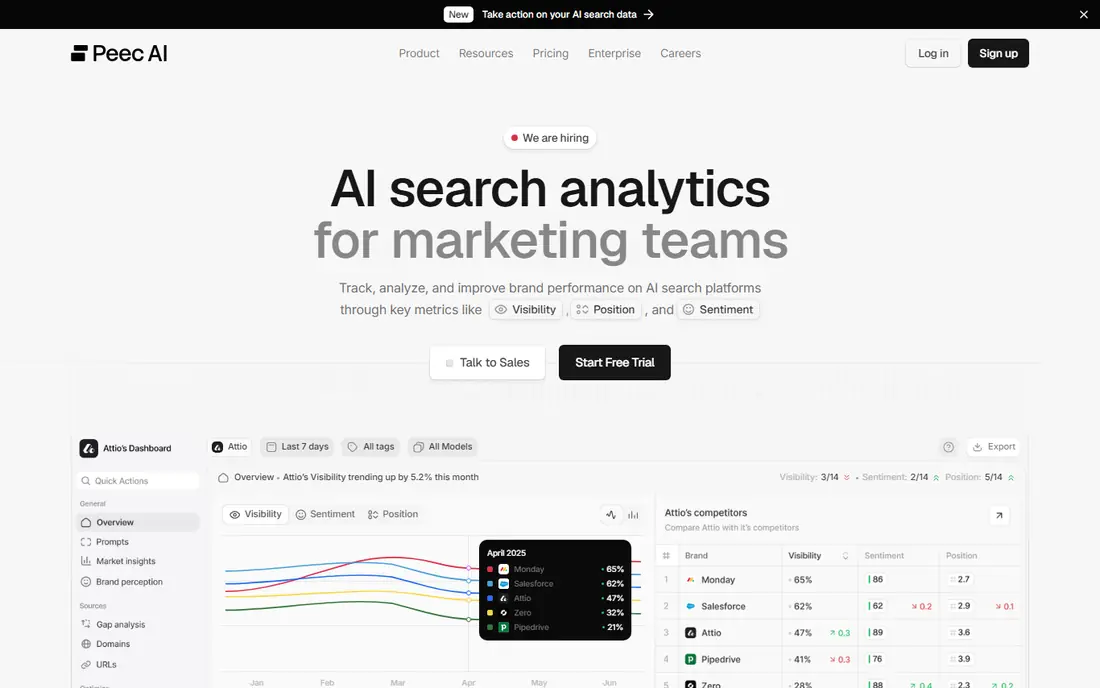
Peec AI keeps the interface focused on one question: where does your brand show up in AI answers, and who shows up instead. That focus suits agencies that need a readable report for each client without a long setup. You pick prompts, add competitors, and watch mention and citation trends over time.
The trade-off is that you need to read the plan details closely. Engine choice, prompt limits and regional coverage change between tiers, so the cheapest plan may not cover the engines your customers actually use. If you manage brands in Europe or across several countries, ask about regional tracking before you buy.
- Clear prompt and competitor views
- Regional tracking options for multi-country brands
- Unlimited seats on published plans
- Entry pricing is in euros and varies by plan
- Some engines are chosen per plan rather than included by default
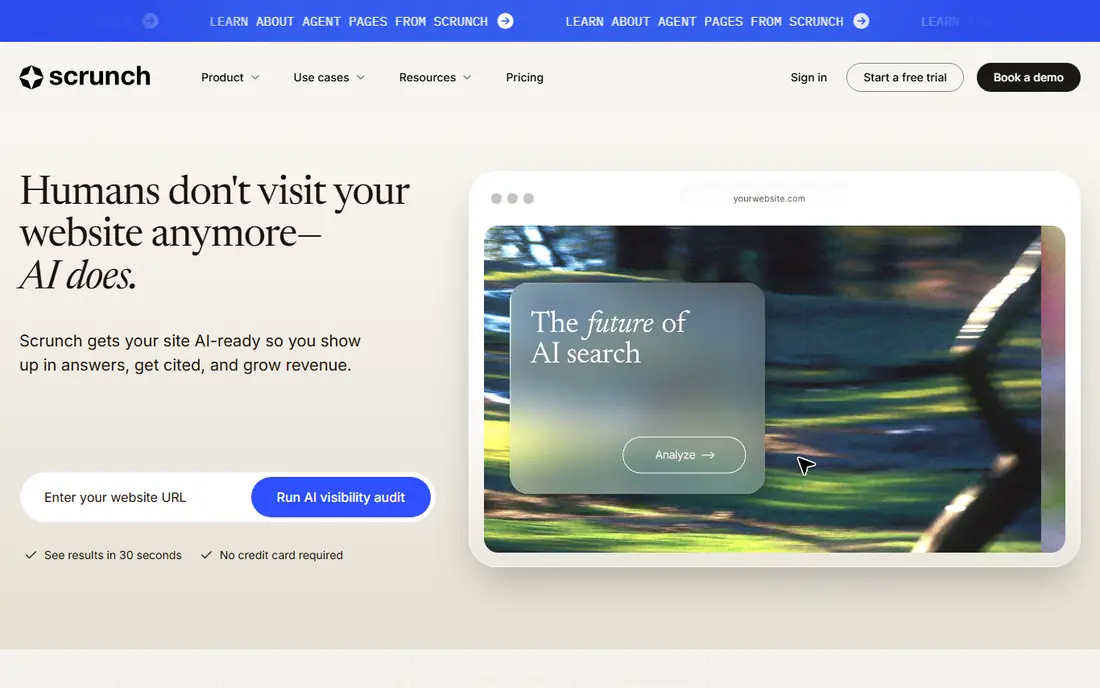
Scrunch stands out for teams that want to know why an AI answer cites a competitor. It digs into citations at the URL level and pairs that with data on how AI crawlers visit your site, which helps technical and content teams work from the same evidence. That combination is useful when a brand is mentioned but rarely linked or recommended.
At $250 per month to start, Scrunch is a mid-market buy rather than a casual test. It fits best when someone on your team can act on the findings each week, whether that means updating a page, adding a comparison, or fixing a crawl block. If no one owns that follow-up work, a cheaper tracker will tell you the same headline numbers for less.
- Detailed citation and source analysis
- AI bot and crawler monitoring
- Content briefs tied to visibility gaps
- Entry price is high for a solo marketer
- The full engine set sits on higher plans
For a founder or a small marketing team, Otterly AI is the sensible first step into AI visibility. The entry plan covers a modest prompt set across major engines, which is enough to learn whether AI answers mention your brand at all and which competitors appear most often. Setup is short, and the reports stay readable.
The limit to watch is prompt volume. Fifteen prompts on the entry plan will not cover a full product range, so larger catalogs will need a higher tier or a second tool. Treat Otterly AI as a way to prove the value of AI tracking, then upgrade once you know which prompts matter.
- Lowest entry price in this list
- Quick setup for a small prompt set
- Covers ChatGPT, Perplexity and other major engines
- Prompt limits are tight on the entry plan
- Extra engines and higher limits cost more
Goodie AI tries to close the gap between measurement and action. Alongside mention and citation tracking, it surfaces prioritized tasks and, on higher plans, ties AI visibility to traffic and revenue signals. That matters because a visibility chart alone rarely convinces a busy team to rewrite pages.
The price puts Goodie AI firmly in mid-market territory, and smaller teams may find the same tracking elsewhere for less. It earns its place here for brands that already know they have an AI visibility problem and need a work list, not just another dashboard. Check the prompt limit on the entry plan against your real prompt list before signing.
- Prioritized optimization actions alongside tracking
- Revenue and traffic attribution features
- Broad model coverage on higher plans
- High entry price for small businesses
- Some features depend on integrations with analytics tools
AthenaHQ is the easiest tool in this list to try without a sales call. A free plan with a starting credit lets you run your own brand and a few competitors through major models and see real answers, not just a demo dataset. That hands-on check is valuable in a category where every vendor chart looks good.
Paid plans step up sharply, with Starter listed around $295 per month in recent comparisons, so the free plan is best seen as a trial of the method rather than a long-term free solution. If the free results show clear gaps you can fix, the paid tier may pay for itself. If they show little movement, you have learned that without spending much.
- Free plan to test with your own brand
- Broad model coverage on paid plans
- Optimization workflows and citation tools
- Paid Starter plan is priced for teams, not solo users
- Credit-based usage needs monitoring
Semrush AI Visibility Toolkit
Best for: Teams already using Semrush
If your team already lives in Semrush for keyword and site work, this toolkit is the lowest-friction way to add AI visibility. You track prompts for a domain, compare competitors, and keep SEO and AI data in one place instead of learning a separate platform. The $99 per month per domain price, billed annually, is straightforward for a single brand.
The limit is scope. Multi-brand agencies will pay per domain, and teams that need Claude or Copilot coverage should confirm current engine support before buying. For a single site with an existing Semrush subscription, though, the convenience is hard to beat.
- Sits inside a familiar SEO suite
- Tracks prompts across major AI engines
- Per-domain pricing is easy to budget for one site
- Priced per domain, so multi-brand costs add up
- Coverage does not include every engine
Ahrefs Brand Radar takes a different angle from most tools here. Instead of only tracking prompts you write, it draws on a large dataset of AI prompts and answers, so you can research how a brand appears across many topics. That makes it strong for competitive research and for agencies pitching a new client.
Pricing is the hurdle. Entry pricing starts around $199 per month per platform index in recent comparisons, and full multi-platform coverage costs more, on top of any Ahrefs base plan considerations. It fits research-heavy teams better than a small brand that only needs to watch its own name.
- Very large prompt dataset for research
- Lets you study competitors without owning their accounts
- Ties AI citations to backlink-style source data
- Per-platform pricing adds up for full coverage
- No free plan, so budget for a paid test
Rankscale appeals to startups and small agencies that want many engines without an enterprise bill. Recent comparisons list entry pricing around $17 to $20 per month, with credits that roll over on some plans, which is generous compared with most tools here. Coverage spans a wide set of engines, including Claude on higher tiers.
Because pricing and credit rules have shifted during 2026, treat any quoted figure as a starting point and confirm it on the vendor pricing page during your trial. If the numbers hold, Rankscale is one of the best value options for broad tracking. If your prompt set is large, model the monthly credit cost first.
- Broad engine coverage for the price
- Credit-based plans that suit variable tracking needs
- White-label reporting on higher plans
- Published pricing has varied during 2026, so confirm the current plan
- Credit usage needs care on large prompt sets
How we picked these
We compared official feature pages, published pricing pages, trial terms and public reviews for tools that track brand visibility in AI-generated answers. We kept only tools that are live in 2026, cover at least the major AI engines or a large prompt dataset, and report mentions, citations or share of voice at the prompt level. We left out pure SEO rank trackers, one-off audit tools and tools without a working product page.
We did not run hands-on tests of every plan, and we did not accept vendor claims at face value where pricing or engine coverage conflicted between sources. Where pricing varied, we used "See website" and pointed you to the vendor page, so you check the current figure before buying.
What to check before you pay
Start with your prompt list, not the vendor demo. Write down the 20 to 50 questions a buyer would actually ask an AI assistant about your category, including comparison questions such as which tool is best for a specific job. A tool that cannot track those exact prompts will not help, no matter how polished its charts look.
Match the plan to your prompt count
Entry plans often cap prompts at 15 to 50, while a mid-size brand can easily need 100 or more. Count your core prompts, your competitor prompts and your regional variants before you compare prices. A cheap plan that forces you to drop half your prompts is not cheap.
Read the citation data, not just the score
A visibility score is a summary, and every vendor calculates it differently. Open the underlying answers, check which pages get cited, and look for factual errors about your brand. Fixing a wrong price, feature or comparison on a cited page often moves results faster than publishing new posts.
Plan who acts on the data
AI visibility tools report gaps, but they do not fix your site by themselves. Assign one owner for weekly prompt reviews, one for content fixes and one for technical checks such as AI crawler access. If that ownership is missing, start with a low-cost tracker and upgrade only when the work list is being cleared.