Best AI Recruiting Tools in 2026: 9 Platforms Compared
By ToolNimba Editorial Team October 29, 2026 12 min read

- Top pick
 Paradox
High-volume hourly hiring
Starting priceSee websiteCheck out ParadoxRead our review - Runner-up
 HireVue
Enterprise video interviews
Starting priceSee websiteCheck out HireVueRead our review - Also great
 Eightfold
Talent intelligence at scale
Starting priceSee websiteCheck out EightfoldRead our review
How we researched this
We compared official pricing and feature pages, app store listings, privacy policies and public user reviews. Prices change, so check the provider's site before you pay.
Key takeaways
- Paradox is our pick for high-volume hourly hiring, while SeekOut and HireEZ suit teams that need to find scarce technical talent.
- Workable and Manatal give smaller teams an AI layer inside a normal applicant tracking system, without an enterprise contract.
- Most enterprise tools in this group use quote-based pricing, so budget for a demo, a pilot, and a written quote before you commit.
- AI should screen and schedule, not decide alone. Keep a human in the loop, check for bias, and review local hiring rules before you automate rejection.
Quick comparison
| Name | Best for | Starting price | Free plan | |
|---|---|---|---|---|
| Paradox | High-volume hourly hiring | See website | No | Visit |
| HireVue | Enterprise video interviews | See website | No | Visit |
| Eightfold | Talent intelligence at scale | See website | No | Visit |
 SeekOut | Technical and niche sourcing | $149 per month | Free trial (14 days) | Visit |
 HireEZ | Sourcing and outreach | $99 per month | No | Visit |
 Fetcher | Automated passive candidate outreach | See website | No | Visit |
 Workable | Small teams wanting an AI ATS | $299 per month | Free trial (15 days) | Visit |
 Manatal | Budget AI ATS | $15 per user per month | Free trial (14 days) | Visit |
 Greenhouse | Structured hiring with AI help | See website | No | Visit |
The best AI recruiting tools
AI recruiting tools fall into three jobs, and confusing them is the most common buying mistake. Some find people, some screen and schedule them, and some sit inside an applicant tracking system and help across the whole process. We compared official product pages, pricing pages, and public reviews to sort the tools below by the job they do best.
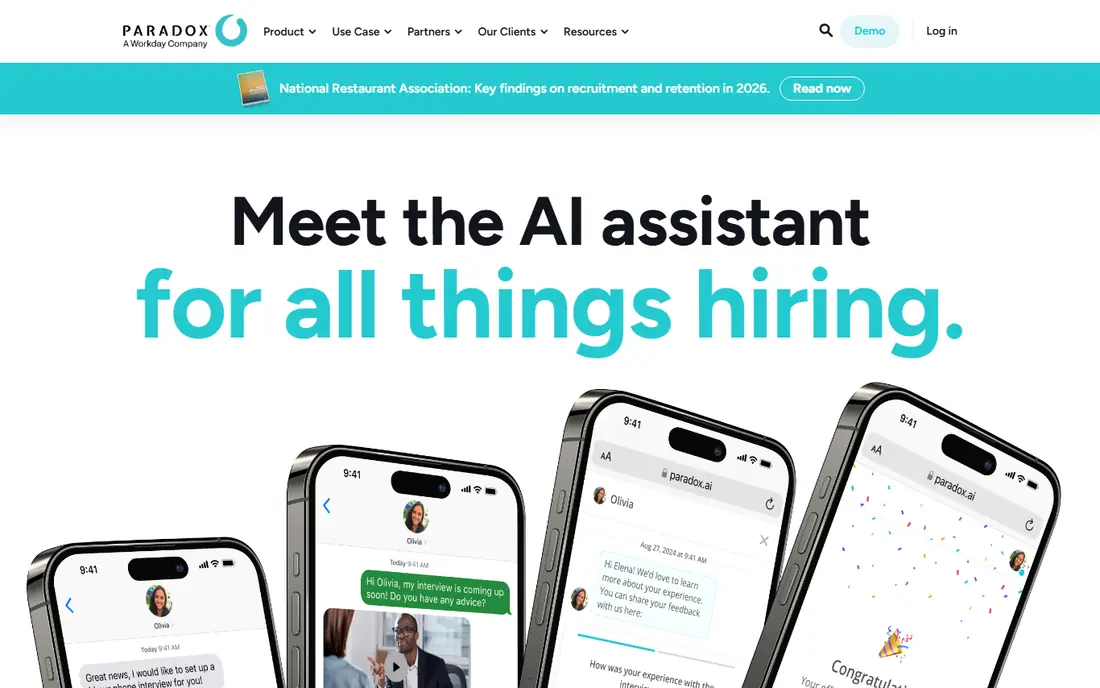
Paradox, now owned by Workday, is built for a specific pain, which is hiring hundreds or thousands of hourly workers without a recruiter touching every application. Its assistant, Olivia, chats with candidates, asks screening questions, answers common questions, and books interviews by text or chat, day or night. That speed matters when a candidate applies to five employers at once and takes the first interview offered.
The cost and setup reflect that enterprise focus. Paradox does not publish a simple price list, and third-party listings put the starting point around $1,000 per month, with larger deals far above that. A small team hiring a handful of roles will not need this machinery, and may find the implementation heavy. For a high-volume employer, though, the combination of screening plus scheduling in one conversational flow is hard to match.
- Olivia assistant screens and schedules by chat and text around the clock
- Built for retail, hospitality, healthcare, and logistics hiring
- Quote-based pricing with a high floor
- Overkill for a team hiring a few roles a year
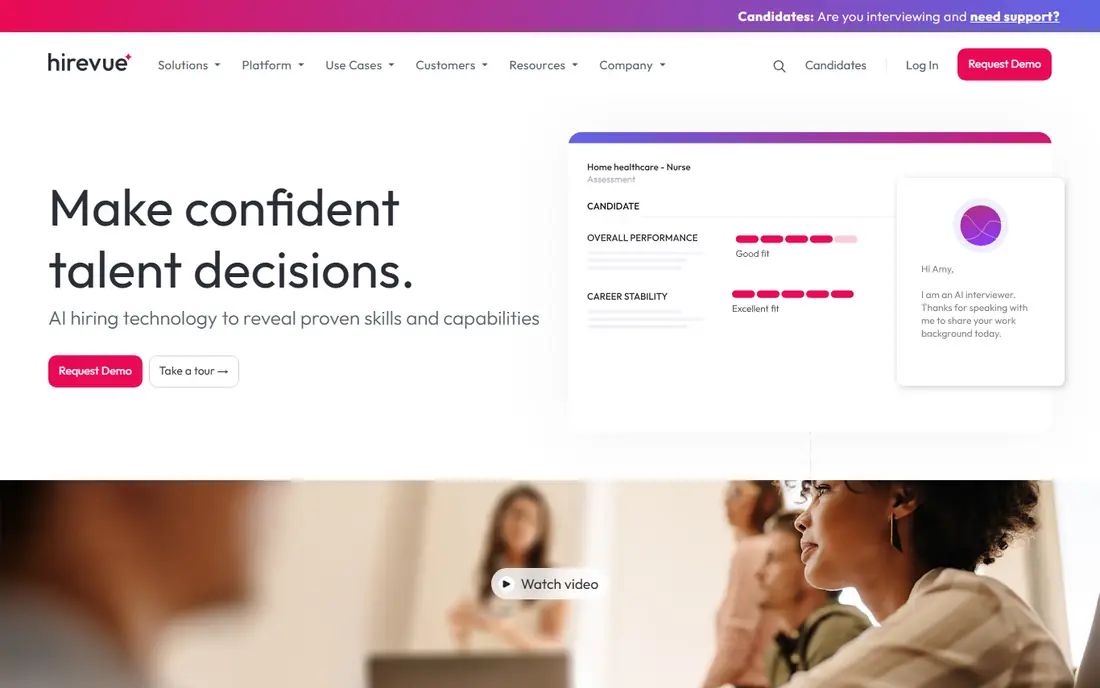
HireVue suits employers that screen thousands of applicants for the same kinds of roles and need every candidate to face the same questions. Its platform covers on-demand video interviews, assessments, and structured interview guides, with AI features that help recruiters review responses and compare candidates on the same criteria. That consistency is the point, especially for large graduate, retail, or customer service hiring programs.
The trade-off is formality and cost. HireVue is an enterprise purchase, with quote-based pricing and an implementation project, not a self-serve signup. Candidates may also find recorded video interviews less personal than a live conversation, so employers should explain the process clearly and keep a human review step. For a large team that needs defensible, repeatable screening, HireVue is a strong choice. For a startup hiring ten people, it is more tool than you need.
- Structured video interviews and assessments at scale
- Strong compliance and reporting documentation
- Interview scheduling tools
- Enterprise pricing and setup
- Smaller teams may find it heavy and formal for candidates
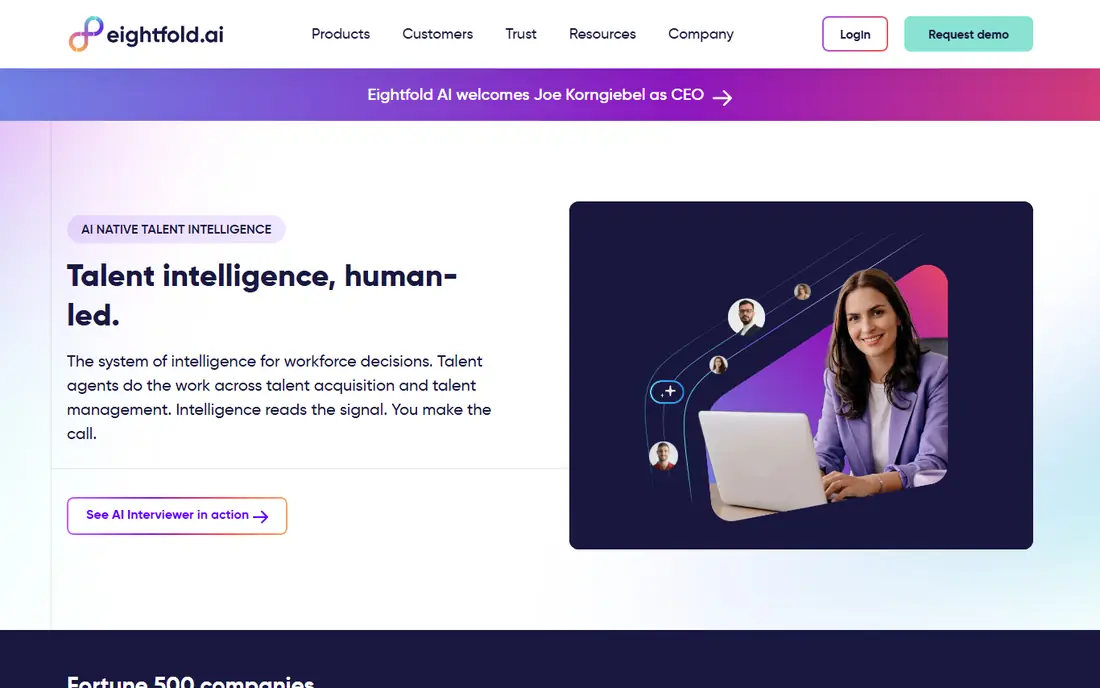
Eightfold is a talent intelligence platform, not a simple job board or screening tool. It builds skills profiles from resumes, internal records, and public career data, then matches people to open roles, internal moves, and future needs. Large employers use it to find existing employees who could fill a role, to reduce reliance on external hiring, and to plan workforce skills over time.
That breadth is also the challenge. Eightfold works best with a large workforce, clean data, and a team that will act on its recommendations. Pricing is quote-based, and the project to connect HR systems and train the team is real. Smaller employers will get faster value from a simpler ATS with AI matching, such as Manatal or Workable. Large employers with a serious internal mobility goal, though, will find Eightfold in a class of its own.
- Skills-based matching across internal and external talent
- Career site and internal mobility tools
- Deep talent analytics
- Enterprise pricing and implementation
- Needs clean HR data to work well
SeekOut helps recruiters find people who are not actively applying, especially in engineering, research, security, and other technical fields. Its search draws on profiles, code, publications, and patents, and its AI match scoring helps a recruiter rank candidates against a role instead of paging through keyword results. In 2026 it added a self-serve Recruit Core plan, which makes it accessible to smaller teams for the first time.
That plan starts at $149 per month on annual billing, with a monthly option at $179, and includes contact credits and exports, so check the credit limits against how many candidates you contact each month. Higher tiers are quote-based, and the full enterprise price is much higher. For a team hiring common roles that already attract applicants, SeekOut adds little. For a team chasing scarce specialists, it can pay for itself with one hire.
- Deep search across technical, academic, and patent data
- AI match scoring
- Self-serve plan for small teams
- Higher tiers are quote-based
- Best value shows up for hard-to-fill roles, not easy ones
HireEZ, formerly Hiretual, is a sourcing platform first and an outreach tool second. Recruiters can search a large profile database, build lists for a role, and run email and text sequences to passive candidates, then track who replies and who converts to an interview. That workflow suits agencies and in-house teams that live on outbound recruiting rather than waiting for applications.
The entry plan starts at $99 per month for one user, with limits on profiles and emails, and higher plans at $199 and $399 per month add volume and seats. Teams should therefore price it by monthly outreach, not by the headline rate. HireEZ also overlaps with SeekOut, so a team rarely needs both. Pick HireEZ if outreach automation is the priority, and SeekOut if deep technical search is the priority.
- Sourcing across many external sources
- AI outreach sequences by email and text
- Analytics on campaign response
- Entry plan limits profiles and emails
- Pricing rises quickly with team size and volume
Fetcher takes a different approach from SeekOut and HireEZ. Instead of giving a recruiter a search box, it runs automated sourcing and outreach for a role, with human review of candidate batches before messages go out. A small team without a dedicated sourcer can keep a pipeline warm while recruiters focus on interviews and offers.
The trade-off is control. Because Fetcher does much of the work, recruiters have less direct control over each search string and message than they would with a self-serve tool. Pricing is also quote-based, with entry points reported around $115 per month in some comparisons, so get a written quote for your role volume. If your bottleneck is simply finding and contacting passive candidates, Fetcher is worth a pilot. If you want to run your own searches, pick a self-serve platform instead.
- Largely hands-off sourcing and email outreach
- Human-reviewed candidate batches
- Good fit for small teams without a sourcer
- Pricing is quote-based and varies by volume
- Less control than a self-serve search tool
Workable is the most balanced pick for a small or mid-size team that wants AI without buying three separate tools. It is a full applicant tracking system, covering job posting, pipelines, interview scheduling, and candidate communication, and its AI features help with job intake, sourcing, screening, and summaries. That means a hiring manager can post a role, see ranked candidates, and move them through stages in one place.
The starting price of $299 per month reflects that scope, and it is a step up from a budget ATS such as Manatal. Teams hiring only a few roles a year may find a cheaper tool or a pay-per-job option better value. Teams hiring steadily, across several roles at once, will likely find Workable saves enough recruiter time to justify the price, and the trial is long enough to test it on a live role.
- Full ATS with AI job intake, sourcing, and screening help
- Easy job posting and pipeline
- Strong integrations
- AI features sit on paid plans
- Per-month price is high for a very small team
Manatal is the budget pick in this group, and it earns that spot by keeping the core simple. For $15 per user per month, a recruiter gets an ATS with pipelines, candidate profiles, AI matching, and social profile enrichment, which is enough for a small agency or a startup hiring team. Setup is quick, and the per-user price makes it easy to add a seat when hiring picks up.
The limits show up at scale. Manatal does not offer the deep assessment, compliance, or talent intelligence features of HireVue or Eightfold, and its AI is best at ranking and enriching candidates, not at running interviews. That is fine for most small teams, who need organization and a shortlist more than they need an enterprise suite. If your budget is tight and you want AI help inside a normal ATS, start here.
- Low entry price
- AI candidate matching and profile enrichment
- Simple pipelines for agencies and small teams
- Less depth than enterprise ATS platforms
- AI features are lighter than dedicated screening tools
Greenhouse is a well-known ATS for teams that want hiring to be structured and fair. Interviewers use scorecards, candidates face the same core questions, and hiring managers can compare feedback side by side instead of relying on memory. Its AI features help draft job posts, summarize applications, and surface relevant candidates, without replacing the interview panel.
Pricing is quote-based, with Core, Plus, and Pro tiers, and onboarding is a paid add-on, so the first-year cost is higher than the subscription alone suggests. Smaller teams may also find the structured process heavier than a simple pipeline tool. For a growing company that wants consistent, defensible hiring and a system that scales to many roles and interviewers, Greenhouse is a strong, proven choice, and it pairs well with a sourcing tool such as SeekOut or HireEZ.
- Strong structured interview and scorecard system
- Broad integrations
- AI features for job posts, summaries, and screening help
- Quote-based pricing
- Onboarding can add cost
- More process than a small team may want
How we picked these
We compared official product pages, pricing pages, and public reviews, and we favored tools that are still sold as independent products in October 2026. That matters in this category, because several familiar names have been acquired or folded into larger suites in recent years. We also favored a mix of sourcing, screening, and ATS tools, so a reader can match a tool to a bottleneck instead of buying an all-in-one suite they do not need. We did not test these tools on live hiring, and we did not rely on vendor claims alone for pricing where a public price was unavailable.
How to buy without regret
Start with one bottleneck and measure it before you buy. If you cannot find enough qualified candidates, test a sourcing tool on one hard role for a month. If you cannot schedule fast enough, test a conversational screening tool on one high-volume role. If your pipeline is a mess, fix the ATS first, because AI layered on a broken process will only produce faster confusion.
Then check the human and legal side. Ask what the AI decides, what it only recommends, and how a recruiter overrides it. Review bias testing, data handling, and any local rules that apply to automated hiring tools, such as New York City Local Law 144. Keep a human review step before any rejection, tell candidates when AI is involved in screening, and keep records of how decisions were made. A tool that saves time but creates a compliance problem is not a saving.