Best AI Search Tracking Tools in 2026: 9 Tools Compared
By ToolNimba Editorial Team October 29, 2026 11 min read

- Top pick
 Profound
Enterprise AI visibility
Starting priceSee websiteCheck out ProfoundRead our review - Runner-up
 Peec AI
Daily tracking with many seats
Starting price$95 per monthCheck out Peec AIRead our review - Also great
 Otterly.AI
Lowest-cost entry
Starting price$29 per monthCheck out Otterly.AIRead our review
How we researched this
We compared official pricing and feature pages, app store listings, privacy policies and public user reviews. Prices change, so check the provider's site before you pay.
Key takeaways
- AI search tracking measures whether assistants mention, recommend, or cite your brand, which classic rank trackers do not show.
- Prompt count, engine count, and tracking frequency together decide the real cost, since adding an engine can drain a prompt allowance faster.
- Cheap entry plans suit a first baseline, while agencies need more prompts, more engines, and reporting that clients can read.
- A tracker only reports gaps, so budget time or a second workflow for fixing the pages and facts that AI answers cite.
Quick comparison
| Name | Best for | Starting price | Free plan | |
|---|---|---|---|---|
| Profound | Enterprise AI visibility | See website | Free trial | Visit |
| Peec AI | Daily tracking with many seats | $95 per month | Free trial | Visit |
| Otterly.AI | Lowest-cost entry | $29 per month | Free trial | Visit |
 Scrunch AI | Audits plus agent-ready pages | $300 per month | Free trial | Visit |
 Goodie AI | Retail and shopping visibility | See website | No | Visit |
 AthenaHQ | Revenue-linked visibility | $295 per month | Yes | Visit |
 Semrush AI Visibility | AI tracking inside Semrush | $99 per month | Free trial | Visit |
 Ahrefs Brand Radar | Brand tracking inside Ahrefs | $199 per month | No | Visit |
 Rankscale | Simple visibility metrics | $99 per month | Free trial | Visit |
The best AI search tracking tools
AI search tracking asks a new question: when someone asks ChatGPT, Gemini, Perplexity, or Google AI Overviews for a recommendation, does your brand appear, and what sources do the answers cite. The tools below track prompts across those engines and report mentions, positions, sentiment, and citations.
Profound is the most enterprise-focused tracker in this list, built for brands that need daily visibility data across ChatGPT, Perplexity, Gemini, Claude, Google AI Mode, Copilot, and more. It reports how AI models describe a brand, which competitors appear alongside it, and which prompts drive demand, plus agent analytics that show how AI crawlers read a site. Published comparisons previously listed Starter at $99 per month and Growth at $399, but more recent listings show brand pricing moving to a custom enterprise quote, with a free 7-day trial covering three engines.
That shift matters for small buyers. Profound now fits large brands and agencies that can justify a custom contract and need compliance features such as SSO and SOC 2. Smaller teams should compare Peec AI or Otterly.AI first, since those offer published self-serve prices. For an enterprise program where AI visibility is a board-level metric, Profound remains a strong reference point.
- Deep coverage across many answer engines
- Prompt volume data from real conversations
- Enterprise compliance and support options
- Brand pricing is now quote-based after self-serve plans changed
- Entry costs are high for small teams
- Prompt caps on lower tiers can feel tight
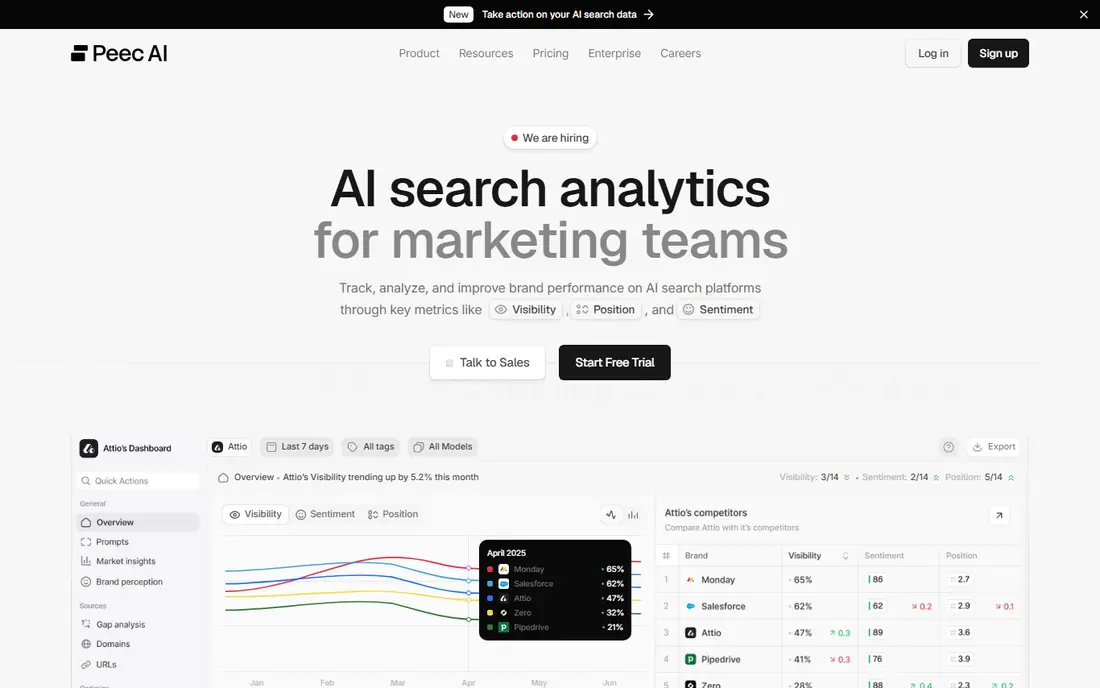
Peec AI is a focused AI search analytics platform that tracks selected prompts daily across engines chosen by the buyer. Starter costs $95 per month for 50 prompts, one project, and three models, while Pro at $245 covers 150 prompts and Advanced at $495 covers 350 prompts. Annual billing lowers those rates to around $80, $205, and $420 per month. Unlimited users make it practical for a team that shares one dashboard.
The engine cap is the key detail. Three engines are included at base, so a team that needs ChatGPT, Gemini, Perplexity, Claude, and Google AI Mode together should budget for add-ons. Peec AI also reports mentions and sentiment rather than full citation-level detail on every plan, so check that distinction if citation proof matters to you. For daily, team-wide tracking at a published price, Peec AI is a solid middle option.
- Daily tracking
- Unlimited users on standard plans
- Sentiment and competitor share of voice reporting
- Base plans cover three engines, with extra engines as paid add-ons
- Prompt allowance drains faster with more models
- No API on some listings
Otterly.AI is the cheapest credible way to see whether AI search matters for your brand. Lite costs $29 per month for 15 prompts tracked daily across ChatGPT, Google AI Overviews, Perplexity, and Microsoft Copilot, with unlimited team members. Standard at $189 covers 100 prompts and adds API and MCP access, while Premium at $489 covers 400 prompts. A GEO audit that checks on-page factors affecting citation likelihood is included on every plan.
Fifteen prompts is enough for a baseline, not for a full buyer journey across products and competitors. Add-on engines also raise the real cost, since Gemini, Claude, and Google AI Mode are paid extras. Otterly.AI suits a small brand or a solo marketer testing the channel. Growing teams will likely land on Standard, so model that price from the start rather than only the Lite rate.
- Lowest published entry price
- Daily tracking
- Unlimited team members and brand reports on all plans
- Lite covers only 15 prompts
- Gemini, Claude, and Google AI Mode cost extra
- Jump to Standard is large
Scrunch AI combines monitoring with technical fixes in a way few rivals match. Starter costs $300 per month, or $250 billed annually, with a 7-day trial, and Growth costs $500 per month. Plans include prompt-level visibility, sentiment, share of answer, citation tracking, and page audits, plus an Agent Experience Platform that detects AI agents at the CDN layer and serves them a clean, machine-readable version of pages.
The entry price puts Scrunch in the mid-market and enterprise range, not the budget tier. Sitecore acquired Scrunch in June 2026, which may help buyers already in that ecosystem and may concern buyers who prefer an independent vendor. For a brand or agency team that will run audits and act on citation gaps, Scrunch offers more than a dashboard. For simple mention tracking, a cheaper tool covers the same headline metric.
- Prompt-level monitoring plus page audits
- Citation tracking
- Agent Experience Platform serves an AI-friendly version of a site
- High entry price
- Prompt counts have changed across plan versions, so confirm the current plan
- Sitecore ownership may matter to some buyers
Goodie AI focuses on a narrower but growing problem: how products appear in AI shopping answers. Instead of only tracking brand mentions, it reports product shelf presence, AI-assigned labels, and category dominance in ChatGPT and Amazon Rufus. That angle matters for retailers, since an AI answer can recommend a product without the shopper ever opening a search results page.
Quote-based pricing is the main drawback for comparison. Published comparisons put Goodie around $399 per month for 120 prompts, but the company itself does not publish a firm entry price, so confirm the rate and prompt allowance on a call. Goodie suits commerce brands where AI shopping drives revenue. Service businesses and B2B brands will likely get more value from a general tracker such as Peec AI or Profound.
- Focus on AI shopping surfaces such as ChatGPT and Amazon Rufus
- Product shelf presence and category dominance reporting
- Retail-specific labels and rankings
- Pricing is quote-based, so no public entry price
- Retail focus means less value for non-commerce brands
- Newer category with fewer public case studies
AthenaHQ, also written as Athena, stands out by linking AI visibility to business outcomes rather than only mentions. Its free Essential plan covers five engines with 300 credits, while Starter costs $295 per month with 3,600 credits, where one credit equals one AI response. Paid plans reach 11 models and connect to GA4 and Shopify, which helps ecommerce teams show whether AI visibility turns into visits and sales.
The credit model needs careful modeling. A prompt tracked across several engines and locations can consume credits faster than a simple prompt count suggests, so test with a realistic prompt set during the free plan. AthenaHQ suits ecommerce and revenue-focused teams that need to justify AI work in sales terms. For a simple daily mention chart, a flat prompt plan may be easier to budget.
- Free Essential plan with credits
- Connects visibility to traffic and revenue through GA4 and Shopify
- Covers many models on paid plans
- Credit model is hard to forecast as usage grows
- Paid entry is high for small teams
- Scheduled runs may be weekly or monthly rather than daily on some plans
Semrush AI Visibility Toolkit, also called the AI Visibility Toolkit, lets existing Semrush users add AI tracking without a separate vendor. Published listings put the toolkit at $99 per month per domain, or bundled into Semrush SEO plus AI Search plans starting around $199 per month. It tracks brand visibility in AI answers alongside classic position tracking, which helps teams compare organic and AI visibility in one report.
Per-domain pricing is the cost warning for agencies with many clients. Each brand adds a fee, so a 20-client roster costs far more than a single-domain price suggests. Semrush AI Visibility suits teams already paying for Semrush that want AI data in the same workflow. Standalone trackers may be cheaper for AI-only work.
- Sits inside the wider Semrush suite
- AI Visibility Toolkit available per domain
- Combines AI data with classic rank and keyword data
- Per-domain pricing adds up for many brands
- Full value needs a Semrush core plan for some bundles
- Prompt and domain limits apply
Ahrefs Brand Radar tracks how a brand appears in AI answers and how its share of voice compares with competitors and categories. Published listings put standalone access at $199 per month for a single AI index, with higher tiers and add-on checks for broader coverage, while paid Ahrefs plans include Brand Radar features at varying levels. That integration helps teams that already use Ahrefs for backlinks, research, and audits.
The price is the barrier for a standalone purchase. A small brand that only needs AI mention tracking can start far cheaper with Otterly.AI. Brand Radar suits Ahrefs users who want brand and category data in the same account they already use for SEO. Check which AI platforms and prompt volumes are included at your tier, since coverage changes by plan.
- Brand mention and share of voice tracking across AI platforms
- Sits inside Ahrefs for users who already pay for research
- Category benchmarking included
- Standalone price is high for a single brand
- Full platform coverage costs more
- No free plan, only paid access
Rankscale offers a simpler take on AI visibility, focused on clear metrics and benchmarking rather than a large enterprise platform. Published comparisons put Pro at $99 per month, with entry listings around $20 per month in some tables, so the exact current plan structure should be confirmed on the vendor pricing page before buying. It tracks ChatGPT, Perplexity, and Google AI Overviews, which covers the most common AI search surfaces for many buyers.
The simplicity is both a strength and a limit. Teams that want a readable visibility score and competitor comparison without a large platform will like Rankscale. Teams that need citation forensics, page audits, or revenue linking will need a deeper tool such as Scrunch or AthenaHQ. For a first paid tracker beyond Otterly.AI, Rankscale is a reasonable middle step.
- Simple AI answer visibility and benchmarking
- Tracks ChatGPT, Perplexity, and Google AI Overviews
- Clear Pro pricing in published comparisons
- Narrower engine coverage than some rivals
- Fewer audit and fix features
- Pricing details vary across third-party listings, so confirm on the vendor site
How we picked these
We compared official pricing and feature pages, plus published AI visibility comparisons, and we favored tools that still offer a clear tracking product in 2026. We checked prompt allowances, engine coverage, tracking frequency, citation detail, and whether pricing is published or quote-based. We did not claim hands-on testing, and this category changes fast, with plans and prices shifting within months, so confirm the current plan on the vendor site before you buy.
What to check before you buy
Start with a prompt list that mirrors real buyer questions, not only brand names, since AI answers change most on non-branded questions. Then count engines, locations, and tracking frequency together, since those multiply usage. A 50-prompt plan across five engines tracked daily is a larger job than the same 50 prompts on one engine.
Also decide what action follows a finding. If the answer cites a competitor page, you need a content fix, a fact update, or a schema change, not only a chart. Finally, trial two tools on the same prompt set for two weeks, since AI answers vary by day and by model, and a single snapshot can mislead.