Best App to Learn Mandarin in 2026: 9 Apps Compared
By ToolNimba Editorial Team October 31, 2026 10 min read

- Top pick
 HelloChinese
Structured beginners
Starting priceFreeCheck out HelloChineseRead our review - Runner-up
 Duolingo
Daily habit building
Starting priceFreeCheck out DuolingoRead our review - Also great
 Pleco
Dictionary and lookup
Starting priceFreeCheck out PlecoRead our review
How we researched this
We compared official pricing and feature pages, app store listings, privacy policies and public user reviews. Prices change, so check the provider's site before you pay.
Key takeaways
- HelloChinese is the best structured starting point for beginners, with tone training, grammar and character lessons in one course.
- Duolingo suits daily habit building, but its Mandarin course is shallow for grammar and advanced speaking, so pair it with a deeper app.
- Pleco is the essential dictionary companion, while Du Chinese covers graded reading and Skritter covers character writing.
- Speaking progress needs real conversation, so italki tutors or a speaking app should join any app only routine at some point.
- No single app covers tones, characters, reading, listening and speaking well, so build a small stack around your weakest skill.
Quick comparison
| Name | Best for | Starting price | Free plan | |
|---|---|---|---|---|
| HelloChinese | Structured beginners | Free | Yes | Visit |
| Duolingo | Daily habit building | Free | Yes | Visit |
| Pleco | Dictionary and lookup | Free | Yes | Visit |
 LingoDeer | Grammar and pronunciation | See website | Yes | Visit |
 Skritter | Character writing | See website | Free trial | Visit |
 Du Chinese | Graded reading | Free | Yes | Visit |
 Pimsleur | Audio listening and speaking | See website | Free trial | Visit |
 italki | Live tutor conversation | See website | No | Visit |
 ChineseSkill | Guided step by step study | Free | Yes | Visit |
The best apps to learn Mandarin
Mandarin is hard for English speakers because tones change meaning, characters carry no alphabet clues, and grammar works differently. A good app should teach tones early, introduce characters gradually, explain grammar clearly and give you speaking and listening practice. We compared official feature pages, pricing, app store listings and public reviews, and we included course apps, tools and tutors so you can build a complete routine.

HelloChinese is the best first app for most beginners because it treats Mandarin as a system, not a set of phrases. Lessons build pinyin, tones, vocabulary, grammar, reading, writing and speaking in order, with speech recognition to check pronunciation. Native speaker videos and character writing practice add depth that gamified apps often skip.
The main limit is level. HelloChinese takes you solidly through beginner and lower intermediate stages, but advanced learners will need graded readers, tutors and native media to keep progressing. That is normal for a course app. Start here, build a daily habit, and add reading and speaking tools as you outgrow the early levels.
- Structured curriculum from zero
- Serious tone training
- Speaking, grammar and character lessons
- Content plateaus at intermediate level
- Advanced learners will need other tools
Duolingo is excellent at getting you to open the app every day, and that habit matters more than any single lesson. Its Mandarin course introduces pinyin, tones and basic vocabulary in short, game like lessons, and the free version is enough for a first month of casual study. Many learners start here because the barrier to entry is so low.
Depth is the trade off. Grammar explanations are thin, tone production feedback is limited, and character learning stays basic compared with HelloChinese or Skritter. Use Duolingo as a habit builder or warm up, not as your only Mandarin app, and move to a structured course when you want faster progress.
- Free and easy to start
- Streaks and gamification keep habits alive
- Good pinyin onboarding
- Shallow grammar explanations
- Weak advanced speaking and character depth
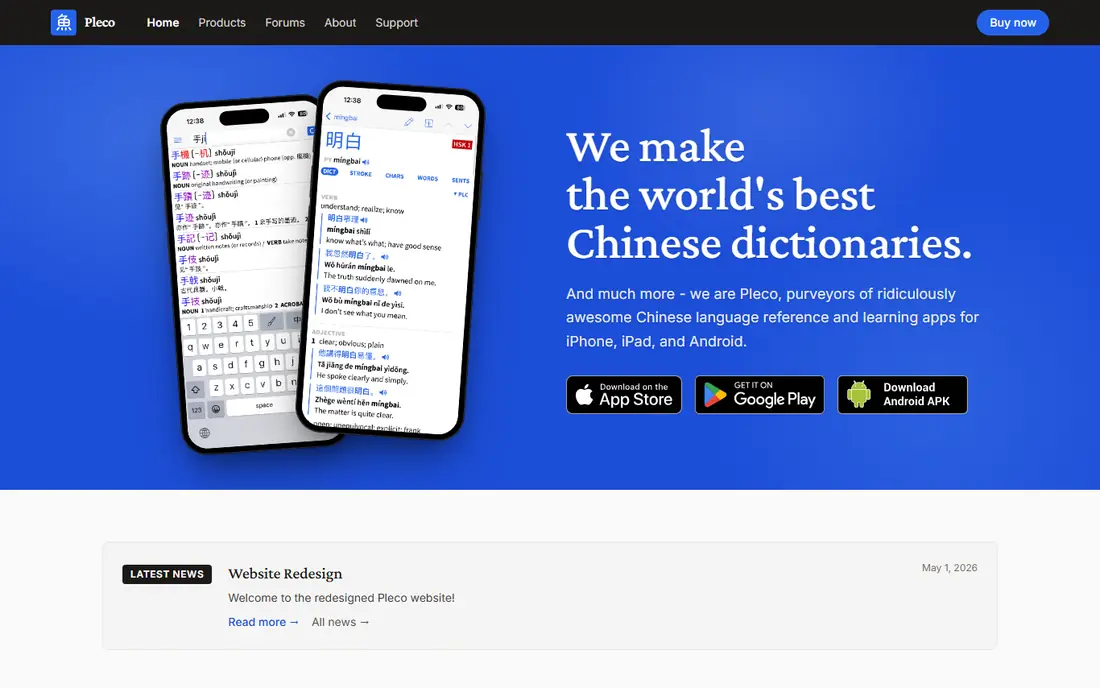
Pleco is the tool almost every serious Mandarin learner ends up using, even if it is not a course. It is a dictionary first, with handwriting input, camera character recognition, stroke order animations, audio pronunciation and example sentences. When you meet a new word in a reader, a show or a conversation, Pleco tells you what it means in seconds.
It will not teach you Mandarin on its own, because it has no structured curriculum in the free base app. Paid add ons for flashcards and a document reader let it grow with you. Install Pleco on day one, learn its handwriting and camera tools, and keep it beside whatever course app you choose.
- Best Chinese dictionary for learners
- Handwriting and camera lookup
- Stroke order and audio
- Not a full course
- Paid add ons for flashcards and reader features
LingoDeer appeals to learners who want to understand why Mandarin sentences work the way they do, not just repeat phrases. Its lessons explain grammar points clearly, build vocabulary in context and include pronunciation practice. That structure suits learners who found Duolingo too shallow but still want a guided course.
Free lessons are limited, and you will need a paid plan for full access. Advanced learners may still need readers and tutors for depth. If grammar is your weak point, LingoDeer is a strong second course alongside HelloChinese, especially for beginner to intermediate study.
- Clear grammar explanations
- Structured lessons
- Good pronunciation focus
- Free content is limited
- Advanced content is thinner than specialist tools
Skritter solves a specific problem that other apps handle poorly, which is learning to write and recognise Chinese characters. It teaches stroke order, checks your writing, and uses spaced repetition to review characters and vocabulary at the right time. That focused practice helps characters stick in a way that passive reading alone rarely achieves.
It is a paid app with a free trial, and it does not teach speaking or grammar as a full course. Pair Skritter with HelloChinese or LingoDeer, using Skritter for 10 minutes a day on characters while your course app covers grammar and speaking. That split works well for learners who want to read and write, not just speak.
- Best app for learning to write characters
- Stroke order feedback
- Spaced repetition for vocabulary
- Paid subscription with only a trial free
- Not a full speaking course
Du Chinese is the best reading app for Mandarin learners because it grades texts to your level. Beginner stories use limited vocabulary and simple grammar, while advanced texts cover news, culture and fiction. Tapping a character shows its definition and pronunciation, so you can read without stopping to use a separate dictionary every minute.
Reading alone will not teach you to speak, so pair Du Chinese with a course app and speaking practice. Free lessons let you test the format, while a paid plan opens the full library. If you want to start reading real Chinese early, Du Chinese is the most polished way to do it.
- Graded readers from beginner to advanced
- Tap any character for definition and audio
- Listening versions included
- Reading only
- Needs a course or tutor for speaking and grammar
Pimsleur suits learners whose study time is mostly audio, such as commuting, walking or doing chores. Its lessons use spaced repetition and call and response drills to build listening and speaking reflexes, with attention to tones. That audio focus helps you understand spoken Mandarin and respond without relying on text.
It will not teach you to read characters, so it works best as a complement to a course app or reader. A free trial lets you test the method, and a subscription covers the full Mandarin course. If you struggle to find desk time but have audio time, Pimsleur can keep your Mandarin moving forward.
- Audio only lessons for commuting
- Strong listening and speaking drills
- Tone aware pronunciation practice
- Does not teach reading or characters
- Subscription cost adds up
italki is where app learning turns into real conversation. You can book one to one lessons with native Mandarin tutors, choose a tutor by price, style and availability, and get direct feedback on tones, pronunciation and grammar. That live correction is something no app can fully replace, especially for tones.
Lessons are paid per hour, with prices varying by tutor, so regular weekly lessons cost more than any app subscription. Start with trial lessons, find a tutor whose style suits you, and book a regular slot if your budget allows. Even one lesson every two weeks will improve speaking faster than app only study.
- One to one lessons with native tutors
- Feedback on tones and grammar
- Flexible scheduling and pricing
- Costs add up with regular lessons
- Tutor quality varies, so trial lessons matter
ChineseSkill offers a guided, game like path through Mandarin basics, with lessons that cover listening, speaking, reading and writing in small steps. It suits learners who want a clear path without choosing what to study each day. The free version lets you test the style before paying for full access.
Many learners find HelloChinese deeper for grammar and tones, so ChineseSkill works best as an alternative first app or as extra practice. If you like its lesson style and it keeps you studying daily, that consistency matters more than small differences in curriculum. Use it alongside Pleco and a reader for a fuller routine.
- Step by step guided lessons
- Gamified practice
- Covers listening, speaking, reading and writing basics
- Less depth than HelloChinese for many learners
- Advanced content is limited
How we picked these
We compared official feature pages, pricing pages, app store listings, HSK level coverage and public reviews. We looked at tone training, character support, grammar explanations, reading levels, speaking practice and price, and we included tools and tutors because no single course app covers every skill. We did not claim hands on testing that we did not carry out, and we noted where free tiers are limited.
Building a Mandarin study stack that works
A simple stack covers four skills without taking hours a day. Use HelloChinese or LingoDeer for 15 minutes of structured study, Pleco for lookup, Du Chinese for 10 minutes of reading, and Skritter for 10 minutes of characters if reading matters to you. Add italki or another speaking practice when you can hold basic conversations, even simple ones.
Tones, characters and HSK levels
Learn tones from the first week, because tone mistakes change meaning and are harder to fix later. Learn characters gradually, starting with high frequency words, and use HSK word lists as a guide rather than a strict rule. If you plan to take an HSK exam, check that your app covers the current HSK levels, since the scale has changed in recent years.
How long daily study should take
Thirty minutes a day, split across a course app and reading or speaking, beats occasional long sessions for most learners. Short, regular practice helps tones, characters and vocabulary stick through spaced repetition. If you only have 15 minutes, spend it on your course app and Pleco, and add reading on days when you have more time.