Best Apps for Kids to Learn English in 2026: 8 Apps Compared
By ToolNimba Editorial Team October 29, 2026 8 min read

- Top pick
 Khan Academy Kids
Free early learning
Starting priceFreeCheck out Khan Academy KidsRead our review - Runner-up
 Lingokids
English as a second language
Starting priceSee websiteCheck out LingokidsRead our review - Also great
 ABCmouse
Guided curriculum ages 2 to 8
Starting price$14.99 per monthCheck out ABCmouseRead our review
How we researched this
We compared official pricing and feature pages, app store listings, privacy policies and public user reviews. Prices change, so check the provider's site before you pay.
Key takeaways
- Khan Academy Kids is our pick for most families, because it is completely free, ad-free and covers early reading well.
- Lingokids and Duolingo ABC are the best picks for English as a second language, with playful, bite-size lessons.
- ABCmouse suits families who want a long, guided curriculum across reading, maths and other subjects.
- Starfall is the best budget pick for early phonics, with a free learn-to-read section and a low annual membership.
- Short, regular sessions work better than long ones, so pick an app your child asks for again.
Quick comparison
| Name | Best for | Starting price | Free plan | |
|---|---|---|---|---|
| Khan Academy Kids | Free early learning | Free | Yes | Visit |
| Lingokids | English as a second language | See website | Yes | Visit |
| ABCmouse | Guided curriculum ages 2 to 8 | $14.99 per month | Yes | Visit |
 Duolingo ABC | Bite-size phonics and reading | Free | Yes | Visit |
 Studycat | Playful English for young learners | See website | Free trial | Visit |
 Monkey Junior | Vocabulary and phonics | See website | Free trial | Visit |
 Endless Alphabet | Vocabulary for preschoolers | See website | Free trial | Visit |
 Starfall | Early phonics on a budget | $35 per year | Yes | Visit |
The best apps for kids to learn english
We compared official app pages, pricing pages, app store listings and public reviews for eight English learning apps for children. All eight are live, widely available in the US, and designed for young learners rather than adults.
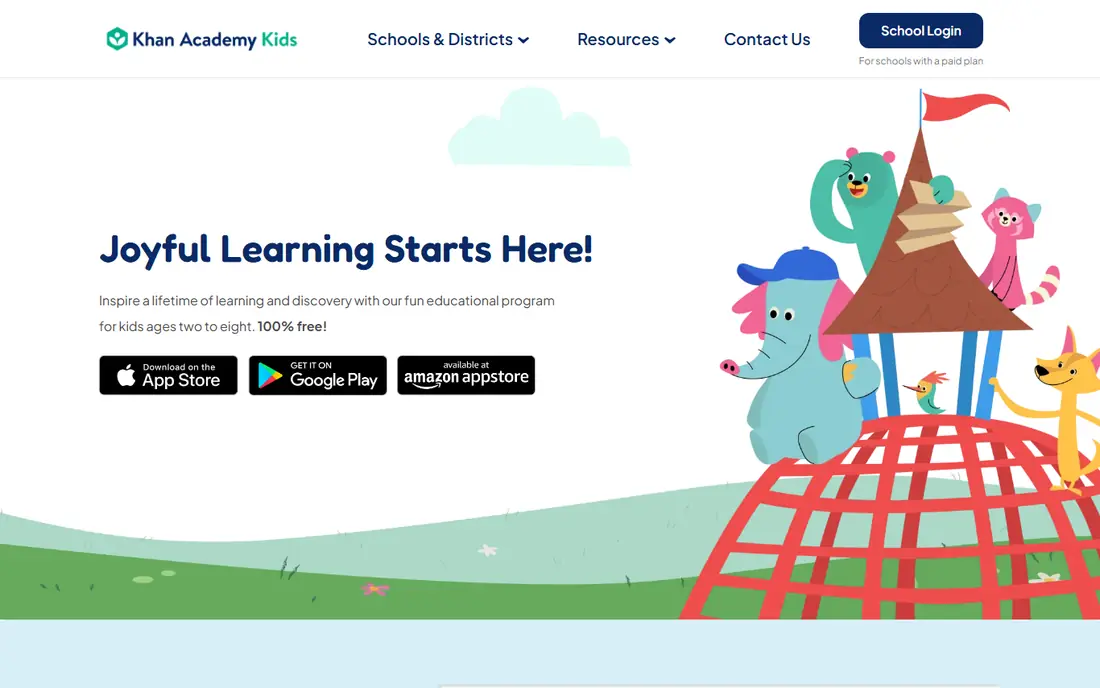
Khan Academy Kids is our pick for most families, and the reason is simple: it is free, ad-free and genuinely good. Created with early learning experts, it covers phonics, sight words, reading, early maths and social-emotional learning for ages 2 to 8. Books, games and activities can be downloaded for offline use, which helps on trips.
The limit is age range. Older children will outgrow the content, and the app runs on phones, tablets and Chromebooks rather than as a full web app. For preschool and early primary children, though, it is the best free English learning app available, and parents should start here before paying for anything.
- Completely free with no ads or subscriptions
- Covers phonics, sight words and early reading
- Parent and teacher tools
- Aimed at ages 2 to 8, so older children will outgrow it
- App only, with no full web version

Lingokids is built for young children learning English, including children for whom English is a second language. Its lessons use songs, games, videos and interactive activities, which keeps short sessions fun. Parents get progress reports, and the content adapts to the child's level.
The honest catch is that the full library sits behind a paid plan, and pricing varies by app store and offer, so check the current price in the app before you subscribe. For families who want a playful, English-focused app with a clear learning path, Lingokids is a strong pick.
- Play-based English lessons
- Songs, games and videos
- Progress reports for parents
- Full content needs a paid plan
- Pricing varies by store and offer

ABCmouse offers a long, guided curriculum for ages 2 to 8, with more than 13,000 activities across reading, maths, science, art and music. Children follow a learning path, earn tickets and customise avatars, which keeps many children motivated over months. The app is ad-free and supports up to three child profiles on Premium.
The price is the decision point. Premium costs 14.99 dollars a month, or 79.99 dollars a year on the web, after a trial on web sign-ups, while Basic access gives up to 10 activities a day for free. If you want English plus other subjects in one app, ABCmouse is worth it. If you only need English, a focused app may suit better.
- Large guided curriculum with over 13,000 activities
- Reading, maths, science and art
- Ad-free
- Monthly price adds up
- Broader than English alone, so less focused for ESL families
Duolingo ABC brings the Duolingo style to early reading. Short lessons cover phonics, sight words and simple stories, with characters and rewards that keep children coming back. It is free, which makes it an easy second app alongside Khan Academy Kids or Lingokids.
The limit is depth. Duolingo ABC suits early readers best, and older or more advanced children will need a richer app such as ABCmouse or Starfall. For a free, daily phonics habit, it is excellent, and the price cannot be beaten.
- Free with no subscription
- Short phonics and reading lessons
- Fun characters and rewards
- Aimed at younger readers
- Less depth for older or advanced children
Studycat, formerly Fun English, teaches English through games that focus on vocabulary, listening and speaking. Children play with words, match sounds and practise pronunciation in a colourful world that feels like a game rather than a lesson. That design suits young learners who resist formal study.
The catch is that full access needs a paid plan after a trial, so check the current price in the app store. Studycat is also narrower than ABCmouse, focusing on English rather than a full curriculum. For English vocabulary and speaking practice, it is a joyful pick.
- Games built around vocabulary and speaking
- Colourful, child-friendly design
- Progress tracking
- Paid after a trial
- Narrower age focus than ABCmouse
Monkey Junior covers vocabulary, phonics and reading for young learners, with lessons organised by level so children can start at the right place. It offers a large library of words, images and audio, and lessons can be used offline. Parents can track progress and adjust levels as a child improves.
The trade-off is price and polish. Full access needs a paid plan after a trial, and the interface can feel busy next to Duolingo ABC or Khan Academy Kids. For families who want a deep vocabulary library for English learning, Monkey Junior is a solid choice.
- Large vocabulary and phonics library
- Multiple levels for different ages
- Offline lessons
- Paid plans after a trial
- Interface is busy for some children
Endless Alphabet teaches vocabulary one word at a time, with a monster animation that acts out the meaning of each word. Children learn letters, sounds and word meanings together, which makes it a favourite for preschoolers. The humour and animation keep young children engaged in a way that flashcards cannot.
The limit is scope. Endless Alphabet teaches words, not a full reading curriculum, so pair it with a phonics app such as Duolingo ABC or Starfall. Some word packs need an in-app purchase, so check the current pricing before you buy the full set.
- Delightful animations for each word
- Teaches letters, sounds and meanings
- No ads in the paid app
- Vocabulary only, not a full reading curriculum
- Some content needs in-app purchase
Starfall is a long-running learn-to-read site and app for pre-K to grade 3, with a free learn-to-read section and a home membership at 35 dollars a year. Its phonics sequence is clear and steady, which suits children who need a calm, structured path rather than a flashy game.
The design feels dated next to Lingokids or Khan Academy Kids, and game variety is lower. For budget-conscious families who want solid phonics, that hardly matters. Starfall remains one of the best value English reading tools available.
- Free learn-to-read section
- Low annual membership
- Strong phonics focus for pre-K to grade 3
- Design feels dated next to newer apps
- Less game variety than Lingokids
How we picked these
We compared official app pages, pricing pages, app store listings and public reviews, and we kept only apps that are live, child-focused and widely available in the US. We looked at age range, phonics and vocabulary coverage, ad-free status, parent controls and price. We did not claim hands-on testing that did not happen, and prices reflect the vendor pages we checked in October 2026, so confirm the current price before you subscribe.
How to use an English app well
Keep sessions short and regular, around 10 to 20 minutes for young children, and sit with your child at first so you can see what they find hard. Pair app time with reading aloud, talking about new words, and playing word games away from the screen. An app teaches words and sounds, but conversation is what turns them into language.
Safety and ads to check
Prefer apps that are ad-free or that keep ads away from children, and check whether the app offers in-app purchases that a child could tap. Turn on parent controls where available, and review the privacy policy for data collection. Khan Academy Kids and Duolingo ABC are strong here because they are free without ads.