Best Contact Center Software in 2026: 9 Platforms Compared
By ToolNimba Editorial Team November 8, 2026 11 min read

- Top pick
 Five9
Large outbound and blended centers
Starting price$119 per user per monthCheck out Five9Read our review - Runner-up
 Genesys Cloud CX
Large omnichannel operations
Starting price$75 per user per monthCheck out Genesys Cloud CXRead our review - Also great
 Talkdesk
Regulated and mid-market teams
Starting price$85 per user per monthCheck out TalkdeskRead our review
How we researched this
We compared official pricing and feature pages, app store listings, privacy policies and public user reviews. Prices change, so check the provider's site before you pay.
Key takeaways
- Genesys Cloud CX starts at $75 per user per month, which makes it the lowest cost entry among the large enterprise platforms here.
- Five9 starts at $119 per user per month for digital only and $159 for voice, with a 50 seat minimum that rules it out for small teams.
- Aircall at $30 per user per month and CloudTalk at $25 per user per month are the most accessible starting points for small teams.
- Published seat prices rarely equal the final bill, since minutes, AI features, workforce tools, and CRM adapters often cost extra.
- Run a pilot with your real call flows and CRM before signing a multi-year contract, since switching costs are high.
Quick comparison
| Name | Best for | Starting price | Free plan | |
|---|---|---|---|---|
| Five9 | Large outbound and blended centers | $119 per user per month | No | Visit |
| Genesys Cloud CX | Large omnichannel operations | $75 per user per month | No | Visit |
| Talkdesk | Regulated and mid-market teams | $85 per user per month | Free trial | Visit |
 Zendesk | Support teams already on Zendesk | $55 per agent per month | Free trial | Visit |
 NICE CXone | Enterprises needing workforce tools | $71 per user per month | Free trial | Visit |
 RingCentral RingCX | RingCentral phone customers | $65 per user per month | Free trial | Visit |
 Aircall | Small teams with strong CRM needs | $30 per user per month | Free trial | Visit |
 Dialpad Support | AI transcripts and coaching | See website | Free trial | Visit |
 CloudTalk | International sales and support calling | $25 per user per month | Free trial | Visit |
The best contact center software
Contact center software routes calls, chats, emails, and messages to the right agent, then records and reports on what happened. The platforms below range from small team phone tools to enterprise suites with workforce management and AI. We compared official pricing pages, published plan tiers, and seat minimums to build this list.
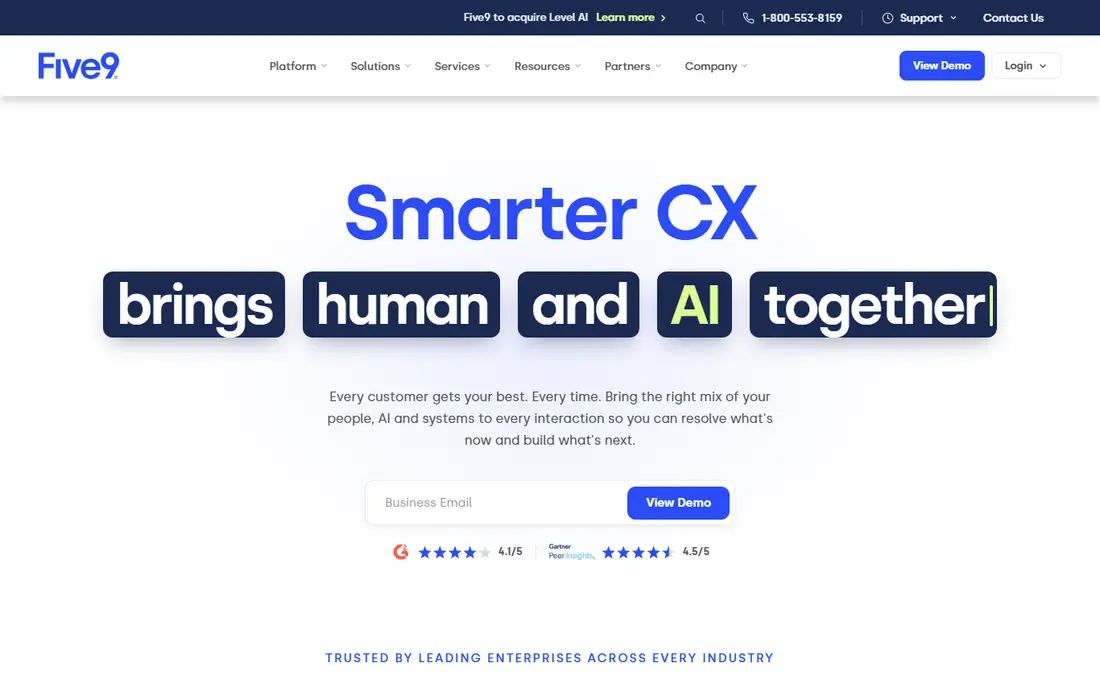
Five9 is a cloud contact center platform for inbound and outbound work across voice, chat, email, SMS, and social channels. Its Digital bundle starts at $119 per concurrent user per month, and Core with voice starts at $159 per concurrent user per month. Higher bundles add advanced AI and workforce engagement tools, priced on a custom quote. All bundles require at least 50 concurrent seats.
That scale requirement defines who should shortlist Five9. A 50 seat Core deployment costs about $7,950 per month before minutes, CRM adapters, and AI overages. For a large center with shift work, concurrent pricing can save money compared with paying for every named agent. For a team of ten, the minimum alone ends the conversation.
- Deep outbound dialing and AI features
- Strong CRM adapters
- Proven at very large scale
- 50 seat minimum
- Higher tiers are quote only
- Add-ons lift the total cost
Genesys Cloud CX lists four tiers when billed annually: CX 1 at $75, CX 2 at $115, CX 3 at $155, and CX 4 at $240 per user per month. CX 1 covers voice centers, CX 2 adds digital channels and quality tools, CX 3 adds full workforce engagement, and CX 4 adds journey management and advanced AI. Organizations can choose named or concurrent licensing, but not both in the same organization.
Genesys fits operations that need serious routing, analytics, and workforce tools in one platform. The published prices are list prices, and AI features consume tokens with overage charges possible, so model token use before you scale AI. For mid-market teams, CX 2 is often the sensible entry point, with room to grow into CX 3.
- Four clear tiers from $75 to $240 per user
- Deep routing and AI copilot features
- Named or concurrent licensing
- AI token limits can add cost at scale
- Implementation needs planning for large deployments
Talkdesk CX Cloud starts at $85 per user per month for Digital Essentials and $105 for Voice Essentials, rising to $165 for Elite omnichannel with workforce management and $225 for Industry Experience Clouds. Talkdesk Express gives eligible small teams in the US and Canada up to 25 free licenses, which is more generous than most enterprise vendors offer at no cost.
The catch is that the base price buys a narrower product than the marketing suggests. Workforce management, outbound engagement, secure payments, and several other tools sit in add-on packages. Talkdesk fits regulated teams that value industry editions and compliance tooling, but budget for add-ons when you compare it with Genesys or Five9.
- Industry specific editions for finance, health care, and retail
- Free Express tier for small US and Canada teams
- Strong AI copilot tools
- List prices often assume multi-year terms
- Outbound dialer and workforce tools are add-ons
Zendesk Suite starts at $55 per agent per month on the Team tier, with Growth and Professional tiers above it and Enterprise on a custom quote. The Suite covers ticketing, messaging, and help center tools, with voice available as part of the broader contact center setup. Teams already using Zendesk for support gain the most, since customer history, macros, and apps carry over without a migration.
Zendesk is less of a pure dialer platform than Five9, and its strength is support workflow rather than outbound sales. If your volume is mostly inbound support across email and chat, with some voice, Zendesk is a natural fit. If outbound dialing drives revenue, a dialer-first platform will serve you better.
- Tickets, chat, email, and voice in one support workspace
- Huge app marketplace
- Familiar to many support teams
- Voice and advanced AI features sit on higher tiers
- Costs rise as you add channels and seats
NICE CXone Mpower lists a Digital Agent tier at $71 per user per month, Voice Agent at $94, Omnichannel Agent at $110, and suites from $135 to $249 per user per month. The platform covers automatic call distribution, interactive voice response, omnichannel routing, workforce optimization, feedback management, and interaction analytics. That breadth suits large centers that need quality, scheduling, and analytics in one contract.
The price ladder deserves care. The entry tiers cover fewer features than the suites, and a team that needs the full workforce and AI set will land far above the entry price. NICE fits enterprises with compliance needs and large agent counts. Smaller teams will find Aircall or CloudTalk easier to buy and run.
- Broad channel coverage and workforce optimization
- Strong analytics and AI features
- Proven in regulated industries
- Published suite prices rise quickly to $249 per user
- Complex setup for smaller teams
RingCentral RingCX starts at $65 per user per month, with higher tiers reaching about $145 per user per month. It offers omnichannel routing, AI summaries, analytics, and supervisor tools, and it sits naturally alongside RingCentral phone, video, and messaging. Teams already on RingCentral avoid a second vendor for phones and gain a single bill and shared admin.
The trade is dependence. RingCX makes most sense inside a RingCentral estate, and teams on another phone system may prefer a standalone platform. It also sits in the middle of enterprise pricing, neither the cheapest nor the most expensive, so compare its higher tiers with Genesys CX 2 and Talkdesk Elite before you decide.
- Voice, video, SMS, and AI summaries in one platform
- Pairs with RingCentral phone and team messaging
- 20 plus channels in higher tiers
- Best value requires RingCentral phone
- Contact center pricing rises to $145 per user on higher tiers
Aircall starts at $30 per user per month on Essentials, billed annually, with a three license minimum, and Professional at $50 per user per month adds smart routing, queue callback, and deeper monitoring. The platform is built around voice, with call queuing, IVR, call notes, and a shared call inbox, plus integrations with Salesforce, HubSpot, Zendesk, and other common tools.
Aircall suits sales and support teams that live in a CRM and want phones working inside it within days, not months. It is not a full enterprise workforce suite, and teams needing advanced scheduling or AI at scale will outgrow it. For a team of three to thirty, the low entry price and small minimum are the main draw.
- Fast setup
- More than 100 CRM and helpdesk integrations
- Three seat minimum keeps the floor low
- Smart routing and advanced monitoring sit on the $50 Professional tier
- Per minute costs vary by country
Dialpad Support, formerly Dialpad Contact Center, offers voice and digital routing with AI transcripts, post-call recaps, and a power dialer on its Essentials tier, with coaching and workforce management on higher tiers. Published comparisons place Essentials near $80 to $89 per user per month, but Dialpad does not publish Support pricing as clearly as its phone plans, so request a written quote.
Dialpad fits teams that want AI help for every agent without buying a separate transcription tool. The coaching features, such as live guidance and scorecards, are the reason to pay above Essentials. If you only need basic queues, Aircall or CloudTalk will cost less for the same headcount.
- Built-in AI transcripts, recaps, and coaching tools
- Voice and digital routing in one workspace
- Separate from the phone system
- Support pricing is not published on the main pricing page
- Higher tiers for coaching and workforce tools cost more
CloudTalk starts at $25 per user per month, with queues, IVR, skill routing, and CRM logging included for sales and support teams that call across countries. Higher tiers add monitoring, wallboards, and deeper analytics. The platform also offers auto, smart, preview, power, and parallel dialers, which gives outbound teams real choice without moving to an enterprise suite.
CloudTalk suits distributed teams that call customers in many countries and want to start with one or two licenses. The one agent minimum is rare in this market and makes a pilot cheap. Check per minute rates for your main calling countries before you commit, since international minutes can change the total quickly.
- Low entry price with a one agent minimum
- Strong international numbers in more than 160 countries
- Multiple dialer types
- Monitoring and wallboards need higher tiers
- Pricing in euros on some plans can confuse US budgeting
How we picked these
We compared official pricing pages, published tiers, seat minimums, and channel coverage. We kept platforms that route and report on customer contacts at scale, not just business phone systems. We included enterprise suites and small team tools together, because a ten person team and a five hundred person center buy contact center software in different ways. Where pricing was quote only, we said so rather than inventing a number.
What to check before you sign
Start with your contact mix. Count voice, chat, email, and SMS volume separately, since some plans cover only one channel at the entry tier. Check seat minimums, contract length, and whether pricing is per named user or per concurrent user, since shift teams benefit from concurrent pricing. Ask for a written list of add-ons, including minutes, AI tokens, workforce tools, and CRM adapters.
Run a pilot with real flows. Route a real queue, test CRM screen pops, record calls, and pull the reports your managers will use weekly. A demo with sample data hides routing gaps, reporting limits, and admin effort. Compare the pilot bill, not the list price, and confirm what happens to pricing when you add seats mid-contract.
Sources
- https://www.five9.com
- https://www.genesys.com
- https://www.talkdesk.com
- https://www.zendesk.com
- https://www.nice.com
- https://www.ringcentral.com
- https://www.aircall.io
- https://www.dialpad.com
- https://www.cloudtalk.io
- https://www.genesys.com/pricing
- https://www.nextiva.com/blog/talkdesk-pricing.html
- https://www.cloudtalk.io/call-center-software/
Frequently asked questions
What is the best contact center software for a small business?
Aircall and CloudTalk are the strongest small team picks here, with entry prices of $30 and $25 per user per month and low seat minimums. Zendesk also works well for small support teams already using its helpdesk. Enterprise suites such as Five9 are usually a poor fit below 50 seats because of minimums and contract length.
What is the best contact center platform for large enterprises?
Genesys Cloud CX and NICE CXone lead for large operations, with deep routing, workforce management, and analytics in tiered plans. Five9 leads for large outbound and blended centers with heavy dialing needs. All three require careful implementation planning, so budget time and staff alongside the seat price.
How much does contact center software cost per user?
Entry prices in this list run from $25 per user per month at CloudTalk to $119 at Five9 for digital only, with most enterprise tiers between $65 and $165. Higher tiers, AI features, minutes, and workforce tools raise the total. Always request a quote for your seat count, channels, and contract length.
Does contact center software include a phone system?
Some platforms include voice, while others pair with a phone system you already own. RingCentral RingCX pairs with RingCentral phone, and Dialpad Support sits apart from Dialpad phone plans. Aircall and CloudTalk include voice calling as their core product. Confirm whether numbers, minutes, and toll-free costs are included before you compare prices.
What is the difference between a contact center and a call center?
A call center handles phone calls, while a contact center handles calls plus chat, email, SMS, and social messages in one routing and reporting system. Most modern platforms are contact centers even when voice is still the largest channel. If most contacts arrive by chat or email, weight digital routing as heavily as voice quality.
Which contact center software has the best AI features?
Genesys, Five9, Talkdesk, and NICE all invest heavily in AI, with agent copilots, virtual agents, summaries, and predictive routing. The difference is how AI is metered, with Genesys using tokens and others bundling minutes or charging by add-on. Test AI on your real transcripts during a pilot, since generic demos flatter every vendor.