Best Conversion Tracking Software for Lead Gen in 2026
By ToolNimba Editorial Team November 19, 2026 7 min read
We did not test these tools hands-on. Picks are based on vendor documentation and public information. Read our editorial policy and disclosure.

- Top pick
 HubSpot Marketing Hub
All-in-one lead gen tracking and CRM
Starting priceSee websiteCheck out HubSpot Marketing HubRead our review - Runner-up
 Adobe Analytics
Enterprise journey and campaign measurement
Starting priceSee websiteCheck out Adobe AnalyticsRead our review - Also great
 Mixpanel
Product-led lead flow analysis
Starting price$100 per monthCheck out MixpanelRead our review
How we researched this
We compared official pricing and feature pages, app store listings, privacy policies and public user reviews. Prices change, so check the provider's site before you pay.
Direct answer
HubSpot Marketing Hub is the first pick for most lead gen teams because it ties campaign tracking to contact records and reporting. Adobe Analytics suits enterprises with complex journeys, while Hotjar adds behavior context. Seven options are compared here.
Key takeaways
- HubSpot Marketing Hub connects campaign tracking to contact records for lead attribution.
- Adobe Analytics unifies customer data for enterprise journey measurement.
- Mixpanel combines analytics, session replay, and experiments for product-led lead flows.
- Hotjar adds behavior insights like heatmaps and recordings to see how leads engage.
Quick comparison
| Name | Best for | Starting price | Free plan | |
|---|---|---|---|---|
| HubSpot Marketing Hub | All-in-one lead gen tracking and CRM | See website | See website | Visit |
| Adobe Analytics | Enterprise journey and campaign measurement | See website | See website | Visit |
| Mixpanel | Product-led lead flow analysis | $100 per month | Yes | Visit |
 Amplitude | Behavioral analytics for self-improving funnels | See website | See website | Visit |
 Heap | Automatic capture of user behavior | See website | Yes | Visit |
 Segment | Unifying lead data across tools | See website | Free trial | Visit |
 Hotjar | Behavior insights for lead forms | $39 per month | Yes | Visit |
Conversion Tracking for Lead Generation, one by one
Lead generation depends on knowing which campaigns and touchpoints create qualified contacts. ToolNimba compared seven conversion tracking platforms to help you match features to your team.
HubSpot Marketing Hub
Best for: All-in-one lead gen tracking and CRM
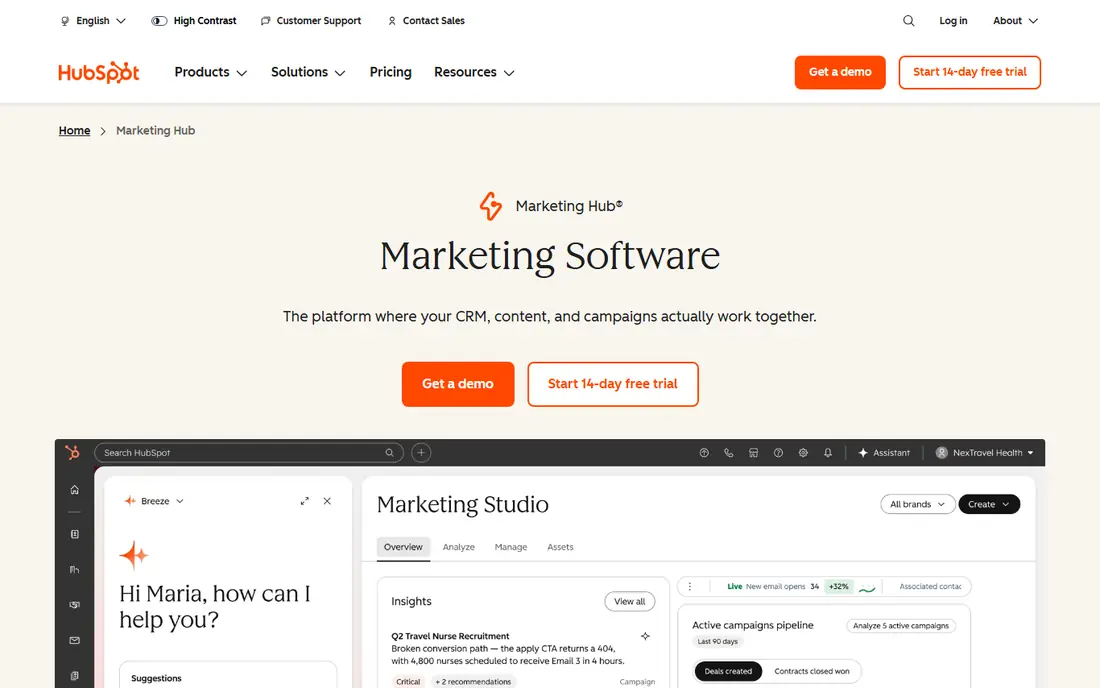
HubSpot Marketing Hub is an integrated marketing platform that connects forms, landing pages, email, and ads to a shared contact database. For lead generation, this means conversion events can be attributed to contacts and followed through the funnel. It fits teams that want tracking and CRM in one system without stitching multiple tools together.
The platform is broad, so setup requires planning and the reporting depth varies by tier. Teams with highly custom analytics stacks may prefer a dedicated measurement tool. Consider HubSpot when lead tracking and contact management should live together.
- Ties campaigns to contact records
- Built-in forms and landing pages
- Reporting for lead nurturing
- Advanced reporting in higher tiers
- Can be complex to configure
Adobe Analytics is an enterprise digital experience analytics platform that unifies customer data and measures marketing performance across journeys. It supports lead gen teams that need to analyze multi-touch attribution and segment audiences at scale. It fits organizations with dedicated analytics resources and complex digital estates.
Deployment and maintenance demand specialist skills, and the interface is dense for casual users. Smaller teams may find lighter tools faster to adopt. Choose Adobe Analytics when enterprise-grade journey analysis is the priority.
- Unifies customer data across channels
- AI-powered insights for journeys
- Strong segmentation capabilities
- Implementation requires expertise
- Interface can feel complex
Mixpanel is a product intelligence platform combining analytics, session replay, experiments, and feature flags. For lead gen, it helps teams see how prospects move through signup and onboarding flows event by event. It suits product-led teams that treat lead conversion as part of the product experience.
Mixpanel is built around product events rather than marketing campaign sources, so channel attribution may need additional tooling. Teams wanting a marketing-first view might pair it with a CRM or CDP. Pick Mixpanel when behavioral depth matters most.
- Event-based funnel analysis
- Session replay and experiments
- AI-powered insights
- Less focused on marketing channels
- Requires event tracking setup
Amplitude is a product analytics platform that brings AI into building self-improving products, from analytics to feedback to code. Lead gen teams use it to understand which behaviors correlate with conversion and to test improvements. It fits teams that want to optimize the post-click experience with data.
Like other product analytics tools, Amplitude centers on events rather than ad channel reporting, so marketing attribution may require integration. It may be more than a simple lead form needs. Choose Amplitude when funnel behavior and experimentation drive your roadmap.
- Event-based funnel and retention analysis
- AI features across the workflow
- Feedback and experimentation support
- Campaign attribution is not the core focus
- Setup requires event planning
Heap by Contentsquare is a digital insights platform that shows everything users do on your site, revealing behaviors that stay invisible with other tools. For lead gen, this helps teams see where prospects hesitate or drop off in forms and landing pages. It fits teams that want broad behavioral visibility without predefining every event.
Automatic capture can produce a lot of data to organize, and channel attribution is not its main strength. Teams needing strict campaign measurement may combine it with a CRM or CDP. Consider Heap when discovering unknown friction points is the goal.
- Captures interactions without manual tagging
- Surfaces unknown user behaviors
- Useful for form and page analysis
- Can generate large volumes of data
- Attribution modeling is limited
Segment is a customer data platform from Twilio that collects, unifies, and enriches customer data across apps and devices. For lead gen, it acts as the tracking backbone that sends consistent conversion events to analytics, CRM, and marketing tools. It fits teams that want clean, centralized data before choosing reporting layers.
Segment does not provide the dashboards or attribution reports itself, so you still need analysis tools on top. Implementation requires engineering involvement. Pick Segment when data consistency across many systems is the main challenge.
- Collects and unifies customer data
- Routes data to many destinations
- Reduces tracking fragmentation
- Not a reporting tool itself
- Requires technical setup
Hotjar is a behavior insights platform now part of Contentsquare, focused on the midsize and SMB market. Lead gen teams use heatmaps, recordings, and feedback to see how visitors interact with forms and landing pages. It fits teams that want qualitative context alongside conversion numbers.
Hotjar explains behavior but does not replace a full analytics or attribution system. Teams needing multi-channel campaign reporting should pair it with another tool. Choose Hotjar when form and page-level friction is the question.
- Heatmaps and session recordings
- Feedback and survey tools
- Easy to add to landing pages
- Limited attribution reporting
- Best paired with analytics
How the list was put together
ToolNimba compared documented features, vendor pages, and stated limits for each platform, focusing on how they support lead generation tracking. We did not run hands-on tests. Details can change, so confirm current capabilities on vendor sites. The ordering is editorial and reflects fit for common lead gen use cases rather than a scored ranking.
What to confirm before you sign up
- Check how conversion events are attributed to campaigns and contacts.
- Verify integration with your CRM and advertising platforms.
- Confirm data governance and consent handling for lead forms.
- Review reporting depth for the funnel stages you track.
- Assess setup effort and whether engineering support is needed.
Sources
Official websites of the products reviewed above. Features and prices were checked against these sites when the guide was written, and they can change, so confirm on the vendor site before you buy.
Frequently asked questions
What should lead gen teams look for in conversion tracking software?
Prioritize how well the tool ties conversions to contacts and campaigns, and whether it integrates with your CRM. Also check consent handling and reporting for the funnel stages you manage. Behavioral tools can complement but rarely replace attribution reporting.
Do I need both a CDP and an analytics tool?
A CDP like Segment centralizes and routes clean event data, while analytics tools provide the dashboards and attribution views. Many teams use both so tracking stays consistent across systems. The right mix depends on how many tools consume your lead data.
How do product analytics tools help with lead generation?
Tools like Mixpanel and Amplitude show how prospects behave after they arrive, such as which steps precede a completed form. That behavioral view helps teams remove friction in signup and onboarding flows. They work best alongside a system that tracks marketing sources.
Can behavior insights tools improve lead form conversion?
Heatmaps and recordings from Hotjar or automatic capture in Heap can reveal where visitors hesitate or abandon forms. Teams use those findings to simplify fields and layouts. Pair these insights with conversion data to confirm which changes help.