Best CRM Software for Startups in 2026: 9 Tools Compared
By ToolNimba Editorial Team November 6, 2026 9 min read

- Top pick
 HubSpot CRM
Inbound startups and free start
Starting priceFreeCheck out HubSpot CRMRead our review - Runner-up
 Pipedrive
Visual sales pipelines
Starting price$14 per user per monthCheck out PipedriveRead our review - Also great
 Zoho CRM
Budget-conscious startups
Starting priceFreeCheck out Zoho CRMRead our review
How we researched this
We compared official pricing and feature pages, app store listings, privacy policies and public user reviews. Prices change, so check the provider's site before you pay.
Key takeaways
- HubSpot and Zoho CRM have the best free plans for startups, with HubSpot offering the most generous free tier.
- Pipedrive is the best CRM for startups that live in their sales pipeline and want a clear visual deal flow.
- Close is the best pick for outbound teams that spend their day calling and emailing prospects.
- Attio is the best modern option for tech startups that want a flexible data model and plan to scale.
Quick comparison
| Name | Best for | Starting price | Free plan | |
|---|---|---|---|---|
| HubSpot CRM | Inbound startups and free start | Free | Yes | Visit |
| Pipedrive | Visual sales pipelines | $14 per user per month | Free trial | Visit |
| Zoho CRM | Budget-conscious startups | Free | Yes | Visit |
 Freshsales | Small teams that call prospects | $9 per user per month | Free trial | Visit |
 Close | Outbound sales teams | $9 per user per month | Free trial | Visit |
 Attio | Modern scaling startups | See website | Yes | Visit |
 monday Sales CRM | Visual project-style teams | $12 per user per month | Free trial | Visit |
 Salesforce Starter | Startups planning to scale big | $25 per user per month | Free trial | Visit |
 Copper | Teams that live in Gmail | $9 per user per month | Free trial | Visit |
The best CRM software for startups
A startup CRM should be cheap to start, fast to set up, and easy to leave behind if you outgrow it. These are the best CRM tools for startups in 2026, from free plans for two-person teams to platforms that can grow with you to 50 people and beyond.
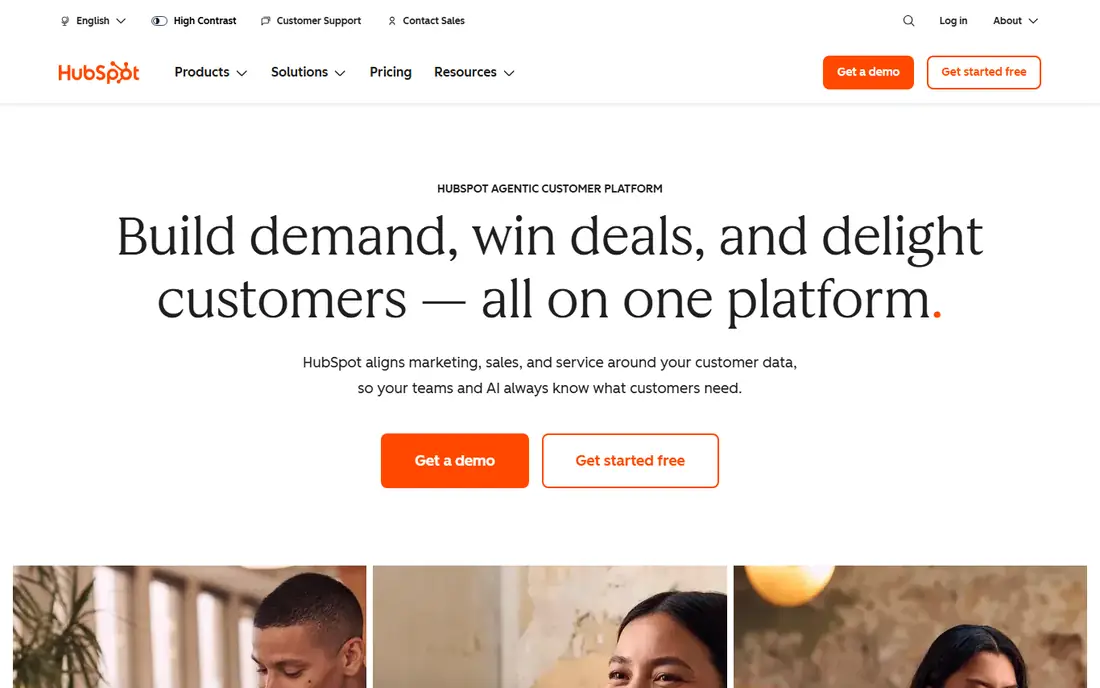
HubSpot is the default recommendation for startups for a reason. The free CRM covers contacts, deal pipelines, meeting scheduling, forms, and live chat, which is enough for a founding team to run on for months. Everything shares one database, so marketing engagement and sales history live on the same contact record.
The catch is the price jump. Real automation, sequences, and custom reporting require higher tiers, and costs scale with marketing contacts. Start free, and only move up when the paid features clearly pay for themselves. For inbound-first startups, HubSpot is still the best CRM for startups overall.
- Generous free CRM with contacts, deals, and forms
- One shared database for sales and marketing
- Easy setup
- Paid automation sits on expensive higher tiers
- Marketing contacts add cost as you grow

Pipedrive is the best CRM tool for startups that sell through a pipeline and want to see exactly where every deal stands. The board view is simple, dragging a deal to the next stage is instant, and activity reminders keep follow-ups from slipping. The Lite plan starts at $14 per user per month on annual billing.
There is no free plan, only a 14-day trial, so you pay from the start. Marketing features and deeper automation also sit on higher tiers. If your team is sales-only and lives in the pipeline, Pipedrive is worth that cost. If you need marketing too, HubSpot free may suit you better.
- Clearest visual pipeline
- Fast to learn
- Strong sales activity tracking
- No free plan, only a trial
- Marketing and automation features need higher tiers or add-ons
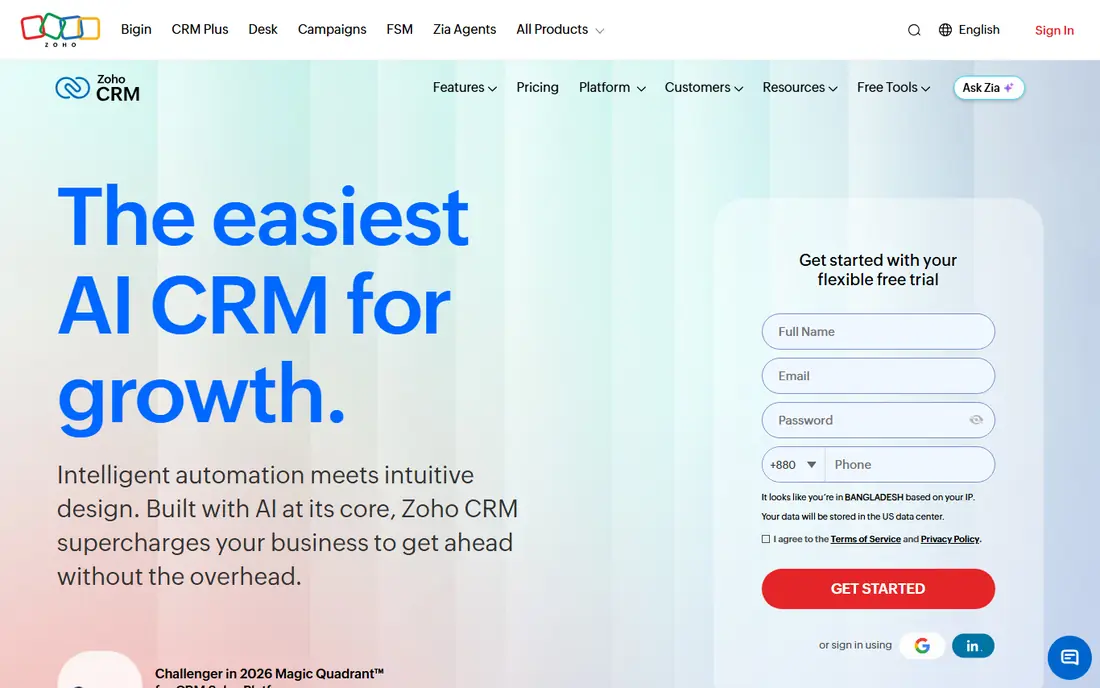
Zoho CRM is the best CRM software for startups that want maximum features for minimum money. The free plan covers up to 3 users with real CRM features, and the Standard paid plan starts at $14 per user per month on annual billing. It also connects with the rest of the Zoho suite, which suits startups already using Zoho Books or Zoho Mail.
Setup takes more patience than HubSpot or Pipedrive, and the interface can feel busy at first. Startups willing to spend a day on setup get a lot for the price, including automation and reporting that rivals charge more for. For cost-conscious teams, Zoho is hard to beat.
- Free for up to 3 users
- Strong features per dollar
- Part of the wider Zoho suite
- Steeper learning curve
- Deepest customization sits on higher tiers
Freshsales is the best CRM platform for startups that want a simple, affordable all-rounder with calling built in. The Growth plan starts at $9 per user per month on annual billing, and the phone, email, and activity tracking work out of the box. Small teams can be set up and selling within a day.
The free plan is limited, and reporting is thinner than in HubSpot or Zoho. Freshsales also suits small teams better than large ones, since it lacks some enterprise depth. For a startup that needs a solid, cheap CRM without a long setup, it is a strong pick.
- Low starting price
- Built-in phone and email
- Fast setup
- Free plan is limited
- Reporting depth trails HubSpot and Salesforce
Close is the best CRM for startups that live on the phone. Calling, SMS, and email are built in, so reps can work through a list without switching tools, and the pipeline view stays simple even at high volume. The Solo plan starts at $9 per user per month on annual billing.
The catch is that Solo covers one user only, so a team pays for higher tiers per seat. There is also no free plan, only a trial. If your startup does outbound sales all day, Close will save enough time to justify the cost. If you do inbound marketing, HubSpot is the better fit.
- Native calling and SMS
- Built for high-volume outbound
- Simple pipeline view
- No free plan
- Solo plan is limited to one user, so teams pay more per seat
Attio is the best CRM software for startups that want a modern, flexible tool and plan to scale. Its data model adapts to how your startup actually works, rather than forcing you into fixed objects, and its free plan covers up to 3 seats. Tech startups and data-led teams tend to like it most.
Paid pricing has varied across 2026 comparisons, which is why we list See website here. The ecosystem is also smaller than HubSpot or Salesforce, so some integrations need more work. If you value flexibility and a modern interface over a huge app marketplace, Attio is worth a trial.
- Flexible modern data model
- Free for up to 3 seats
- Strong API and integrations
- Paid pricing varies and has changed often
- Smaller ecosystem than HubSpot or Salesforce
monday Sales CRM is the best CRM tool for startups that already use monday.com for projects or that think in boards rather than lists. Deals, tasks, and delivery work live in the same visual system, which helps small teams where sales and delivery overlap. The Basic plan starts at $12 per seat per month on annual billing, with a 3-seat minimum.
There is no free plan, only a trial, and very large pipelines can get messy on boards. For creative startups, agencies, and project-led teams, though, monday Sales CRM feels natural in a way that traditional CRMs do not.
- Visual boards teams already know
- Flexible workflows
- Good collaboration features
- No free plan
- Minimum 3 seats
- Can get messy with very large pipelines
Salesforce Starter Suite, at $25 per user per month, is the best CRM platform for startups that know they will need Salesforce scale later. It gives you the core CRM, a huge app marketplace, and a path to the full Salesforce platform without migrating later. Investors and enterprise customers also recognize the name.
The catch is the jump. Real Salesforce costs arrive when you outgrow Starter, and setup takes more admin effort than HubSpot or Pipedrive. Startups that are unsure about scale should start free elsewhere and move to Salesforce later. Startups that already know they need it should start here.
- Entry into the largest CRM ecosystem
- Strong customization
- Scales to enterprise
- Costs jump sharply beyond Starter
- Setup usually needs more admin time
Copper is the best CRM tool for startups that run their business in Gmail. It sits inside Google Workspace, captures contacts and emails automatically, and keeps the pipeline visible without leaving the inbox. The Starter plan starts at $9 per seat per month on annual billing.
It only makes sense for Google Workspace teams, and its reporting is basic next to HubSpot or Salesforce. For a small team that never leaves Gmail, though, Copper removes the friction of a separate CRM entirely, which is why it earns a place on this list.
- Deep Gmail and Google Workspace integration
- Automatic contact capture
- Simple interface
- Only useful for Google Workspace teams
- Reporting is basic compared with larger CRMs
How we picked these
We compared official pricing pages, free plan limits, and independent startup CRM comparisons from 2026, and we favored tools that are actively sold to small teams, offer a free plan or trial, and suit a distinct startup selling motion. We did not claim hands-on testing. Where pricing varied across sources or changed during 2026, we wrote See website rather than publishing a figure we could not verify.
How to choose a CRM for your startup
Start with your selling motion. Inbound teams should start with HubSpot free, outbound teams with Close, pipeline-driven teams with Pipedrive, and Gmail teams with Copper. Picking a CRM that matches how you actually sell matters more than picking the one with the longest feature list.
Then price the tier you will need in a year, not the entry tier. A cheap first year can turn expensive when automation, reporting, or extra seats move you to a higher plan. Work out the cost for your team size at the tier that includes the features you will actually use, and compare that number across vendors.
Finally, test with real deals before you commit. Import a handful of contacts, run a week of real sales activity, and see whether the team updates it without being chased. A CRM the team ignores is worse than a spreadsheet, no matter how good its feature list looks.
Sources
Frequently asked questions
Which CRM platforms are best for startups?
HubSpot, Pipedrive, Zoho CRM, Freshsales, Close, Attio, monday Sales CRM, Salesforce Starter, and Copper are the strongest options in 2026. HubSpot is best for free inbound use, Pipedrive for pipelines, Close for outbound, and Attio for modern scaling startups.
What is the best free CRM tool for startups?
HubSpot has the most generous free CRM, with contacts, deals, forms, and meeting scheduling at no cost. Zoho CRM is free for up to 3 users, and Attio is free for up to 3 seats, so very small teams have three solid free options.
Which CRM tools are best for startups on a budget?
Zoho CRM, Freshsales, and Close offer the lowest paid starting prices in this list, from $9 per user per month on annual billing. HubSpot free and Zoho free cost nothing for small teams, so start there if budget is the main concern.
Does a startup really need a CRM?
Once deals, follow-ups, and contacts no longer fit in a spreadsheet without errors, yes. A CRM keeps one shared record of every prospect, reminds the team about follow-ups, and gives founders a true view of the pipeline instead of guesswork.
How much does CRM software for startups cost?
Free plans exist from HubSpot, Zoho, and Attio. Paid plans in this list start from $9 per user per month for Freshsales, Close, and Copper, $12 for monday Sales CRM, $14 for Pipedrive and Zoho, and $25 for Salesforce Starter, all on annual billing where noted.