Best Delivery App in 2026: 8 Apps Compared
By ToolNimba Editorial Team October 29, 2026 10 min read

- Top pick
 DoorDash
Widest restaurant choice in most cities
Starting priceFreeCheck out DoorDashRead our review - Runner-up
 Uber Eats
City food delivery and Uber One members
Starting priceFreeCheck out Uber EatsRead our review - Also great
 Grubhub
Restaurant delivery with regular deals
Starting priceFreeCheck out GrubhubRead our review
How we researched this
We compared official pricing and feature pages, app store listings, privacy policies and public user reviews. Prices change, so check the provider's site before you pay.
Key takeaways
- DoorDash has the widest restaurant coverage in most US cities, which makes it the easiest default for food delivery.
- Uber Eats is the strongest second option, especially where Uber One membership or a wide restaurant list matters.
- Instacart, Shipt and Walmart cover groceries best, and they often beat restaurant apps on weekly shopping value.
- goPuff wins for late-night convenience items, because it stocks its own warehouses rather than relying on stores.
- Always compare the total at checkout, since delivery fees, service fees and tips can change the cheapest option.
Quick comparison
| Name | Best for | Starting price | Free plan | |
|---|---|---|---|---|
| DoorDash | Widest restaurant choice in most cities | Free | Yes | Visit |
| Uber Eats | City food delivery and Uber One members | Free | Yes | Visit |
| Grubhub | Restaurant delivery with regular deals | Free | Yes | Visit |
 Instacart | Grocery delivery from many stores | Free | Yes | Visit |
 Shipt | Target and grocery delivery | Free | Yes | Visit |
 Walmart | Everyday grocery delivery at low prices | Free | Yes | Visit |
 goPuff | Fast convenience delivery | Free | Yes | Visit |
 Amazon Fresh | Prime members ordering groceries | Free | Yes | Visit |
The best delivery apps
The best delivery app depends on what you are ordering. Restaurant apps, grocery apps and convenience apps solve different problems, and the cheapest choice can change by neighbourhood, order size and time of day. The eight apps below cover the main use cases for US consumers.
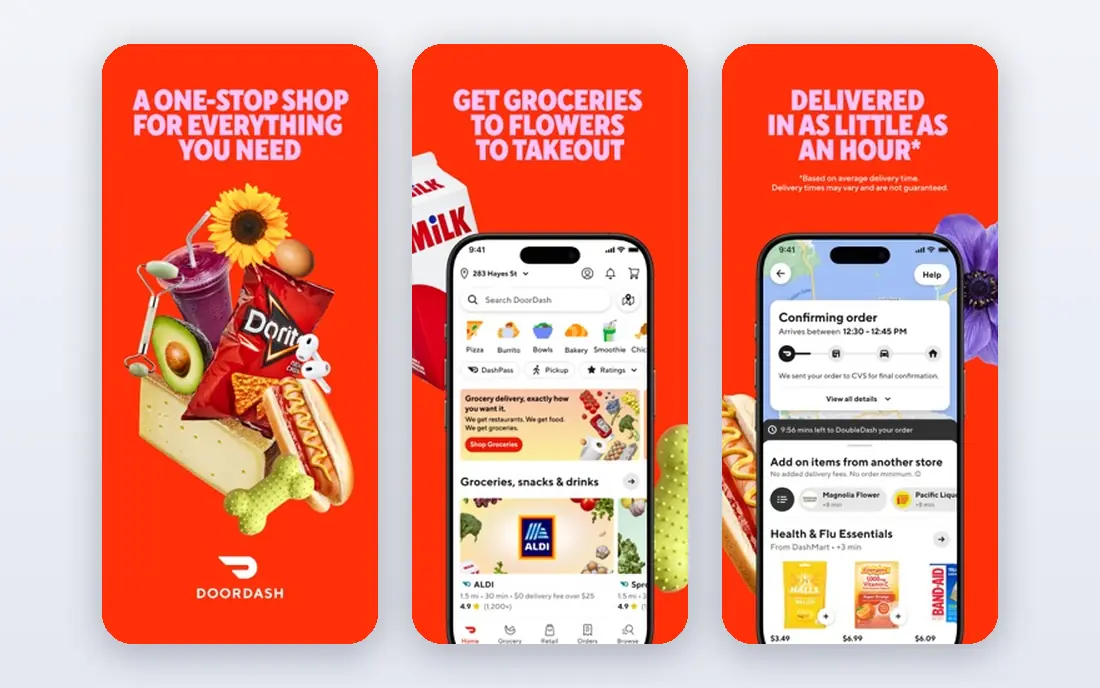
DoorDash earns its place first because coverage matters more than any single feature. In many cities it lists more restaurants than rivals, including local spots as well as chains, so you are less likely to hit a dead end when you want a specific meal. The app also handles groceries, convenience items and retail orders, which means one account can cover a weekly shop and a late dinner.
The catch is the total cost. A low delivery fee at the top of the screen does not tell the whole story, since service fees, small order fees and tips sit further down the checkout. DashPass can make sense if you order often, but it only saves money when you use it enough to cover the monthly cost. Compare the final total before you commit to a membership.
- Very large restaurant selection
- Grocery and convenience delivery too
- DashPass can cut delivery fees for frequent users
- Fees and menu prices can add up
- Delivery times vary at peak hours

Uber Eats is the natural alternative when DoorDash does not list the restaurant you want, or when its fees look high for that order. Its tracking is clear, and the app feels familiar if you already use Uber for rides. For people who already pay for Uber One, the fee savings on food delivery can make Uber Eats the better default, even if DoorDash has a slightly longer restaurant list.
The weakness is consistency. Availability, delivery times and fees change by area and by hour, so a good experience in one city does not guarantee the same result in another. Check the same order on both apps when cost matters, and pay attention to the estimated delivery window, not only the fee.
- Strong city coverage
- Live order tracking
- Uber One can reduce fees across Uber services
- Prices and fees vary by restaurant and time
- Some areas have fewer options than DoorDash
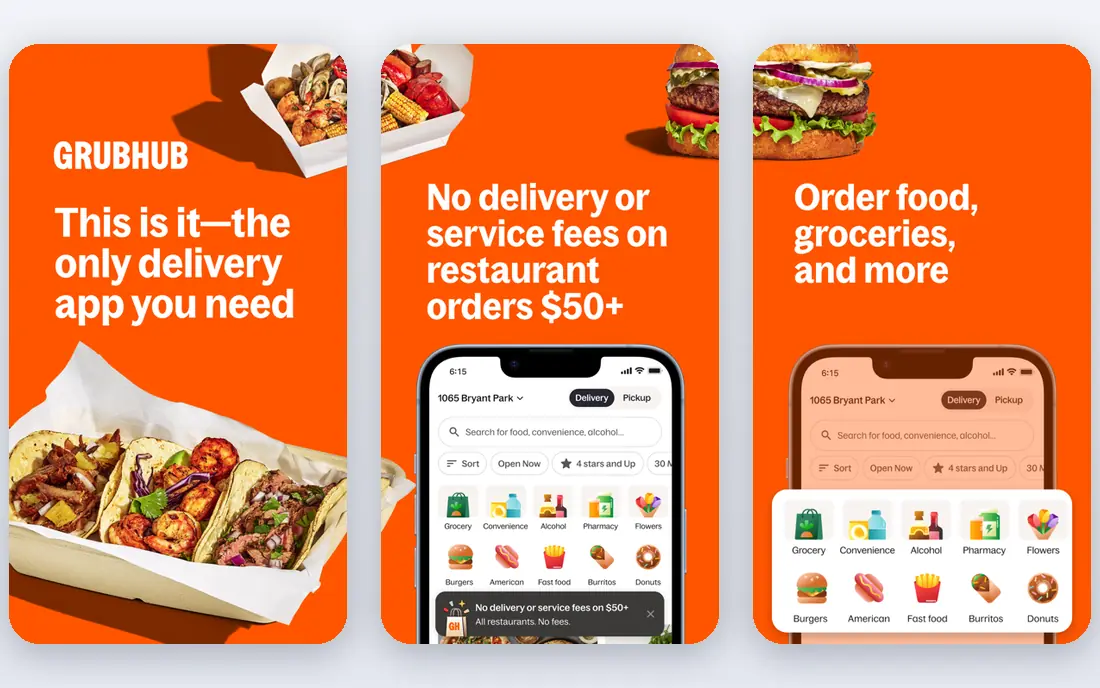
Grubhub remains worth keeping on your phone even if it is not your first choice. It has deep roots in restaurant delivery, and its promotions can make a familiar order cheaper than on a rival app. That matters for repeat orders, where a small saving each week adds up over a year. Grubhub also lists many independent restaurants that matter to local food scenes.
The limit is coverage. In some suburbs and smaller cities, Grubhub lists fewer restaurants than DoorDash or Uber Eats, and delivery times can be longer. Treat Grubhub as a comparison tool and a deals app, rather than assuming it will always be available. When it has your restaurant and a promotion, it often wins on total price.
- Long history in restaurant delivery
- Frequent promotions
- Useful in cities where it has strong coverage
- Coverage is patchier than DoorDash in some areas
- Fees still apply on many orders
Instacart is the best choice when the order is a full grocery shop rather than a single meal. It connects you to many stores, from supermarkets to warehouse clubs and pharmacies, and a shopper picks items and can ask about replacements when something is out of stock. That flexibility helps when you need a specific brand or want to shop at several stores without leaving home.
The trade-off is price transparency. Item prices on Instacart can differ from in-store prices, and service fees add to the bill. Instacart Plus can reduce delivery fees for frequent shoppers, but check whether your usual stores and order sizes qualify for free delivery. For a large weekly shop, Instacart often still beats a restaurant app on value, even with fees included.
- Wide choice of grocery and retail stores
- Same-day delivery in many areas
- Shopper can suggest replacements
- Some item prices are higher than in-store prices
- Service fees apply on top of delivery fees
Shipt feels closest to having a personal shopper, and it is especially strong for Target orders. If your household already shops at Target for groceries, household goods and everyday items, Shipt lets you keep that routine without a store trip. Shoppers communicate about replacements, which helps when a product is out of stock or a size has changed.
The main question is frequency. A membership only pays off if you order often enough, so occasional shoppers should check per-order pricing first. Store availability also varies, so confirm that your preferred stores are covered before relying on Shipt for a weekly shop. For Target loyalists, though, it is a clear and simple option.
- Strong Target coverage
- Same-day delivery
- Personal shopper model
- Store choice varies by area
- Membership value depends on how often you order
Walmart is the value pick for grocery delivery, because its prices start low and its store network is very wide. For a family doing a regular grocery shop, that price base often matters more than a free delivery promotion elsewhere. The Walmart app also covers household items, pharmacy products and general goods, so one order can cover more than food.
Delivery slots are the practical limit. Popular times can fill up, and you may need to plan ahead rather than ordering at the last minute. Walmart Plus can help with delivery benefits, but again, compare the membership cost with how often you order. If you shop at Walmart already, delivery is a natural extension rather than a new habit to learn.
- Low grocery prices with no store markup on many items
- Wide store network
- Walmart Plus adds delivery benefits
- Delivery slots can fill up at peak times
- Product range varies by store
goPuff solves a narrow problem very well: you need snacks, drinks, medicine or household essentials quickly, often late at night. Because it stocks its own local warehouses, it can deliver faster and more predictably than an app that sends a shopper to a store. The flat delivery fee also makes small orders easier to judge, since the cost does not swing as much with order size.
Do not expect goPuff to replace a supermarket. Its range is built for convenience, not for a full shop with fresh produce, meat and specialty items. Use it for top-up orders, late-night needs and small essentials, and use Instacart, Shipt or Walmart for the main weekly shop. That split gives you speed where it matters and value where it counts.
- Own warehouses allow fast delivery of snacks, drinks and essentials
- Flat delivery fee model in many areas
- Late-night availability
- Smaller product range than a supermarket
- Not suited to a full weekly grocery shop
Amazon Fresh makes most sense for households that already pay for Prime. Grocery delivery then fits into an account and app you already use, and delivery windows can be convenient for a regular shop. Amazon Fresh also supports SNAP and EBT payment in eligible areas, which matters for families who rely on those benefits for groceries.
The limit is geography. Amazon Fresh is not available everywhere, and its range may not match a local supermarket for specialty items. If you do not already have Prime, do not buy it for groceries alone unless the delivery savings and other Prime benefits together justify the annual cost. For existing Prime members, though, it is a practical grocery option to compare with Walmart and Instacart.
- Grocery delivery tied to Prime
- Low minimums in many areas
- SNAP and EBT accepted in eligible areas
- Availability varies by area
- Best value depends on already having Prime
How we picked these
We compared official app and website information, store and restaurant coverage, delivery models, fees and membership options, plus public reviews and help pages, to check that each app still operates in the US. We kept the focus on consumer food and grocery delivery, as requested, and we covered restaurant, grocery and convenience use cases rather than listing only the largest apps. We did not claim hands-on testing, and fees vary by area and order, so the checkout total is the final source before you order.
How to pick the right delivery app for you
Start with what you order most. If you order restaurant meals several times a week, coverage and a membership such as DashPass or Uber One matter most. If you order groceries weekly, compare Instacart, Shipt, Walmart and Amazon Fresh on your usual basket, not on a single promotional order. A small saving on delivery fees means little if item prices are higher across your whole shop.
Next, check your neighbourhood, not national claims. Open two or three apps, search for your usual restaurants and stores, and look at delivery times and total fees. Some apps shine in cities and fade in suburbs, and the reverse is also true. Save your favourite restaurants and repeat orders in the app you use most, so reordering takes seconds rather than a fresh search each time.
Finally, watch the membership trap. A monthly plan only saves money when you order often enough to cover it, and free delivery usually still leaves service fees and tips. If you order rarely, pay per order and compare totals. If you order often, run one month with a membership, add up what you saved, and cancel if the math does not work.