Best Employee Onboarding Software in 2026: 9 Tools Compared
By ToolNimba Editorial Team November 6, 2026 9 min read

- Top pick
 BambooHR
Growing teams that want a clear HR hub
Starting price$10 per employee per monthCheck out BambooHRRead our review - Runner-up
 Rippling
Teams that want HR, IT and payroll together
Starting price$8 per employee per monthCheck out RipplingRead our review - Also great
 Gusto
Small US employers
Starting price$49 per month plus $6 per personCheck out GustoRead our review
How we researched this
We compared official pricing and feature pages, app store listings, privacy policies and public user reviews. Prices change, so check the provider's site before you pay.
Key takeaways
- BambooHR and Rippling are the strongest all-round picks for small and mid-size teams that want onboarding tied to core HR records.
- Gusto is the simplest route for small US employers that need payroll and onboarding in one place.
- Deel and HiBob are better fits when new hires sit in more than one country.
- Quote-only tools such as Workday and Paylocity only make sense once headcount and compliance needs are large enough to justify the setup.
- Always confirm what is included in the quoted plan, since payroll, benefits and IT setup are often separate add-ons.
Quick comparison
| Name | Best for | Starting price | Free plan | |
|---|---|---|---|---|
| BambooHR | Growing teams that want a clear HR hub | $10 per employee per month | No | Visit |
| Rippling | Teams that want HR, IT and payroll together | $8 per employee per month | Free trial | Visit |
| Gusto | Small US employers | $49 per month plus $6 per person | No | Visit |
 Deel | Hiring across borders | $5 per employee per month | No | Visit |
 Zoho People | Budget teams already using Zoho | $4 per employee per month | Yes | Visit |
 HiBob | Mid-size teams with global staff | See website | No | Visit |
 Workday | Large enterprises | See website | No | Visit |
 Paycor | Mid-market US employers | $99 per month plus $5 per employee | No | Visit |
 Factorial | Small European and international teams | See website | Free trial | Visit |
The best employee onboarding software
Good onboarding is mostly paperwork, access and timing done in the right order. The tools below handle offer letters, forms, e-signatures, task lists and first-week checklists, and the best ones keep that work connected to payroll and benefits. We compared official pricing pages, feature lists and public reviews, and we left out tools that only handle recruiting.
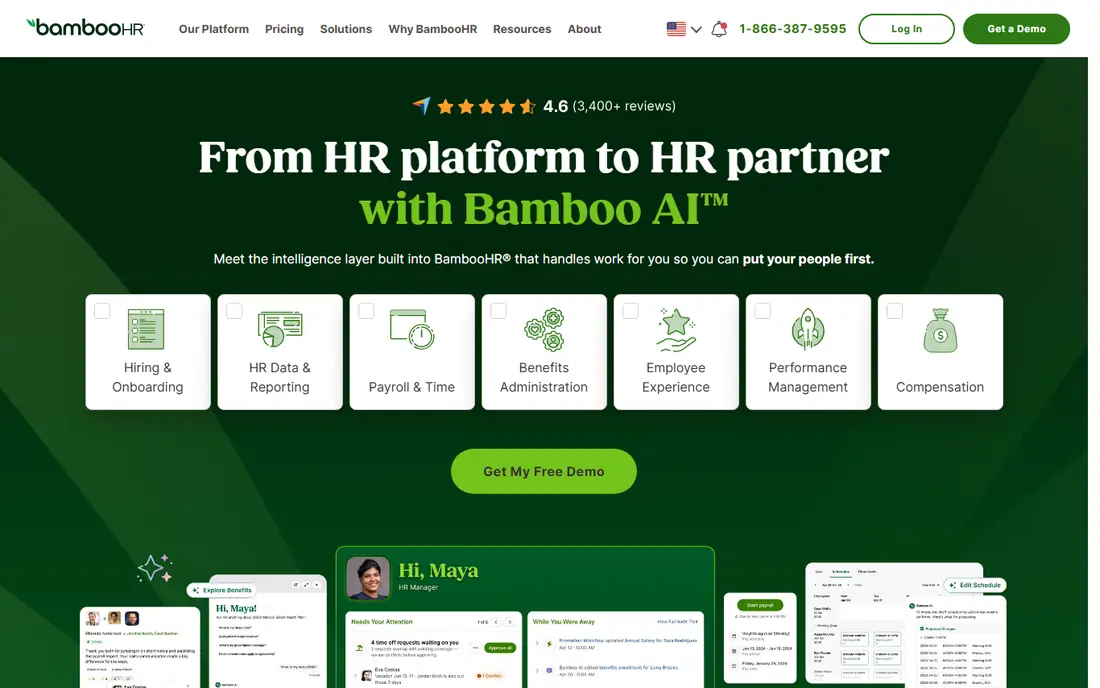
BambooHR suits a team that has outgrown spreadsheets but does not want an enterprise system. New hires complete forms and sign documents before day one, managers see a checklist of tasks, and HR keeps one record for each employee. That record then feeds time off, reporting and later reviews, so onboarding is not a separate pile of files.
The catch is the way pricing is built. Core HR is the starting point, and payroll, benefits administration and time tracking are priced separately. For a US team that needs all of those, the total is higher than the headline rate. Still, for teams that mainly need clean records and a smooth first week, it is a strong, easy to learn choice.
- Clear employee records
- Guided onboarding checklists
- E-signatures and mobile access
- Payroll and benefits are separate add-ons
- Pricing rises with headcount
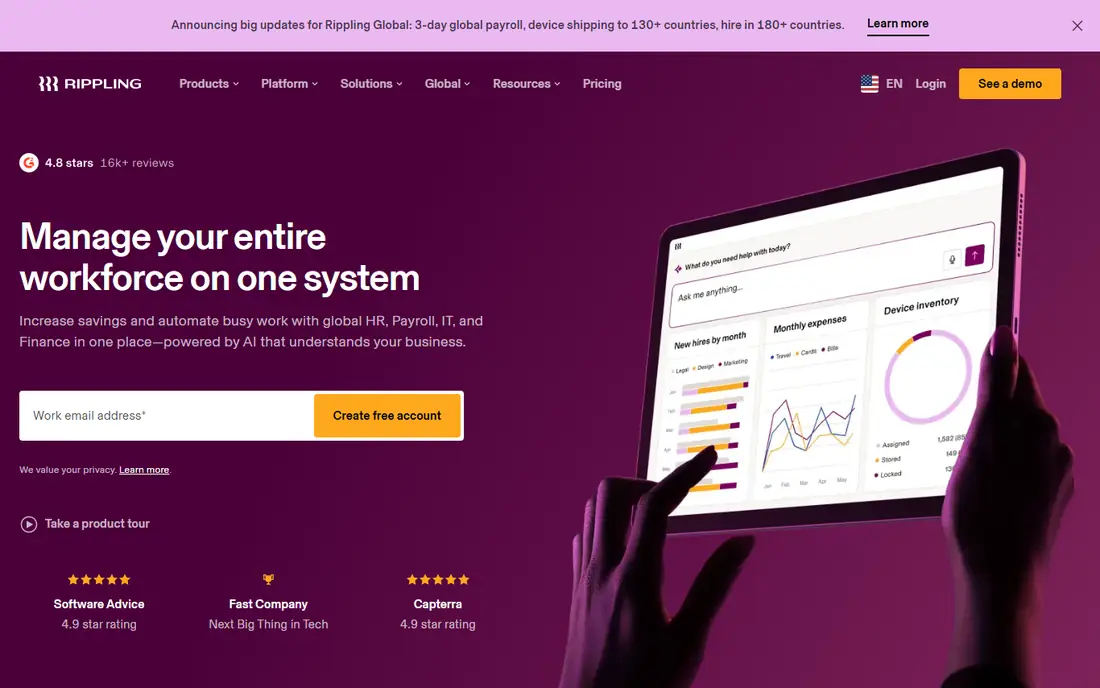
Rippling stands out because onboarding does more than collect forms. When a hire is added, the system can set up payroll, assign apps and trigger device and access workflows. That matters for remote and hybrid teams, where a new starter needs accounts on day one rather than after a week of tickets.
The trade-off is scope. Rippling sells HR, IT and finance as modules, so a team that turns everything on pays much more than the entry rate. It also rewards a team that is willing to set up workflows properly. If you only need simple checklists, a smaller tool may be cheaper and faster.
- Onboarding triggers IT and payroll setup
- Wide app integrations
- Strong automation options
- Costs climb as modules are added
- Some features need setup time
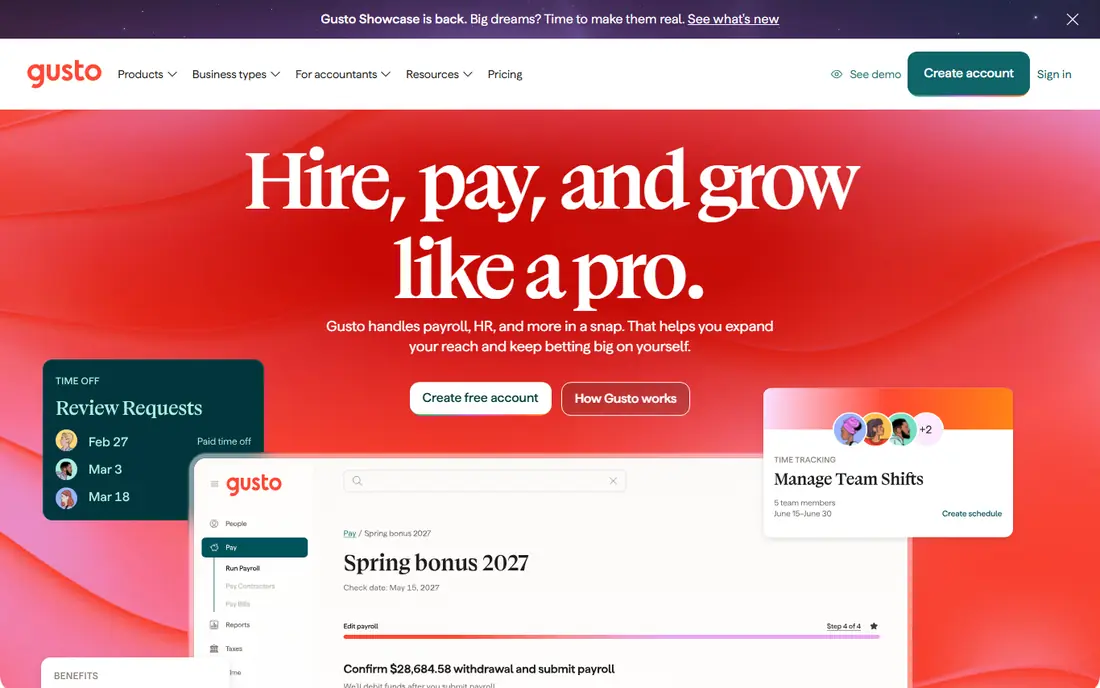
Gusto is the easiest pick for a small US business hiring its first few employees. New hires enter their details, sign forms and set up direct deposit, and payroll runs from the same record. The pricing is published clearly, which makes budgeting simple, and the interface is friendly for owners who are not HR specialists.
The limit is depth. Larger teams, multi-state complexity and global hiring push Gusto beyond its comfort zone, and the richer HR features require the higher plans. For a local team that wants payroll done right and onboarding kept simple, that trade is usually worth it.
- Simple payroll plus onboarding in one place
- Clear published pricing
- Helpful compliance prompts
- US focused
- Advanced HR tools sit on higher tiers
Deel is built for teams that hire in more than one country. Its HR plans cover employee records and onboarding, while its employer of record service handles workers where the company has no local entity. That combination is hard to match with a US-only HR tool.
Pricing needs a close read. The low HR starting rate is not the same as the cost of employing someone through Deel in another country, where fees are per employee per month and much higher. Still, for a distributed team, Deel removes a lot of the paperwork that otherwise lands on HR and legal.
- Global hiring and compliance support
- HR tools for distributed teams
- Contractor options
- Employer of record pricing is far higher
- Local rules still need care
Zoho People is the value pick in this list. The free plan covers up to three users, and paid plans start low, which makes it a good fit for a very small team or a startup testing a formal onboarding process. Checklists, forms and employee records are covered, and it connects well with Zoho Books, Zoho CRM and other Zoho apps.
The weakness is polish. Onboarding workflows are solid but less guided than BambooHR or Rippling, and teams that want deep automation may outgrow it. If price is the main constraint and the team already uses Zoho, it is hard to beat.
- Low entry price
- Free plan for up to three users
- Fits the wider Zoho suite
- Interface feels dated in places
- Onboarding depth is lighter than leaders
HiBob, often called Bob, targets mid-size companies that have outgrown basic HR tools. Onboarding flows, task lists and documents are handled in a modern interface that employees tend to like, and the system is designed for teams spread across countries and time zones.
The main drawback is pricing transparency. HiBob does not publish a starting rate, so you need a quote and a clear list of what is included. Payroll is handled through integrations and partners rather than as a single built-in product in every market. For a growing international team, that is manageable, but budget planning takes an extra call.
- Modern interface
- Good for multi-country teams
- Strong onboarding workflows
- Quote-only pricing
- Payroll needs partners or add-ons
Workday is the enterprise answer to onboarding. It ties hiring, HR records, payroll and finance together, with audit trails and controls that large, regulated companies need. For a multinational with thousands of employees, that single system can replace several disconnected tools.
For everyone else, Workday is too much. Pricing is custom, implementation can take months, and small teams will pay for depth they never use. It belongs on this list because it is the standard at the top end, not because most readers should buy it.
- Deep HR and finance integration
- Strong global compliance
- Proven at scale
- Expensive and slow to implement
- Overkill for small teams
Paycor suits US employers in the mid-market that need payroll, HR and onboarding together. New hire forms, tax documents and onboarding tasks sit alongside payroll, which cuts down on double entry. For businesses with fewer than 50 employees, Paycor publishes a starting plan, which helps with early budgeting.
Larger teams move to quote-based pricing, and the range of features can feel crowded at first. Teams that already run payroll elsewhere may also find overlap. Still, for a US company that wants one vendor for payroll and onboarding, Paycor is a serious option.
- US payroll depth
- HR and onboarding in one platform
- Published small-business pricing
- Quote-based pricing for larger teams
- Interface can feel busy
Factorial is popular with small and mid-size teams in Europe, and it has grown into other markets too. Onboarding, documents, time off and employee records are covered in one place, and the interface is approachable for teams without a dedicated HR department.
The catch for US readers is payroll. Factorial is not a full US payroll replacement in the way Gusto or Paycor is, so American teams may need a separate payroll tool. Pricing is also quote-based, so a demo is needed to get a firm number. For a European or international small team, it is a well-rounded pick.
- Broad HR coverage for small teams
- Document and time-off tools included
- Good value in Europe
- US payroll depth is limited
- Pricing is not published in detail
How we picked these
We compared official feature pages, pricing pages and app store listings, plus public reviews, and we kept only tools that handle onboarding as a core job: forms, e-signatures, task checklists and employee records. We favored tools that connect onboarding to payroll, benefits or IT access, and we noted where pricing was published and where it required a quote. We did not claim hands-on testing, and prices were checked against vendor and comparison sources in October 2026.
What to check before you buy
Start with the documents your new hires must actually complete, including tax forms, right-to-work checks and any state forms. A tool that handles those well saves more time than one with a long feature list. Next, check who owns each task: HR, the hiring manager, IT and payroll all need clear steps, and reminders should go to the right person automatically.
Then look at the total price, not the headline rate. Add payroll, benefits, background checks and any per-employee fees, and ask whether implementation or training is charged separately. Finally, run a trial with one real hire if you can. A checklist that looks good in a demo can still feel clumsy when a manager is trying to complete it on a phone on day one.
Sources
- https://www.bamboohr.com/pricing
- https://www.rippling.com/pricing
- https://www.gusto.com/pricing
- https://www.deel.com/pricing
- https://www.zoho.com/people/pricing.html
- https://www.hibob.com/pricing
- https://www.workday.com/en-us/products/human-capital-management.html
- https://www.paycor.com/pricing
- https://www.factorialhr.com/pricing
Frequently asked questions
What is the best employee onboarding software for a small business?
For most small US teams, Gusto or BambooHR is the simplest starting point. Gusto wins when payroll is the priority, while BambooHR wins when clean HR records and checklists matter most. Zoho People is the cheapest route if the budget is tight.
What is the best HR onboarding software for remote teams?
Rippling and Deel are the strongest for remote and distributed teams. Rippling ties onboarding to IT access and payroll, while Deel is better when hires are in different countries. Both need a careful look at module pricing before signing.
How much does employee onboarding software cost?
Small teams can start from around $4 to $10 per employee per month, or a flat monthly fee plus a per-person charge. Mid-market and enterprise tools are often quote-based and cost far more once payroll, benefits and implementation are added.
Can onboarding software handle e-signatures and tax forms?
Yes, most tools on this list include e-signatures and standard new-hire forms. Tax and compliance forms vary by country and state, so confirm that your location and worker type are covered before you commit.
Do I need separate payroll software with an onboarding tool?
It depends. Gusto, Paycor and Rippling include payroll options, while BambooHR, HiBob and Factorial treat payroll as an add-on or partner integration. If you already have payroll you like, a records-first tool may be enough.