Best ERP Software for Manufacturing in 2026: 9 Systems Compared
By ToolNimba Editorial Team November 7, 2026 9 min read

- Top pick
 SAP S/4HANA
Large enterprise manufacturing
Starting priceSee websiteCheck out SAP S/4HANARead our review - Runner-up
 Oracle NetSuite
Mid-market scaling
Starting priceSee websiteCheck out Oracle NetSuiteRead our review - Also great
 Microsoft Dynamics 365
Microsoft ecosystem makers
Starting price$80 per user per monthCheck out Microsoft Dynamics 365Read our review
How we researched this
We compared official pricing and feature pages, app store listings, privacy policies and public user reviews. Prices change, so check the provider's site before you pay.
Key takeaways
- SAP S/4HANA and Oracle NetSuite suit large and mid-market manufacturers that need deep, integrated finance and operations.
- Epicor Kinetic and Infor CloudSuite suit discrete and complex manufacturers that need manufacturing-native workflows.
- Microsoft Dynamics 365 suits companies already invested in Microsoft 365, Teams, and Power BI.
- Odoo and Acumatica suit smaller and growing manufacturers that need lower entry costs or flexible user pricing.
Quick comparison
| Name | Best for | Starting price | Free plan | |
|---|---|---|---|---|
| SAP S/4HANA | Large enterprise manufacturing | See website | No | Visit |
| Oracle NetSuite | Mid-market scaling | See website | No | Visit |
| Microsoft Dynamics 365 | Microsoft ecosystem makers | $80 per user per month | Free trial | Visit |
 Epicor Kinetic | Discrete manufacturing | See website | No | Visit |
 Infor CloudSuite | Industry-specific manufacturing | See website | No | Visit |
 Sage X3 | Process and regulated manufacturing | See website | No | Visit |
 Acumatica | Growing makers, flexible users | See website | Free trial | Visit |
 Odoo | Small makers and startups | See website | Yes | Visit |
 IFS Cloud | Asset-intensive manufacturing | See website | No | Visit |
The best ERP software for manufacturing
Manufacturing ERP must handle bills of material, shop floor scheduling, inventory, purchasing, quality, and finance in one system. We compared official product pages, pricing information, and public reviews, focusing on manufacturing depth, deployment options, and total cost, not just licence price.
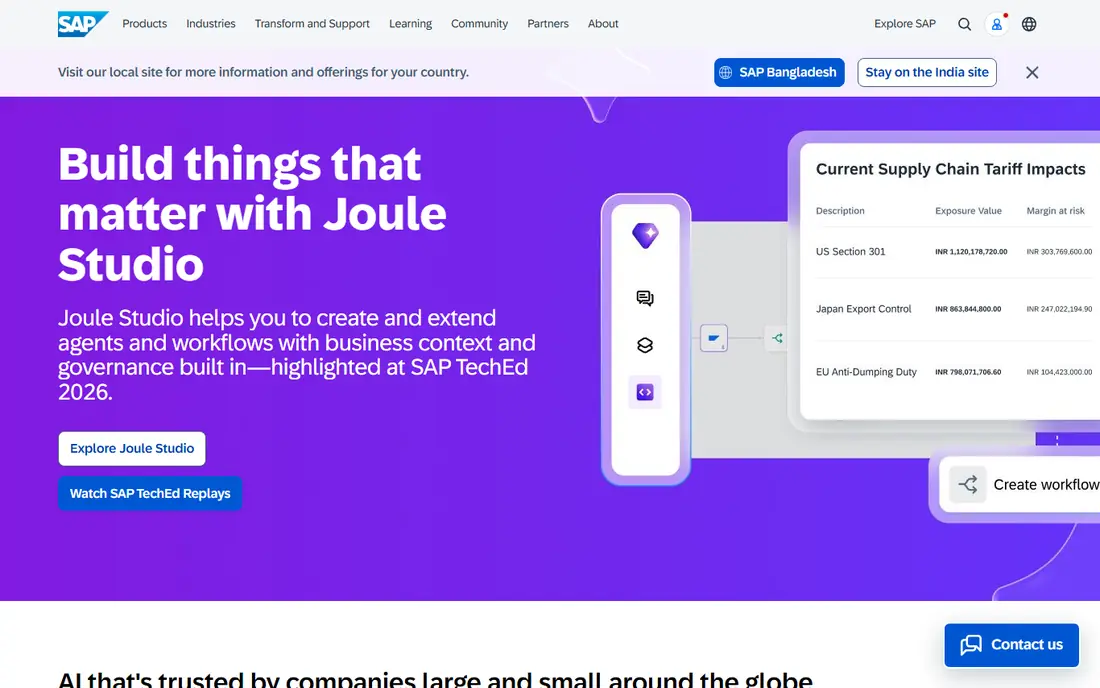
SAP S/4HANA, now sold as SAP Cloud ERP, is the benchmark for large manufacturers running multiple plants, countries, and product lines. It covers production planning, materials management, quality, warehouse, and finance in one integrated system, with real-time data that supports complex supply chains. The public cloud edition suits companies willing to standardise processes, while private cloud options allow more customisation.
Cost and change are the real barriers. Pricing is quote-based, implementation often runs into six or seven figures for large sites, and a successful rollout needs strong internal ownership. Smaller manufacturers will find it too large and too rigid. For a global maker above a certain scale, however, SAP depth and ecosystem are difficult to match.
- Deepest manufacturing and finance integration
- Global multi-plant support
- Strong partner ecosystem
- Quote-based enterprise pricing
- Implementation is a major programme
- Standardisation limits customisation on public cloud
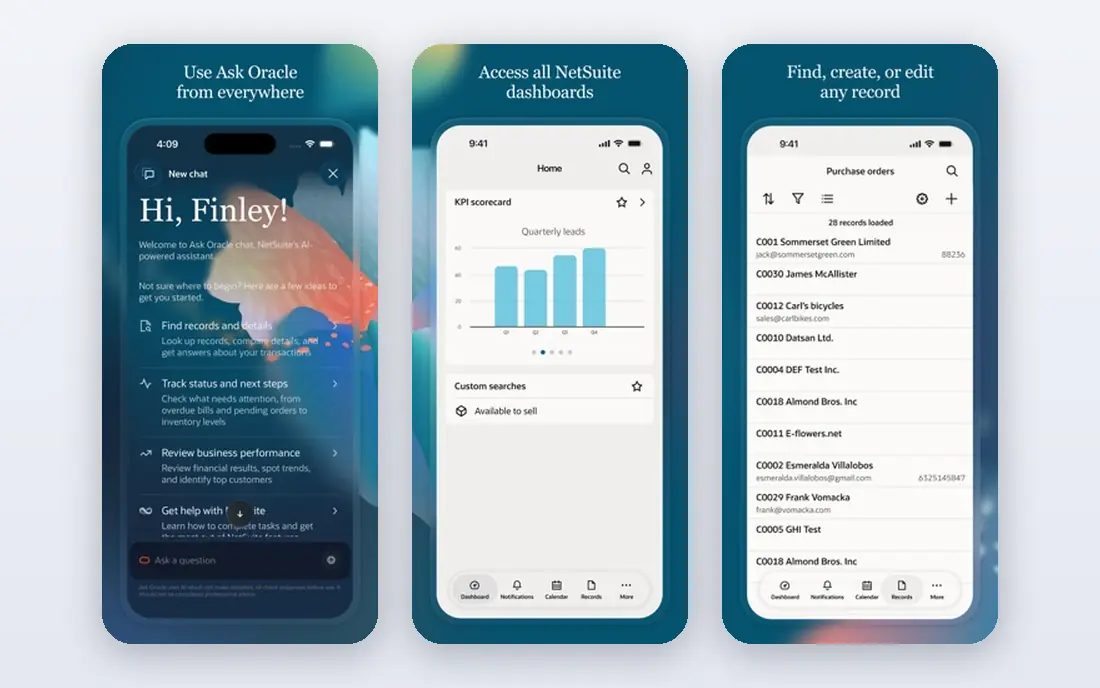
Oracle NetSuite suits fast-growing mid-market manufacturers that want finance, inventory, order management, and manufacturing in one cloud system. Third-party comparisons list a base licence around $999 per month plus per-user fees, though exact pricing is quote-based and depends on modules and users. Multi-entity, multi-currency, and multi-location support help companies expanding into new markets or subsidiaries.
Manufacturing depth is strong for many discrete and light process makers, but complex shop floor or advanced planning needs may require add-ons or partner extensions. Implementation also needs careful scoping, since module choices drive both cost and timeline. For a scaling manufacturer that values a single cloud suite, NetSuite is a strong default shortlist entry.
- Cloud-only suite for finance, inventory, and manufacturing
- Multi-entity and multi-currency support
- Fast to deploy for its class
- Base licence plus per-user fees add up
- Manufacturing depth varies by module
- Customisation needs partner skill
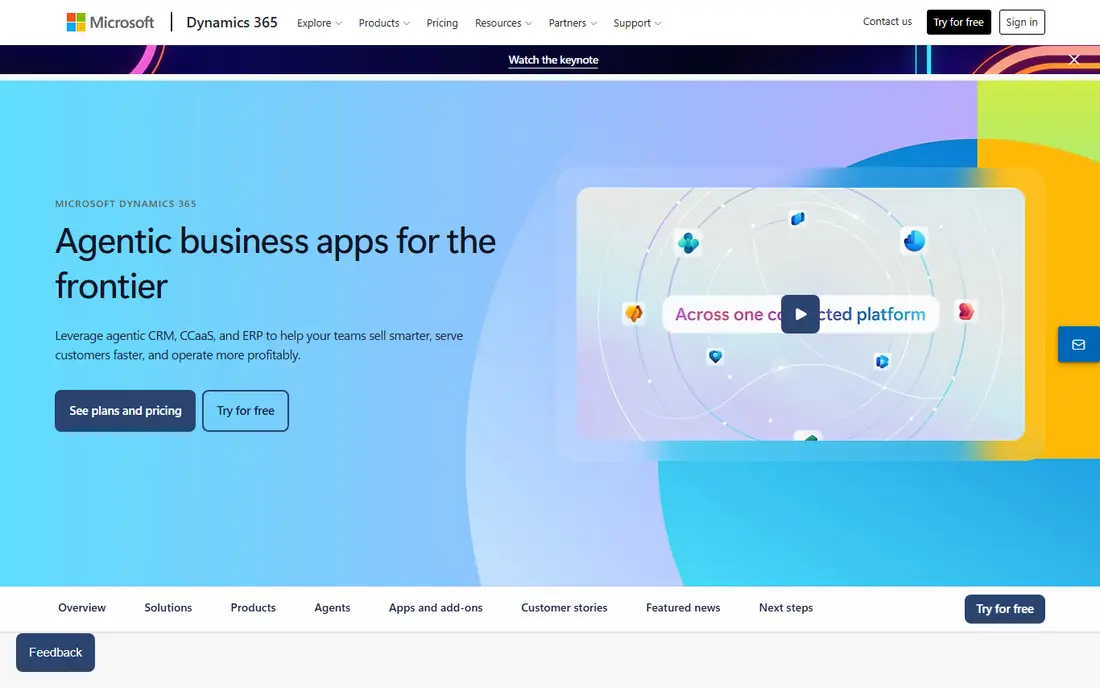
Microsoft Dynamics 365 covers manufacturing through two main paths: Business Central for smaller and mid-sized makers, and Dynamics 365 Supply Chain Management for larger operations. Business Central Essentials is listed at $80 per user per month, with Premium at $110 per user per month adding manufacturing and service management. That Microsoft integration, from Outlook and Teams to Excel and Power BI, reduces training friction for many teams.
Licensing complexity is the drawback, since the right tier depends on user roles, modules, and company size. Implementation is partner-led, so partner quality matters as much as the software itself. For a manufacturer already standardised on Microsoft tools, Dynamics 365 offers a natural, well-supported path.
- Strong Microsoft 365, Teams, and Power BI integration
- Business Central for smaller makers
- Supply Chain Management for larger sites
- Manufacturing needs Premium in Business Central
- Implementation is partner-led
- Licensing has many tiers
Epicor Kinetic is built for discrete manufacturers, job shops, and engineer-to-order companies, with deep support for bills of material, scheduling, shop floor control, and quality. Third-party comparisons list subscription pricing around $100 to $200 per user per month, though exact pricing is quote-based and depends on modules and users. Cloud and on-premise deployment options give makers flexibility on hosting.
Implementation is a serious project, with manufacturing-focused consulting costs that can exceed licence fees in the first year. Companies outside manufacturing will find the focus narrow. For a discrete maker that lives on the shop floor, however, Kinetic workflows feel purpose-built in a way that generalist ERPs do not always match.
- Manufacturing-native design for discrete makers
- Strong job shop and engineer-to-order support
- Cloud or on-premise deployment
- Quote-based pricing
- Implementation can be costly
- Focus limits appeal outside manufacturing
Infor CloudSuite, including CloudSuite Industrial for discrete manufacturing, offers industry-specific workflows for automotive, aerospace, defence, food, and other complex makers. Planning, scheduling, inventory, and supply chain tools are tuned for those industries, rather than generic templates. Cloud hosting on AWS and regular updates appeal to companies that want to avoid managing infrastructure.
Pricing is quote-based, and large implementations need experienced partners, which adds cost and timeline risk. Smaller makers may find the platform larger than needed. For a complex manufacturer with industry-specific compliance or planning needs, Infor industry editions are worth a detailed demo against Epicor and SAP.
- Industry-specific editions for discrete and process makers
- Strong planning and supply chain tools
- AWS cloud hosting
- Quote-based pricing
- Implementation is complex for large sites
- Partner dependence for customisation
Sage X3 suits mid-market manufacturers in food, beverage, chemicals, pharmaceuticals, and other regulated or process industries, where batch tracking, quality control, and compliance matter. It combines finance, purchasing, inventory, production, and sales in one system, with multi-site and multi-currency support for companies operating across borders. That finance strength helps controllers who need reliable costing and reporting.
Pricing is quote-based, and implementation depends heavily on partner skill, so reference customers in your industry matter. The interface also feels less modern than some cloud-native rivals. For a process maker that prioritises financial control and traceability, Sage X3 remains a credible, proven option.
- Strong finance and inventory control
- Process manufacturing support
- Multi-site and multi-legislation capabilities
- Quote-based pricing
- Implementation needs partner expertise
- Interface feels older than some rivals
Acumatica stands out because it does not charge per user. Instead, pricing is based on resources such as transaction volume, which suits manufacturers with many shop floor, warehouse, and office users who only touch the system occasionally. Cloud manufacturing, inventory, and distribution modules cover the core needs of a growing maker, with a modern web interface.
Resource-based pricing needs careful modelling, since a busy season or a surge in transactions can raise costs. Exact pricing is quote-based through partners, so get a written estimate at your actual volume. For a growing manufacturer that would pay heavily under per-seat pricing, Acumatica offers a flexible and often cheaper alternative.
- Unlimited users with resource-based pricing
- Cloud manufacturing and distribution
- Good for user-heavy teams
- Quote-based pricing through partners
- Spend tracks transaction volume
- Manufacturing depth varies by edition
Odoo is the lowest-cost entry point for a small manufacturer that needs basic manufacturing, inventory, purchasing, and sales without an enterprise budget. Its modular app structure lets a startup start with inventory and manufacturing, then add CRM, accounting, or e-commerce as needed. An open source community edition is available for self-hosting, while Odoo Online and Odoo.sh offer managed options.
Depth is the trade-off. Complex planning, advanced shop floor control, and industry-specific compliance are lighter than in Epicor, Infor, or SAP, and implementation quality varies by partner. For a small maker with straightforward production, Odoo offers remarkable value. For a complex plant, use it as a stepping stone, not as a final enterprise system.
- Low entry cost with modular apps
- Manufacturing, inventory, and sales in one platform
- Open source option available
- Manufacturing depth is lighter than Epicor or SAP
- Implementation quality varies
- Add-ons can fragment the system
IFS Cloud suits asset-intensive and project-based manufacturers, including aerospace, defence, energy, and industrial equipment makers that combine manufacturing with maintenance and field service. Enterprise asset management, project management, and service tools sit alongside manufacturing and finance, which helps companies that sell, maintain, and service complex equipment.
Pricing is quote-based and enterprise-scale, and implementation is a major programme, so smaller makers should look at Acumatica, Odoo, or Business Central instead. For a large, asset-heavy manufacturer, IFS offers a unified platform that generalist ERPs struggle to match without extensive customisation.
- Strong for aerospace, defence, energy, and project manufacturing
- Enterprise asset management
- Project and service integration
- Quote-based enterprise pricing
- Implementation is large-scale
- Overkill for simple discrete makers
How we picked these
We compared official product pages, pricing information, and public reviews, and we favoured systems that are actively sold for manufacturing, support bills of material, scheduling, inventory, and finance, and offer cloud or hybrid deployment. Where pricing is quote-based, we say so rather than presenting a third-party estimate as a list price. Always request a written quote at your user count, modules, and transaction volume.
How to choose without underestimating total cost
Licence price is only part of an ERP budget. Implementation, data migration, training, partner consulting, and ongoing support often exceed the first year licence cost, especially for SAP, Oracle, Infor, and IFS. Build a five-year total cost model, including internal staff time, before comparing vendors on monthly price alone.
Run a pilot on your hardest products
Demo with your most complex bill of material, a rush order, a partial shipment, and a quality hold. A system that handles simple products well but struggles with variants, lot tracking, or engineer-to-order changes will fail where it matters most. Involve shop floor, warehouse, finance, and quality staff in that pilot, not just IT.
Sources
Frequently asked questions
What is the best ERP software for manufacturing?
There is no single best system, since fit depends on size and type. SAP S/4HANA suits large enterprises, NetSuite suits scaling mid-market makers, Epicor Kinetic suits discrete manufacturers, and Odoo suits small makers on a budget.
How much does manufacturing ERP cost?
Licence costs range from low Odoo pricing to quote-based enterprise pricing for SAP, Infor, and IFS, with mid-market systems often costing $80 to $200 per user per month or more. Implementation, migration, and support can add tens or hundreds of thousands of dollars in the first year.
Is cloud or on-premise ERP better for manufacturing?
Cloud ERP suits most growing manufacturers, since it reduces infrastructure work and delivers regular updates. On-premise or private cloud suits makers with strict data, latency, or customisation requirements, and Epicor, SAP, and Infor all offer options beyond public cloud.
How long does ERP implementation take?
Small manufacturers can go live in a few months on Business Central or Odoo, while mid-market and enterprise rollouts often take six to eighteen months. Timeline depends on data quality, customisation, integrations, and how much change management the shop floor needs.
Can ERP software handle both discrete and process manufacturing?
Some systems handle both, including SAP, NetSuite, and Sage X3, while others specialise, such as Epicor for discrete and Sage X3 for process makers. Check batch tracking, formula management, and shop floor workflows for your specific production type before choosing.