Best Event Apps for Conferences in 2026: 9 Apps Compared
By ToolNimba Editorial Team November 7, 2026 10 min read

- Top pick
 Whova
Attendee engagement at conferences
Starting priceSee websiteCheck out WhovaRead our review - Runner-up
 Eventbrite
Simple public ticketed events
Starting priceFreeCheck out EventbriteRead our review - Also great
 Cvent
Enterprise conference programs
Starting priceSee websiteCheck out CventRead our review
How we researched this
We compared official pricing and feature pages, app store listings, privacy policies and public user reviews. Prices change, so check the provider's site before you pay.
Key takeaways
- Whova is our pick for attendee engagement at academic and association conferences, with networking, agendas and community boards in one app.
- Eventbrite is the simplest choice for public ticketed events, with free publishing for free events and per-ticket fees on paid events.
- Cvent suits large enterprise conference programs that need venue sourcing, registration and analytics in one system.
- Swapcard is best for trade shows and exhibitor-led events, with AI matchmaking from $610 per year.
- RingCentral Events is the strongest virtual-first option, while Guidebook and EventMobi serve budget-conscious and highly customized events.
Quick comparison
| Name | Best for | Starting price | Free plan | |
|---|---|---|---|---|
| Whova | Attendee engagement at conferences | See website | No | Visit |
| Eventbrite | Simple public ticketed events | Free | Yes | Visit |
| Cvent | Enterprise conference programs | See website | No | Visit |
 Swapcard | Trade shows and AI networking | $610 per year | No | Visit |
 Bizzabo | Corporate marketing events | $17,999 per year | No | Visit |
 EventMobi | Highly customized events | See website | No | Visit |
 Guidebook | Budget-conscious organizations | See website | No | Visit |
 RingCentral Events | Virtual and hybrid conferences | $99 per month | Free trial | Visit |
 Accelevents | Hybrid in-person and virtual events | $7,500 per event | No | Visit |
The best event apps for conferences
A good conference app does more than show an agenda. It helps attendees find sessions, meet the right people, check in quickly and stay informed when plans change. Organizers, meanwhile, need registration, ticketing, analytics and on-site tools that work under pressure. Here are nine apps that cover conferences from small community gatherings to large enterprise programs.
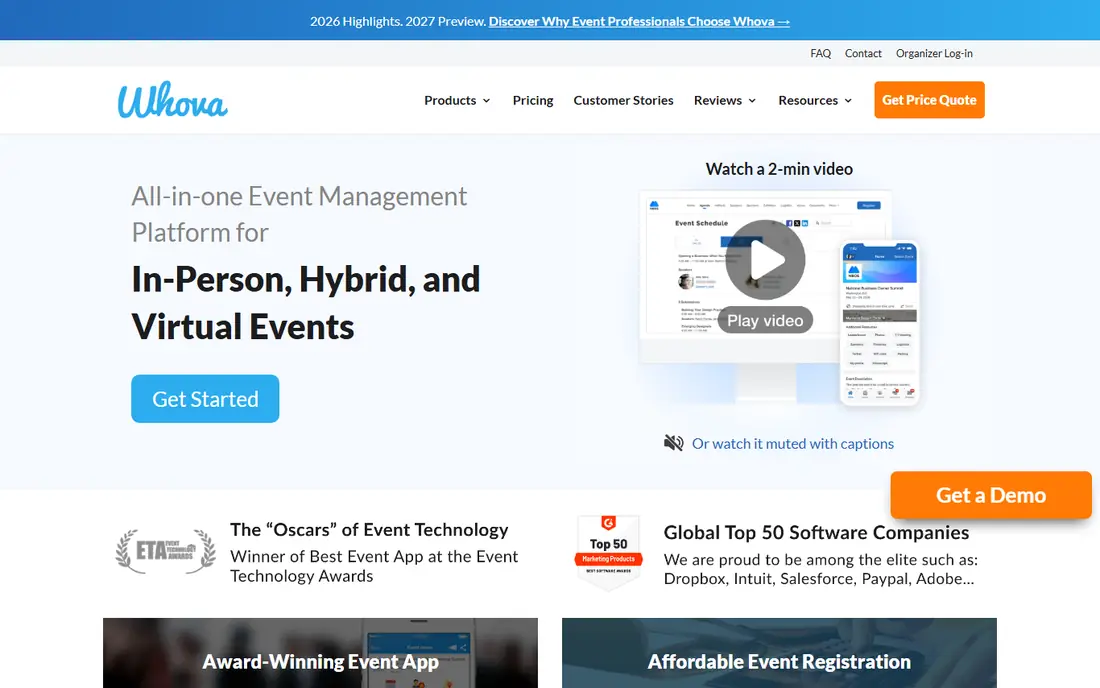
Whova is the engagement-first choice for conferences, especially academic, association and community events. Attendees get personalized agendas, speaker profiles, session details, live polls and community boards where they can post questions, arrange meetups and share photos. AI matchmaking suggests people to meet based on interests, which helps first-time attendees who do not know anyone at the event.
The main drawback is pricing transparency. Whova does not publish a starting price, so organizers must request a quote, and costs are typically quoted per event based on attendee numbers. Backend customization is also more limited than enterprise platforms like Cvent. If attendee interaction is your top priority and you can work through a quote process, Whova is the app most likely to keep attendees opening it all day.
- Strong attendee networking and community boards
- Agenda and speaker tools
- Popular with academic conferences
- No published price, so budgeting needs a quote
- Limited backend customization
- Attendee data controls are restricted
Eventbrite is the simplest way to publish and ticket a public event. Creating a free event costs nothing, and paid events carry a service fee of 3.7 percent plus $1.79 per ticket, plus a 2.9 percent payment processing fee per order, with fees paid by ticket buyers by default unless the organizer absorbs them. The built-in marketplace helps people discover your event, and the organizer app handles check-in and sales tracking.
The trade-off is depth. Eventbrite's attendee experience is simpler than a dedicated conference app, with less networking, matchmaking and session interaction, and customization options are limited. For conferences under a few hundred attendees, community events and public ticketed gatherings, that simplicity is a strength. For large multi-track conferences with complex agendas, a dedicated conference platform will serve attendees better.
- Free to publish free events
- Built-in event discovery
- Easy setup and organizer app
- Per-ticket fees add up on paid events
- Limited customization
- Attendee app is simpler than Whova
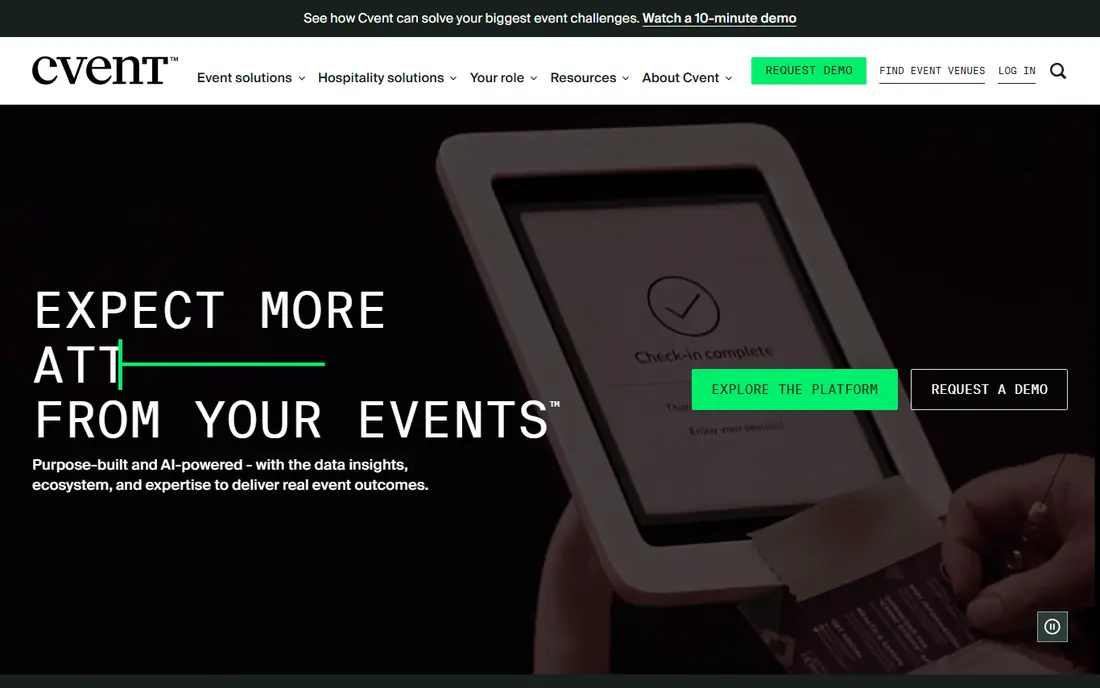
Cvent is the enterprise standard for conference programs that run many events a year. It covers registration, venue sourcing through a large marketplace, attendee engagement, on-site check-in and reporting, with more than 200 integrations to connect event data to CRM and marketing systems. For organizations that need consistent processes across dozens of events, that breadth is hard to match.
The cost and complexity rule it out for small events. Pricing is quote-based and typically runs to five figures per year, and the platform takes time to learn and configure. Small organizers will find Cvent slow and expensive for a single conference. Large enterprises, associations and companies with complex, multi-event programs are the audience Cvent is built for, and for them it is the most complete option here.
- End-to-end registration, venue sourcing and analytics
- Huge integration range
- Scales to large programs
- Quote-based pricing only
- Steep learning curve
- High cost for small events
Swapcard is built for B2B trade shows and exhibitor-led events, where the value of attending comes from meeting the right people and capturing leads. Its AI matchmaking recommends attendees, exhibitors and sessions, and exhibitors get lead capture tools that feed directly into follow-up. Self-service plans start from $610 per year, which makes Swapcard accessible to smaller trade shows as well as large expos.
The limits are scope and pricing at the top end. Swapcard is overkill for a simple ticketed lecture or community gathering, and enterprise features for large shows are quote-based. Organizers should also plan setup time carefully, since matchmaking works best when attendee profiles are complete. If your event is a trade show where networking and exhibitor ROI matter most, Swapcard is the strongest fit on this list.
- AI matchmaking and lead capture
- Self-service plans from $610 per year
- Strong for exhibitors
- Less suited to simple ticketed events
- Higher tiers are quote-based
- Setup takes planning for large shows
Bizzabo is a marketing-led event platform for corporate conferences and branded experiences. It combines registration, a branded event website and mobile app, virtual event production and analytics, with integrations to marketing systems such as HubSpot. The attendee experience is polished, and organizers get clear reporting on registration, engagement and pipeline impact.
The price starts at $17,999 per year, which makes Bizzabo a poor fit for a single small conference but reasonable for a company running several marketing events a year. Some reviewers also note fewer advanced data controls than enterprise rivals. If your events are marketing investments and you need branding, analytics and a consistent experience across a yearly program, Bizzabo earns its price. If you run one event, a cheaper platform will do.
- Strong branding and event marketing tools
- Built-in analytics
- Polished attendee experience
- High starting price
- Fewer advanced data controls than some rivals
- Best for annual programs, not one-off events
EventMobi suits organizers who need a conference app that matches their event exactly, rather than a standard template. It offers hundreds of customization templates, a native app that works offline in venues with weak Wi-Fi, and pricing models that include per-attendee options starting around $1 per product per attendee in some reports. Registration, agendas, networking and live polling are all included.
The downside is that pricing is not published, so budgeting requires a conversation, and deep customization takes time to configure well. EventMobi is also a smaller vendor than Cvent, which matters for organizations that need a large vendor's support network. For technical teams and organizers with specific workflows, the flexibility is worth it. For simple events, a simpler tool will be faster.
- Deep customization with hundreds of templates
- Strong offline app
- Per-attendee pricing options
- No published starting price
- Customization takes time
- Smaller brand than Cvent
Guidebook is a practical choice for universities, associations and organizations that run many events on a tight budget. Its native mobile app works offline, which matters in large venues and older buildings, and some plans allow unlimited events, so the cost does not rise with every additional gathering. Agendas, maps, speaker lists and attendee messaging cover the core conference needs without excess complexity.
The trade-offs are pricing transparency and marketing depth. Guidebook pricing is quote-based, although it is generally positioned below enterprise platforms, and its marketing and analytics tools are lighter than Bizzabo's. The interface is functional rather than flashy, which suits academic and association audiences but may disappoint brands that want a highly polished look. For high-volume, budget-conscious organizers, Guidebook is a dependable workhorse.
- Native offline app
- Unlimited events on some plans
- Popular with universities and associations
- Pricing is quote-based
- Fewer marketing tools than Bizzabo
- Interface is functional rather than flashy
RingCentral Events, formerly Hopin, is built for virtual-first and hybrid conferences. It offers multi-stage virtual venues, breakout rooms, networking areas and streaming tools that scale to tens of thousands of attendees, with paid tiers starting from $99 per month and a 30-day free trial. For a conference with a large remote audience, that virtual experience is stronger than bolting a livestream onto an in-person app.
The limits are expo depth and total cost. Virtual expo booths feel basic compared with dedicated trade show platforms, and ticket fees and add-ons can raise the bill beyond the subscription price. Purely in-person conferences will also get more value from an app built around on-site agendas and check-in. If your audience is largely remote or hybrid, RingCentral Events is the most capable virtual-first option here.
- Virtual venues that scale to large audiences
- Breakout rooms and networking
- 30-day free trial
- Expo booths feel basic
- Costs rise with ticket fees and add-ons
- Less focused on purely in-person events
Accelevents is an all-in-one platform for hybrid events, covering registration, ticketing, mobile apps, virtual venues, lead capture and analytics in one system. Pricing starts at $7,500 per event, which reflects its positioning for professional conferences that serve both an in-person audience and a remote audience at the same time. Organizers get one system for both audiences instead of stitching together separate tools.
That price rules it out for small or single-track events, and there is no free plan to test it cheaply. For mid-size and large conferences with a genuine hybrid audience, though, the unified approach saves coordination effort and gives cleaner analytics across both audiences. If your event is fully in person, a cheaper conference app will cover your needs for far less.
- True hybrid support for in-person and virtual audiences
- All-in-one registration and engagement
- Strong analytics
- High per-event price
- Overkill for small events
- No free plan
How we picked these
We compared official feature pages, pricing pages and recent 2026 comparisons of event platforms, and we favored apps with a real product, a clear conference use case and published or widely reported pricing. Where pricing was quote-based, we said so rather than inventing a figure. We did not claim hands-on testing; our comparison is based on vendor pages, pricing pages and public reviews.
Choosing an app for your conference size
Small public events under 500 attendees are usually best served by Eventbrite, with its free publishing and built-in discovery. Mid-size conferences that need agendas, networking and engagement should shortlist Whova, Swapcard or Guidebook, depending on whether attendees, exhibitors or budget matter most. Large enterprise programs should compare Cvent, Bizzabo and Accelevents on registration complexity, analytics and total annual cost, not just the subscription price.
Whatever size you choose, test the attendee app before event day. Load a real agenda, test check-in on the devices your staff will use, and check offline behavior in the venue if Wi-Fi is uncertain. The best conference app is the one attendees actually open, and that depends as much on a clear agenda and good session data as on the platform itself.
Sources
- https://whova.com
- https://www.eventbrite.com
- https://www.cvent.com
- https://www.swapcard.com
- https://www.bizzabo.com
- https://www.eventmobi.com
- https://guidebook.com
- https://www.ringcentral.com
- https://www.accelevents.com
- https://eventify.io/blog/event-management-apps
- https://www.nunify.com/blogs/cvent-alternatives
- https://www.engineerica.com/conferences-and-events/post/best-event-registration-platforms/
Frequently asked questions
What is the best event app for conferences?
Whova is the best all-round conference app for attendee engagement, especially at academic and association events. Eventbrite is best for simple public ticketed events, Cvent for large enterprise programs, and Swapcard for trade shows where exhibitor networking matters most.
Are there free event apps for conferences?
Eventbrite is free to publish free events, although paid events carry per-ticket fees. RingCentral Events offers a 30-day free trial, and some platforms offer free tiers for small virtual events. Most dedicated conference apps, including Whova and Cvent, are paid and quote-based.
How much does a conference app cost?
Prices range widely. Eventbrite is free for free events with per-ticket fees on paid tickets, Swapcard self-service plans start from $610 per year, RingCentral Events starts from $99 per month, and Accelevents starts at $7,500 per event. Enterprise platforms such as Cvent and Bizzabo start at five figures per year.
Do conference apps work offline?
Some do. Guidebook and EventMobi offer native offline apps that keep agendas and maps available without Wi-Fi, which helps in large venues. Other apps are web-based and need a connection, so check offline support if your venue has weak coverage.
Can attendees network through a conference app?
Yes, most dedicated conference apps include networking features. Whova offers community boards and AI matchmaking, Swapcard focuses on AI matchmaking and lead capture for trade shows, and RingCentral Events offers virtual networking rooms for remote attendees.
What is the best app for a hybrid conference?
RingCentral Events and Accelevents are the strongest hybrid options, since both serve in-person and virtual audiences in one platform. RingCentral Events is better for virtual-first events, while Accelevents suits professional conferences with a substantial audience in both formats.