Best Event Management Software in 2026: 8 Platforms Compared
By ToolNimba Editorial Team October 29, 2026 8 min read

- Top pick
 Eventbrite
Public ticketed events
Starting priceFreeCheck out EventbriteRead our review - Runner-up
 Cvent
Enterprise event portfolios
Starting priceSee websiteCheck out CventRead our review - Also great
 Whova
Conference engagement and networking
Starting priceSee websiteCheck out WhovaRead our review
How we researched this
We compared official pricing and feature pages, app store listings, privacy policies and public user reviews. Prices change, so check the provider's site before you pay.
Key takeaways
- Eventbrite is the easiest start for public ticketed events, while Cvent, Bizzabo, and Stova suit complex enterprise programs.
- Whova stands out for attendee engagement and networking at conferences, and RingCentral Events suits virtual-first events.
- Most enterprise event platforms use quote-based pricing, so request a full quote including support, onboarding, and per-registrant fees.
- Per-ticket fees look cheap at first but add up fast on large paid events, while flat or annual plans suit repeat events.
- Our pick for most organizers is Eventbrite for simple events and Whova for conferences, with Cvent for large enterprise portfolios.
Quick comparison
| Name | Best for | Starting price | Free plan | |
|---|---|---|---|---|
| Eventbrite | Public ticketed events | Free | Yes | Visit |
| Cvent | Enterprise event portfolios | See website | No | Visit |
| Whova | Conference engagement and networking | See website | No | Visit |
 Bizzabo | B2B event marketing | See website | No | Visit |
 RingCentral Events | Virtual and hybrid conferences | $99 per month | Free trial | Visit |
 Accelevents | Hybrid in-person and virtual events | See website | No | Visit |
 vFairs | Virtual and hybrid expos | See website | No | Visit |
 Swoogo | Complex registration logic | $11,800 per year | No | Visit |
The best event management software
Event management software covers registration, ticketing, event websites, attendee apps, check-in, and reporting. The best choice depends on event size, format, and whether you run one event or a whole portfolio each year.
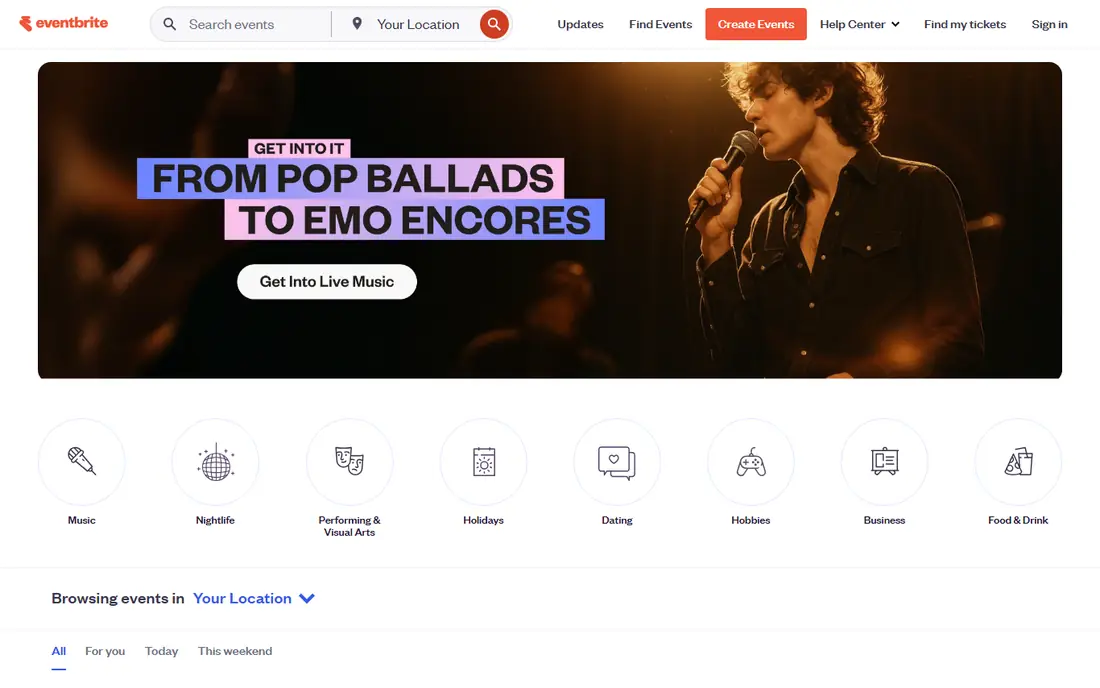
Eventbrite is the fastest way to publish a ticketed event. You create a page, set ticket types, share the link, and attendees check out through a flow they already know. Free events are free to list, and the public marketplace helps small public events reach people who were not on the organizer mailing list.
The limit is scale and control. Paid events carry per-ticket fees, which become a major cost on a large conference, and branding and registration logic are simpler than enterprise tools offer. For classes, concerts, fundraisers, and community events, Eventbrite is still the most practical choice. For a complex multi-track conference, look at Whova or Cvent.
- Easy setup and public event discovery
- Free for free events
- Familiar checkout for attendees
- Per-ticket fees add up on large paid events
- Customization is limited compared with enterprise platforms

Cvent is the enterprise standard for organizations running many events with complex needs. Registration logic, venue sourcing, attendee management, onsite check-in, and reporting sit in one system, which helps large teams keep data consistent across events. It also integrates with CRM and marketing tools that enterprises already use.
Small teams will find Cvent heavy and expensive. Pricing requires a quote, onboarding takes time, and the feature depth that helps an enterprise can slow down a simple event. Choose Cvent when you run a portfolio, need venue sourcing, and must report consistently across dozens of events each year.
- Deep registration, venue sourcing, and reporting
- Suited to large portfolios and complex events
- Strong integrations
- Pricing is quote based and enterprise level
- Learning curve is steep for small teams

Whova earns its place through the attendee experience. The app helps people build agendas, meet other attendees, message exhibitors, and follow sessions, which matters more at a conference than a polished registration form alone. Academic and association conferences use it heavily, because engagement and networking drive repeat attendance.
Organizers who need deep backend customization may find Whova less flexible than Cvent or Swoogo. Pricing is also quote based, so small events should request a quote early and compare it with Eventbrite plus a simple app. For a mid-size conference where attendee experience is the priority, Whova is a strong pick.
- Strong attendee app and networking features
- Agenda, exhibitor, and messaging tools in one place
- Popular with academic conferences
- Pricing is quote based
- Backend customization is more limited than Cvent
Bizzabo is built for marketing-led events, where the event is part of a pipeline and brand story. Event websites, registration, and onsite tools are designed to look polished, and analytics help marketing teams show which sessions and sponsors drove interest. Virtual and hybrid production features support events that mix in-person and remote audiences.
Cost is the main barrier. Annual pricing reported around $17,999 per year in public summaries puts Bizzabo out of reach for small organizers, and data controls are less deep than some enterprise platforms. For B2B teams that run flagship conferences as marketing assets, the branding and analytics justify the price.
- Strong branding and event marketing tools
- Built-in analytics
- Virtual production features
- Annual pricing is high for small teams
- Fewer advanced data controls than some enterprise rivals
RingCentral Events, formerly Hopin, is designed for virtual-first conferences. Attendees move between stages, sessions, networking rooms, and expo areas in a browser, without travel. That format suits global audiences, webinars at scale, and hybrid events where remote attendees need more than a video link.
In-person features are not its strength, and expo booths can feel simpler than a dedicated trade show platform. Pricing starts around $99 per month in public summaries, with higher tiers and ticket fees as events grow. Choose it when virtual reach matters most, and pair it with an onsite tool if your event is mainly in person.
- Multi-stage virtual venues and networking
- Streaming and expo features
- Entry pricing for virtual events
- Virtual expo booths can feel basic
- Costs rise with scale and ticket fees
Accelevents covers the full hybrid event in one platform: registration, event website, mobile app, virtual sessions, badge printing, and exhibitor lead capture. That breadth helps organizers who run the same event for in-person and remote audiences and do not want to stitch together three tools.
Pricing is the catch. Public summaries place entry costs around $7,500 per event, so small events should compare carefully with Eventbrite and a separate app. For mid-size hybrid conferences and trade shows, the all-in-one approach saves integration work and gives attendees one consistent experience.
- All-in-one registration, mobile app, and virtual tools
- Badge printing and lead capture
- Suited to hybrid formats
- Pricing is quote based and event-level costs can be high
- Setup needs planning for complex events
vFairs specializes in virtual environments that feel like a real expo. Exhibitors get booths, attendees browse halls, join sessions, and chat with staff, which suits trade shows, job fairs, and university open days held online. Hybrid options extend that experience to in-person attendees as well.
Teams running a simple in-person conference will find vFairs more virtual than they need, and pricing requires a quote. For virtual expos where booth interaction and sponsor value matter, vFairs is one of the most purpose-built options on this list.
- Immersive virtual expo halls and booths
- Strong for trade shows and job fairs
- Hybrid support
- Pricing is quote based
- In-person features are secondary to virtual design
Swoogo is the choice when registration is the hard problem. Conditional logic lets organizers show different questions, prices, and tracks based on attendee type, session choices, or membership, without building custom forms. That flexibility helps associations and enterprises with complex pricing and multi-track agendas.
The price reflects that focus. At around $11,800 per year in public summaries, Swoogo is an investment for organizations that run repeat complex events, not a one-off workshop. If your event has simple ticketing, Eventbrite will do. If registration logic keeps breaking your current tool, Swoogo solves that exact pain.
- Powerful conditional registration logic
- Flexible event websites
- Strong for complex multi-track events
- Annual price is high for small organizers
- Attendee app and engagement tools are less central than Whova
How we picked these
We compared official product pages, pricing summaries, and public feature descriptions for platforms that handle registration, ticketing, attendee management, or virtual event delivery. We kept only tools that exist today and cover event management as a core use, not single-purpose ticketing widgets alone. We did not claim hands-on testing we did not do, and where pricing is quote based we marked it as See website so organizers request a full quote.
How to choose an event platform without surprises
Start with format and size, then work backward to features. A 50-person workshop needs simple ticketing and check-in, while a 2,000-person conference needs an attendee app, networking, and onsite support. Writing down attendee count, format, ticket types, and must-have integrations will rule out most platforms quickly.
Next, model total cost for your actual event. Include platform fees, per-ticket or per-registrant fees, payment processing, onboarding, and onsite support, because headline prices hide those items. Ask for a written quote that covers all of them, and check contract terms for repeat events. Finally, run a test registration as an attendee and as an organizer before you commit, because a confusing checkout or a slow app will hurt attendance more than a missing feature.