Best HRIS Software in 2026: 9 Platforms Compared
By ToolNimba Editorial Team November 7, 2026 10 min read

- Top pick
 BambooHR
Midsize HR teams that want clarity
Starting price$10 per employee per monthCheck out BambooHRRead our review - Runner-up
 Rippling
Growing teams that also need IT
Starting price$8 per user per monthCheck out RipplingRead our review - Also great
 Gusto
Small US teams led by payroll
Starting price$49 per monthCheck out GustoRead our review
How we researched this
We compared official pricing and feature pages, app store listings, privacy policies and public user reviews. Prices change, so check the provider's site before you pay.
Key takeaways
- BambooHR publishes the clearest HRIS pricing, with Core at $10 per employee per month for larger teams.
- Gusto publishes payroll-led pricing from $49 per month plus $6 per person, which suits small US teams best.
- Rippling starts at $8 per user per month for core modules, but the full platform price depends on which modules you turn on.
- Workday, ADP, and Paylocity are quote only, so budget time for demos and a written quote before you compare totals.
- The best HRIS for a midsize company is the one that covers payroll, time off, and reporting without forcing a second system.
Quick comparison
| Name | Best for | Starting price | Free plan | |
|---|---|---|---|---|
| BambooHR | Midsize HR teams that want clarity | $10 per employee per month | Free trial | Visit |
| Rippling | Growing teams that also need IT | $8 per user per month | No | Visit |
| Gusto | Small US teams led by payroll | $49 per month | No | Visit |
 Workday | Large global enterprises | See website | No | Visit |
 ADP Workforce Now | Midsize to large US employers | See website | No | Visit |
 Paylocity | Midsize teams that want payroll plus talent | See website | No | Visit |
 HiBob | Midsize companies with global teams | See website | No | Visit |
 Deel | Hiring contractors and staff abroad | $49 per month | No | Visit |
 Namely | Midsize teams that want HR plus benefits | See website | No | Visit |
The best HRIS software
An HRIS, or human resource information system, holds employee records, time off, hiring, performance, and often payroll in one place. The platforms below serve different sizes, from small US teams to global enterprises. We compared official pricing pages, published tiers, and module coverage to build this list.
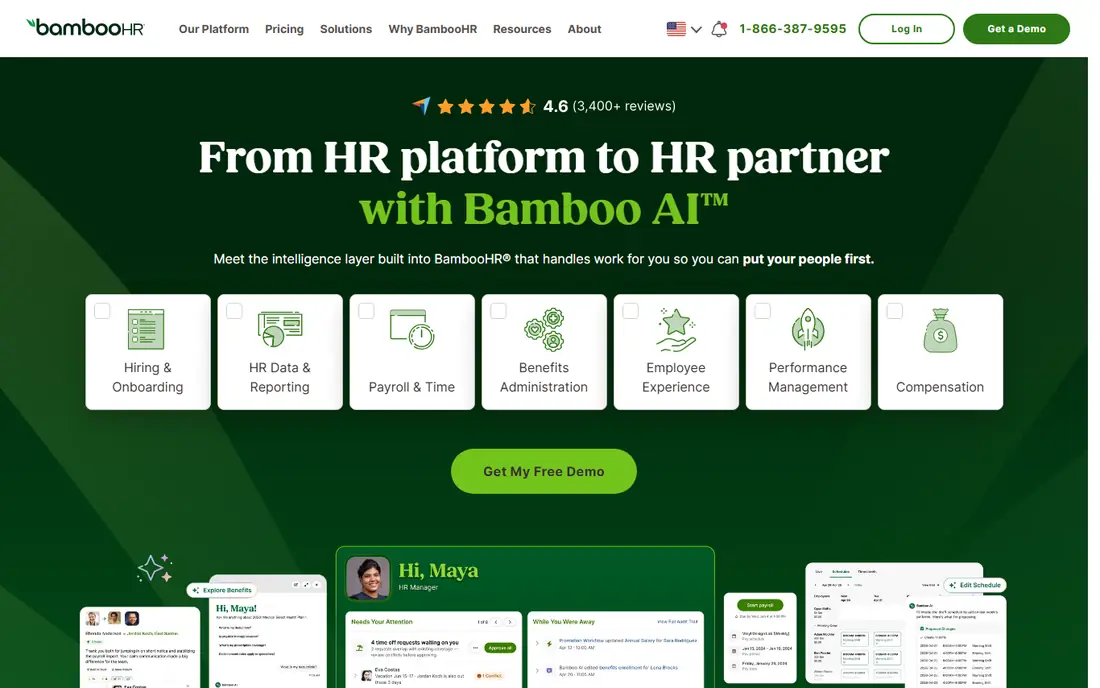
BambooHR offers Core at $10, Pro at $17, and Elite at $25 per employee per month for companies with more than 25 employees. Companies with 25 or fewer employees pay a flat monthly rate starting at $250. Core covers employee records, custom reports, workflows, hiring and onboarding, and time off. Pro adds performance management, goals, and recognition, while Elite adds compensation planning and salary benchmarking.
BambooHR suits midsize teams that want a clean HR system without a long implementation. The gap is payroll, which is a separate add-on, so the headline price is not the full cost if you also need pay runs. Compare Core plus payroll against an all-in-one payroll platform before you decide.
- Clear published pricing
- Strong employee records, time off, and reporting
- Hiring and onboarding included
- Payroll, benefits, and time tracking are paid add-ons
- Small teams pay a flat rate from $250 per month
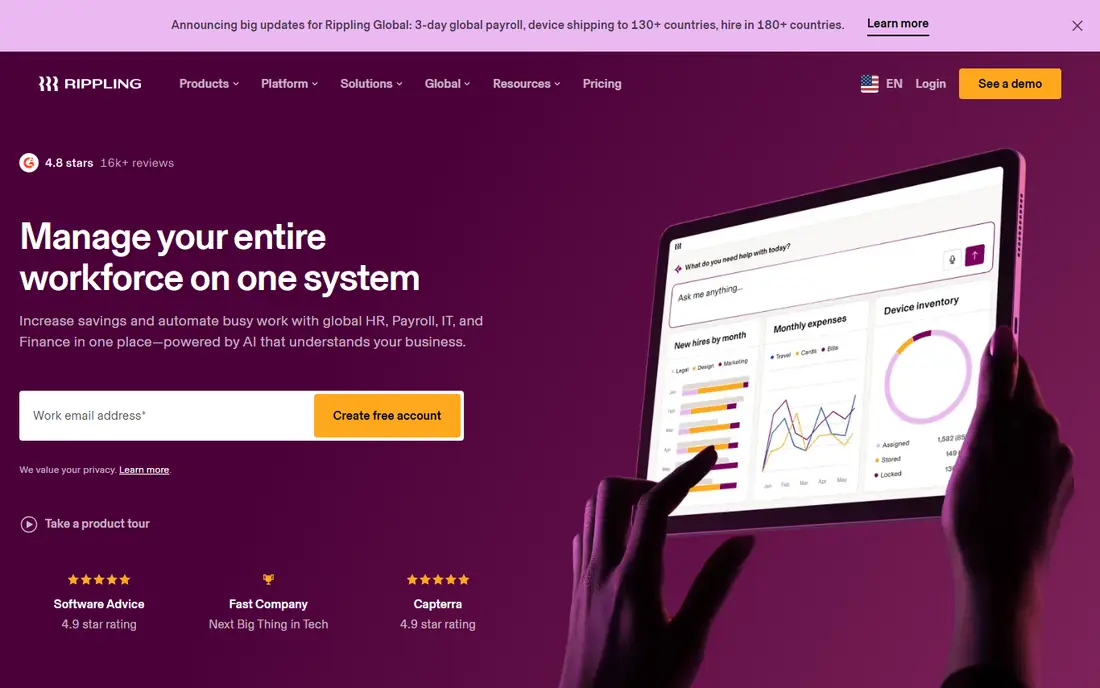
Rippling starts at $8 per user per month plus a base fee for core modules, with payroll, benefits, time tracking, IT device management, and global employment as added modules. Its strength is the single workflow that provisions payroll, benefits, laptop setup, and app access when someone joins, and removes them all when someone leaves. That saves real admin time for remote and fast growing teams.
The risk is budget surprise. Published comparisons put full setups at $21 to $29 per employee per month or more, depending on modules. Rippling suits tech and remote teams that will use IT and global features within a year. If you only need US payroll and HR, Gusto or BambooHR will usually cost less.
- HR, payroll, IT, and global employment on one employee record
- Strong onboarding automation
- Modular pricing
- Full platform cost is quote based and often several times the starting price
- Pricing pages disagree on the base fee
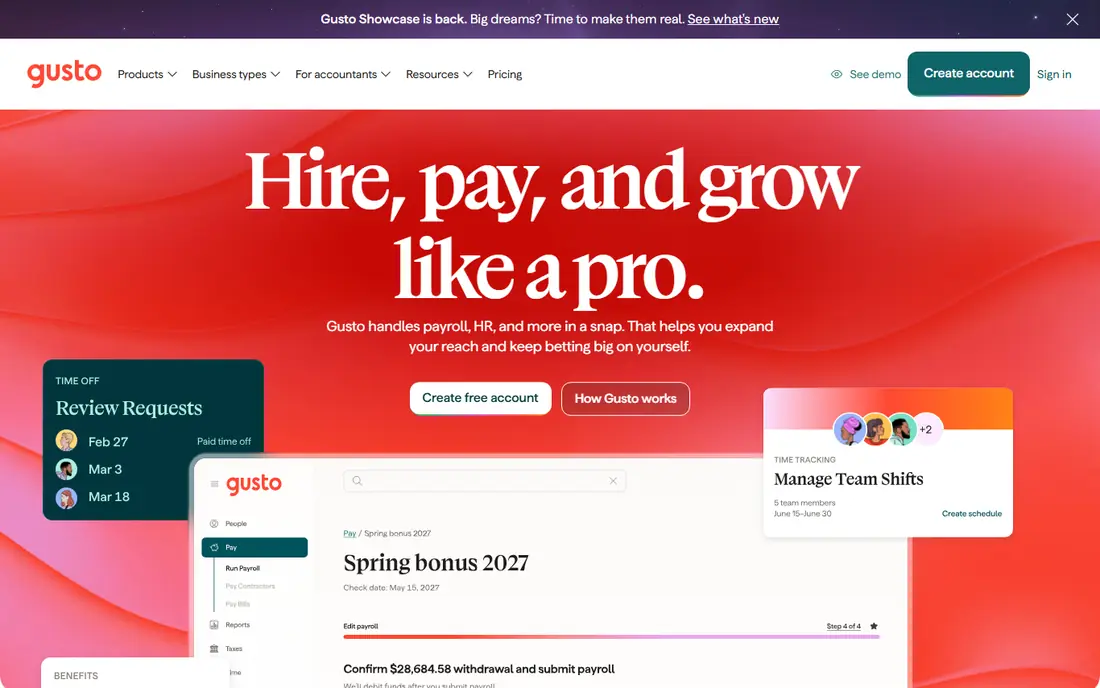
Gusto Simple costs $49 per month plus $6 per person, Plus costs $80 per month plus $12 per person, and Premium costs $180 per month plus $22 per person. Simple covers single-state payroll, employee profiles, and basic HR admin. Plus adds multi-state payroll and time tracking, while Premium adds compliance alerts, expert HR advice, and custom reporting. Contractor-only payroll starts at $35 per month plus $6 per contractor.
Gusto suits small US companies that want payroll done correctly without a sales process. It suits less well for companies hiring widely abroad, where Deel or Rippling offer deeper employer of record coverage. For a team under 50 with mostly US staff, Gusto is often the simplest buy.
- Transparent published pricing
- Full service payroll and tax filing
- No annual contract on published plans
- Global hiring is thinner than Deel or Rippling
- Advanced HR tools sit on higher tiers
Workday Human Capital Management covers core HR, payroll, talent management, time, and workforce planning in one cloud system, with AI-driven analytics and global compliance features. Published buyer guides estimate core HCM in the range of $34 to $42 per employee per month for large deployments, but Workday itself prices by quote and typically serves organizations with hundreds or thousands of employees.
Workday suits large employers that need one system across countries, currencies, and complex org structures. It does not suit a 50 person company, where implementation cost and admin effort will outweigh the benefits. If you are growing toward enterprise scale, shortlist Workday early, but expect a months-long selection and rollout.
- Unified HR, payroll, talent, and planning at global scale
- Strong analytics and compliance tooling
- Deep enterprise integrations
- Quote only pricing
- Long implementation
- Overkill for teams under several hundred staff
ADP Workforce Now serves midsize to large employers with payroll, HR, time, benefits, and talent modules in one platform, backed by ADP tax filing and compliance services. Pricing is by quote and varies by headcount, modules, and payroll frequency, so two companies of the same size can receive different totals. ADP also serves smaller firms through ADP RUN, which is a separate product line.
ADP suits US employers that value payroll accuracy and compliance depth above a modern interface. It suits less well for teams that want transparent self-serve pricing or a lightweight HR tool. Request a module-by-module quote, and compare it with BambooHR plus payroll and with Paylocity before you sign.
- Deep payroll and tax expertise
- Broad HR, benefits, and time modules
- Strong compliance support for US employers
- Quote only pricing
- Module choices can make quotes hard to compare
- Interface feels dated in places
Paylocity covers payroll, HR, time and attendance, benefits, talent management, and employee engagement for midsize employers. Its engagement tools, including surveys, recognition, and learning, stand out against payroll-first rivals. Pricing is by quote, based on headcount and modules, with no published starting price for most buyers.
Paylocity suits midsize companies that want payroll and people tools together and plan to use engagement features, not just records. It suits less well for very small teams, where Gusto is simpler and cheaper. Ask for the cost of each module you will actually use, and pilot reporting with your own headcount data.
- Payroll, HR, time, and talent in one platform
- Strong employee engagement and learning tools
- Good reporting
- Quote only pricing
- Implementation effort varies by modules
- Smaller teams may find it heavy
HiBob, often called bob, is an HR platform for midsize and multinational companies, covering employee records, time off, performance, compensation, and people analytics. It is known for a modern interface and for handling distributed teams across countries, with local compliance support through its platform and partners. Pricing is by quote and varies by headcount and modules.
HiBob suits companies with staff in several countries that want one people system without moving to Workday scale. US employers that need deep native payroll may prefer ADP, Paylocity, or Gusto, since HiBob payroll coverage depends on country and partner. Demo global time off and reporting with your actual locations before you commit.
- Modern interface with strong global HR coverage
- Good performance, time off, and reporting
- Popular with distributed teams
- Quote only pricing
- Payroll is handled through partners in many countries
- US payroll depth varies
Deel lets companies hire contractors and employees abroad without setting up a local entity. Contractor management starts at $49 per contractor per month, US PEO services start near $125 per employee per month, and employer of record services start near $599 per employee per month, plus local employment costs such as taxes and statutory benefits. Deel handles contracts, payroll, benefits, and compliance in each country.
Deel suits teams whose growth is international first. It suits less well as a sole HR system for a mostly US team, where Gusto or BambooHR offer deeper domestic HR tooling at lower cost. If most of your team is abroad, shortlist Deel first and compare it with Rippling global employment on total cost per country.
- Employer of record coverage in many countries
- Contractor payments from $49 per contractor per month
- Strong global compliance
- Employer of record pricing is high at $599 per employee per month
- US HR depth is thinner than US-first platforms
Namely serves midsize companies with employee records, payroll, benefits administration, time, performance, and reporting in one system. Its benefits tools, including enrollment and carrier connections, are a reason many midsize teams pick it over a records-only HRIS. Pricing is by quote and depends on headcount, modules, and benefits complexity.
Namely suits companies in the 50 to 1,000 range that want HR and benefits together without enterprise scale. It suits less well for very small teams, where published pricing from Gusto or BambooHR is easier to judge. Ask how benefits carriers, payroll timing, and reporting work for your states before you sign.
- HR, payroll, benefits, and time in one platform
- Strong benefits administration
- Good fit for 50 to 1,000 staff
- Quote only pricing
- Smaller teams may find the platform broad
- Integration depth varies by payroll partner
How we picked these
We compared official pricing pages, published tiers, and module coverage for HR, payroll, time, and talent. We kept platforms that serve as a system of record for employees, not just payroll or recruiting point tools. We included quote-only enterprise platforms alongside transparently priced options, because midsize buyers often compare both. Where pricing was not published, we wrote See website rather than estimating a total.
What to check before you buy
Start with headcount and locations. A US-only team of 30 has different needs from a 300 person team across six countries, and the wrong platform will cost more in workarounds than in fees. List the modules you must have on day one, such as payroll, time off, benefits, and performance, and price only those modules.
Test the daily work. Enter a new hire, approve time off, run a payroll preview, and pull a headcount report with your own data. Check who owns data migration, how long implementation takes, and what support costs after go-live. A clean demo with sample data hides migration effort, which is where many HRIS projects stall.
Sources
Frequently asked questions
What is the best HRIS software for midsize companies?
BambooHR, Paylocity, and Namely are strong midsize picks, with BambooHR offering the clearest published pricing. Rippling suits midsize teams that also need IT and global hiring. Workday suits larger enterprises rather than typical midsize firms. Match the platform to headcount, locations, and whether payroll must sit inside the same system.
What is the best HRIS platform for small businesses?
Gusto is the strongest small business pick for US teams, with published payroll-led pricing and no annual contract. BambooHR also works for small teams, though the flat rate from $250 per month changes the math under 25 staff. Rippling can work for small tech teams that need IT provisioning from day one.
How much does HRIS software cost per employee?
Published prices here run from $8 per user per month at Rippling for core modules and $10 per employee at BambooHR Core, to quote-only enterprise pricing at Workday, ADP, and Paylocity. Gusto adds a monthly base fee plus a per person fee. Payroll, benefits, and time modules often sit outside the headline price, so compare module totals.
Does HRIS software include payroll?
Not always. Gusto, Rippling, ADP, Paylocity, and Namely include payroll as a core or bundled module. BambooHR offers payroll as a paid add-on, and HiBob payroll coverage depends on country. Confirm payroll, tax filing, and benefits administration are included in your quote before you compare prices.
What is the difference between HRIS, HCM, and HRMS?
The terms overlap heavily in vendor marketing. HRIS usually means a system of record for employee data. HCM often means a broader suite covering talent and workforce planning. HRMS is an older term for a similar suite. Focus on the modules and pricing in the quote rather than the label on the product page.
Which HRIS is best for global teams?
Deel leads for hiring abroad through employer of record services, and Rippling offers global employment alongside HR and IT. HiBob suits distributed teams that want one people system across countries. Workday suits large global enterprises with complex compliance needs. Compare cost per country, not just the platform fee.