Best Influencer Marketing Platforms in 2026: 8 Platforms Compared
By ToolNimba Editorial Team October 29, 2026 9 min read

- Top pick
 GRIN
Ecommerce brands managing many creators
Starting priceSee websiteCheck out GRINRead our review - Runner-up
 Aspire
Ambassador and product seeding programs
Starting priceSee websiteCheck out AspireRead our review - Also great
 CreatorIQ
Large enterprise influencer programs
Starting priceSee websiteCheck out CreatorIQRead our review
How we researched this
We compared official pricing and feature pages, app store listings, privacy policies and public user reviews. Prices change, so check the provider's site before you pay.
Key takeaways
- The best influencer marketing platforms split into discovery tools, creator management systems, and marketplaces, so the right choice depends on the job you need done.
- Small brands usually do better with a lower priced discovery or marketplace tool, while larger brands need contracts, approvals, and payments in one place.
- Many leading platforms do not publish prices, so ask for a quote based on creator volume, seats, and contract length before you budget.
- Shopify brands get extra value from tools built around product seeding, affiliate links, and store orders.
Quick comparison
| Name | Best for | Starting price | Free plan | |
|---|---|---|---|---|
| GRIN | Ecommerce brands managing many creators | See website | No | Visit |
| Aspire | Ambassador and product seeding programs | See website | No | Visit |
| CreatorIQ | Large enterprise influencer programs | See website | No | Visit |
 Upfluence | Turning customers into creators | See website | No | Visit |
 Modash | Creator discovery and vetting | $199 per month | No | Visit |
 Heepsy | Affordable creator discovery for small teams | $49 per month | Yes | Visit |
 Collabstr | Hiring creators for single projects | See website | Yes | Visit |
 Shopify Collabs | Shopify stores starting affiliate and gifting programs | Free | Yes | Visit |
The best influencer marketing platforms
We compared official feature pages, pricing pages, and public reviews for the platforms below. Our focus was discovery, campaign workflow, payments, reporting, and how clear the pricing is.
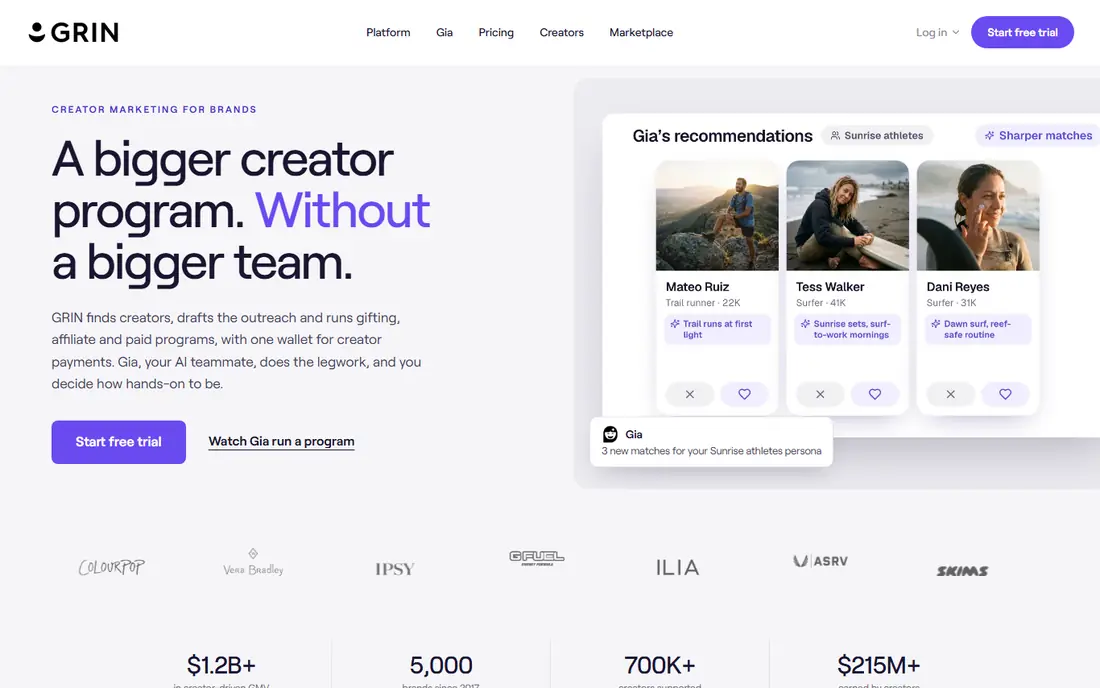
GRIN works best as a creator relationship system rather than as a simple search tool. Brands can find creators, send products, track content, and handle affiliate sales and payments without moving between several tools. That joined-up workflow matters when a program grows past a handful of creators and spreadsheets start to break.
The Shopify connection is a real strength for direct to consumer brands. Product seeding, discount codes, and order data sit close to the creator record, which makes it easier to see which partnerships led to sales. The trade off is access. GRIN is priced by quote, so small brands should request pricing early and compare the total cost with a cheaper discovery tool plus manual outreach.
- Strong Shopify integration
- Creator management, seeding, and payments in one place
- Useful reporting for ecommerce sales
- Pricing is not published
- Better suited to established brands than to a first small test
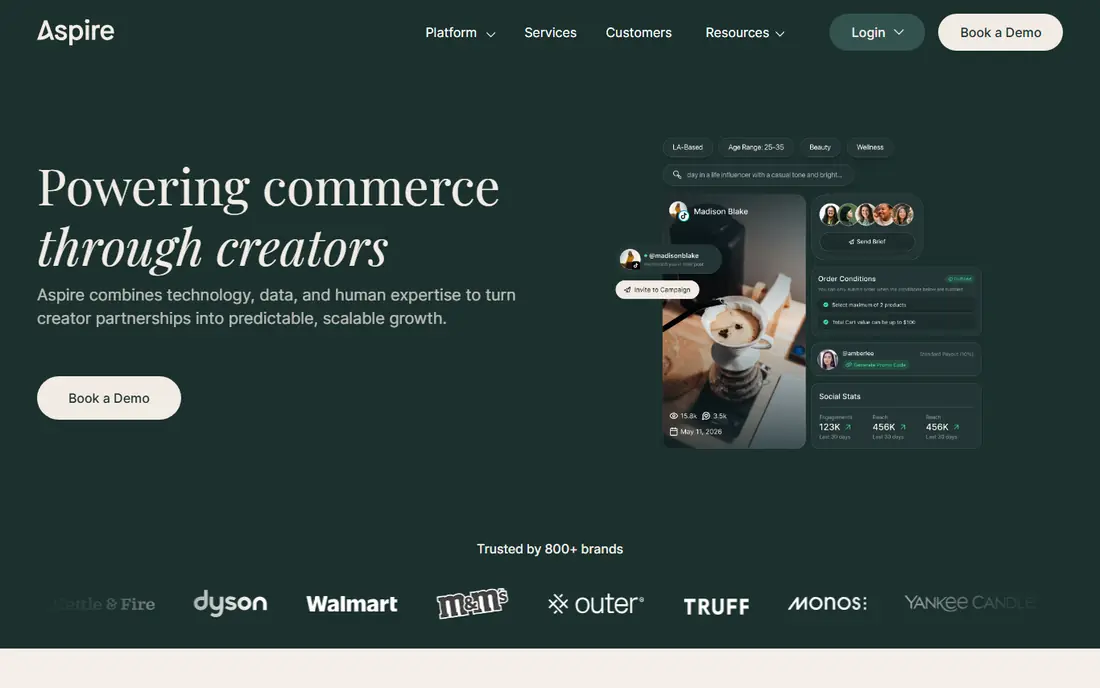
Aspire suits brands that want ongoing relationships rather than one off posts. Its marketplace helps teams find creators, invite them, agree terms, and keep content and communication in one place. That structure helps when the same creators post again across seasons or product launches.
We like Aspire for ambassador programs because repeat work is where value builds. Creators learn the brand, content improves, and reporting becomes more useful over time. The honest catch is the buying process. Aspire does not publish a starting price, so teams with a small budget should confirm the minimum commitment before they invest time in a demo.
- Creator marketplace for outreach
- Structured campaign workflows
- Content and relationship tools in one system
- Pricing is not published
- Smaller brands may find the sales process heavy
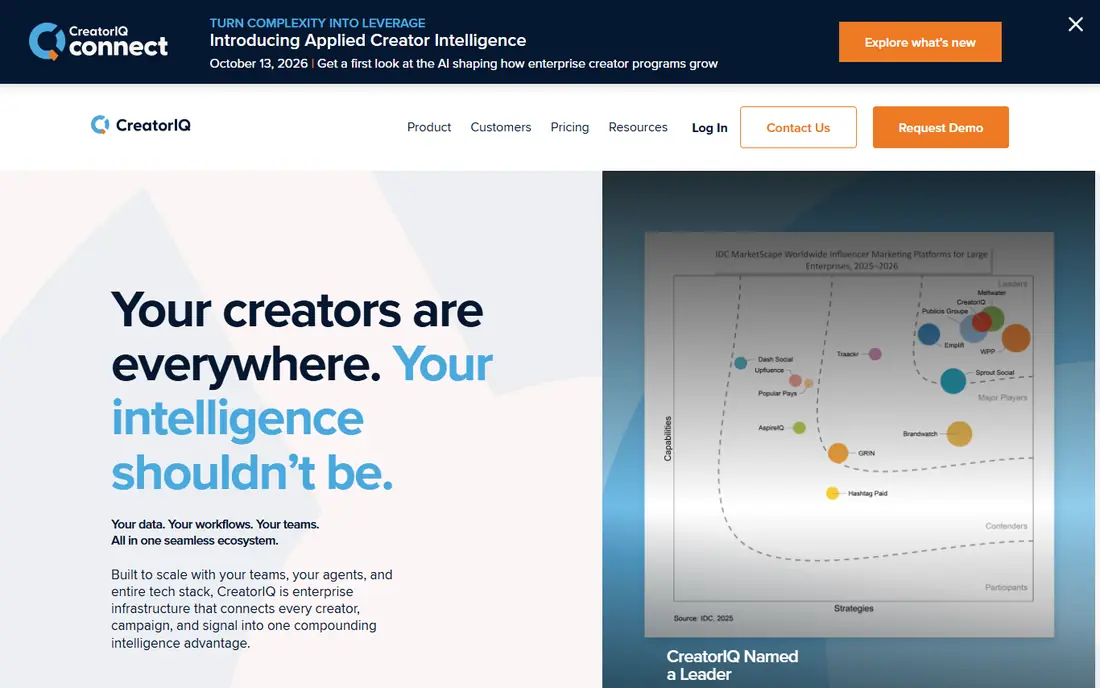
CreatorIQ is built for brands and agencies running large, global programs with strict controls. It offers discovery, campaign management, measurement, and workflows for approvals and compliance. For a team managing hundreds of creators across markets, that control is the point.
The drawback is scale in the other direction. CreatorIQ is not a quick, low cost test tool. Implementation and pricing reflect enterprise use, so a small brand will likely get better value elsewhere. If your program already spans regions, agencies, and paid amplification, this is one of the strongest options to shortlist.
- Large creator database
- Detailed analytics and reporting
- Brand safety and compliance controls
- Enterprise pricing and setup
- More than most small teams need
Upfluence takes a different starting point from most discovery tools. Instead of only searching social profiles, it can help brands find creators inside their own customer base. That matters because existing customers already know the product, and their content often feels more natural than a cold outreach post.
The platform also covers campaign management, affiliate tracking, and payments, which keeps the work in one place. The weakness is transparency. Pricing is by quote, and reported starting points vary, so get a written quote tied to your creator count. Brands without an ecommerce store will get less from its strongest features.
- Can identify creators among existing customers
- Ecommerce integrations
- Built in creator payments
- Pricing is not published
- Database size is smaller than some rivals
Modash is our pick for teams whose main problem is finding the right creators and checking them properly. Its database covers a very large number of profiles, with filters for audience, location, engagement, and past brand work. That depth helps teams avoid creators whose audience does not match the brand.
Modash is less of an end to end campaign suite than GRIN or CreatorIQ. Teams may still manage contracts and payments elsewhere, but for discovery first work that trade is fair. Published pricing from $199 per month also makes budgeting simpler than quote only rivals, and the tool is easy to trial against a real shortlist.
- Very large creator database
- Detailed audience and performance data
- Clear published starting price
- Campaign management is lighter than full suite rivals
- Vetting still needs human judgment
Heepsy is a sensible first step for a small business that wants to find creators without an enterprise contract. The free plan lets teams run basic searches, and paid plans start at $49 per month. Filters cover the basics that matter most, such as category, location, follower range, and audience details.
The limit is scope. Heepsy is mainly a discovery tool, so outreach, contracts, content approval, and payments need other tools or manual work. That is fine for a small test with a few creators. Teams that need full workflow should pair it with a clear process, or move to a suite once volume grows.
- Low starting price
- Free plan for basic searches
- Filters for location, category, and audience size
- Campaign management is limited
- Data depth is thinner than enterprise tools
Collabstr works more like a marketplace than a software suite. Brands browse creators, review packages, and buy content or promotion directly. That model suits a product launch, a single video, or a test with a new creator before committing to a longer deal.
We like the simplicity for small teams. There is no large annual contract to justify, and the platform handles the transaction. The catch is management. Collabstr is not designed to run a large ambassador program with complex approvals and reporting, so growing brands may outgrow it. Always review a creator past posts and audience before ordering.
- Marketplace model for direct hiring
- Clear creator packages
- Payments handled through the platform
- Less suited to long term program management
- Quality varies by creator, so check past work
Shopify Collabs
Best for: Shopify stores starting affiliate and gifting programs
Shopify Collabs is the easiest starting point for a Shopify brand. It lets creators apply, share affiliate links and discount codes, and earn commission on sales. Because it lives inside Shopify, order tracking is straightforward and setup is quick.
The trade off is depth. Discovery, vetting, and reporting are simpler than in a dedicated influencer platform, and the tool is of no use to brands outside Shopify. Even so, for a store testing creator affiliate work for the first time, the free starting point is hard to beat. Upgrade to a dedicated platform only when creator volume or reporting needs demand it.
- Free to install for Shopify stores
- Affiliate links and discount codes built in
- Creators can apply to join
- Only useful for Shopify stores
- Discovery and reporting are simpler than dedicated platforms
How we picked these
We compared official feature and pricing pages, app store listings, and public reviews for platforms that were active in October 2026. We favored tools that clearly cover discovery, campaign work, or creator payments, and we left out tools that only offer social scheduling or generic analytics. Where a vendor does not publish pricing, we say so rather than guessing a figure.
What to check before you sign up
Start with the job, not the database size. If you need ten creators for a launch, a marketplace or discovery tool may be enough. If you need fifty creators posting every month, you need workflow, approvals, and payments in one system, or the admin work will eat the budget.
Check audience quality before follower count. Look at comments, past brand work, audience location, and whether engagement looks natural. A smaller creator with a matched audience often beats a large account with weak relevance. Ask for a trial or demo using your own shortlist, and confirm what counts toward the price, such as seats, creator contacts, or active campaigns.
Finally, confirm contracts and content rights in writing. Agree who owns the content, where it can be reused, how long it can run, and how payment works if a post underperforms or is late. A good platform makes those terms easy to set. It does not replace a clear agreement with each creator.