Best IoT Platform in 2026: 8 Platforms Compared
By ToolNimba Editorial Team October 31, 2026 8 min read

- Top pick
 ThingsBoard
Most IoT projects and dashboards
Starting price$10 per monthCheck out ThingsBoardRead our review - Runner-up
 AWS IoT Core
Large AWS-based fleets
Starting priceSee websiteCheck out AWS IoT CoreRead our review - Also great
 Azure IoT Hub
Microsoft-based industrial fleets
Starting priceSee websiteCheck out Azure IoT HubRead our review
How we researched this
We compared official pricing and feature pages, app store listings, privacy policies and public user reviews. Prices change, so check the provider's site before you pay.
Key takeaways
- ThingsBoard is our pick for most projects, thanks to its open-source core, dashboards, and hosted cloud option.
- AWS IoT Core and Azure IoT Hub suit large fleets that already use those clouds, but their pricing is usage-based and harder to predict.
- Blynk, Ubidots, and Datacake are better for small fleets and prototypes, with free tiers for a handful of devices.
- Check protocol support, data retention, and device limits before you commit, since those caps decide the real cost.
Quick comparison
| Name | Best for | Starting price | Free plan | |
|---|---|---|---|---|
| ThingsBoard | Most IoT projects and dashboards | $10 per month | Yes | Visit |
| AWS IoT Core | Large AWS-based fleets | See website | Yes | Visit |
| Azure IoT Hub | Microsoft-based industrial fleets | See website | Yes | Visit |
 Blynk | Mobile-first small projects | See website | Yes | Visit |
 Ubidots | Small fleets and dashboards | See website | Yes | Visit |
 Losant | Enterprise workflows and dashboards | See website | Free trial | Visit |
 Particle | Cellular-connected hardware | See website | Yes | Visit |
 Datacake | Simple sensor dashboards | See website | Yes | Visit |
The best iot platform options
An IoT platform connects devices, stores their data, and turns that data into dashboards, alerts, and actions. Some platforms are full cloud building blocks, while others give you a ready-made dashboard in an afternoon. The eight below cover both ends of that range.
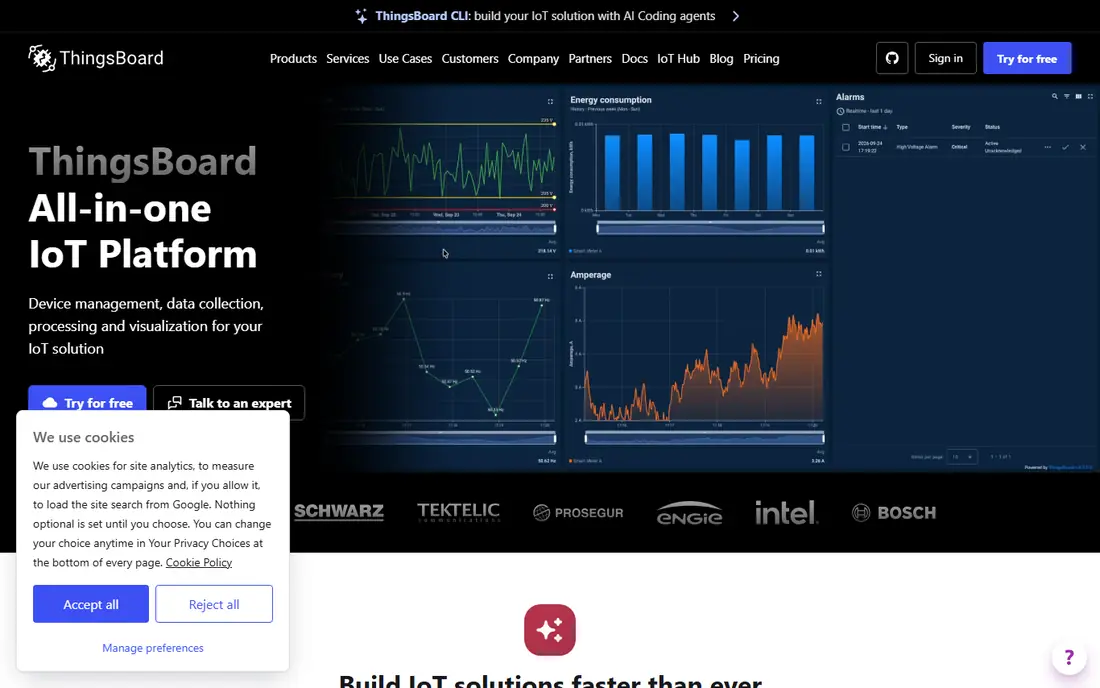
ThingsBoard is our pick for most readers because it covers the whole job: device connection, data storage, rules, alarms, and dashboards. It supports common protocols such as MQTT, CoAP, and HTTP, and it offers a gateway for industrial protocols such as Modbus and OPC UA. That range means one platform can serve sensors, machines, and gateways without extra glue code.
You can self-host the open-source version or use ThingsBoard Cloud, which starts at a published monthly rate. Self-hosting gives you full data control, but you own updates and scaling. The cloud option removes that burden, with a free tier for small trials. If you want one platform that can grow from a prototype to a production fleet, start here.
- Open-source core
- Strong dashboards and rule chains
- Self-hosted or cloud options
- Setup takes technical skill
- Support for the free core is community-based
AWS IoT Core is a message broker and device registry for fleets that already run on Amazon Web Services. Devices publish data over MQTT or HTTPS, rules route that data to storage, analytics, or alerts, and device shadows keep track of each device state. For a large fleet with strict security needs, that foundation is hard to match.
The catch is that IoT Core is a building block, not a finished dashboard product. You will likely add other AWS services for visualization, storage, and user access, and message-based pricing means costs move with traffic. A free tier covers a limited number of messages for 12 months. Choose AWS IoT Core when scale and AWS integration matter more than a quick dashboard.
- Huge scale
- Deep AWS service links
- Strong device security options
- Usage-based pricing is hard to forecast
- Building dashboards takes extra work

Azure IoT Hub is Microsoft's hub for device connection, management, and messaging. Device twins store reported and desired state, jobs push updates to many devices at once, and links to Azure services support storage, analytics, and dashboards. Industrial teams often pair it with Azure IoT Operations or related services for edge workloads.
Pricing is based on hub units and daily message allowances, with a free tier for small trials. That model suits steady fleets, but bursty traffic needs careful sizing. If your company already uses Microsoft 365, Entra ID, or Azure data tools, IoT Hub keeps identity and data in one place.
- Strong Microsoft integration
- Device twins and jobs
- Industrial protocol support
- Pricing is tiered by messages
- Setup suits teams with Azure experience
Blynk stands out for mobile control. You build a phone dashboard with drag-and-drop widgets, connect a device, and control it from the app within hours. That speed makes it popular for home projects, small commercial products, and classroom work. It also supports common hardware boards and cloud or local server options.
The free tier covers exploration with a small device count, so commercial products will need a paid plan. Blynk is less suited to heavy industrial data pipelines than ThingsBoard or Azure, but for a product where the phone app is the main interface, it is a strong choice.
- Fast mobile app building
- Simple device setup
- Good for prototypes
- Free tier is limited to a few devices
- Larger fleets need higher plans
Ubidots focuses on getting sensor data onto a dashboard with little code. Devices send data over MQTT or HTTP, and you build charts, maps, and alerts from that stream. It suits environmental monitoring, agriculture, asset tracking, and other sensor-first projects where the dashboard is the main output.
The free tier covers a small number of devices for non-commercial use, which is enough to test an idea. Paid plans add devices, data retention, and commercial use. Ubidots will not replace a full industrial platform for complex edge logic, but for a small fleet that needs clear charts fast, it is hard to beat.
- Quick dashboards
- Simple device setup
- Good for sensor projects
- Free tier is for non-commercial use
- Costs rise per device
Losant gives enterprise teams a visual way to build IoT applications. Workflows connect devices, data, and business systems with drag-and-drop logic, and dashboards present the results to operators or customers. It also supports edge compute, so some logic can run close to the device rather than only in the cloud.
Pricing is quote-based, which makes it harder to compare at a glance, and the workflow model takes time to learn well. Losant fits companies that want a finished application platform, with user accounts, dashboards, and workflows, rather than raw cloud building blocks. Ask for a trial and a scoped quote before you commit.
- Visual workflow builder
- Strong dashboards
- Good enterprise features
- Quote-based pricing
- Learning curve for workflow logic
Particle is different because it sells hardware and cloud together. Its boards and modules connect over Wi-Fi or cellular, and its cloud handles device management, data, and firmware updates. That joined approach helps product teams ship connected hardware without stitching together separate vendors for connectivity and cloud.
The trade-off is dependence on Particle hardware and its pricing model, which varies by device count and data use. A free developer tier helps with prototypes. If your product needs cellular connectivity and over-the-air updates from day one, Particle removes a lot of early friction.
- Hardware plus cloud in one system
- Cellular data options
- Good fleet tools
- Hardware lock-in risk
- Pricing depends on device and data volume
Datacake is built for teams that want sensor dashboards without a long setup. It works well with LoRaWAN devices and gateways, and it offers ready-made dashboards, alerts, and data exports. Small fleets for building monitoring, agriculture, or asset tracking can be live quickly.
The free tier covers a small number of devices, and paid plans are sold in device bundles. Datacake is not the best pick for heavy custom logic or large industrial fleets, but for straightforward monitoring it offers a clean path from device to dashboard.
- Simple setup
- Clear dashboards
- LoRaWAN-friendly
- Free tier covers few devices
- Less depth for complex workflows
How we picked these
We compared official feature pages, pricing pages, and app store listings, plus public reviews, for platforms that are live in October 2026. We favored platforms with a clear free tier or trial, published device limits where available, and real protocol and dashboard support. Where a vendor does not publish a price, we say so rather than repeating an estimate as fact.
What to check before you choose
Start with your devices and protocols. List every sensor, gateway, and radio type, and confirm the platform supports its protocol and message format. Next, check data retention, dashboard sharing, and alert options, since a platform that stores data for only a short period may force you to add external storage.
Then model cost at three fleet sizes, not just today. Message-based pricing, per-device pricing, and bundled plans behave very differently as you grow. Run a small pilot with real hardware, test offline behavior, and check how firmware updates and device replacement work. A platform that is easy for five devices can become painful at five hundred if those tasks are manual.
Free IoT platforms and monitoring tools
Free tiers are useful for learning and prototypes, but they often cap devices, messages, or retention. ThingsBoard, Blynk, Ubidots, and Datacake all offer free starting points, while AWS and Azure offer limited free usage. For long-term free monitoring, self-hosted open-source tools are often the better path, since you pay only for hosting.