Best Marketing Automation Software in 2026: 9 Platforms Compared
By ToolNimba Editorial Team October 29, 2026 10 min read

- Top pick
 HubSpot Marketing Hub
CRM-based marketing teams
Starting price$20 per seat per monthCheck out HubSpot Marketing HubRead our review - Runner-up
 ActiveCampaign
Deep automation on a budget
Starting price$15 per monthCheck out ActiveCampaignRead our review - Also great
 Mailchimp
Simple email plus automation
Starting price$13 per monthCheck out MailchimpRead our review
How we researched this
We compared official pricing and feature pages, app store listings, privacy policies and public user reviews. Prices change, so check the provider's site before you pay.
Key takeaways
- HubSpot Marketing Hub is our pick for teams that want marketing, sales and service data in one CRM.
- ActiveCampaign gives the deepest automation for the money at small and mid-size list sizes.
- Brevo is the cheapest route to real automation when you pay by sends rather than contacts.
- Klaviyo is the strongest ecommerce choice, but its bill grows with your active profile count.
- Enterprise tools like Marketo and Salesforce Account Engagement only make sense once a dedicated admin can run them.
Quick comparison
| Name | Best for | Starting price | Free plan | |
|---|---|---|---|---|
| HubSpot Marketing Hub | CRM-based marketing teams | $20 per seat per month | Yes | Visit |
| ActiveCampaign | Deep automation on a budget | $15 per month | Free trial | Visit |
| Mailchimp | Simple email plus automation | $13 per month | Yes | Visit |
 Klaviyo | Ecommerce email and SMS | $20 per month | Yes | Visit |
 Brevo | Low-cost send-based plans | $9 per month | Yes | Visit |
 Salesforce Account Engagement | Salesforce B2B teams | $1,250 per month | Free trial | Visit |
 Adobe Marketo Engage | Enterprise B2B marketing | See website | No | Visit |
 Zoho Marketing Automation | Zoho users and small teams | $19 per month | Free trial | Visit |
 GetResponse | Email plus webinars and funnels | $19 per month | Yes | Visit |
The best marketing automation software
Marketing automation should save time without creating a second job. The platforms below cover simple welcome flows, ecommerce journeys, lead scoring and enterprise nurture programs. Compare them on list size, billing model and how much setup your team can handle.

HubSpot stands out because automation runs on real CRM data. Workflows can react to lifecycle stage, lead score, deal status and sales activity, not just email opens. That makes handoffs to sales cleaner, and reporting can follow a contact from first visit to closed deal without stitching tools together.
The pricing structure needs care. Starter is $20 per seat per month, while Professional starts at $800 per month plus a $3,000 onboarding fee, which is a large step for a growing team. The free plan helps small teams start, but serious automation sits behind the paid tiers. Choose HubSpot when your team already lives in a CRM and wants one system for the full customer journey.
- Marketing, sales and CRM data in one place
- Strong workflow builder on paid plans
- Free tools for starting out
- Big price jump from Starter to Professional
- Onboarding fee on higher plans
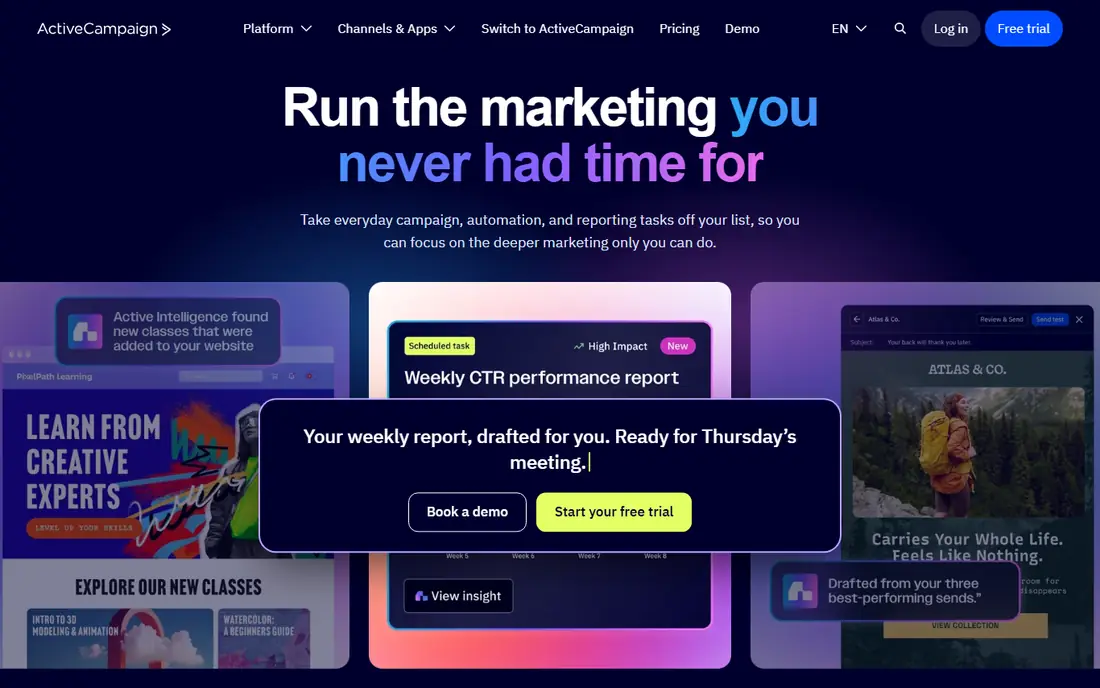
ActiveCampaign earns its place with an automation builder that handles branching, conditions, goals and split paths without feeling like a developer tool. Small businesses can build welcome series, nurture flows, re-engagement campaigns and sales follow-ups in one place, and the Plus plan adds CRM pipelines and lead scoring.
The Starter plan starts at $15 per month for 1,000 contacts on annual billing, but the bill climbs as the list grows, and some features sit behind higher tiers. There is a 14-day free trial rather than a free plan. If automation depth matters more than a free tier, ActiveCampaign is hard to beat at this price.
- Visual automation builder with branching logic
- CRM and lead scoring on higher plans
- Good value at small list sizes
- No permanent free plan
- Price rises with contact count
- Add-ons can raise the total
Mailchimp is still the easiest on-ramp for many small businesses. The email builder is friendly, templates look polished, and integrations cover most ecommerce platforms, CRMs and website builders. Paid plans add automation flows, from welcome series and abandoned cart messages to post-purchase follow-ups, with Standard allowing up to 200 flows.
Watch the billing details. The free plan covers only 250 contacts and 500 sends per month, and paid prices rise with your contact total, including unsubscribed contacts unless you archive them. Essentials starts at $13 per month for 500 contacts, and Standard starts at $20 per month. Mailchimp fits teams that want simple, good-looking email automation without a complex setup.
- Easy builder and templates
- Large integration library
- Automation flows on paid plans
- Free plan is now limited to 250 contacts
- Price rises with total contacts, including unsubscribed ones
Klaviyo is built for stores, and it shows. It syncs order, browsing and customer data from platforms like Shopify, then lets you segment by products bought, order value, recency and predicted lifetime value. Abandoned cart, browse abandonment, welcome and win-back flows come ready to adapt, and revenue reporting ties each flow to sales.
Pricing is based on active profiles, starting at $20 per month for up to 500 profiles, with a free plan up to 250 profiles. SMS runs on separate credits, so a combined email and SMS program costs more than the email price alone. For ecommerce brands where email drives real revenue, Klaviyo often pays for itself. For a simple newsletter, it is more tool than you need.
- Deep Shopify and ecommerce data
- Strong segmentation and predictive analytics
- Proven abandoned cart and post-purchase flows
- Bill grows with active profiles
- SMS is a separate cost
- Can feel expensive at scale
Brevo flips the usual pricing model. Instead of charging per contact, it charges by monthly email volume, with unlimited contacts on every plan. That makes it cheap for a large list that only emails a few times a month. The free plan allows 300 emails per day, and Starter starts at $9 per month for 5,000 emails.
The detail to check is automation. Starter does not include marketing automation, so the realistic entry point for automation is Standard at $18 per month for 5,000 emails. Brevo also bundles a CRM, chat and transactional email, which suits small teams that want several tools in one account. If your list is large but your send volume is modest, Brevo is the value pick.
- Pay by sends, not contacts
- Unlimited contacts on paid plans
- Email, SMS and WhatsApp in one account
- Automation starts on the Standard plan, not Starter
- Add-ons for branding removal and landing pages
Salesforce Account Engagement
Best for: Salesforce B2B teams
Formerly called Pardot, Salesforce Account Engagement is the natural choice for B2B teams already on Salesforce. Leads, campaigns and sales activity share one record, and Engagement Studio builds multi-step nurture programs with scoring and grading that sales teams can trust. Higher editions add account-based marketing, business units and deeper analytics.
The Growth edition starts at $1,250 per organization per month, billed annually, for 10,000 contacts, which puts it firmly in mid-market territory. Running it well also takes Salesforce admin time, and some features, such as SMS, are add-ons. If Salesforce is your CRM and your sales cycle is long, this integration is worth the cost. If not, a cheaper tool will do the same core job.
- Native Salesforce integration
- Lead scoring, grading and Engagement Studio
- Strong for long B2B sales cycles
- Expensive entry point
- Needs Salesforce expertise to run well
- Annual contract required
Marketo Engage is built for enterprise B2B teams with complex nurture programs. It handles lead scoring, account-based marketing, multi-step journeys, webinars and attribution across long buying cycles, and it integrates with major CRMs. Its four packages, Growth, Select, Prime and Ultimate, scale from smaller enterprise teams to global programs.
Adobe does not publish Marketo prices, so every deal is a custom annual quote based on database size and add-ons. Implementation often needs specialist help, and the platform rewards teams that have a dedicated marketing operations owner. Choose Marketo when your B2B program is large enough to justify that investment. Smaller teams will move faster on HubSpot or ActiveCampaign.
- Deep B2B nurture, scoring and account-based marketing
- Strong analytics and attribution options
- Large partner ecosystem
- Quote-only pricing
- Long implementation
- Needs a dedicated admin
Zoho Marketing Automation fits teams that already use Zoho products or want a low-cost journey builder. It tracks website behavior, scores leads, builds personalized journeys and runs multichannel campaigns across email and SMS. Standard starts at $19 per month for 1,000 contacts, with Premium and Enterprise tiers adding deeper journeys, attribution and ecommerce features.
The trade-off is ecosystem depth. Zoho does not match HubSpot or Klaviyo for third-party integrations or ready-made templates, so teams with unusual stacks should check connectors first. For small teams that want solid automation without enterprise pricing, Zoho is a practical middle ground.
- Journey builder with behavior tracking
- Lead scoring and management
- Good value for Zoho shops
- Smaller integration and template range than larger rivals
- Pricing varies by contacts and region
GetResponse bundles more than email into one account. Paid plans add landing pages, forms, autoresponders and, on higher tiers, webinars and sales funnels, which suits course creators, coaches and small businesses that sell through webinars. The free plan covers 500 contacts and 2,500 emails per month, and Starter starts at $19 per month for 1,000 contacts.
The Starter limit matters. It includes only one custom automation workflow, so teams that need a welcome series plus an abandoned cart flow must step up to Marketer at $59 per month. If webinars or funnels are part of your plan, that step can still be good value. If you only need email automation, compare ActiveCampaign first.
- Free plan for up to 500 contacts
- Webinars and sales funnels on higher plans
- Unlimited sends on paid plans
- Starter allows only one automation workflow
- Price rises with list size
How we picked these
We compared official pricing pages, feature lists, free plans and public reviews, and we favored tools that are still sold and supported for the audiences named here. We weighed automation depth, billing model, ecommerce and CRM integration, and how much setup each platform demands. Prices are starting figures at common list sizes, and most tools charge more as contacts, profiles or sends grow, so check the price at your real list size before you buy.
How to choose the right platform
The best platform is the one your team will actually run every week. A powerful tool that sits unused is worse than a simpler one with live flows.
Start with your billing model
Contact-based tools charge more as your list grows, even if you email rarely. Send-based tools like Brevo charge by volume instead. Profile-based tools like Klaviyo charge for everyone you can email. Model your cost at your current list size and at double that size, then pick the model that stays affordable.
Count the flows you really need
List the automations you will build in the first 90 days: welcome, nurture, abandoned cart, re-engagement and sales follow-up. Check that your chosen plan includes all of them, including branching and scoring if you need it. A cheap plan that blocks your second workflow is not cheap.
Plan for setup time
Enterprise tools need an admin and weeks of setup. Simpler tools can launch a first flow in a day. Be honest about who will own the platform, how much training they need, and whether you need help with migration. A free trial is a good test, but only if you build a real flow during it.
Sources
- https://www.hubspot.com/products/marketing
- https://www.activecampaign.com
- https://www.mailchimp.com
- https://www.klaviyo.com
- https://www.brevo.com
- https://www.salesforce.com/products/marketing-cloud/account-engagement/
- https://business.adobe.com
- https://www.zoho.com/marketingautomation/
- https://www.getresponse.com