Best Membership Management Software for Churches in 2026
By ToolNimba Editorial Team November 19, 2026 8 min read
We did not test these tools hands-on. Picks are based on vendor documentation and public information. Read our editorial policy and disclosure.

- Top pick
 Planning Center
Connecting ministries, services and member records
Starting price$5 per monthCheck out Planning CenterRead our review - Runner-up
 Breeze ChMS
Simple member data, events and giving
Starting price$72 per monthCheck out Breeze ChMSRead our review - Also great
 Church Community Builder
Engagement-focused church operations
Starting priceSee websiteCheck out Church Community BuilderRead our review
How we researched this
We compared official pricing and feature pages, app store listings, privacy policies and public user reviews. Prices change, so check the provider's site before you pay.
Direct answer
Planning Center is our first pick for most churches because it ties membership records to ministry scheduling and congregation communication. Breeze ChMS suits teams that want the simplest path to organized member data, while MinistryPlatform fits larger churches with complex structures. Seven options are compared here.
Key takeaways
- Planning Center connects member records with service planning, events and team communication in one system.
- Breeze ChMS emphasizes ease of use for organizing data, events, giving and attendance.
- Rock RMS is built around relationships and offers an extensible platform with community support.
- MinistryPlatform targets large churches, dioceses and denominational offices needing flexibility.
Quick comparison
| Name | Best for | Starting price | Free plan | |
|---|---|---|---|---|
| Planning Center | Connecting ministries, services and member records | $5 per month | Yes | Visit |
| Breeze ChMS | Simple member data, events and giving | $72 per month | Free trial | Visit |
| Church Community Builder | Engagement-focused church operations | See website | Free trial | Visit |
 Fellowship One | All-in-one ministry management | See website | See website | Visit |
 Rock RMS | Relationship-centered, extensible church systems | $4.45 per average weekend attendee | See website | Visit |
 ShelbyNext | Membership and financial tools together | See website | See website | Visit |
 MinistryPlatform | Large churches and denominational offices | See website | See website | Visit |
Church Membership Management Software, one by one
Choosing membership software for a church means balancing member records, giving, attendance and communication in one place. ToolNimba compared the documented features and stated limits of seven church management tools to help you shortlist with confidence.
Planning Center
Best for: Connecting ministries, services and member records
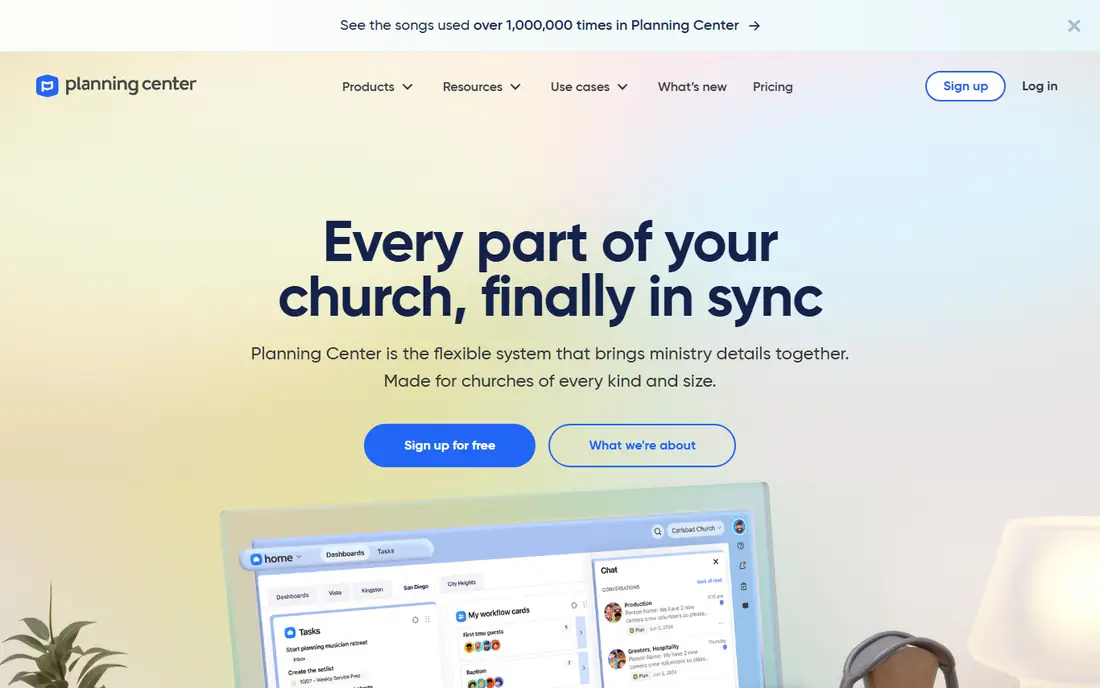
Planning Center presents itself as integrated church management software that organizes ministries, coordinates events, plans services and communicates with teams while connecting the congregation. It fits churches that want membership data to sit alongside service planning and ministry coordination rather than in a separate system. Teams with multiple ministries and regular weekly services are the natural audience.
The breadth of modules is the main tradeoff: a small church may not need every component, and configuring several areas takes time and agreement on process. If you mainly need a simple member directory with basic giving and attendance, a leaner tool such as Breeze ChMS may be easier to adopt. Consider Planning Center when coordination across ministries matters.
- Integrated church management modules
- Service planning and event coordination
- Congregation communication tools
- Many modules can feel broad for small teams
- Setup across modules takes planning
Breeze ChMS describes itself as an easy-to-use church management system that helps churches organize data, manage events, offer online giving and track attendance. It suits congregations that want a straightforward member database without a long configuration project, and volunteers who need to look up people and events quickly. Smaller churches and teams with limited administrative staff are a natural fit.
The simplicity that makes Breeze approachable can become a constraint when a church needs advanced ministry workflows, complex reporting or multi-site coordination. In that case, a broader platform such as Planning Center or MinistryPlatform may serve better. Choose Breeze when adoption speed and clarity for volunteers matter more than depth.
- Positioned as easy to use
- Organizes data and manages events
- Online giving and attendance tracking
- Fewer deep ministry modules
- May feel limited as complexity grows
Church Community Builder
Best for: Engagement-focused church operations
Church Community Builder appears within the Pushpay church engagement platform, which describes giving, custom apps, analytics and live streaming for churches. It fits congregations that want membership and engagement data connected to giving and digital tools rather than treated as a standalone database. Churches investing in a broader engagement strategy are the likely audience.
Because the offering is framed around an engagement platform, churches seeking only a basic member directory may find it more than they need and harder to scope. Confirm which membership features are included in the current product before committing. If your priority is a simple, focused member database, compare Breeze ChMS or ShelbyNext instead.
- Church engagement platform framing
- Giving and analytics features
- Custom apps and live streaming mentioned
- Product messaging centers on engagement
- Feature breadth may exceed small church needs
Fellowship One positions its software as a way to organize the church and streamline ministry, introducing FellowshipOne GO Complete as an all-in-one ministry management product line. It fits churches that want membership, administration and ministry operations handled together under one vendor relationship. Congregations replacing disconnected spreadsheets and tools are a reasonable fit.
The product line structure means buyers should confirm exactly which capabilities sit in the edition they are considering, since published detail on individual features is limited. Churches with very simple needs may prefer a lighter tool. Consider Fellowship One when you want a single ministry management suite and are prepared to verify scope during a demo.
- Ministry management focus
- All-in-one product line
- Streamlines church administration
- Product line naming can confuse buyers
- Less detail published on individual features
Rock RMS describes itself as a church management system centered on relationships, serving churches, parishes and organizations, and as a proven innovation platform with active community support. It fits churches that want a flexible system they can shape around how they track people and relationships, and that have someone able to handle configuration. Organizations with unusual data needs often gravitate here.
That flexibility carries a cost: setup and ongoing changes can demand technical time, and a small team without administrative capacity may struggle to keep the system tuned. If you want something usable quickly with minimal configuration, a simpler option such as Breeze ChMS is worth comparing. Pick Rock RMS when extensibility is a priority.
- Relationship-centered model
- Extensible innovation platform
- Active community support
- Flexibility can require technical effort
- Extensive configuration may overwhelm small teams
ShelbyNext, from Shelby Systems, is church management software that serves churches and non-profits with membership and financial tools. It fits congregations that want member records and financial administration handled by the same vendor, particularly where accounting and contributions need to align. Churches with staff responsible for both membership and finance are the natural audience.
The financial emphasis means ministry scheduling and service planning may be less central than in platforms built around those workflows. Buyers should confirm which modules they need and how they connect. If service planning and volunteer coordination are your main pain points, compare Planning Center; if financial integration leads, ShelbyNext deserves a look.
- Membership and financial tools
- Serves churches and non-profits
- Established church software focus
- Interface and modules vary by product
- Less emphasis on ministry scheduling
MinistryPlatform provides churches, dioceses and denominational offices with the power and flexibility to address a changing ministry landscape, according to its homepage. It fits larger churches and multi-entity organizations whose membership structures, reporting needs and workflows exceed what a simple database can handle. Denominational offices managing many congregations are explicitly in scope.
That power comes with complexity: the platform assumes staff or partners who can configure and maintain it, and a small congregation may never use its depth. Churches wanting fast adoption with minimal administration should look at Breeze ChMS or Planning Center first. Choose MinistryPlatform when organizational scale and flexibility are the deciding factors.
- Built for large church complexity
- Serves dioceses and denominational offices
- Emphasizes power and flexibility
- Likely overkill for small congregations
- Configuration assumes administrative capacity
How the list was put together
ToolNimba compared documented features, vendor homepage descriptions and stated limits for each tool in this list. We did not run hands-on tests, and no vendor paid for placement. Details such as module scope and edition contents change, so confirm current capabilities on each vendor site before buying. The ordering reflects editorial judgment about common church needs, not a measured ranking.
What to confirm before you sign up
- List the membership records and fields your staff actually use each week
- Confirm how giving, attendance and member data connect in the product
- Ask how volunteer and ministry leaders will access records and permissions
- Check what training and support are included for your team size
- Verify data export and migration options before committing member records
Sources
Official websites of the products reviewed above. Features and prices were checked against these sites when the guide was written, and they can change, so confirm on the vendor site before you buy.
Frequently asked questions
What should a church look for in membership management software?
Start with the core records your staff touch weekly: member profiles, attendance, giving and communication. Then check how those areas connect, who needs access, and how much configuration your team can sustain. A tool that fits your administrative capacity matters more than a long feature list.
Is simpler software better for smaller churches?
Often yes. A straightforward system such as Breeze ChMS can be adopted quickly by volunteers and staff without a long setup project. Larger platforms add depth, but that depth only pays off when someone can configure and maintain it. Match the tool to the team you actually have.
How do church tools differ on giving and financial records?
Some platforms treat giving as part of a broader engagement or financial suite, while others include basic online giving alongside member records. ShelbyNext emphasizes membership and financial tools together, for example. Confirm how contributions reconcile with your accounting process before deciding.
When does a large church need a platform like MinistryPlatform?
When membership structures, reporting and multi-entity coordination outgrow a simple database, a flexible platform becomes worthwhile. MinistryPlatform explicitly serves churches, dioceses and denominational offices. Smaller congregations usually get more value from a focused tool they can run without dedicated administration.