Best Performance Management Software in 2026: 9 Tools Compared
By ToolNimba Editorial Team October 31, 2026 11 min read

- Top pick
 Lattice
Mid-market reviews and goals
Starting priceSee websiteCheck out LatticeRead our review - Runner-up
 15Five
Weekly check-ins and coaching
Starting priceSee websiteCheck out 15FiveRead our review - Also great
 Culture Amp
People-science reviews and surveys
Starting priceSee websiteCheck out Culture AmpRead our review
How we researched this
We compared official pricing and feature pages, app store listings, privacy policies and public user reviews. Prices change, so check the provider's site before you pay.
Key takeaways
- Lattice and Culture Amp lead for mid-market and enterprise depth, but pricing is less transparent.
- 15Five is strongest for weekly check-ins, while PerformYard wins on flexible review forms.
- Small Improvements and Effy suit small teams that want a first formal process without heavy admin.
- BambooHR makes sense when performance should sit beside core HR data in one system.
- A tool only works when managers use it, so adoption and training matter as much as features.
Quick comparison
| Name | Best for | Starting price | Free plan | |
|---|---|---|---|---|
| Lattice | Mid-market reviews and goals | See website | Free trial | Visit |
| 15Five | Weekly check-ins and coaching | See website | Free trial | Visit |
| Culture Amp | People-science reviews and surveys | See website | No | Visit |
 PerformYard | Flexible review cycles | $5 per user per month | Free trial | Visit |
 Leapsome | Reviews plus learning and engagement | See website | Free trial | Visit |
 BambooHR | HRIS with performance built in | See website | Free trial | Visit |
 Small Improvements | Lightweight reviews for small teams | $3 per user per month | Free trial | Visit |
 ThriveSparrow | Reviews plus engagement surveys | $5 per employee per month | Free trial | Visit |
 Effy | Self-serve reviews for small teams | $3 per seat per month | Yes | Visit |
The best performance management software apps
Performance management software should make reviews, goals, and feedback easier, not add another admin burden. The market splits into focused performance platforms, HR suites with performance as one module, and lightweight tools for a first formal cycle. We compared products across that split, with attention to pricing, review flexibility, and how much work managers must do each week.
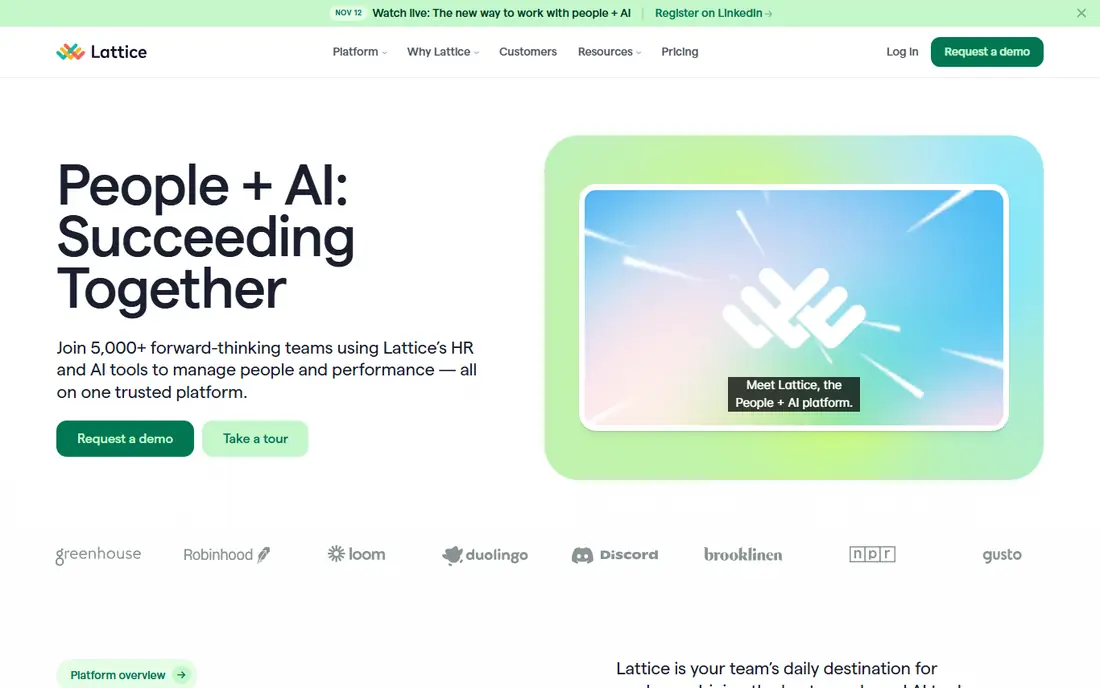
Lattice stands out first for performance reviews, OKRs, and continuous feedback. We put it near the top because it covers the core job without forcing a team to stitch together several smaller tools, and its main workflows are easy to explain to a colleague who has not used it before. That breadth matters when a decision affects more than one person, because the tool chosen on day one is often the tool that still has to make sense in six months. For most buyers, the practical test is simple. Check whether performance reviews, OKRs, and continuous feedback shows up in the plan you would actually pay for, not only in the top tier, and check how limits change as use grows. confirm the annual minimum before a trial turns into a budget surprise. If both answers look acceptable, it is a strong shortlist candidate, and a short trial with real data will tell you more than any demo video.
- Reviews, goals, feedback, and engagement in one platform
- Strong for growing teams
- Pricing and minimums can be high for small teams
- Some features need higher tiers
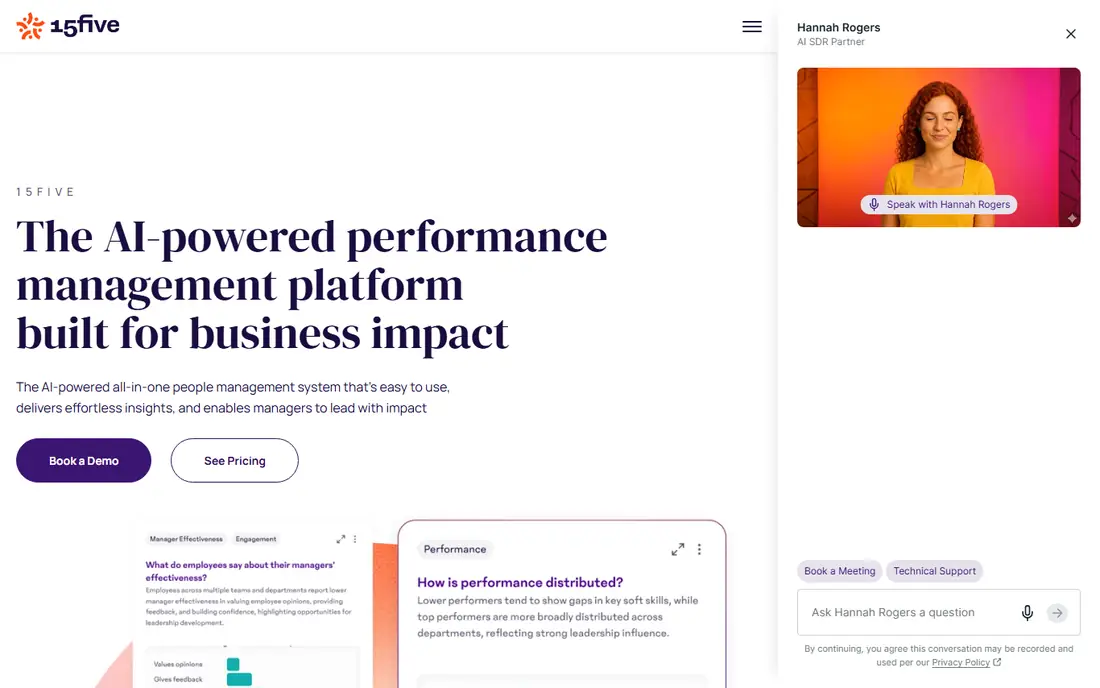
If your priority is manager check-ins, reviews, and career conversations, 15Five deserves a close look. It takes a narrower problem and handles it in depth, which can be more useful than a broad platform that only touches the same area in passing. Teams with a clear use case often prefer that focus, because setup is shorter and the results are easier to judge. The trade-off is scope, and that is where buyers should be careful. the best check-in tool still fails if managers do not use it weekly. Before committing, list the two or three tasks you will do every week and confirm each one works in the plan you intend to buy. When those tasks are covered, the narrower focus becomes an advantage rather than a limit.
- Weekly check-ins, 1-on-1s, and reviews that managers actually use
- Good for hybrid teams
- Annual billing only on many plans
- Advanced features sit in higher tiers
Culture Amp is a good middle-ground choice for people who want employee surveys, reviews, and calibration without a long learning curve. Its interface and documentation are aimed at regular users rather than specialists, so a small team can usually get value in the first week. That matters when there is no dedicated administrator to run the tool. Still, no tool in this guide is right for every buyer. quote-based pricing means a sales process before a clear cost. A useful check is to run one real project through it from start to finish, including export, sharing, and any reporting you need at the end. If that full loop feels smooth, the tool will likely hold up under normal use.
- Research-backed surveys and review design
- Benchmarking helps larger employers
- Pricing is not public
- Implementation can be heavier than lightweight rivals
For buyers who care most about custom review cycles and flexible forms, PerformYard offers a different balance from the leaders above it. It may not win on every feature, but it can be the better fit when price, simplicity, or a specific workflow matters more than having the largest feature list. That kind of fit is easy to miss in a side-by-side table. The honest catch is worth stating plainly. teams that need deep HRIS data may need another system beside it. Weigh that limit against the price and against how often you would hit it in practice. A limit that rarely matters in daily work should not rule out a tool, while a limit that blocks a weekly task should move it down your list at once.
- Flexible review forms and cycles
- Simpler than enterprise suites
- Clear per-person pricing
- Analytics and integrations are less deep than larger platforms
Leapsome stands out first for performance reviews, goals, and employee development. We put it near the top because it covers the core job without forcing a team to stitch together several smaller tools, and its main workflows are easy to explain to a colleague who has not used it before. That breadth matters when a decision affects more than one person, because the tool chosen on day one is often the tool that still has to make sense in six months. For most buyers, the practical test is simple. Check whether performance reviews, goals, and employee development shows up in the plan you would actually pay for, not only in the top tier, and check how limits change as use grows. contract length should be checked before a pilot. If both answers look acceptable, it is a strong shortlist candidate, and a short trial with real data will tell you more than any demo video.
- Reviews, goals, surveys, and learning in one place
- Good for European teams
- Pricing is not public
- One-year terms are common
If your priority is HR data, reviews, and goals in one system, BambooHR deserves a close look. It takes a narrower problem and handles it in depth, which can be more useful than a broad platform that only touches the same area in passing. Teams with a clear use case often prefer that focus, because setup is shorter and the results are easier to judge. The trade-off is scope, and that is where buyers should be careful. buyers who only need performance may pay for a wider HR suite. Before committing, list the two or three tasks you will do every week and confirm each one works in the plan you intend to buy. When those tasks are covered, the narrower focus becomes an advantage rather than a limit.
- Performance sits beside core HR data, which reduces double entry
- Good for small to mid-size teams
- Performance needs the higher tier
- It is not a standalone performance specialist
Small Improvements is a good middle-ground choice for people who want simple reviews and 1-on-1s for teams up to a few hundred people without a long learning curve. Its interface and documentation are aimed at regular users rather than specialists, so a small team can usually get value in the first week. That matters when there is no dedicated administrator to run the tool. Still, no tool in this guide is right for every buyer. larger companies may outgrow its reporting and controls. A useful check is to run one real project through it from start to finish, including export, sharing, and any reporting you need at the end. If that full loop feels smooth, the tool will likely hold up under normal use.
- Simple reviews, goals, and 1-on-1s
- Low price and low admin load
- Fewer enterprise features such as deep calibration or complex compensation links
For buyers who care most about performance, goals, engagement, and recognition, ThriveSparrow offers a different balance from the leaders above it. It may not win on every feature, but it can be the better fit when price, simplicity, or a specific workflow matters more than having the largest feature list. That kind of fit is easy to miss in a side-by-side table. The honest catch is worth stating plainly. check integration depth with your HRIS before rollout. Weigh that limit against the price and against how often you would hit it in practice. A limit that rarely matters in daily work should not rule out a tool, while a limit that blocks a weekly task should move it down your list at once.
- Combines reviews, goals, engagement, and recognition
- AI-assisted development plans
- Newer brand than Lattice or Culture Amp, so long-term track record is shorter
Effy stands out first for fast, self-serve review cycles. We put it near the top because it covers the core job without forcing a team to stitch together several smaller tools, and its main workflows are easy to explain to a colleague who has not used it before. That breadth matters when a decision affects more than one person, because the tool chosen on day one is often the tool that still has to make sense in six months. For most buyers, the practical test is simple. Check whether fast, self-serve review cycles shows up in the plan you would actually pay for, not only in the top tier, and check how limits change as use grows. it suits a first formal cycle better than a complex enterprise program. If both answers look acceptable, it is a strong shortlist candidate, and a short trial with real data will tell you more than any demo video.
- Low price, free tier for small teams, and fast setup with no sales call
- Depth for calibration, compensation, and enterprise reporting is limited
How we picked these
We compared official feature pages, pricing pages, app store listings where relevant, privacy policies, and public reviews. We kept only products that are available now and that fit the topic in a direct way, not tools that mention the topic only as a side feature. Where a price or free tier could not be verified on the vendor site or store listing, we wrote See website rather than repeating an unverified figure. We also looked for honest limits, such as caps on a free plan, features held back for higher tiers, and cases where a product works best for one size of team or one kind of project. A product stayed on the list only when its strengths were clear enough to recommend for a specific buyer, even when it was not the best choice for everyone.
How to pick a performance platform
Start with the cycle you want
Decide whether you need annual reviews, quarterly check-ins, continuous feedback, or all three. A tool built for annual cycles can feel clumsy for weekly check-ins, and a lightweight check-in tool can feel thin for calibration and compensation reviews.
Test the manager experience
Managers decide whether a system lives or dies. Run a pilot with real managers, real forms, and real deadlines, and watch how long a review takes. If managers need training videos to finish a simple review, adoption will suffer.
Check HRIS and payroll links
Reviews are more useful when goals, roles, and reporting lines stay in sync. Check whether the tool syncs with your HR system, whether data exports are easy, and whether access controls fit your privacy rules. A tool that needs manual data entry every cycle will lose trust fast.