Best Police Scanner App in 2026: 8 Apps Compared
By ToolNimba Editorial Team October 29, 2026 10 min read

- Top pick
 Scanner Radio
Widest free feed directory
Starting priceFreeCheck out Scanner RadioRead our review - Runner-up
 Broadcastify
Official feed source and alerts
Starting priceFreeCheck out BroadcastifyRead our review - Also great
 5-0 Radio Police Scanner
Simple listening with news extras
Starting priceFreeCheck out 5-0 Radio Police ScannerRead our review
How we researched this
We compared official pricing and feature pages, app store listings, privacy policies and public user reviews. Prices change, so check the provider's site before you pay.
Key takeaways
- Scanner Radio and Broadcastify give you the widest live feed coverage for free, because most feeds come from volunteers on the Broadcastify network.
- Paid Pro versions mainly remove ads and add features like recording, rather than opening secret channels.
- Many police departments now use encrypted radio, so no app can hear every agency in every city.
- Use these apps to stay informed during storms and major incidents, and rely on official alerts for evacuation and safety instructions.
Quick comparison
| Name | Best for | Starting price | Free plan | |
|---|---|---|---|---|
| Scanner Radio | Widest free feed directory | Free | Yes | Visit |
| Broadcastify | Official feed source and alerts | Free | Yes | Visit |
| 5-0 Radio Police Scanner | Simple listening with news extras | Free | Yes | Visit |
 Police Scanner: Fire Radio | Maps, codes and sleep timer | Free | Yes | Visit |
 OpenMHz | Browser listening without an app | Free | Yes | Visit |
 Citizen | Local safety alerts and live video | Free | Yes | Visit |
 RadioReference | Feed database and radio research | Free | Yes | Visit |
 PulsePoint | Fire and EMS incident alerts | Free | Yes | Visit |
The best police scanner apps
Police scanner apps stream live radio from police, fire and EMS feeds shared by volunteers. They are useful when sirens pass, during severe weather, or when a major incident is unfolding nearby, but coverage depends on what volunteers stream and on whether a department encrypts its traffic.

Scanner Radio is the app most people mean when they ask for a police scanner app. It pulls together thousands of live feeds, mainly from Broadcastify, and organises them by location and service type, so you can find police, fire, weather and amateur radio in your area without knowing frequencies. The top feeds list and the alert when a feed gains many listeners at once are genuinely useful during breaking news, because a sudden surge often means something large is happening.
The free app is supported by ads, and Pro removes them and adds extra features. Store listings show Pro options that include monthly and yearly prices, and recent user comments note that a free trial can convert to a paid subscription if you do not cancel in time, so read the trial screen carefully. Audio quality also depends on the volunteer feed, not on the app, so a distant or quiet feed will still sound rough. For breadth of coverage at no cost, Scanner Radio is our pick for most people.
- Very large feed directory
- Listener-count alerts for busy feeds
- Favourites and nearby feed search
- Free version shows ads
- Audio quality varies by feed
- Pro is a subscription, so check the trial terms
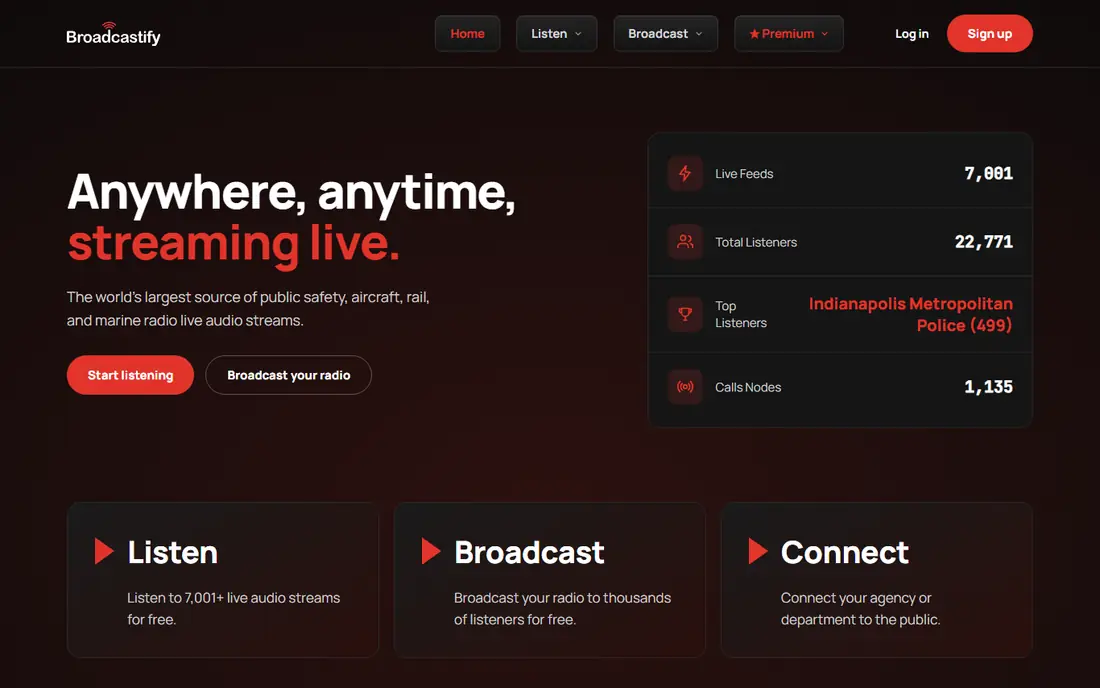
Broadcastify is the source behind many scanner apps, and using its own app cuts out the middleman. It lists thousands of police, fire, ambulance, aviation, rail, marine and amateur radio streams, and you can search by location, save favourites and receive alerts for major incidents. If you also listen on a computer, the web player means you do not need to keep your phone tied up.
The free version gives full access to live feeds with ads, while the paid version removes ads and adds access to archives. That makes the paid upgrade a convenience rather than a necessity for most listeners. Feeds can still disappear when a volunteer stops streaming or a department changes its system, which is a limit of the whole category, not a fault of this app alone. Start here if you want the source network itself.
- Largest volunteer feed network
- Major incident alerts
- Web player as well as apps
- Free app shows ads
- Premium mainly adds archives and removes ads
- Some feeds go offline without warning
5-0 Radio Police Scanner
Best for: Simple listening with news extras
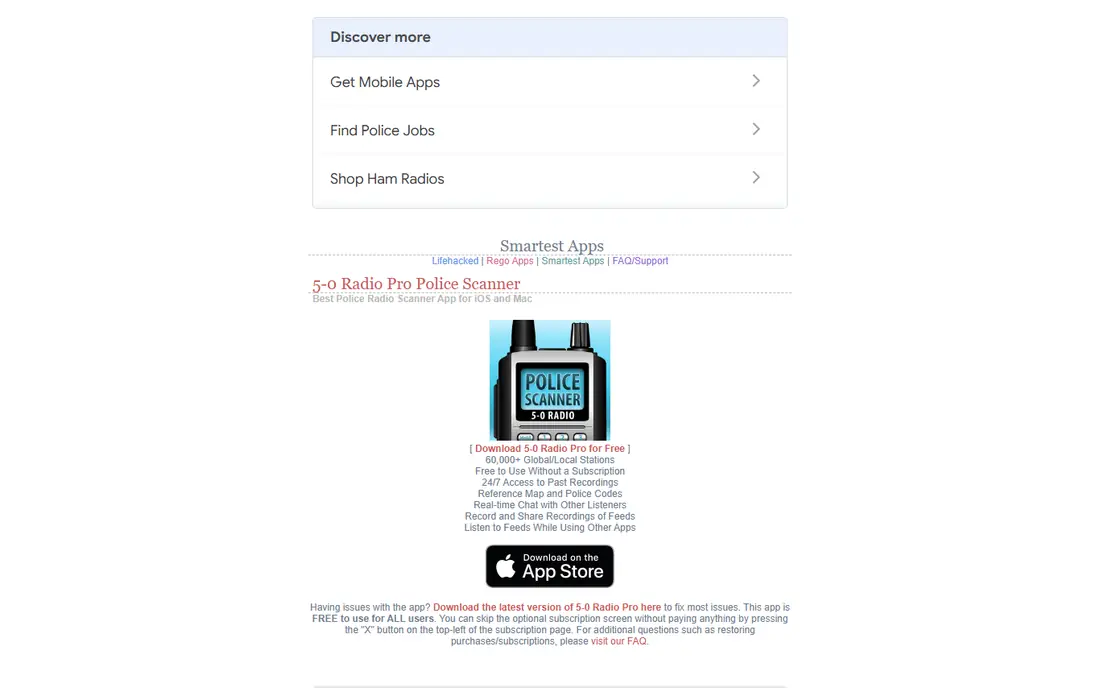
5-0 Radio has been around for years and keeps its focus on finding a feed fast and pressing play. You can search by name, country or nearby stations, save favourites, and see a top list of stations other listeners are using right now. The Pro version adds an ad-free experience, a sleep timer, themes and extra police news and video content for people who want more than audio alone.
That extra content is a mixed blessing. If you only want to hear what is happening near you, the news stories and videos can feel like clutter. Prices for Pro purchases have also changed over time and differ between stores, so check the price shown in your own app store before you buy. For a simple, long-running scanner app with a paid ad-free option, 5-0 Radio is a solid choice.
- Easy to browse by location
- Pro version is ad-free
- Adds police news and video extras
- News and video extras distract from pure listening
- In-app purchase prices vary by store
- Feed quality varies
Police Scanner: Fire Radio
Best for: Maps, codes and sleep timer
This app, often listed as Police Scanner: Fire Radio, is aimed at listeners who want context as well as audio. It shows feeds on a map, lets you search by keyword, and includes a reference for police and fire codes so you can follow what officers are describing without prior radio knowledge. A sleep timer, lock screen controls and a widget make it easy to listen in the background or before bed.
The free version is ad-supported, and Premium, listed in store pages at $9.99 per month, removes ads. That monthly price is high compared with one-time or cheaper Pro options elsewhere, so only pay it if you use the app daily and value the map and code tools. For a listener who wants to learn the codes while listening, it is a helpful package.
- Built-in map of feeds
- Police codes reference in the app
- Sleep timer and widgets
- Premium is a monthly subscription
- Ads in the free version
- Listener counts can be a distraction
OpenMHz is a web-based scanner platform run from trunked radio systems that volunteers host, rather than a polished consumer app. You open it in a browser, pick a system and talkgroup, and listen to calls as they are captured, with archives available on many systems. That makes it a good option on a work computer or a device where you do not want to install another app.
The trade-off is coverage and polish. OpenMHz only covers systems where someone runs a receiver and shares it, so your city may not be listed, and the interface assumes you know what a talkgroup is. It is not the best first app for a casual listener. It is a useful second tool for radio hobbyists and for people in covered areas who want to replay recent calls.
- No app install needed
- Works in a browser
- Archive playback on supported systems
- Coverage is limited to systems volunteers run
- Interface is technical
- No mobile app polish
Citizen is not a scanner app in the classic sense, and that distinction matters. Instead of streaming police radio, it sends alerts about incidents near you, shows them on a map, and lets nearby users share live video. For a city resident who wants to know why helicopters are overhead or why a street is closed, that alert-first approach can be faster to understand than raw radio audio.
The downside is tone and coverage. Alerts about crime and emergencies can feel constant in a busy city, and smaller towns may see far fewer reports. Citizen also offers paid safety features in some areas, so check what is included free in your location. Use Citizen alongside a scanner app, not as a replacement, when you want plain-language context for what you hear.
- Fast local incident alerts
- Live video from nearby users
- Map of incidents near you
- Not a traditional scanner feed app
- Alerts can feel alarming
- Coverage is strongest in larger cities
RadioReference is the database that powers much of the scanner world. It lists frequencies, trunked systems, talkgroups and feed details, maintained by a large community of radio users. If you own a physical scanner, or you want to understand why a feed is silent, this is where you look up whether a system has changed, moved to a new band, or gone encrypted.
As an everyday listening app it is less direct. The site is built for research, and while Broadcastify feeds link to it, a casual listener may find Scanner Radio or Broadcastify easier for daily use. Keep RadioReference in your pocket for the moments when a feed disappears and you want to know why, or when you are learning how local radio systems work.
- Deep database of frequencies and systems
- Community-maintained
- Essential for hobbyists
- Website-first experience
- Not as simple as a one-tap app
- Some features need a paid account
PulsePoint takes a different approach from the rest of this list. It shows live fire and EMS incidents from agencies that choose to share data, and it can alert trained bystanders to a nearby cardiac arrest where CPR may help before crews arrive. The incident list and map are clear, and the data comes from the agencies themselves rather than from volunteer radio streams.
That also limits it. Police radio audio is not part of PulsePoint, and your area will only appear if local fire and EMS agencies participate. It is best used as a companion to a scanner app: hear a fire dispatch on Scanner Radio, then check PulsePoint for the incident type and location in plain terms. For fire and medical awareness, it is one of the most useful free tools available.
- Official incident data from participating agencies
- CPR alerts for nearby cardiac arrests
- Clear incident map
- Only covers participating fire and EMS agencies
- No police radio audio
- Not available everywhere
How we picked these
We compared official app store listings, vendor sites and public reviews, rather than claiming hands-on trials we did not run. We looked for apps and services that are still available in 2026, that truly provide live police, fire or EMS audio or incident data, and that do not promise access to encrypted channels they cannot deliver. We left out clone apps with copied names and no clear developer, because their feeds and privacy practices are hard to verify.
What to know before you listen
First, check whether your local police use encryption. Many departments now encrypt some or all traffic, and when they do, no app can legally decode it for you. A silent feed may mean encryption, a volunteer offline, or a system change, not a broken app. Second, treat scanner audio as unverified. Callers and dispatchers describe events as they unfold, and early details are often wrong, so wait for official statements before repeating what you hear.
Third, do not use scanner audio to interfere with emergency work. Do not drive to an incident, do not share an officer location in real time, and do not use what you hear to evade police. Listening to public feeds is legal in most US states for personal use, but using a scanner while committing a crime, or in a vehicle where state law restricts it, can be illegal. Check your state rules if you plan to listen while driving, and always follow official evacuation and safety instructions over anything you hear on a feed.