Best Real Estate Apps in 2026: 8 Apps Compared
By ToolNimba Editorial Team October 31, 2026 8 min read

- Top pick
 Zillow
Broadest home search
Starting priceFreeCheck out ZillowRead our review - Runner-up
 Redfin
Buying and selling with lower fees
Starting priceFreeCheck out RedfinRead our review - Also great
 Realtor.com
Fresh MLS listings
Starting priceFreeCheck out Realtor.comRead our review
How we researched this
We compared official pricing and feature pages, app store listings, privacy policies and public user reviews. Prices change, so check the provider's site before you pay.
Key takeaways
- Zillow has the broadest national search, while Realtor.com draws closely from MLS feeds for fresher listing status.
- Redfin combines search with a full-service brokerage and lower listing fees in many markets.
- Trulia adds neighborhood and lifestyle data that Zillow and Realtor.com show in less depth.
- Renters should start with Apartments.com or Zumper, since buyer portals duplicate rental listings more often.
- Home value estimates are starting points only, with off-market errors near 7 percent on major portals, so confirm price with comps and an agent.
Quick comparison
| Name | Best for | Starting price | Free plan | |
|---|---|---|---|---|
| Zillow | Broadest home search | Free | Yes | Visit |
| Redfin | Buying and selling with lower fees | Free | Yes | Visit |
| Realtor.com | Fresh MLS listings | Free | Yes | Visit |
 Trulia | Neighborhood research | Free | Yes | Visit |
 Homes.com | Simple national search | Free | Yes | Visit |
 Apartments.com | Verified rental listings | Free | Yes | Visit |
 Zumper | Fast rental search | Free | Yes | Visit |
 Auction.com | Foreclosure and auction homes | Free | Yes | Visit |
The best real estate apps
We compared official app pages, feature lists, and public reviews for each app below. All eight are free to search, with brokerage, agent, or auction fees applying only when you transact.

Zillow is our pick for most buyers who want one big search. Its inventory covers for-sale homes, rentals, sold history, and for-sale-by-owner listings, with filters for price, beds, baths, and commute. Saved searches and alerts make it easy to watch a neighborhood without checking daily.
The catch is freshness and lead routing. Status changes travel from the MLS through syndication, so a home can show as available after it went pending. The agent who answers a tour request may also be a paid placement rather than the listing agent. Use Zillow for discovery, then confirm status with the listing agent before getting attached.
- Largest national inventory in one search
- Zestimate, saved searches, and alerts
- For-sale-by-owner listings included
- Listing status can lag the MLS
- Inquiries may route to paid Premier Agent placements
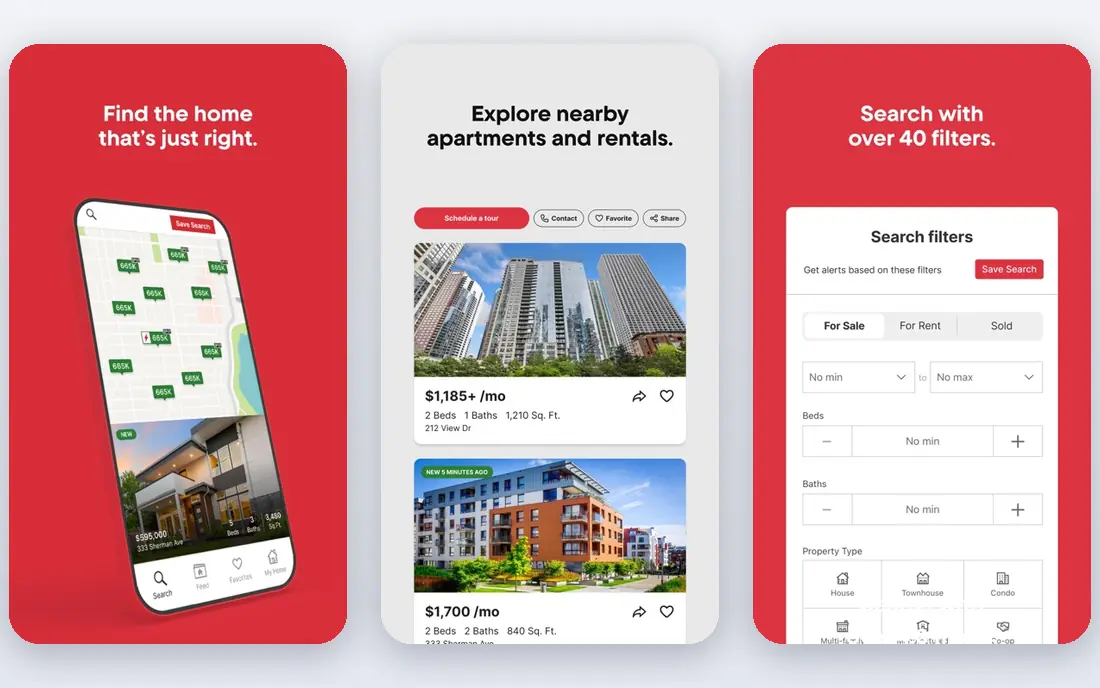
Redfin suits buyers and sellers who want search plus a brokerage in one place. Its listings refresh quickly from MLS feeds, its Estimate and Hot Homes data help with pricing context, and its salaried agent model supports lower listing fees than a traditional commission in many markets. Buyers may also qualify for a rebate in some areas.
The trade-off is agent choice. Redfin assigns agents rather than letting you pick any local agent, which will not suit everyone. Its coverage of for-sale-by-owner homes is also thinner than Zillow. If lower fees and fast data matter most, Redfin is a strong pick.
- Fast MLS refresh
- Redfin Estimate and market data
- Full-service brokerage with reduced listing fees in many markets
- In-house agent model means you do not pick your agent freely
- For-sale-by-owner coverage is thinner
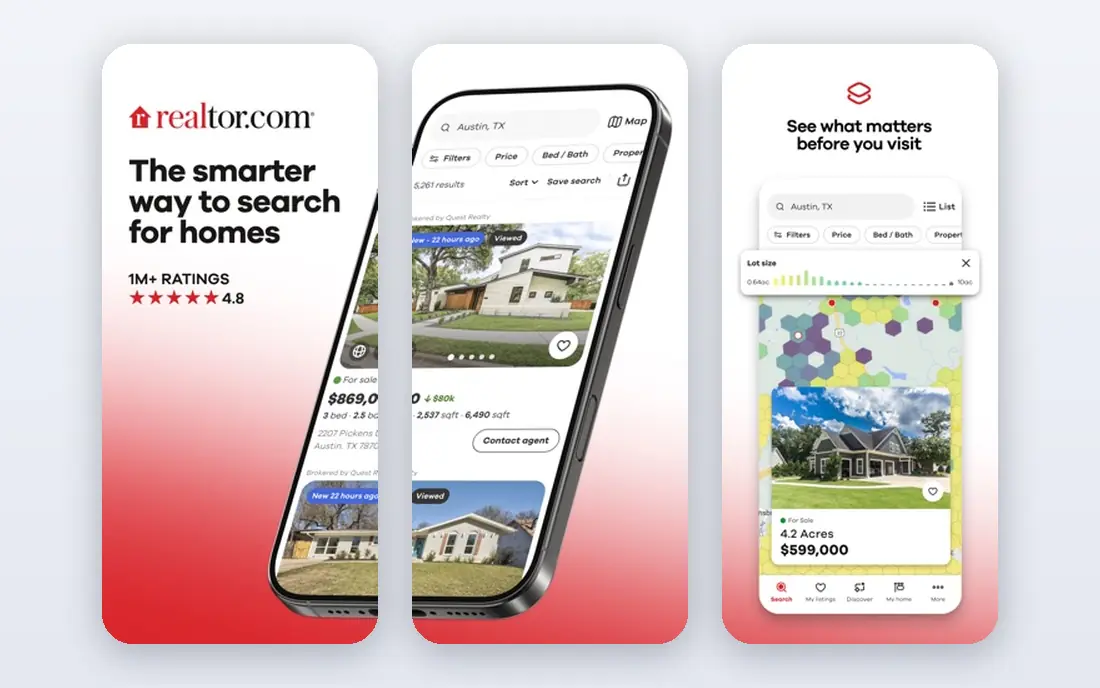
Realtor.com is the best pick for buyers who care most about listing accuracy. Operated as the official site of the National Association of Realtors under license, it draws closely from MLS feeds, so status changes tend to surface sooner than on portals that rely on syndication. Market reports and neighborhood data add useful context.
The downside is polish. The app feels less consumer-friendly than Zillow or Redfin, and it does not emphasize for-sale-by-owner listings. If you hate chasing homes that already sold, Realtor.com should be your primary search, with Zillow kept open for broader coverage.
- MLS-sourced listings with fast status updates
- Verified licensed agent connections
- Detailed market reports
- Interface feels less polished than Zillow
- No for-sale-by-owner focus
Trulia, a Zillow subsidiary, is best used as a research layer rather than a sole search app. Its neighborhood pages layer schools, crime context, commute data, and lifestyle notes over the map, which helps buyers compare areas before touring. Mortgage and affordability calculators also help set a realistic budget.
Because Trulia shares much of its inventory with Zillow, it adds little as a second search. Use it to research neighborhoods you found on Zillow or Realtor.com, then return to your main app for alerts and tours. That split gives you depth without duplicate alerts.
- Deep neighborhood, school, and lifestyle data
- Crime and commute context
- Affordability and mortgage calculators
- Owned by Zillow, so listings overlap heavily
- Less useful as a standalone search
Homes.com suits first-time buyers who find Zillow busy and want a simpler search. Its interface is clean, its inventory is growing from MLS sources, and its tools help buyers connect with agents without heavy upselling. For a straightforward search, it does the job well.
The limit is depth. Homes.com has fewer advanced filters, estimates, and market tools than Zillow or Redfin, and its agent footprint is smaller. Use it as a clean second search, especially if Zillow feels cluttered, but keep a larger portal for full coverage.
- Clean, simple search experience
- Growing MLS-sourced inventory
- Agent-to-client tools
- Fewer advanced features than larger portals
- Smaller audience and agent footprint
Apartments.com is the best starting app for renters. Its listings come largely from landlords directly, which reduces the duplicates and stale posts that clutter buyer portals. Filters for rent, pets, amenities, and lease terms help narrow a rental search fast.
The trade-off is scope. Apartments.com is a rental app, not a buying app, so buyers should look elsewhere. Renters in smaller cities may also see fewer listings than in large metros. Pair it with Zumper for the widest rental coverage.
- Landlord-direct, verified rental listings
- Fewer duplicates than buyer portals
- Detailed filters for rent, pets, and amenities
- Few for-sale listings
- Coverage varies by city
Zumper suits renters who need to move fast in competitive markets. Instant alerts flag new listings as they appear, and online applications in many markets let you apply before a weekend open house fills up. The mobile search is quick and well suited to daily checks.
Like Apartments.com, Zumper is rental-only, so buyers gain little here. Inventory also varies by city, and the fastest alert does not guarantee a landlord reply. Use Zumper alongside Apartments.com, and apply promptly when a good rental appears.
- Instant alerts for new rentals
- Online applications in many markets
- Fast mobile search
- Rental-only focus
- Some markets have thinner inventory than Apartments.com
Auction.com is for investors and bargain hunters who want homes outside standard listings. Its inventory covers foreclosures, bank-owned homes, and auctions, with bidding terms and property details in one place. Standard portals rarely show this inventory in full.
The risk is real. Auction homes often sell as-is, may need major repairs, and may require fast payment or cash, so they do not suit first-time buyers. Research title, condition, and financing before bidding, and treat Auction.com as a specialist tool, not a general home search.
- Foreclosure, bank-owned, and auction inventory not found on standard portals
- Auction terms and bidding info in one place
- Auction purchases carry higher risk and need cash or fast financing
- Fees apply to auctions
How we picked these
We compared official app pages, feature lists, and public reviews for each app. We required a current US app or site for buying, selling, or renting, with real listings in 2026. We favored portals with distinct strengths, such as breadth, MLS freshness, neighborhood data, rental verification, or auction inventory, over portals that only duplicate the same search.
How to use real estate apps without getting misled
Start with one primary search and one research layer. Realtor.com or Zillow gives volume, Trulia gives neighborhood depth, and Glassdoor-style care applies here too: check the source of every number. A home value estimate is a model output, not an appraisal, and off-market estimates on major portals carry median errors near 7 percent.
Next, confirm status and details before touring. Ask the listing agent whether the home is still available, verify square footage, HOA dues, and taxes from official records, and check days on market across portals. A home that shows differently on two apps is a sign to verify, not to trust the prettier number.
Finally, understand agent routing and fees. Since 2024 practice changes, buyers sign a buyer agency agreement with a fee before touring, and that fee is negotiated deal by deal. Ask how your agent is paid, whether a tour request routes to a paid placement, and what a listing fee or rebate covers before you commit.
Sources
- https://www.zillow.com
- https://www.redfin.com
- https://www.realtor.com
- https://www.trulia.com
- https://www.homes.com
- https://www.apartments.com
- https://www.zumper.com
- https://www.auction.com
- https://listwithclever.com/real-estate-blog/top-10-sites-that-compete-with-zillow/
- https://listwithclever.com/best-home-buying-websites/