Best Route Optimization Software in 2026: 9 Tools Compared
By ToolNimba Editorial Team October 31, 2026 9 min read

- Top pick
 OptimoRoute
Delivery and field service routing
Starting price$35 per driver per monthCheck out OptimoRouteRead our review - Runner-up
 Routific
Small local delivery teams
Starting priceFreeCheck out RoutificRead our review - Also great
 Spoke Dispatch
Courier dispatch and proof of delivery
Starting price$125 per monthCheck out Spoke DispatchRead our review
How we researched this
We compared official pricing and feature pages, app store listings, privacy policies and public user reviews. Prices change, so check the provider's site before you pay.
Key takeaways
- OptimoRoute suits delivery and field service teams that need time windows, workload balancing, and multi-day planning.
- Routific is the best low-cost start, with a free tier and simple route planning for small local teams.
- Spoke Dispatch, formerly Circuit for Teams, fits courier companies that need dispatch and proof of delivery on top of routing.
- Pricing models differ: per-driver plans suit high-volume teams, while per-order plans suit low-volume teams.
- Route planning alone is not dispatch: check driver apps, tracking, notifications, and proof of delivery before you buy.
Quick comparison
| Name | Best for | Starting price | Free plan | |
|---|---|---|---|---|
| OptimoRoute | Delivery and field service routing | $35 per driver per month | Free trial | Visit |
| Routific | Small local delivery teams | Free | Yes | Visit |
| Spoke Dispatch | Courier dispatch and proof of delivery | $125 per month | Free trial | Visit |
 Route4Me | Complex multi-stop logistics | See website | Free trial | Visit |
 Upper | Growing fleets with real constraints | $40 per user per month | Free trial | Visit |
 Onfleet | High-volume on-demand delivery | $599 per month | Free trial | Visit |
 Badger Maps | Field sales route planning | $58 per user per month | Free trial | Visit |
 RoadWarrior | Solo drivers and small route teams | $49 per month | Free trial | Visit |
 MyRouteOnline | Basic route planning for small teams | $19 per month | Free trial | Visit |
The best route optimization software
Route optimization software sequences stops into the fastest sensible order, accounting for traffic, time windows, vehicle capacity, and driver shifts. Delivery platforms add dispatch, driver apps, customer notifications, and proof of delivery on top of that engine. The best tool for a solo driver looks very different from the best tool for a fifty-vehicle fleet, so start with your stop count, driver count, and delivery type.
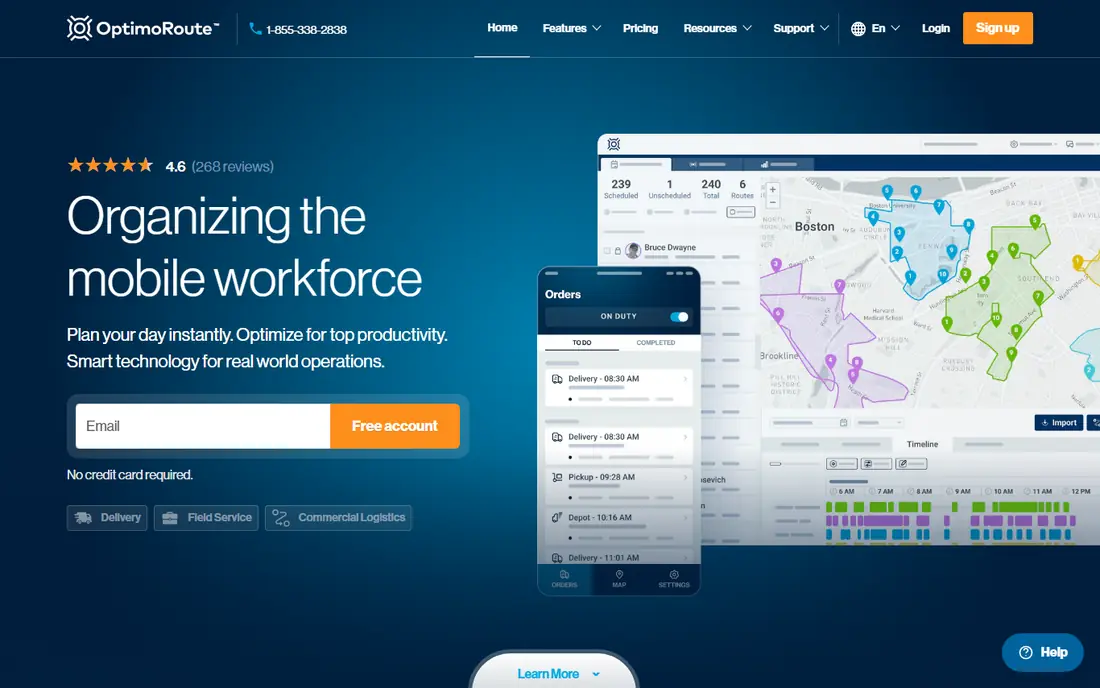
OptimoRoute is our pick for delivery and field service teams that need more than a simple stop sequence. It handles time windows, driver skills, vehicle capacity, and multi-day schedules, and it balances workloads so one driver does not carry an unfair share. The driver app adds tracking and proof of delivery, which helps dispatchers and customers alike. Per-driver pricing means the bill grows with each hire, even if order volume stays flat, so model it at peak staffing. For teams with complex routes and regular schedules, that depth is worth the price.
- Skill-based routing and multi-day planning
- Workload balancing across drivers
- Driver app with live tracking and proof of delivery
- Per-driver cost rises with headcount
- Advanced features need higher tiers
- Setup takes time for complex constraints
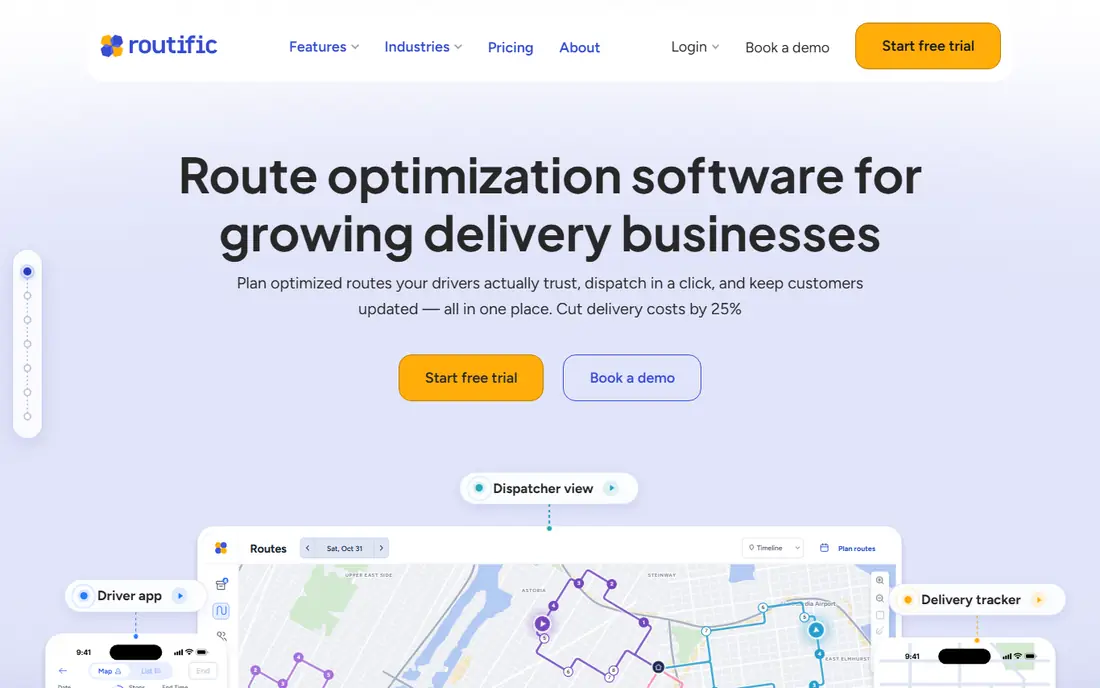
Routific is the best starting point for a small local delivery team. Its free tier covers a modest monthly order volume, and its interface is easy for dispatchers and drivers to learn. Routes can be edited by drag and drop, and customers receive notifications as deliveries progress. The limits show up for truck fleets, since truck-specific constraints are thin, and for large operations that need deeper dispatch controls. If you run a local bakery, pharmacy, or grocery delivery service with a handful of drivers, Routific gives you professional routing without a large upfront cost.
- Free tier for up to 100 orders a month
- Simple interface for small teams
- Customer notifications and driver tracking
- Limited truck-specific routing
- Fewer dispatch features than enterprise tools
- Paid plans scale by order volume
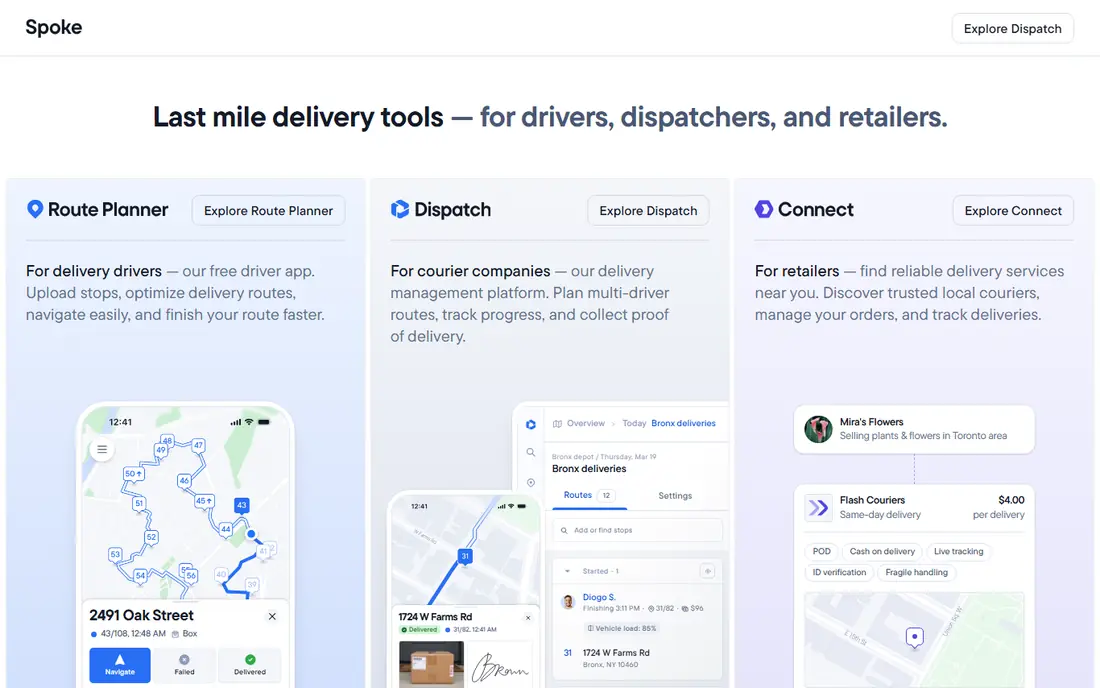
Spoke Dispatch continues the work of Circuit for Teams, which rebranded to Spoke in 2026. It is built for courier companies that need dispatch, client management, and proof of delivery alongside routing. A client portal lets shippers track their deliveries, and proof can be tailored per client, which matters for couriers serving businesses with different requirements. Pricing is per stop, so the bill follows delivery volume rather than headcount. That suits seasonal courier work, but high-volume operators should model the total at peak months before committing.
- Built for courier operations
- Client portal and per-client proof
- Driver app with tracking and notifications
- Per-stop pricing can rise with volume
- Smaller feature set than enterprise platforms
- Newer brand after Circuit rebrand
Route4Me suits operations with complex, high-stop routes and a need for customization. Its API and add-on marketplace let teams build routing into existing systems, and its territory tools help field teams divide work sensibly. That flexibility comes with complexity and less pricing transparency than before, since current plans are largely quote-based. Small teams may find simpler tools faster to adopt. If you run a logistics operation with unusual constraints and an in-house system to connect, Route4Me offers the depth to match.
- Extensive API and add-on modules
- Handles very large multi-stop routes
- Territory management for field teams
- Pricing is no longer openly published
- Add-ons can raise the total cost
- Interface can feel complex for small teams
Upper fits fleets of five to fifty vehicles that have outgrown basic planners. It optimizes routes with real constraints such as time windows, priorities, and vehicle limits, and its driver experience is straightforward enough for daily use. Proof of delivery and customer notifications are included, which helps growing delivery businesses look professional. The per-user price means a larger team pays more, but the rate is transparent compared with quote-only rivals. For a growing fleet that needs reliable optimization without enterprise complexity, Upper is a strong middle option.
- Clear pricing for growing fleets
- Handles time windows and vehicle constraints
- Driver-friendly routes and proof of delivery
- Per-user pricing grows with team size
- Less enterprise depth than larger platforms
- Some features need higher tiers
Onfleet is built for mid-market and enterprise on-demand delivery, where orders arrive all day and dispatch must happen fast. Its auto-dispatch, driver app, and proof features handle high volumes, including barcode scanning and ID checks for regulated deliveries. That power comes at a high entry price, well above small-team tools, and per-task pricing means the bill tracks volume closely. A small local team will find it excessive. A courier or retailer running hundreds of daily deliveries will appreciate the dispatch depth and reliability.
- Strong auto-dispatch for on-demand work
- Barcode scanning and ID checks
- Reliable driver app for high-volume teams
- High entry price
- Overkill for small teams
- Per-task pricing adds up at scale
Badger Maps is a different kind of route tool: it plans visits for field sales teams rather than deliveries for couriers. It maps customers, builds efficient visit routes, and connects to CRM systems so reps see customer details on the road. Territory management helps managers divide regions fairly. It is not a dispatch platform, so delivery teams needing proof of delivery and customer notifications should choose a delivery tool instead. For a sales team that spends its day visiting accounts, Badger Maps turns a scattered call list into a sensible daily route.
- Built for sales visits and territory planning
- CRM integrations for customer data
- Route visualization for field teams
- Not a full delivery dispatch platform
- Proof of delivery features are limited
- Price is high for basic routing alone
RoadWarrior suits solo drivers and very small teams that need a route planned quickly on a phone. Its mobile-first design keeps the workflow simple: enter stops, optimize, and drive. That simplicity is its main appeal, and its price sits below enterprise platforms. The trade-off is depth: dispatch, team tracking, and proof features are thinner than OptimoRoute or Onfleet. If you drive your own route or manage two or three drivers, RoadWarrior covers the core job well. If you run a dispatch operation, choose a platform built for teams.
- Simple route building for solo drivers
- Mobile-first design
- Low friction for small teams
- Fewer dispatch and tracking features
- Less suited to large fleets
- Some features need higher tiers
MyRouteOnline is the basic planner for teams that only need routes occasionally. It creates optimized multi-stop routes at a low price, without the dispatch, tracking, and proof features of larger platforms. That makes it a good fit for a small business that plans a weekly delivery run or a field visit list, rather than running daily dispatch. The limits are clear: it does not replace a delivery platform for live operations. If your need is a clean route a few times a week, MyRouteOnline is the cheapest capable option here.
- Low entry price for basic planning
- Simple multi-stop route creation
- Good for occasional route work
- No full dispatch platform
- Limited driver app and tracking
- Fewer constraint options than leading tools
How we picked these
We compared official pricing pages, feature pages, and public reviews, and we kept only tools that optimize multi-stop routes for delivery, field service, or sales. We favored tools with published prices, trials, or free tiers, and we included solo, small-team, and enterprise options. Prices change often, and several enterprise plans are quote-based, so confirm pricing at your driver count and stop volume before you buy.
How to compare pricing fairly
Pricing models make direct comparison tricky. Per-driver plans suit teams with high order volume relative to headcount, since the bill stays flat as orders grow. Per-order or per-task plans suit teams with modest volume, since you pay for what you deliver. Per-stop plans suit couriers with seasonal drivers, since the bill follows deliveries rather than hires. At roughly 3,000 orders a month with ten drivers, the models cost about the same; beyond that, per-driver pricing usually wins.
Test with your real data. Import a typical week of stops, with time windows, vehicle limits, and driver skills, and compare the routes each tool produces. Check the driver app on a real phone, test customer notifications, and confirm proof of delivery captures what your clients require. A tool that produces a neat route on paper but frustrates drivers on the road will cost more in missed deliveries than it saves in subscription fees.