Best Secure Email Service in 2026: 8 Services Compared
By ToolNimba Editorial Team November 7, 2026 10 min read

- Top pick
 Proton Mail
Best all-round secure mail
Starting price$3.99 per monthCheck out Proton MailRead our review - Runner-up
 Tuta
Best value encrypted mail
Starting price$3 per monthCheck out TutaRead our review - Also great
 Mailfence
OpenPGP and power users
Starting price$2.50 per monthCheck out MailfenceRead our review
How we researched this
We compared official pricing and feature pages, app store listings, privacy policies and public user reviews. Prices change, so check the provider's site before you pay.
Key takeaways
- Proton Mail is the best all-round secure email service, with strong encryption, a large ecosystem and a usable free tier.
- Tuta is the best value paid option, with lower prices and encryption that covers subject lines as well as message bodies.
- Mailfence suits advanced users who want OpenPGP compatibility, key management and a full productivity suite.
- Encryption only works fully when both sides use it, so mail to Gmail or Outlook addresses falls back to password-protected delivery.
- Free tiers are genuinely useful for a private secondary inbox, but custom domains, more storage and extra addresses require a paid plan.
Quick comparison
| Name | Best for | Starting price | Free plan | |
|---|---|---|---|---|
| Proton Mail | Best all-round secure mail | $3.99 per month | Yes | Visit |
| Tuta | Best value encrypted mail | $3 per month | Yes | Visit |
| Mailfence | OpenPGP and power users | $2.50 per month | Yes | Visit |
 StartMail | Aliases and privacy | $5.99 per month | No | Visit |
 Posteo | Low-cost green hosting | See website | No | Visit |
 Mailbox.org | Privacy plus office tools | See website | No | Visit |
 Hushmail | Simple encrypted mail | See website | No | Visit |
 CounterMail | Maximum security focus | See website | No | Visit |
The best secure email service
Secure email services protect your messages with end-to-end or zero-access encryption, so the provider cannot read your mail, unlike mainstream free providers that scan messages for advertising. We compared official pricing pages, security descriptions and public reviews to find services for personal users, businesses and power users alike.
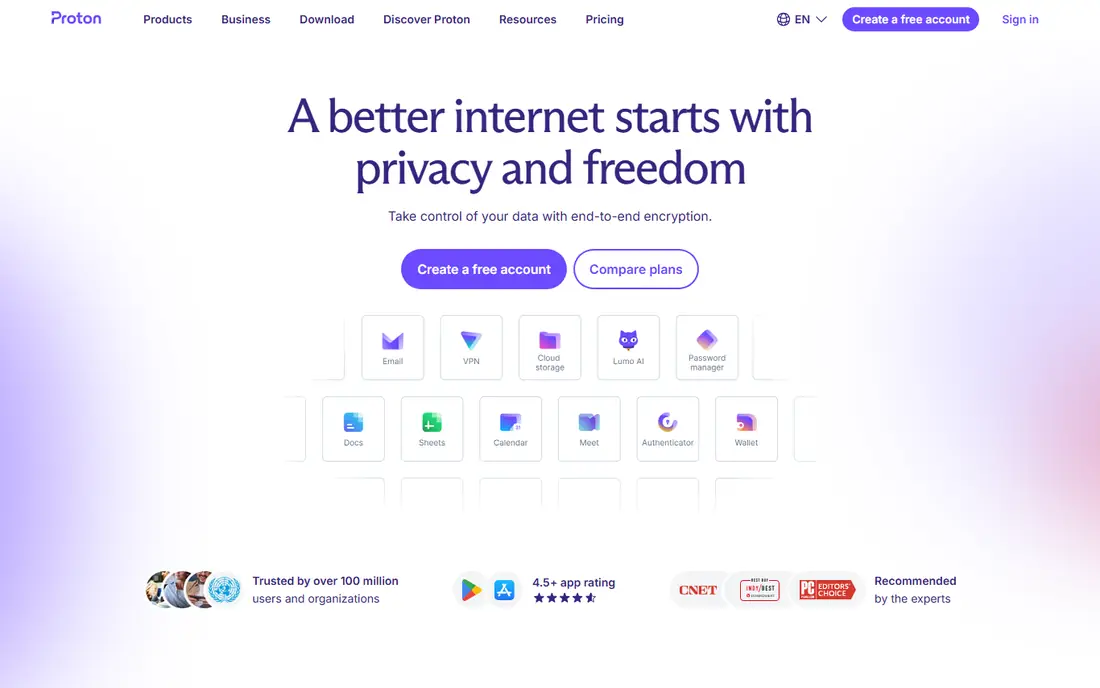
Proton Mail is the secure email service we recommend first, because it balances security, usability and ecosystem better than any rival. Messages between Proton users are end-to-end encrypted, the provider uses zero-access encryption so it cannot read your stored mail, and PGP support lets you exchange encrypted mail with outside PGP users. Higher plans bundle calendar, drive and VPN, which makes Proton a full privacy suite.
The limits are honest ones. Subject lines are not encrypted, which is a standard email limitation, and the free tier offers limited storage, with desktop Bridge access behind a paid plan. Paid plans start around $3.99 per month. If you want one secure inbox that also covers calendar and files, Proton Mail is the pick.
- End-to-end encryption with PGP support
- Swiss jurisdiction and zero-access encryption
- Calendar, drive and VPN in higher plans
- Subject lines are not end-to-end encrypted
- Free storage is limited
- Bridge for desktop clients requires a paid plan
Tuta, formerly Tutanota, is the best value secure email service and the strongest on encryption breadth. Its system encrypts the full message including subject lines, and it uses zero-access encryption so the provider cannot read your mail. Paid plans start around $3 per month, undercutting Proton, and the free tier gives a usable private inbox.
The trade is interoperability. Tuta's custom encryption works fully only between Tuta users, and there is no IMAP support for traditional desktop clients, so you use Tuta's own apps. Users who need PGP exchange or desktop client access should pick Proton or Mailfence. Users who want the cheapest strong encryption with a clean app will like Tuta most.
- Encryption covers subject lines and full messages
- Lower prices than rivals
- Post-quantum encryption work underway
- Custom encryption only works fully inside Tuta
- No IMAP support for outside clients
- Smaller ecosystem than Proton
Mailfence is the power user's secure email service. It emphasizes OpenPGP encryption, lets you manage keys directly in the browser, and adds digital signatures so recipients can verify your messages. Calendar, documents and contacts turn it into a full suite, and custom domains with anti-spoofing features suit small businesses.
The interface feels dated beside Proton and Tuta, and the free tier is small at 500 MB, with paid plans from $2.50 per month. Users who want PGP compatibility with other secure systems, or who run a small team on a privacy-first suite, will get the most from Mailfence. Casual users will find Proton or Tuta easier.
- OpenPGP encryption with key management in the browser
- Calendar, documents and contacts included
- Belgian jurisdiction
- Interface feels dated next to Proton and Tuta
- Free tier is small
- Advanced features need learning time
StartMail is built around aliases, which is a practical privacy feature many users underestimate. Unlimited disposable aliases let you give every service a different address, so a breach at one site does not expose your real inbox, and you can shut off an alias that starts receiving spam. PGP support and Netherlands jurisdiction round out a solid privacy story.
The cost is the barrier. There is no free tier, and paid plans start at $5.99 per month, which is more than Proton or Tuta for email alone. StartMail suits users who value aliases above bundles and who want a private inbox without a free-tier compromise. Budget buyers should start with Proton or Tuta free tiers instead.
- Unlimited aliases for private sign-ups
- PGP encryption support
- Netherlands jurisdiction with strong privacy law
- No free tier
- Higher starting price than rivals
- Smaller feature set than Proton's bundle
Posteo is the low-cost, principled option from Germany. It charges a small monthly fee, runs on green energy, carries no ads and no tracking, and even accepts anonymous payment by cash in an envelope. For users who want a private inbox from a small, independent provider, Posteo's ethics and price are appealing.
The limits are features. There is no free tier, custom domains are not part of the basic offer, and storage is smaller than Proton or Tuta paid plans. Pricing is listed on the vendor site in euros. If low cost and independence matter more than bundles and aliases, Posteo is a strong, quiet choice.
- Low price with no ads and no tracking
- Green energy hosting in Germany
- Anonymous payment options available
- No free tier
- No custom domains on the basic account
- Smaller storage than larger rivals
Mailbox.org is a German privacy provider that pairs secure mail with office tools, drive storage and video conferencing. It suits users who want a Google Workspace alternative without Google, with custom domains for personal or business use. Encryption is supported, though setting it up takes more effort than the automatic systems at Proton and Tuta.
There is no free tier, and pricing is listed on the vendor site. The interface is functional rather than polished, which matters less for a work inbox than for a personal one. If you want one privacy-first account for mail, documents and calls, Mailbox.org is worth comparing against Proton's bundle.
- Privacy-focused mail with office, drive and video tools
- German jurisdiction
- Custom domains supported
- No free tier
- Interface is functional rather than polished
- Encryption setup needs more effort than Proton or Tuta
Hushmail is one of the longest-running encrypted mail services, offering simple webmail with encryption for personal, business and healthcare users. Its straightforward approach appeals to users who want encrypted mail without learning PGP or managing keys, and business plans cover compliance needs for small firms.
The drawbacks are real. There is no free tier for new users, the feature set is narrower than Proton or Tuta, and past cases where Hushmail complied with law enforcement requests concern some privacy purists, even though any provider can face legal orders. Users who want modern features should pick Proton or Tuta. Users who want a simple, established encrypted webmail may still like Hushmail.
- Long-running encrypted mail service
- Simple webmail with encryption
- Business and healthcare plans available
- No free tier for new users
- Feature set is narrower than Proton
- Past legal compliance cases concern some privacy purists
CounterMail is the niche pick for users who prioritize security engineering above convenience. It runs diskless servers, so mail is not stored on hard drives in the usual way, offers a USB key option for extra authentication, and operates from Sweden. That design appeals to users with a high threat model.
Convenience is the cost. There is no free tier, the interface is basic, and the provider is smaller than Proton or Tuta, with a niche audience. Pricing is listed on the vendor site. Most users will be better served by Proton or Tuta, but security-focused users who want CounterMail's specific design will find nothing else quite like it.
- Diskless servers and strong encryption focus
- USB key option for extra authentication
- Swedish jurisdiction
- No free tier
- Interface is basic
- Smaller provider with a niche audience
How we picked these
We compared official pricing pages, security documentation and public reviews for email services that offer end-to-end or zero-access encryption in 2026. We favored providers with a track record of several years, a clear jurisdiction, and a usable free tier or trial where offered, and we left out services that shut down or that only encrypt in transit. We did not claim hands-on testing, and prices reflect vendor listings checked in October 2026, with some quoted in euros.
What encryption actually protects
End-to-end encryption protects message contents between users of the same encrypted service, and zero-access encryption means the provider cannot read your stored mail. Neither protects mail sent to a mainstream provider in full, since the message must be decrypted to reach a Gmail or Outlook inbox. For those contacts, secure services fall back to password-protected links or standard delivery, which is safer than plain mail but not fully encrypted.
Choose for your contacts, not just yourself
If your main contacts already use Proton, joining Proton gives you full encryption with them. If they use Tuta, Tuta does the same. For mixed contacts, pick the service whose apps, aliases and price you like best, and use password-protected messages for sensitive mail to outsiders. Also turn on two-factor authentication, since account takeover defeats any encryption.
Paid plans add the useful features
Free tiers cover a private secondary inbox well, but custom domains, more storage, extra addresses and desktop client access sit behind paid plans. Budget $3 to $6 per month for a serious primary inbox, and check whether the plan you need includes the storage and addresses your mail volume requires.
Sources
Frequently asked questions
Is Proton Mail really more private than Gmail?
Yes, in the ways that matter most. Proton Mail uses zero-access encryption, so Proton cannot read your stored messages, while Gmail scans and processes mail for its services. Proton also carries no ads and is based in Switzerland under strong privacy law. Mail to Gmail addresses is not fully end-to-end encrypted, though, since Gmail cannot receive it that way.
What is the cheapest secure email service?
Tuta and Mailfence offer the cheapest paid plans, starting around $3 and $2.50 per month, and both have free tiers. Posteo is also low-cost but has no free tier. For a free private inbox, start with Proton Mail or Tuta free, then pay only when you need a custom domain or more storage.
Can I use my own domain with secure email?
Yes, on paid plans at Proton Mail, Tuta, Mailfence, StartMail and Mailbox.org, among others. A custom domain lets a business or personal brand send encrypted mail under its own name. Check the plan details, since the number of domains and addresses varies by tier.
Does secure email work with Outlook or Apple Mail?
It depends on the provider. Proton Mail offers Bridge software on paid plans to connect desktop clients, and Mailfence supports standard protocols for many clients. Tuta does not offer IMAP, so you use its own apps. Check client support before paying if you rely on a specific desktop or mobile mail app.
Will switching to secure email stop spam?
It helps, but it does not stop spam entirely. Aliases, as offered by StartMail and others, help you shut off addresses that attract spam, and private providers carry less tracking than free ad-supported mail. You will still receive spam sent to your address, so use aliases and filters alongside encryption.