Best Tools for Personal Development in 2026: 9 Apps Compared
By ToolNimba Editorial Team October 29, 2026 11 min read

- Top pick
 Headspace
Structured meditation for beginners
Starting price$12.99 per monthCheck out HeadspaceRead our review - Runner-up
 Calm
Sleep stories and relaxation
Starting price$14.99 per monthCheck out CalmRead our review - Also great
 Habitica
Gamified habits and to-dos
Starting priceFreeCheck out HabiticaRead our review
How we researched this
We compared official pricing and feature pages, app store listings, privacy policies and public user reviews. Prices change, so check the provider's site before you pay.
Key takeaways
- Headspace and Calm cover meditation and sleep, but they serve different styles, with Headspace more structured and Calm more library-based.
- Habitica and Todoist help turn goals into daily actions, while Day One and Blinkist support reflection and reading in small daily doses.
- Most of these apps are cheap on their own, but subscriptions add up, so pick one habit to build before stacking several paid apps.
- These tools support wellbeing and learning, but they are not a replacement for professional help when you need it.
Quick comparison
| Name | Best for | Starting price | Free plan | |
|---|---|---|---|---|
| Headspace | Structured meditation for beginners | $12.99 per month | Free trial | Visit |
| Calm | Sleep stories and relaxation | $14.99 per month | Free trial | Visit |
| Habitica | Gamified habits and to-dos | Free | Yes | Visit |
 Fabulous | Daily routines and habit coaching | See website | Free trial | Visit |
 Day One | Private journaling and reflection | See website | Yes | Visit |
 Blinkist | Short book summaries | See website | Free trial | Visit |
 MasterClass | Learning from well-known teachers | See website | Free trial | Visit |
 Duolingo | Daily language learning | Free | Yes | Visit |
 Todoist | Simple task and goal tracking | $5 per month | Yes | Visit |
The best tools for personal development
Personal development is a broad goal, so this list covers the habits that support it: calm, sleep, routines, reflection, reading, learning a skill and getting daily tasks done. Pick the area you want to change first, and let one tool earn its place before you add another.

Headspace is the best starting point if you have never meditated and want guidance rather than a large library to browse. Its Basics courses teach the technique step by step with short animations, and later courses cover anxiety, focus and sleep in a clear order. That structure helps beginners build a daily habit, because you always know what to do next instead of choosing from hundreds of sessions.
Annual pricing is $69.99 per year, with monthly at $12.99 per month, and a student plan is listed at $9.99 per year for verified students. The free content is limited, so a trial is the honest way to test it. Advanced meditators may find the guided style too basic, and Calm has a deeper sleep library. For learning meditation from scratch, Headspace remains our pick.
- Clear progressive courses
- Short SOS sessions for stressful moments
- Student and family plans
- Library feels smaller than Calm for sleep
- Structured style can feel restrictive
- Full content needs a subscription
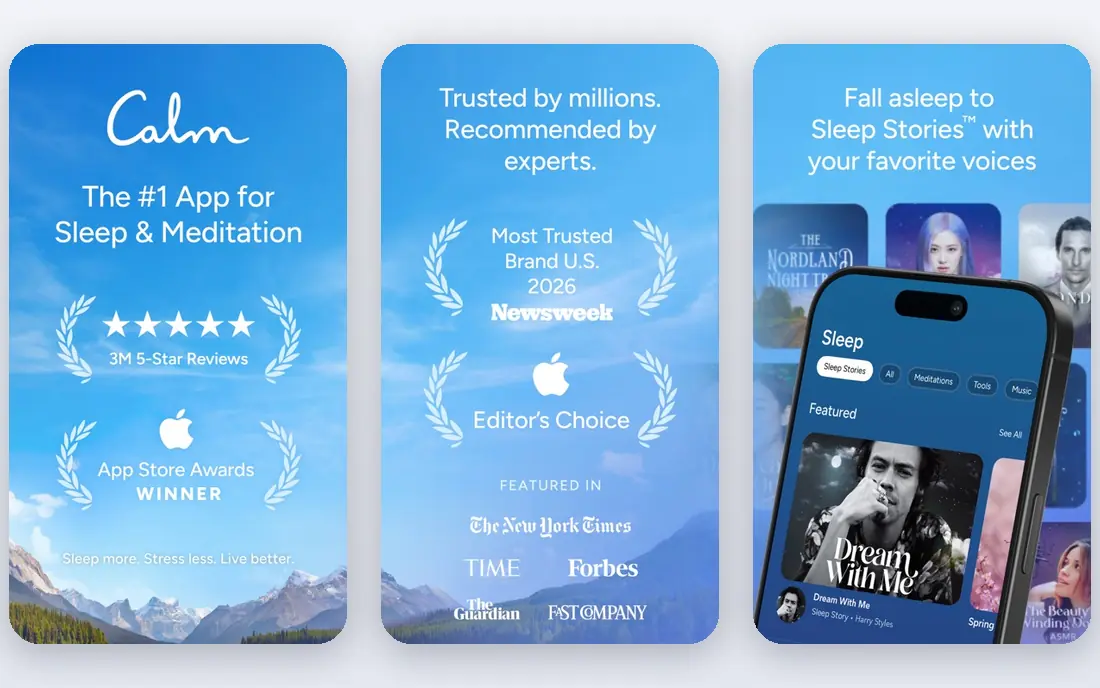
Calm suits people whose main goal is to wind down and sleep, rather than to learn meditation as a skill. Its Sleep Stories, narrated by a range of well-known voices, are the feature most users mention first, and its music, breathing exercises and soundscapes make it easy to use for a few minutes before bed. The style is browse-and-pick, so you can choose what fits your mood instead of following a set course.
Pricing is $69.99 per year on annual billing, or $14.99 per month, with a lifetime option listed at $399.99 in recent guides. A 7-day trial lets you test the sleep content before paying. If you want structured teaching, Headspace is better. If sleep is the problem you want to solve, Calm is the stronger choice.
- Large Sleep Stories library
- Relaxing music and soundscapes
- Browse-and-pick style suits many users
- Less structured teaching than Headspace
- Monthly price is higher
- Lifetime option is expensive
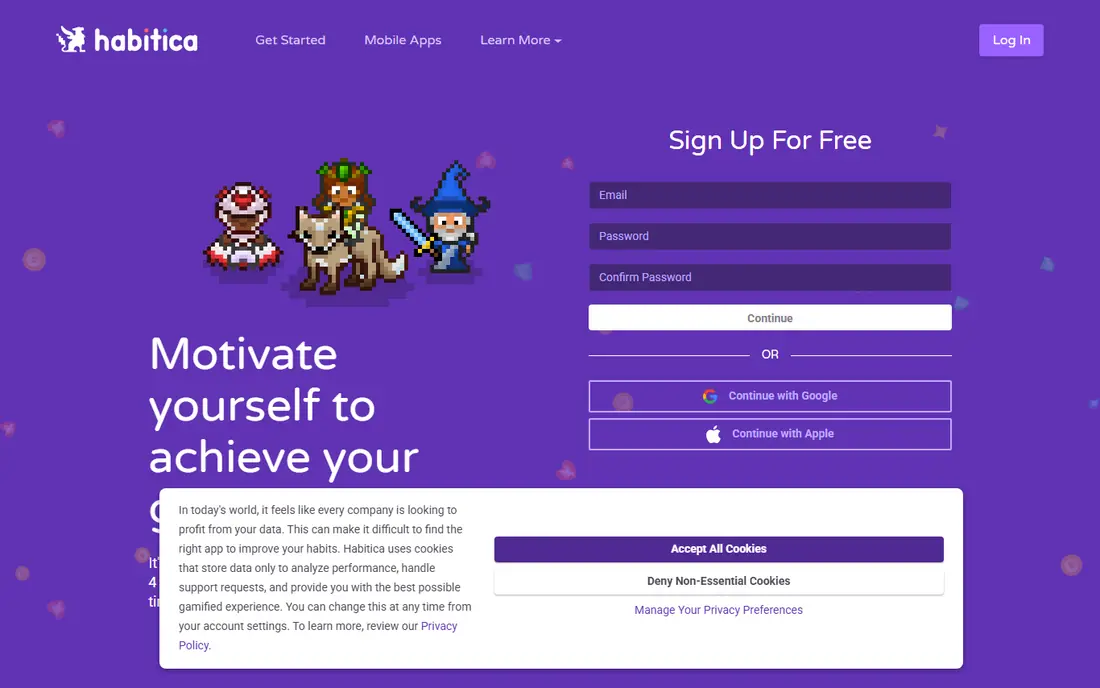
Habitica turns your habit list into a role-playing game, where completing habits and daily tasks earns experience, gold and items for your character. That game layer sounds gimmicky, but for people who struggle to stay consistent, a visible streak and a small reward can be enough to keep a habit alive through a dull week. You can also join a party, where missed dailies affect the group, which adds gentle accountability.
The core app is free, which makes it easy to try without a subscription decision. The theme is the main risk: if game graphics and pixel art put you off, you will not open it, and no habit app works if you do not open it. For younger users, gamers, or anyone who has tried plain habit trackers and drifted away, Habitica is worth a week of testing.
- Turns habits into a game with rewards
- Free core features
- Parties and guilds add social support
- Game theme will not suit everyone
- Interface can feel busy
- Premium features are optional extras
Fabulous takes a coaching approach to habits. Instead of giving you a blank list, it builds a morning routine one small step at a time, then adds journeys for goals such as better sleep, focus or exercise. Each step comes with short explanations of why it matters, which helps if you want to understand the habit, not just tick a box.
That guidance comes at the cost of flexibility. If you already know your routine and just want a tracker, Fabulous can feel slow and prescriptive. Pricing varies by store and plan, so we list it as See website and recommend checking the price in your app store before starting a trial. For someone starting from scratch who wants a guided routine, Fabulous is a thoughtful choice.
- Builds routines step by step
- Coaching journeys for sleep, focus and fitness
- Attractive design
- Price is not always clear upfront
- Some journeys feel slow
- Less flexible than a plain habit tracker
Day One is the journaling app most people stick with, because it removes friction. You can write a short entry, add a photo, tag a location and set a reminder, and the app keeps entries in a clean timeline you can search later. Prompts and templates help on days when you do not know what to write, and the focus on privacy, including passcode and encryption options, suits personal reflection.
A free plan covers basic journaling, while Premium adds unlimited photos, videos and journals, and pricing differs by store and billing period, so check the current price before subscribing. Day One will not force you to journal, and that is the honest limit of any journal app. If you want a private, attractive place to reflect for five minutes a day, it is an excellent tool.
- Clean journaling with photos and location
- Prompts and templates
- Strong privacy options
- Best features need Premium
- Sync and pricing vary by platform
- Journaling still needs your own discipline
Blinkist condenses nonfiction books into short summaries, called Blinks, that you can read or listen to in about 15 minutes. For personal development, that format works well for scanning ideas on habits, leadership, psychology and productivity, and for deciding which full books deserve your time. Curated collections by topic help you find a next read without browsing aimlessly.
The limit is clear: a summary gives you the main ideas, not the arguments, stories and nuance of the full book. Use Blinkist to discover and to refresh ideas, not as a substitute for books that matter to you. Pricing varies by plan and region, so we list it as See website. For busy readers who want a daily dose of ideas, it is a useful tool.
- Key ideas from nonfiction books in about 15 minutes
- Audio and text versions
- Curated lists by topic
- Summaries are not a replacement for reading
- Depth varies by book
- Subscription price varies
MasterClass offers video classes taught by well-known writers, chefs, musicians, athletes and business leaders, filmed to a high standard. For personal development, the value is often in seeing how a skilled person thinks about their craft, from storytelling to negotiation, rather than in a step-by-step course. Short lessons make it easy to watch one class in the evening without committing to a long programme.
It is not a replacement for practice. Watching a class on writing will not make you a writer, and the subscription price, which varies by plan, is higher than buying a single book on the same topic. Use MasterClass for inspiration and perspective, and pair it with a habit app or journal to turn ideas into action. For learners who enjoy video and famous teachers, it is engaging and well made.
- High production quality
- Well-known instructors
- Wide range from writing to leadership
- Subscription cost is higher than a book
- Classes are inspiration more than practice
- Pricing varies by plan
Duolingo is the easiest way to start a language as a personal development goal, because lessons are short, free and built around daily streaks. Five to ten minutes a day is enough to learn basic vocabulary and phrases, and the game-like leagues give a reason to return tomorrow. That low barrier matters, because most language goals fail in the first month, not the twelfth.
The free version includes ads and limited hearts on some platforms, while Super removes ads and adds offline lessons and unlimited hearts. Duolingo alone will not make you fluent, and you will need conversation practice and reading to progress beyond basics. As a daily starter habit that builds confidence, it is one of the best free tools on this list.
- Free core lessons
- Short daily sessions
- Streaks and leagues keep motivation up
- Free version shows ads
- Advanced fluency needs more than the app
- Super features are paid
Todoist is the practical backbone for personal development goals, because goals only happen when tasks get done. You can capture a task in seconds, set a due date in plain language, organise work into projects, and filter by priority or label. The free plan covers core tasks and projects, while Pro at $5 per month adds reminders, filters and longer activity history.
Todoist does not track habits in the way Habitica does, and it will not coach you. Its strength is clarity: a short daily list, a weekly review, and no extra features to distract you. Pair it with a journal or habit app if you want reflection as well as action. For anyone whose personal development plan keeps stalling on follow-through, Todoist is a simple and reliable place to start.
- Fast task capture
- Projects, labels and filters
- Works on almost every device
- No built-in habit tracking
- Advanced reminders need Pro
- Large projects need discipline to maintain
How we picked these
We compared official feature pages, pricing pages and app store listings, and public reviews, rather than claiming hands-on trials we did not run. We looked for tools that are still available in 2026, that cover a distinct part of personal development, and that offer a free plan or trial so you can test them before paying. We left out tools that only serve one narrow niche, and we favoured tools with clear privacy practices for journaling and health-related content.
How to build a routine that lasts
Pick one outcome for the next month, such as sleeping better, reading more, or learning a language, and choose only the tool that serves that outcome. Set a tiny daily minimum, such as five minutes of meditation, one journal entry, or one Duolingo lesson, and track it in Todoist or Habitica so you can see the streak. After a month, review honestly: if you used the tool most days, keep it and add a second tool only if a new goal needs it. If you did not use it, drop it without guilt and try a different approach, because a tool you ignore costs money and attention without helping.
These apps support wellbeing and learning, but they are not medical care. If you are dealing with anxiety, depression, sleep problems that persist, or any health concern, talk to a clinician or a trusted health professional, and use these tools as support alongside proper care, not as a replacement for it.