Best Vacation Rental Software in 2026: 9 Apps Compared
By ToolNimba Editorial Team October 31, 2026 12 min read

- Top pick
 Hostaway
Growing managers and channel automation
Starting priceSee websiteCheck out HostawayRead our review - Runner-up
 Guesty
Managers scaling from a few homes to many
Starting priceSee websiteCheck out GuestyRead our review - Also great
 Lodgify
Direct bookings and branded websites
Starting priceSee websiteCheck out LodgifyRead our review
How we researched this
We compared official pricing and feature pages, app store listings, privacy policies and public user reviews. Prices change, so check the provider's site before you pay.
Key takeaways
- Hostaway and Guesty give growing managers the widest channel coverage and automation in this group.
- Lodgify is the clearest choice when a direct booking website matters more than deep operations tools.
- Hospitable suits Airbnb-focused hosts who mainly want messaging automation without a large system.
- OwnerRez and Beds24 give hands-on hosts more control at a lower monthly cost than enterprise platforms.
Quick comparison
| Name | Best for | Starting price | Free plan | |
|---|---|---|---|---|
| Hostaway | Growing managers and channel automation | See website | Free trial | Visit |
| Guesty | Managers scaling from a few homes to many | See website | Free trial | Visit |
| Lodgify | Direct bookings and branded websites | See website | Free trial | Visit |
 Hospitable | Airbnb hosts who want messaging automation | See website | Free trial | Visit |
 OwnerRez | Hands-on hosts who want control and value | See website | Free trial | Visit |
 Smoobu | Small hosts and European operators | See website | Free trial | Visit |
 Beds24 | Technical hosts who want flexible pricing | See website | Free trial | Visit |
 Hostfully | Guest experience and digital guidebooks | See website | Free trial | Visit |
 iGMS | Airbnb-focused hosts who want automation | See website | Free trial | Visit |
The best vacation rental software apps
Hosts and managers need one place for calendars, messages, payments, and pricing, and the tools below handle that work in different ways. Some suit a single home, while others suit a portfolio of dozens of properties.
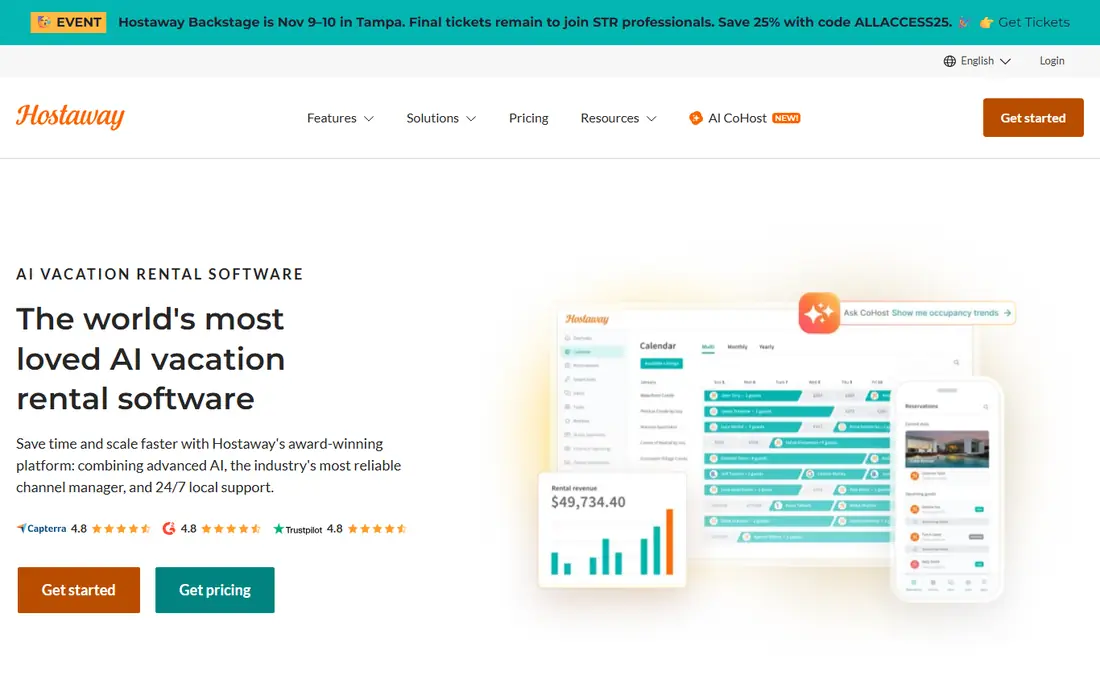
Hostaway sits at the top of this list for managers who want channels, messages, and tasks in one dashboard. It connects to major booking sites and keeps calendars in step, which helps reduce double bookings when a property is listed in several places. The dashboard also pulls guest messages together, so a small team can reply faster without opening five tabs.
The automation tools are the main reason to choose it. Hostaway can send check-in details, answer common questions, and trigger cleaning tasks based on booking events. Its integration library covers pricing tools, smart locks, and cleaning services, so managers can build a setup that fits their portfolio rather than starting over. Reporting helps owners see occupancy and revenue without exporting data by hand.
The honest catch is cost and setup. Pricing is often quoted rather than listed as a simple monthly figure, so a small host should ask for the full price for their property count before signing. Larger portfolios will get more value from the automation, while a host with one home may find a simpler tool easier to run day to day.
- Wide channel coverage
- Strong automation and messaging tools
- Large integration library
- Pricing is quote based for many plans
- Setup can take time for large portfolios
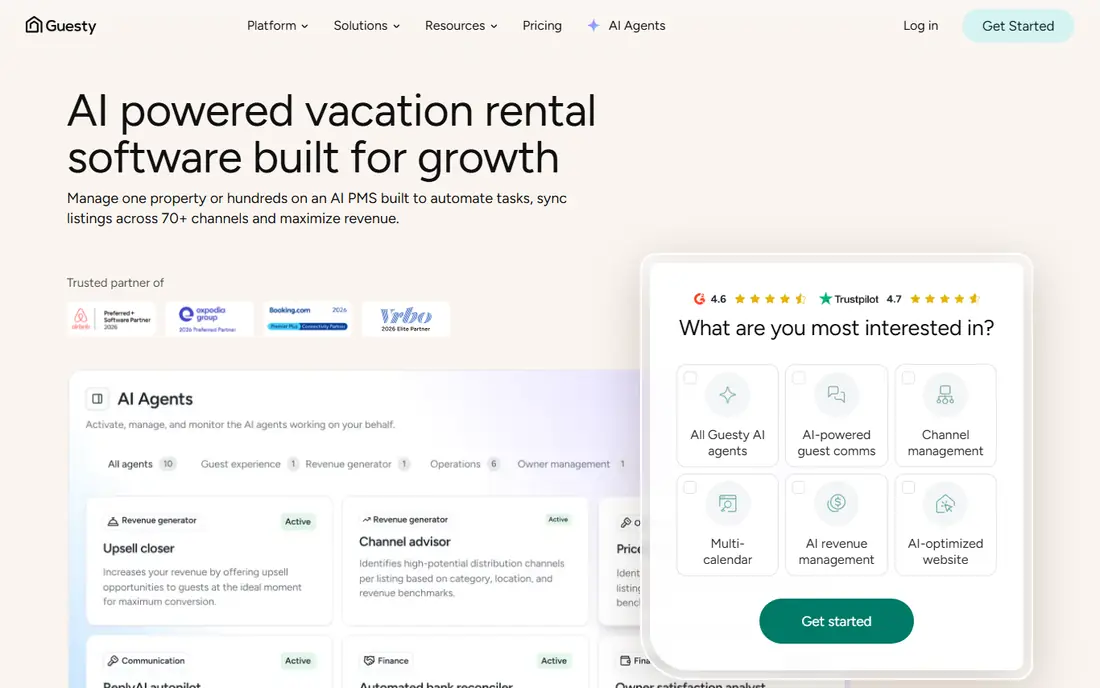
Guesty is built for growth, and that shows in how its plans are arranged. Guesty Lite covers solo hosts with a small number of listings, while Pro and Enterprise add deeper payments, accounting, and team tools as a portfolio grows. For a manager who plans to add properties, staying on one platform avoids a painful move later.
Channel sync, guest messaging, pricing, and owner reporting sit in the same system, which matters when staff numbers grow. The platform supports direct booking websites, automated workflows, and trust accounting on higher tiers, so owners and managers can track money with fewer separate tools. Its partner status with major booking channels also helps listings stay visible and in step.
The catch is scale. A host with one quiet cabin may not need this depth, and the learning curve is steeper than a simple channel manager. Ask about onboarding, support hours, and the total cost at your current listing count, plus the cost at the next tier, so growth does not bring a surprise bill.
- Sync across many channels
- Native payments and accounting on higher tiers
- Tiered plans for solo hosts
- Full platform can feel large for one property
- Enterprise pricing needs a sales conversation
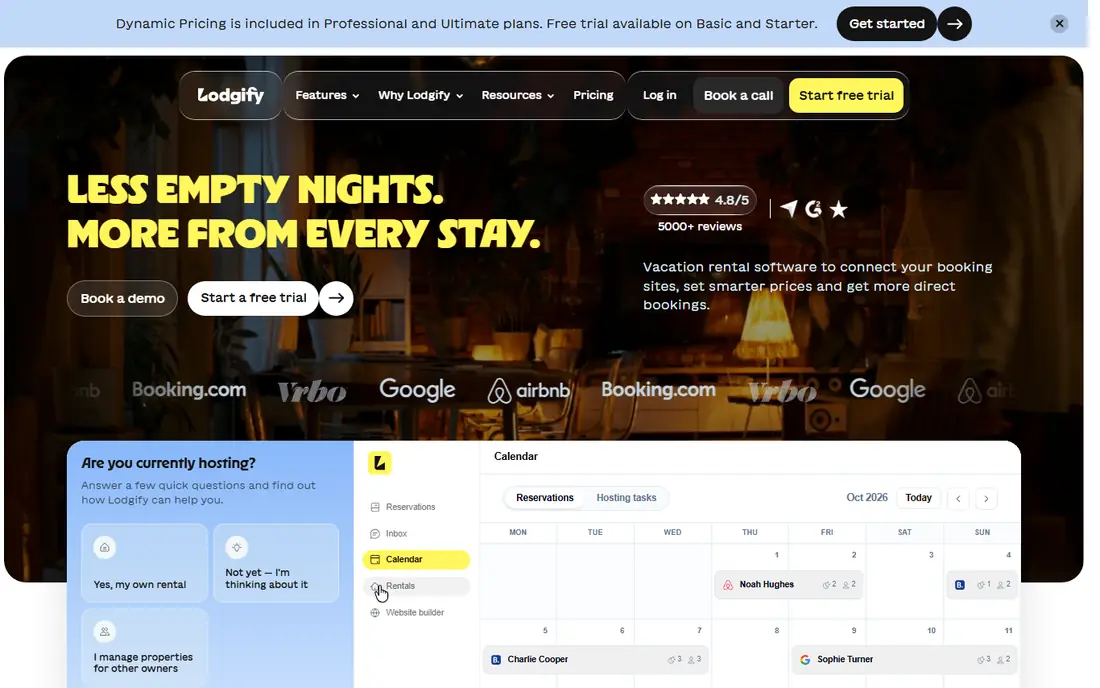
Lodgify appeals most to hosts who want guests to book direct. Its website builder lets a host create a branded site with photos, rates, and a booking engine, which can cut commission costs over time. For a host with one to twenty properties, that focus is often more useful than a long list of enterprise tools.
Calendar sync covers the major channels, and the booking engine handles payments and guest details in one place. Lodgify also offers tools for pricing rules, guest communication, and basic reporting, so daily work stays manageable. The interface is friendly for owners who do not want to learn a complex system before their first booking.
The trade-off is depth. Managers who need advanced owner statements, complex team permissions, or heavy automation may outgrow Lodgify sooner. It works best when direct bookings are the goal and operations stay fairly simple, and it pairs well with a separate pricing tool if dynamic rates matter a lot.
- Strong website builder and booking engine
- Clear plans for small hosts
- Simple calendar sync
- Management depth is lighter than Guesty or Hostaway
- Some features sit on higher tiers
Hospitable started as a messaging tool, and that focus still defines it. Hosts who spend too much time answering the same check-in, Wi-Fi, and checkout questions will feel the benefit quickly. Messages can be automated by booking stage, and the system can reply in a consistent tone across channels.
Setup is lighter than a full property management system, which suits solo hosts and small teams. Hospitable syncs calendars and centralises messages, so a host does not need to check each booking site separately. It also supports automated reviews and basic team tools, which help when a cleaner or co-host needs access.
The limit is scope. Hospitable does not replace accounting, owner payouts, or deep reporting, so managers with complex finances will need another tool. It is the right pick when messaging is the main pain point, and a weaker pick when the goal is one system for every part of the business.
- Fast automated guest messaging
- Simple setup
- Works across major channels
- No native payments or full accounting
- Best for messaging first, not full management
OwnerRez suits hosts who like to set their own rules and understand exactly how each booking is handled. It offers detailed controls for quotes, payments, damage deposits, and guest communication, which helps owners who manage bookings directly as well as through channels. The price point is also attractive for hosts who want depth without enterprise pricing.
Direct booking websites, channel connections, and accounting features sit together, so a host can track income and expenses without juggling spreadsheets. OwnerRez supports custom templates and triggers, which means repeat work can be automated once the rules are set. That control is a real advantage for owners with unusual policies or seasonal pricing.
The catch is the look and feel. The interface is functional rather than modern, and new users may need time to learn the rule system. Hosts who want a polished mobile-first experience may prefer Lodgify or Hospitable, while hosts who value control and value will find OwnerRez hard to beat.
- Detailed booking and accounting rules
- Direct booking tools
- Strong value for US hosts
- Interface looks dated next to newer rivals
- Learning curve for advanced rules
Smoobu is a good first step for a host who wants channel sync without a complex system. It connects listings to major booking sites, keeps calendars updated, and offers a simple website option for direct bookings. For a host with a handful of properties, that coverage solves the most common problem, which is avoiding double bookings.
The platform is easy to learn, and its pricing is accessible for small operations. Smoobu includes guest communication tools, basic reporting, and booking management, so daily tasks stay in one place. European hosts also benefit from features and support aimed at that market, which can matter for local tax and guest needs.
The limit is depth. Larger managers who need advanced automation, owner accounting, or a wide integration library will find Smoobu light. It is best as a simple, low-cost channel manager, and hosts should plan to move to a fuller platform if their portfolio grows well beyond a few properties.
- Easy channel manager
- Simple onboarding
- Affordable entry point
- Management features are lighter than full platforms
- No native payments in many cases
Beds24 is the choice for hosts who are comfortable with settings and want fine control. It connects to a large number of channels and offers detailed pricing rules, availability controls, and API access for custom setups. For a host who manages unusual calendars or works with niche booking sites, that flexibility is valuable.
The pricing model is also appealing. Entry costs are low compared with enterprise platforms, and hosts pay for the level of use they need. Beds24 handles channel management, booking rules, and guest data in a system that can be shaped to a specific workflow, rather than forcing one fixed process on every host.
The catch is usability. The interface is dense, and new users may need guides or support to set it up well. Hosts who want a guided, polished onboarding experience should look at Lodgify or Hostaway first, while technical hosts who value control will appreciate what Beds24 offers for the price.
- Very wide channel list
- Flexible pricing and API options
- Low entry cost
- Interface is technical
- Support and setup need more hands-on effort
Hostfully stands out for the guest side of hosting. Its digital guidebooks give guests house rules, local tips, Wi-Fi details, and check-out steps in one mobile-friendly place, which can cut repeat questions. For hosts who care about reviews and guest satisfaction, that polish matters as much as back-office tools.
The platform also covers property management basics, including channel connections, messaging, and booking tools. Hosts can manage listings and communicate with guests without switching systems for every task. Guidebooks can be updated in one place, so a change to check-in times or local advice reaches every future guest at once.
The trade-off is that Hostfully is not the deepest operations platform in this list. Managers with complex accounting, large teams, or heavy automation needs may need extra tools. It fits best for hosts who put guest experience first and want management tools that support that goal rather than replace it.
- Strong digital guidebooks
- Guest messaging tools
- Clean guest-facing experience
- Full property management depth is lighter than Guesty
- Pricing varies by plan
iGMS is built around Airbnb hosting, and hosts who get most bookings there will find it a natural fit. It centralises messages, automates routine replies, and helps manage cleaning tasks and calendars from one dashboard. For a host with several Airbnb listings, that focus keeps daily work simple.
Automated messaging, review management, and team coordination are the core strengths. Cleaners can receive tasks automatically, and hosts can track turnover without chasing messages across apps. The platform also supports multi-calendar views, so availability stays clear even when listings overlap.
The limit is breadth. Hosts who rely heavily on Vrbo, Booking.com, and direct bookings in equal measure may want a wider channel platform such as Hostaway or Guesty. iGMS is best when Airbnb is the main channel and automation for that workflow is the priority.
- Strong Airbnb automation
- Unified inbox
- Task management for cleaners
- Channel range is narrower than large platforms
- Less suited to huge portfolios
How we picked these
We compared official feature pages, pricing pages, app store listings, privacy policies, and public reviews for each product on this list. We kept only products that are live in October 2026 and that fit the topic directly, and we left out products whose pricing or core features we could not verify. Where a vendor does not publish a clear starting price, we say See website rather than guess. We did not claim hands-on testing that we did not do, and we weighed the fit for different users more heavily than brand size alone.
How to choose vacation rental software without overbuying
Start with your property count and your main channel. A host with one home on Airbnb needs calendar sync and messaging, not enterprise accounting. A manager with twenty homes needs team permissions, owner reporting, and pricing tools that work at scale. Write down the three tasks that take most of your time, then check each shortlisted tool against those tasks only.
Check the total cost, not just the headline price. Some platforms charge per listing, some charge per user, and some add fees for payments or premium features. Ask for a quote at your current size and at double that size, and confirm what is included for onboarding and support. A free trial is useful, but test it with a real listing and a real booking flow, not just a demo.
Finally, confirm channel coverage and exit terms before you commit. Make sure your main booking sites sync in both directions, and ask how you export bookings, guest data, and financial records if you leave. A tool that saves hours each week is worth paying for, while a tool that locks your data in is a risk even at a low price.