Best Website Audit Tools in 2026: 9 Tools Compared
By ToolNimba Editorial Team October 29, 2026 8 min read

- Top pick
 Ahrefs
Audits inside a full SEO suite
Starting price$29 per monthCheck out AhrefsRead our review - Runner-up
 Semrush
All-in-one audits and tracking
Starting price$139.95 per monthCheck out SemrushRead our review - Also great
 SE Ranking
Affordable suite audits
Starting price$52 per monthCheck out SE RankingRead our review
How we researched this
We compared official pricing and feature pages, app store listings, privacy policies and public user reviews. Prices change, so check the provider's site before you pay.
Key takeaways
- Ahrefs and Semrush bundle audits with keyword and backlink data, which suits teams that want one suite.
- Sitebulb and Screaming Frog are the dedicated crawlers, with deeper technical checks and clearer prioritization.
- SEOptimer wins for fast, client-ready audit reports, especially for agencies selling SEO services.
- Sitechecker ties audits to ongoing monitoring, so you learn when something breaks instead of at the next manual crawl.
- Free audits are useful for a quick check, but ongoing monitoring and large crawls need a paid plan.
Quick comparison
| Name | Best for | Starting price | Free plan | |
|---|---|---|---|---|
| Ahrefs | Audits inside a full SEO suite | $29 per month | Yes | Visit |
| Semrush | All-in-one audits and tracking | $139.95 per month | Free trial | Visit |
| SE Ranking | Affordable suite audits | $52 per month | Free trial | Visit |
 Sitebulb | Prioritized technical audits | $18 per month | Free trial | Visit |
 Screaming Frog | Deep desktop crawling | See website | Yes | Visit |
 SEOptimer | Fast client-ready reports | $29 per month | Yes | Visit |
 Sitechecker | Audits plus monitoring | $49 per month | Free trial | Visit |
 Lumar | Enterprise site intelligence | See website | No | Visit |
 Woorank | Quick SMB audits | See website | Free trial | Visit |
The best website audit tools
A website audit finds broken links, slow pages, missing meta data, crawl blocks and other issues that hold rankings back. We compared official feature pages, pricing pages and public documentation to build this list, covering suites, dedicated crawlers and report tools.

Ahrefs Site Audit crawls your site on a schedule and flags issues like broken links, redirect chains, slow pages and missing tags, with explanations for each fix. Results sit alongside keyword, backlink and rank data, so you can connect technical issues to traffic changes.
The Starter plan at 29 dollars per month covers smaller sites, while Lite at 129 dollars covers larger crawls. Free Webmaster Tools gives site owners audits for verified sites. For teams already paying for Ahrefs, the audit tool is a strong bonus rather than a reason to buy alone.
- Site Audit included in every plan
- Scheduled crawls
- Free webmaster tools for your own sites
- Audit depth trails dedicated crawlers
- Full plans cost more

Semrush Site Audit checks over 140 technical and on-page factors, groups them into themes like crawlability, HTTPS and performance, and tracks progress over time. Scheduled crawls keep reports fresh, and issues link to rank tracking and keyword data in the same suite.
The Pro plan starts at 139.95 dollars per month with a 7 day trial. Audit-only users may find cheaper dedicated tools, but teams that already use Semrush for research get a capable audit tool included.
- Site Audit with thematic reports
- Scheduled crawls
- Ties to keyword and position tracking
- Expensive for audit-only use
- Crawl limits vary by plan
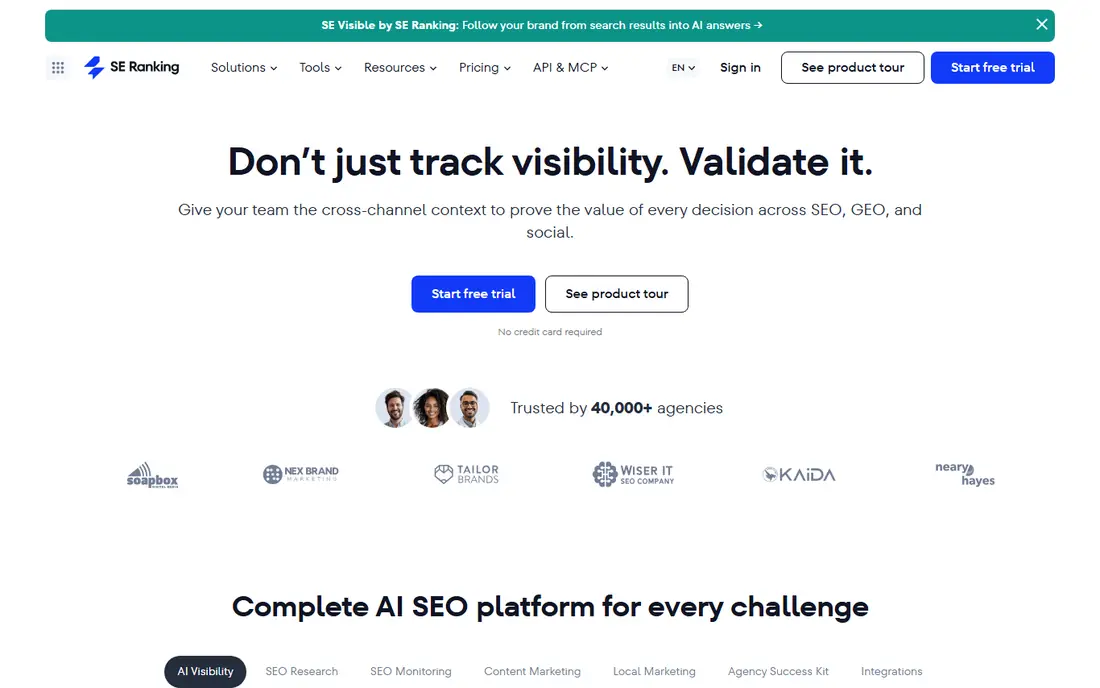
SE Ranking includes a website audit tool that checks on-page, technical and content issues, with scheduled crawls and white label reports for agencies. The Essential plan costs 52 dollars per month on annual billing, with a 14 day free trial.
The audit suits small and mid-size sites and agencies that need client reports without enterprise prices. Very large or complex sites may need a dedicated crawler for deeper checks, but for most sites SE Ranking covers the essentials.
- Audit plus rank tracking and reports
- White label options
- 14 day trial with no card
- Crawl depth below dedicated tools
- History limits on lower tiers
Sitebulb crawls sites and applies hundreds of checks, then organizes results by severity with hints that explain why each issue matters and how to fix it. Audit scores by area help teams prioritize, and notes let teammates record changes inside reports.
Desktop plans start at 18 dollars per month for Lite, with a 14 day free trial and no credit card. Cloud plans start around 125 dollars per month for scheduled audits and team collaboration. For technical SEOs who want clear priorities, Sitebulb is a top pick.
- Hints system prioritizes fixes in plain language
- No crawl limits
- Desktop and cloud versions
- Cloud tier costs much more
- Desktop version needs your machine
Screaming Frog SEO Spider is the crawler many professionals use for technical audits, finding broken links, redirects, duplicates, missing meta data and rendering issues across large sites. The free version covers up to 500 URLs, while the paid license allows unlimited crawling, scheduling and integrations.
As desktop software it runs on your machine, so very large crawls depend on your hardware, and history lives in your exports. For forensic technical work and custom pipelines, it remains the standard.
- Deepest crawl data and filters
- JavaScript rendering
- Scheduling and command-line mode
- Desktop software needs your hardware
- No hosted history
SEOptimer crawls a site and scores SEO, usability, performance and social factors, producing a branded PDF report agencies can hand to prospects. The DIY SEO plan costs 29 dollars per month, with White Label at 39 dollars and Lead Generation at 59 dollars, and a 14 day free trial.
The tool is built to win accounts: fast, clear and presentable. It is not a replacement for a deep crawler on complex sites, but for agencies that need quick audits and lead generation, it pays for itself fast.
- Full audit in under 30 seconds
- White label PDF reports
- Embeddable audit widget for lead generation
- Lighter analytical depth than full platforms
- Report-first rather than fix workflow
Sitechecker pairs its audit crawler, which checks more than 100 issues, with continuous monitoring and page-level change alerts. When something breaks, you learn about it right away rather than at the next manual crawl, and guided fixes explain each step.
Paid plans start around 49 dollars per month with a free trial. The monitoring angle suits teams that manage sites over time rather than running one-off audits. For a single audit, cheaper tools may do, but for ongoing oversight Sitechecker is strong.
- Ongoing monitoring with change alerts
- Guided fixes
- Approachable interface
- Fewer total checks than deepest crawlers
- Best value needs ongoing use
Lumar, formerly DeepCrawl, is an enterprise website intelligence platform that crawls very large sites and reports on technical SEO, accessibility and site health at scale. It handles complex, JavaScript heavy sites and integrates with analytics and search data.
Pricing is quote based and aimed at enterprises and large publishers. Small sites will find cheaper tools more than enough, but teams managing millions of URLs need Lumar scale and depth.
- Built for very large sites
- Deep technical and accessibility checks
- Strong reporting
- Quote based pricing
- Overkill for small sites
Woorank runs a quick audit that scores a site across SEO, mobile, usability and technology, then lists actions in plain language. It suits small business owners and freelancers who want a fast health check without learning a complex tool.
Depth trails Sitebulb and Screaming Frog, and large sites need more. For a quick, understandable audit and a simple action list, Woorank is an easy starting point, with a free trial on paid plans.
- Fast scored audits for small sites
- Clear action lists
- Competitor comparisons
- Less depth than dedicated crawlers
- Best for smaller sites
How we picked these
We compared official feature pages, pricing pages and public documentation for each tool, and favored products that are actively sold and supported in October 2026. We mixed full suites, dedicated crawlers, report tools and enterprise platforms so the list covers freelancers, agencies and large sites. Prices come from vendor pricing pages, and where pricing is quote based we say so plainly rather than guessing.
How to run a website audit that leads to fixes
Start with crawlability and indexation, since pages search engines cannot reach cannot rank. Fix broken links, redirect chains and blocked resources first, then move to titles, headings and content issues. Track the audit score over time so you can show progress, not just a list of problems.
Schedule, do not just scan once
Sites change constantly, so schedule regular crawls or use a monitoring tool like Sitechecker. A one-time audit ages fast, while scheduled audits catch regressions from new releases and content changes.
Fix by impact, not by count. A thousand low-priority warnings matter less than one broken checkout, a missing canonical on a key page or a sudden loss of index coverage. Group findings into revenue-blocking, traffic-blocking and cosmetic, then work the first two groups in order of pages affected. This triage keeps audits from becoming long reports that nobody acts on, which is the most common failure mode for audit tools.