Common German Last Names and What They Mean
 By Shihab Mia July 8, 2026 6 min read
Quick answer
The most common German last name is Muller (meaning miller), followed by Schmidt (smith), Schneider (tailor), Fischer (fisher) and Weber (weaver). Most German surnames come from medieval occupations, which is why so many top names describe a trade.
German last names are among the most meaning-rich family names in Europe. Look down any list of the most common ones and you are really reading a directory of medieval jobs: the miller, the smith, the tailor, the baker. This guide covers the top German surnames, what each one means, and the naming patterns that explain why occupational names dominate. You will also find a full reference table you can scan in seconds.
What are the most common German last names?
The most common German last names are Muller, Schmidt, Schneider, Fischer, Weber, Meyer, Wagner, Becker, Schulz and Hoffmann. Nearly all of them started as job descriptions. Muller (miller) sits at the top because milling grain into flour was one of the most widespread and essential trades in nearly every German village.
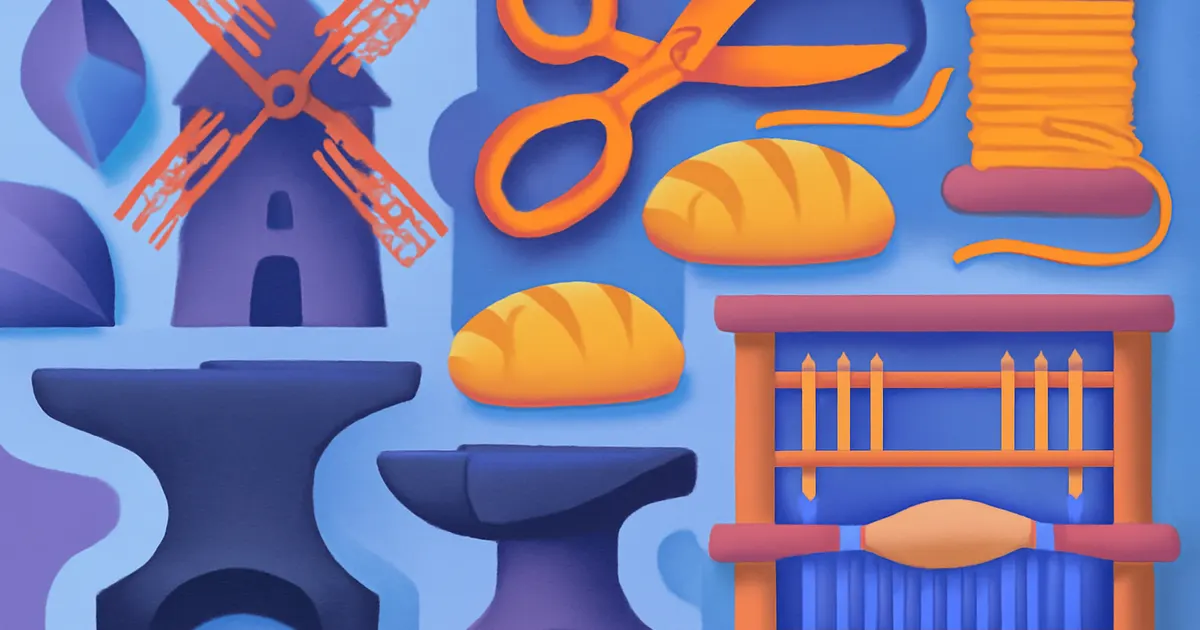
Here is a quick sense of what those top names describe: Muller ground grain, Schmidt worked metal at the forge, Schneider cut and sewed cloth, Fischer caught fish, and Weber worked the loom. Meyer (also spelled Meier, Maier or Mayer) originally meant a steward or a higher-status tenant farmer who managed land. Wagner built and repaired wagons and wheels, Becker baked bread, Schulz was a village official or headman, and Hoffmann held or worked a farmstead.
Common German surnames and their occupational meanings
| Surname | Meaning / origin | Type |
|---|---|---|
| Muller | Miller (grinds grain into flour) | Occupation |
| Schmidt | Smith (metalworker at the forge) | Occupation |
| Schneider | Tailor (cuts and sews cloth) | Occupation |
| Fischer | Fisher (catches fish) | Occupation |
| Weber | Weaver (works a loom) | Occupation |
| Meyer / Meier | Steward or tenant farmer who managed land | Occupation / status |
| Wagner | Wagon-maker or wheelwright | Occupation |
| Becker | Baker (bakes bread) | Occupation |
| Schulz | Village official or headman | Occupation / office |
| Hoffmann | Farmstead holder or manager | Occupation / status |
| Schafer | Shepherd (tends sheep) | Occupation |
| Koch | Cook | Occupation |
| Bauer | Farmer or peasant | Occupation / status |
| Richter | Judge or arbiter | Occupation / office |
| Zimmermann | Carpenter (works in wood) | Occupation |
| Schmitt / Schmitz | Regional variants of Smith | Occupation |
| Braun | Brown (hair or complexion) | Physical trait |
| Klein | Small (short in stature) | Physical trait |
| Gross | Large or tall | Physical trait |
| Hoffman | Courtyard or farmstead dweller | Occupation / place |
Why do so many German surnames come from jobs?
So many German surnames come from jobs because hereditary family names spread across German-speaking lands during the late Middle Ages, roughly the 12th to 16th centuries, and the simplest way to tell two people apart was by what they did. In a village with several men named Hans, calling one Hans the miller and another Hans the baker was immediate and obvious. Over time those descriptions stuck and passed from parent to child.
Because a trade was often inherited, the surname and the occupation frequently stayed together for generations, which reinforced the link. A miller's son often became a miller, so the name Muller genuinely fit the family for a long time before it settled into a fixed, inherited surname.
The four main sources of German last names
- Occupation: by far the largest group. Muller, Schmidt, Schneider, Becker, Wagner and Fischer all describe a trade.
- Place or geography: names tied to a town, region or landscape feature, such as living near a brook, forest or hill.
- Patronymic: names formed from a father's first name, sometimes ending in -s or -sen (for example Peters or Hansen).
- Physical or personal traits: descriptive nicknames that became fixed, such as Klein (small), Gross (large) or Braun (brown).
How do you read German surname spellings and umlauts?
Many German surnames contain umlauts (the two dots over a, o or u), and there is a standard way to write them without the dots. When an umlaut cannot be typed, the accepted rule is to replace it with the base vowel plus an e: a becomes ae, o becomes oe, and u becomes ue.
That is why you will see the same family name written more than one way. Muller may appear as Mueller, and Schroder may appear as Schroeder. Both spellings point to the same name. This is especially common for German families who emigrated to the United States, Canada or Australia, where records were often written with the plain-vowel or the vowel-plus-e form. In this article we use plain ASCII spellings throughout, so Muller and Schroder rather than the dotted versions.
Do German surnames vary by region?
Yes. Although the top occupational names appear everywhere, some patterns cluster in particular parts of the German-speaking world. In the north, especially near the North Sea coast and the old Frisian areas, patronymic names ending in -sen are common, such as Petersen, Hansen and Jansen. This reflects long contact with Scandinavian and Frisian naming habits, where a name literally meant son of Peter or son of Hans. The steward name Meyer also tends to appear more often in northern spellings.
The south tells a slightly different story. In Bavaria, Baden-Wurttemberg, Austria and Switzerland you are more likely to meet the shorter smith form Schmid (without the final t), and farming names are very visible. Huber is a classic example: it named a farmer who held a Hube, a standard medieval measure of farmland, and it remains one of the most common surnames in Bavaria and Austria. In the Rhineland and the west, the smith name shows up as Schmitz and Schmitt. None of this changes the meaning of a name; it mostly changes which spelling you are likely to see.
A quick worked example: reading a German surname
Say you come across the name Muller and want to understand it. Here is a simple way to work through any German surname step by step.
- Note the exact spelling and any variants, for example Muller, Mueller or Moller, so you know you are tracing the same name.
- Check whether the root is a known trade word. Mull relates to milling, which points straight to an occupational origin.
- Assign the meaning: Muller means miller, someone who ground grain into flour.
- Classify the type. Since it names a job, it belongs to the occupational group, the largest category of German surnames.
- Cross-check regional forms. Southern regions might favor one spelling while northern ones favor another, but the meaning stays the same.
Run the same five steps on Zimmermann and you land on carpenter; run them on Braun and you land on a physical trait, brown, rather than a job. The method works because most German names were built from plain, everyday words.
Common mistakes and good to know
- Assuming every name is a job. Most top names are occupational, but Braun, Klein and Gross describe appearance, and many others come from places.
- Treating spelling variants as different families. Muller and Mueller, or Schmidt and Schmitt, are usually regional or transcription variants of the same name, not separate origins.
- Reading modern meaning into the name. A family named Fischer today almost certainly has no connection to fishing. The name records a distant ancestor's trade, not the current family.
- Ignoring regional forms of Smith. Schmidt, Schmitt, Schmitz and Schmid are all local variants of the same metalworking name.
If you are exploring names for a story, a game character, a worldbuilding project or just curiosity, an instant generator saves time and gives you authentic-sounding combinations. You can also compare traditions with our guides to common Italian last names and common Irish last names, or try the German last name generator to build your own authentic-sounding names.
🇩🇪 Try the free tool German Last Name Generator Free German last name generator. Get random, authentic German surnames from 90+ real family names like Muller, Schmidt and Wagner, with meanings. Copy fast.Putting it all together
German last names are a snapshot of medieval working life. The most common ones, led by Muller, Schmidt and Schneider, almost all describe a trade, which makes them unusually easy to decode once you know the pattern. A handful, like Klein and Braun, describe how an ancestor looked, and others point to a place or a father's name. Keep the four categories in mind, remember the umlaut spelling rule, and you can read almost any German surname at a glance. For more name traditions, see our guide to common French last names.
Frequently asked questions
What is the most common last name in Germany?
Muller is the most common German last name. It means *miller*, someone who ground grain into flour. Milling was one of the most widespread trades in medieval German villages, so the occupational name became extremely common and remains the top surname across German-speaking regions today.
What does the surname Schmidt mean?
Schmidt means *smith*, a metalworker who shaped iron and other metals at a forge. It is the German equivalent of the English surname Smith. Regional variants include Schmitt, Schmitz and Schmid, all pointing to the same essential trade of working metal by hand.
Why do German last names often end in -mann?
The ending *-mann* simply means *man* and was attached to a place, trait or role to name a person. Hoffmann meant a farmstead man, and Zimmermann meant a wood man, that is, a carpenter. It marks the bearer as the person associated with that thing or occupation.
How do I write German names with umlauts in English?
Replace the umlaut with the base vowel plus an e. So a becomes ae, o becomes oe, and u becomes ue. Muller can be written Mueller and Schroder can be written Schroeder. Both forms refer to the same name and are widely accepted in records.
Are all common German surnames based on jobs?
No. Most top German surnames are occupational, such as Muller, Schmidt and Becker, but not all. Braun means brown and Klein means small, describing physical traits. Others come from places or from a father's first name. Occupation is simply the single largest category.