Goodreads Alternatives in 2026: 9 Book Trackers Compared
By ToolNimba Editorial Team October 29, 2026 10 min read

- Top pick
 The StoryGraph
Stats and mood-based picks
Starting price$4.99 per monthCheck out The StoryGraphRead our review - Runner-up
 Hardcover
Clean social discovery
Starting priceFreeCheck out HardcoverRead our review - Also great
 Literal
Simple social tracking
Starting priceFreeCheck out LiteralRead our review
How we researched this
We compared official pricing and feature pages, app store listings, privacy policies and public user reviews. Prices change, so check the provider's site before you pay.
Key takeaways
- The StoryGraph is the closest overall replacement for Goodreads, with mood and pace recommendations, quarter-star ratings, and detailed reading stats.
- Hardcover and Literal suit readers who want a cleaner, smaller community without the Amazon connection that comes with Goodreads.
- Fable is the best pick for book clubs, while BookWyrm is the best pick for readers who care about open-source software and data control.
- LibraryThing remains a strong choice for serious cataloging, especially for large collections and detailed edition data.
- Most alternatives let you import a Goodreads export, but you should export your data first and check how many titles match before you delete anything.
Quick comparison
| Name | Best for | Starting price | Free plan | |
|---|---|---|---|---|
| The StoryGraph | Stats and mood-based picks | $4.99 per month | Yes | Visit |
| Hardcover | Clean social discovery | Free | Yes | Visit |
| Literal | Simple social tracking | Free | Yes | Visit |
 Fable | Book clubs | Free | Yes | Visit |
 BookWyrm | Privacy and open source | Free | Yes | Visit |
 LibraryThing | Serious cataloging | Free | Yes | Visit |
 Bookly | Daily reading habits | Free | Yes | Visit |
 Bookmory | Reading stats and calendar | Free | Yes | Visit |
 Pagebound | Design-led community | Free | Yes | Visit |
The best Goodreads alternatives
Goodreads still has the largest community, but many readers leave because of its dated design, its Amazon ownership, and recommendations that feel generic. The alternatives below solve different parts of that problem, so the right pick depends on whether you want stats, clubs, privacy, or a better catalog.
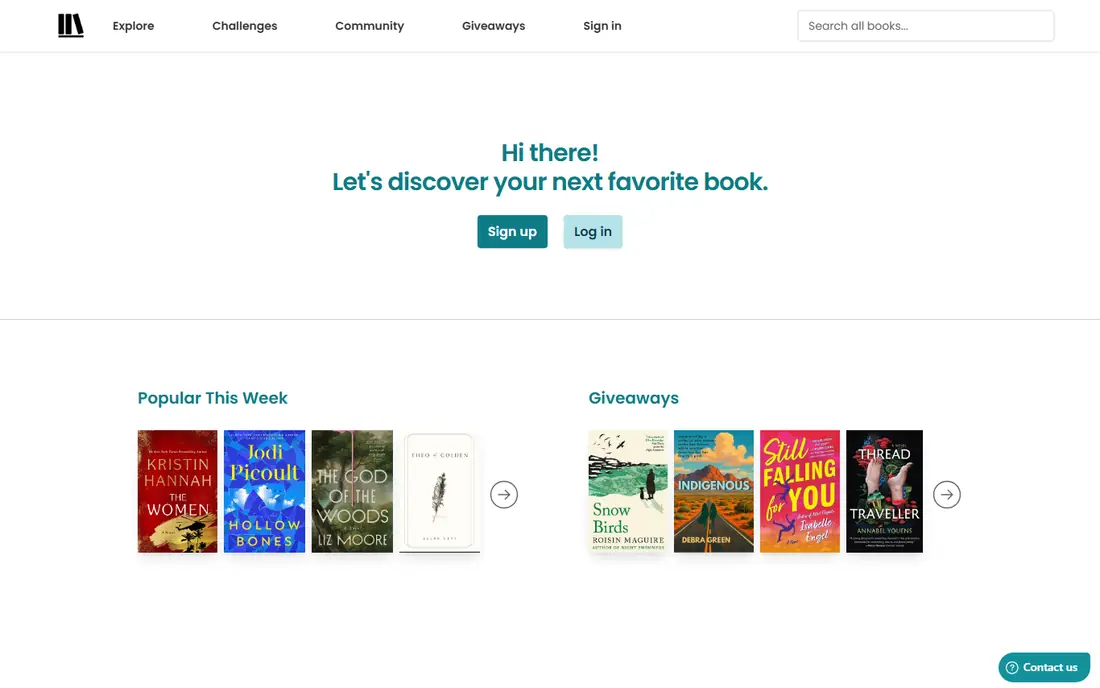
The StoryGraph is the alternative most readers recommend first, and for good reason. You track books with quarter-star ratings, log whether you finished a book, and filter recommendations by mood, pace, and content warnings, which Goodreads does not do in the same way. Reading stats show patterns by genre, mood, page count, and pace, and challenges can be set by books, pages, or time.
The free tier covers most tracking, while Plus at $4.99 per month or $49.99 per year adds custom charts, deeper stats filters, and extra recommendation features, with a 30-day free trial listed on its Plus page. The main gap is community size and Kindle sync. If your friends all stay on Goodreads, or if you rely on automatic Kindle progress, you will feel that difference.
- Mood, pace, and content-warning filters
- Quarter-star ratings
- Detailed stats, challenges, and buddy reads
- Smaller community than Goodreads
- No Kindle sync, so progress must be updated by hand
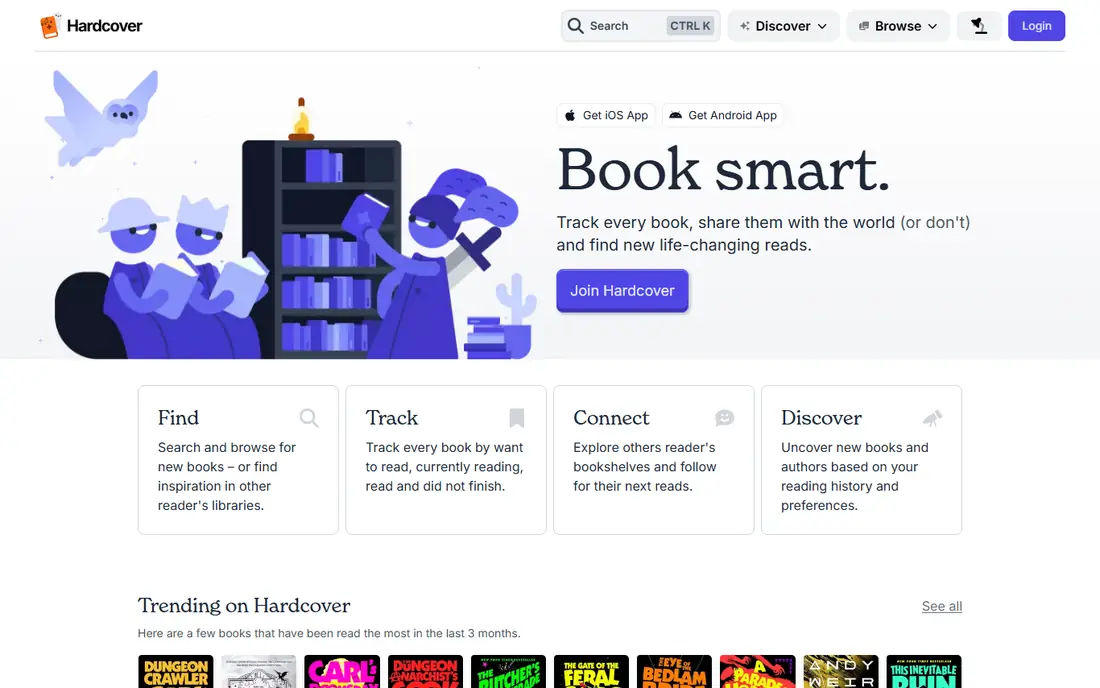
Hardcover feels like Goodreads rebuilt with a modern interface. Shelves, ratings, reviews, and reading goals are all present, but the layout is cleaner and the search and edition data are easier to use. Import from Goodreads is supported, which lowers the cost of switching, and the community is smaller but more focused on books than on advertising.
The trade-off is reach. Fewer friends, fewer reviews for obscure titles, and a smaller catalog of user lists than Goodreads offers. A paid plan adds extra features, but the free tier covers the core tracking most readers need. If you want a quieter, better-designed Goodreads, Hardcover is the first place to look after The StoryGraph.
- Clean design and fast interface
- Goodreads import
- Half-star ratings and detailed edition data
- Smaller community than Goodreads
- Some advanced features sit on a paid plan
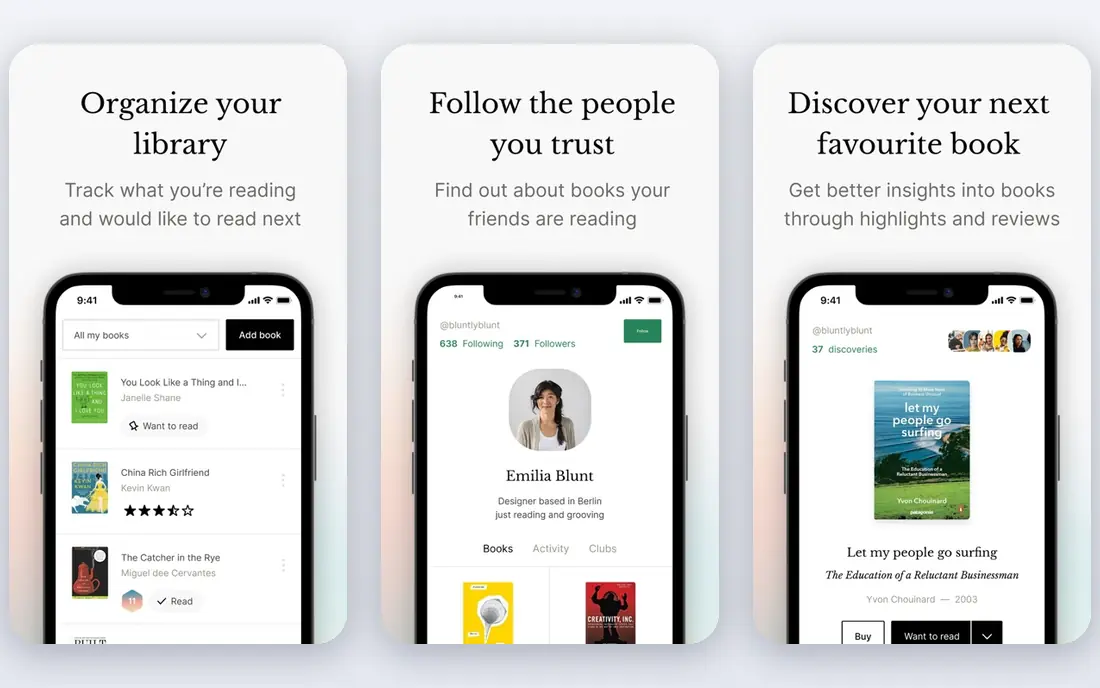
Literal, at literal.club, takes a minimal approach. Your shelves are easy to read, your notes are easy to find, and the social side is built around people and clubs rather than a busy feed. That calm design suits readers who found Goodreads noisy and who want tracking without constant recommendations and ads.
The smaller scale is both the appeal and the limit. You will find fewer reviews for new or niche titles, and the community is smaller than the big platforms. For a reader who mainly tracks personal reading and shares with a small circle, that is a fair trade. For a reader who relies on thousands of reviews before buying, it is not.
- Clean, minimal design
- Social shelves and book clubs
- Goodreads import
- Smaller catalog of community reviews
- Some features have been invite-only at times
Fable is the most social option on this list, and it earns that place through book clubs. You can join or run a club, read together on a schedule, and discuss chapters without spoiling later sections for slower readers. The app also tracks films and TV, which suits households that share recommendations across media.
If you read alone and do not want a feed, Fable will feel busy. Its strength is group reading, so solo trackers will get more value from The StoryGraph or Hardcover. For a club that has outgrown a group chat, though, Fable gives the schedule, discussion, and progress tracking in one place.
- Strong book club tools
- Group reading with discussion
- Film and TV watchlists alongside books
- Club features matter less if you read alone
- Some premium features need a paid plan
BookWyrm is built on ActivityPub, the same federated system behind Mastodon, which means there is no single company owning every reader's data. You join an instance run by a community, or you host your own, and instances can connect with each other. The software is open source, free, and ad-free, which is the strongest privacy story on this list.
That independence has practical costs. There is no polished native iOS app, the web experience is the main route, and the community you see depends on your instance. BookWyrm suits readers who care about data control and open software more than a slick app, and who are comfortable with a web-first tool.
- Open-source and federated
- No ads and no central owner selling your data
- You can join or host an instance
- No native iOS app, with web as the main route
- Community size depends on the instance you join
LibraryThing predates Goodreads and still serves readers who catalog rather than just track. Edition data, series information, and cataloging tools are stronger here than on most newer apps, and it handles large collections, including physical books, with care. Groups and forums have been active for years, and the cataloging community is knowledgeable.
The design shows its age, and discovery feels less modern than on The StoryGraph or Hardcover. A reader who wants a beautiful feed will not find it here. A reader with thousands of books, many editions, and a need for accurate catalog data will find LibraryThing hard to replace.
- Deep cataloging and edition data
- Strong for large collections
- Long-running community and groups
- Dated design compared with newer apps
- Social discovery is weaker than on StoryGraph or Fable
Bookly focuses on the habit of reading rather than the social side. A timer tracks reading sessions, stats show time spent and pages read, and streaks encourage a daily habit. That structure helps readers who set a goal such as twenty minutes a day and want proof they kept it, rather than just a list of finished books.
The trade-off is community. Bookly is weaker for reviews, clubs, and discovery than The StoryGraph, Hardcover, or Fable, so it works best as a habit companion rather than a full Goodreads replacement. Pair it with a tracker if you want both habit stats and a social shelf, or use it alone if the habit is the whole point.
- Reading timer and session tracking
- Habit stats and streaks
- Simple book logging
- Less social depth than Goodreads alternatives built for community
- Some features need a paid plan
Bookmory, like Bookly, is built for readers who track time and progress day by day. A calendar view shows which days you read, session notes capture quotes and thoughts, and stats summarize your reading over weeks and months. The interface is simple, which keeps daily logging from becoming a chore.
Social features are limited compared with Fable or Hardcover, and the most detailed stats need a paid plan, recently listed around $3.49 per month in app store comparisons. For a solo reader who wants a visual record of reading days, Bookmory is a strong, low-cost choice. For a reader who wants clubs and recommendations, look higher on this list.
- Calendar view of reading days
- Session stats and notes
- Clean tracking for daily readers
- Smaller social community
- Some advanced stats sit behind a paid plan
Pagebound is a newer, design-led tracker that has gained attention for its look and its community feel. Shelves, ratings, and social features are presented in a way that feels built for book lovers rather than adapted from a generic social app, and recent versions support importing a Goodreads library. That combination suits readers who want a fresh start without losing their history.
Because it is newer, the community and catalog are still growing, and obscure titles may have thinner data than on Goodreads or LibraryThing. Treat Pagebound as a promising alternative to try alongside a more established tracker, and keep your Goodreads export until you are sure the import captured your shelves correctly.
- Attractive, book-focused design
- Social shelves and community features
- Goodreads import in recent versions
- Newer and smaller than the leading alternatives
- Catalog depth for obscure titles can vary
How we picked these
We compared official feature pages, pricing pages, and app store listings, along with public reviews and help pages, for trackers that offer shelves, ratings, and a Goodreads import or a clear migration route. An app made the list only if it is actively available, covers book tracking as a core job rather than a side feature, and fits ordinary readers rather than a single niche. We left out apps that only summarize books, apps that had stopped development, and general media trackers with weak book data.
How to move from Goodreads without losing your shelves
Export first, delete nothing until the new app looks right. Goodreads lets you export your library as a file, and most alternatives on this list accept that file for import. The import can take time, and a small share of titles may fail to match, especially for obscure editions, so check the counts after import and fix the gaps by hand.
Pick for your main job, not for every feature
No alternative beats Goodreads on every measure at once. Stats readers should start with The StoryGraph, club readers with Fable, privacy readers with BookWyrm, and catalogers with LibraryThing. Trying two apps for a week, with the same ten books logged in each, tells you more than any feature list.
Keep the community question in view
The largest community is still on Goodreads, and that matters if your friends, clubs, and review history live there. Some readers keep Goodreads for friends and use a second tracker for stats or clubs, which is a reasonable compromise while a new community grows. A tracker you actually open beats a perfect tracker you abandon.