How Many Ounces Are in a Gallon?
 By Shihab Mia June 20, 2026 6 min read
Quick answer
There are 128 fluid ounces in 1 US gallon. Half a gallon is 64 fl oz and a quarter gallon (one quart) is 32 fl oz. A UK imperial gallon is bigger at 160 imperial fluid ounces.
A gallon looks like a single big jug, but it is really a stack of smaller units that each double as you climb up. Once you see how the pieces fit together, you never have to memorise the number 128 again because you can rebuild it in your head in a couple of seconds.
Where the number 128 comes from
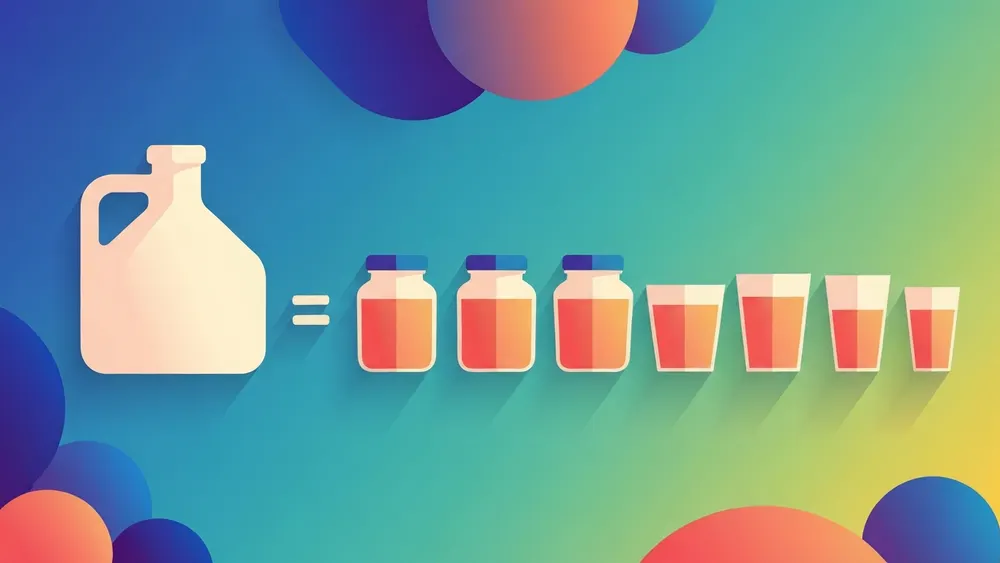
The US customary volume system is built on a simple chain of doublings. Start at the fluid ounce and keep multiplying by two (with one jump of four at the top):
- 8 fluid ounces make 1 cup
- 2 cups (16 fl oz) make 1 pint
- 2 pints (32 fl oz) make 1 quart
- 4 quarts make 1 gallon
Multiply it all out: 8 fl oz per cup, times 16 cups, equals 128 fluid ounces in a gallon. Another way to land on the same answer is 32 fl oz per quart times 4 quarts. Both paths give you 128, which is why a gallon, a half gallon (64 fl oz) and a quart (32 fl oz) are such friendly numbers to work with.
Work it out step by step
If you would rather see the math laid out one move at a time, here is the full climb from a single fluid ounce up to a gallon:
- Start with 1 fluid ounce, the smallest unit in the chain.
- Multiply by 8 to reach 1 cup, which is 8 fluid ounces.
- Multiply the cup by 2 to reach 1 pint, which is 16 fluid ounces.
- Multiply the pint by 2 to reach 1 quart, which is 32 fluid ounces.
- Multiply the quart by 4 to reach 1 gallon, which lands you at 128 fluid ounces.
Gallon conversion chart
US fluid measures, from a single ounce up to two gallons.
| Amount | Fluid ounces | Cups | Pints | Quarts |
|---|---|---|---|---|
| 1 cup | 8 fl oz | 1 | 0.5 | 0.25 |
| 1 pint | 16 fl oz | 2 | 1 | 0.5 |
| 1 quart | 32 fl oz | 4 | 2 | 1 |
| 1/2 gallon | 64 fl oz | 8 | 4 | 2 |
| 1 gallon | 128 fl oz | 16 | 8 | 4 |
| 2 gallons | 256 fl oz | 32 | 16 | 8 |
If you want to flip the question and work the other way, see how many cups are in a gallon for the 16-cup breakdown, or how many cups are in a quart when you only need a smaller batch.
Gallons to ounces at a glance
Scaling a recipe or a drinks order up to several gallons? Because every gallon adds another 128 fluid ounces, you can read the total straight off this table:
Multiple US gallons converted to fluid ounces, litres and pounds of water.
| Gallons | Fluid ounces | Litres | Weight of water |
|---|---|---|---|
| 1/4 gallon | 32 fl oz | 0.95 L | 2.1 lb |
| 1/2 gallon | 64 fl oz | 1.89 L | 4.2 lb |
| 1 gallon | 128 fl oz | 3.79 L | 8.3 lb |
| 2 gallons | 256 fl oz | 7.57 L | 16.7 lb |
| 3 gallons | 384 fl oz | 11.36 L | 25 lb |
| 5 gallons | 640 fl oz | 18.93 L | 41.7 lb |
US vs UK and metric gallons
US vs UK gallon
A UK (imperial) gallon is larger and holds 160 imperial fluid ounces, not 128. The imperial fluid ounce is also a slightly different size from the US fluid ounce, so the two systems do not line up cleanly.
In real numbers, a US gallon is about 3.785 litres while an imperial gallon is about 4.546 litres, roughly 20 percent bigger. This trips people up most with fuel economy: a car rated for a certain number of miles per UK gallon will look thirstier when the same figure is quoted in US gallons. For cooking and everyday liquids in the United States, assume the US gallon and 128 fluid ounces unless a label or recipe clearly says imperial.
It helps to remember that the US and UK fluid ounce are close but not identical. One US fluid ounce is about 29.57 millilitres, while one imperial fluid ounce is about 28.41 millilitres. That small gap is why you should never assume an ounce is an ounce across the two systems.
How much does a gallon of water weigh?
A US gallon of water weighs about 8.34 pounds (roughly 3.78 kilograms) at room temperature. That works out to around 0.52 pounds per pint, so the 128 fluid ounces of volume and the 8.34 pounds of weight are two completely separate numbers describing the same jug. Temperature nudges the figure slightly because water is densest near 4 degrees Celsius, but for everyday kitchen and hydration math, 8.34 pounds per gallon is close enough.
This is exactly why the popular gallon-a-day hydration goal is worth understanding in ounces. One gallon is 128 fluid ounces, which is the same as sixteen 8 oz glasses spread across the day. Many health guides suggest somewhere between 64 and 128 fluid ounces of fluid daily depending on body size and activity, so a single gallon bottle gives you a clear visual target without any counting.
Real-world examples
Knowing that a gallon is 128 fluid ounces turns a lot of fuzzy estimates into quick, confident math:
- Daily water goal: a one-gallon water bottle is 128 fl oz, so the popular "drink a gallon a day" target is sixteen 8 oz glasses.
- Iced tea or punch: a standard recipe that makes a gallon fills sixteen 8 oz cups, or eight pint glasses for a party.
- Milk: a half-gallon carton is 64 fl oz, which is exactly four 16 oz servings.
- Coffee for a crowd: a 12-cup drip pot uses 5 oz "coffee cups," so a gallon of brewed coffee stretches to around 25 of those smaller servings.
- Paint and cleaning supplies: a gallon jug splits neatly into four 32 oz spray bottles.
Common mistakes to avoid
Most gallon conversion errors come from mixing up two different things that share the word ounce. Watch out for these:
- Confusing fluid ounces with weight ounces. A fluid ounce measures volume, while a dry ounce measures weight. A gallon of water weighs about 8.3 pounds, not 128 weight ounces, so do not swap the two.
- Using a US gallon figure for a UK recipe. UK recipes assume 160 imperial fl oz per gallon, so American 128 fl oz math will leave you 25 percent short.
- Assuming a "cup" is always 8 oz. The US legal cup used on labels is 8 fl oz, but some measuring sets and other countries use 250 ml or 240 ml cups, which shifts the totals.
- Forgetting the doubling pattern and guessing. If you blank on 128, just rebuild it: 8 ounces to a cup, double up through pints and quarts, and you are back to the answer.
Good to know
- The 128 figure is for US fluid ounces only. A US dry gallon, used rarely for things like berries, equals about 148.9 US fluid ounces, but you will almost never meet it.
- A half gallon is 64 fl oz, a quart is 32 fl oz, a pint is 16 fl oz and a cup is 8 fl oz, so each step down simply halves the one above it.
- In metric terms a US gallon is 3.785 litres, which is 3785 millilitres, handy when a recipe or label switches systems mid-page.
- A US gallon of water weighs about 8.34 pounds, while an imperial gallon of water weighs about 10 pounds because it holds more liquid.
Convert any volume
For litres, millilitres, imperial gallons and units the chart above does not cover, the converter below does the arithmetic for you. You can also reach for the cooking converter style breakdowns when you are scaling a recipe up or down.
🧪 Try the free tool Volume Converter Free volume converter for liters to gallons, ml to cups, tablespoons and fluid ounces. Type in any unit and the rest update instantly with exact US factors.Frequently asked questions
How many ounces are in a gallon?
There are 128 fluid ounces in 1 US gallon. You can confirm it by multiplying 8 fluid ounces per cup by the 16 cups in a gallon. A UK imperial gallon is larger and holds 160 imperial fluid ounces, so always check which system your recipe or container uses before converting.
How many ounces in half a gallon?
There are 64 fluid ounces in half a US gallon. That is the same as 8 cups, 4 pints or 2 quarts. A standard half-gallon milk or juice carton therefore holds 64 fl oz, which works out to four generous 16 oz servings.
How many cups in a gallon?
There are 16 cups in 1 US gallon. Each US cup is 8 fluid ounces, and 16 cups times 8 equals the 128 fluid ounces in a gallon. So a one-gallon drink dispenser fills sixteen standard 8 oz cups, or eight pint glasses if you are serving a crowd.
Is a US gallon the same as a UK gallon?
No. A US gallon is 128 US fluid ounces (about 3.785 litres), while a UK imperial gallon is 160 imperial fluid ounces (about 4.546 litres). The imperial gallon is roughly 20 percent larger, and the two fluid ounces differ slightly too, so never assume the figures are interchangeable.
How many ounces are in a quart?
There are 32 fluid ounces in 1 US quart, which is a quarter of a gallon. Two quarts make a half gallon (64 fl oz) and four quarts make a full gallon (128 fl oz). A quart also equals 4 cups or 2 pints, keeping the tidy doubling pattern intact.
How many 16 oz bottles make a gallon?
It takes 8 standard 16 oz water bottles to make 1 US gallon, because 8 times 16 equals 128 fluid ounces. If your bottles are 8 oz you would need 16 of them, and for 32 oz bottles you would need just 4. This is a quick way to hit a gallon-a-day goal by counting refills.
How much does a gallon of water weigh?
A US gallon of water weighs about 8.34 pounds, or roughly 3.78 kilograms, at room temperature. Weight and volume are separate measures, so a gallon is always 128 fluid ounces but does not weigh 128 ounces. An imperial gallon of water is heavier at about 10 pounds because it holds more liquid.
How many ounces should I drink a day to reach a gallon?
To drink a full gallon a day you need 128 fluid ounces, which is sixteen 8 oz glasses or eight 16 oz bottles. Many hydration guides suggest between 64 and 128 fluid ounces daily depending on body size and activity, so a one-gallon bottle gives you a simple visual target to sip through the day.
Is a gallon 64 or 128 ounces?
A full US gallon is 128 fluid ounces. The figure 64 fluid ounces refers to half a gallon, which is where the mix-up often comes from. So a gallon jug is 128 fl oz, and a half-gallon carton like many milk or juice containers is 64 fl oz.