NetSuite Alternatives in 2026: 9 ERP Platforms Compared
By ToolNimba Editorial Team November 7, 2026 9 min read

- Top pick
 Odoo
Modular ERP on a budget
Starting price$24.90 per user per monthCheck out OdooRead our review - Runner-up
 Microsoft Dynamics 365 Business Central
Microsoft-stack companies
Starting price$70 per user per monthCheck out Microsoft Dynamics 365 Business CentralRead our review - Also great
 Acumatica
Growing mid-market firms
Starting priceSee websiteCheck out AcumaticaRead our review
How we researched this
We compared official pricing and feature pages, app store listings, privacy policies and public user reviews. Prices change, so check the provider's site before you pay.
Key takeaways
- Odoo and ERPNext offer the lowest entry cost, while Dynamics 365 and Acumatica suit firms that need a more structured ERP rollout.
- Many NetSuite alternatives are priced by quote, so the total cost depends on users, modules and implementation help.
- Finance-led firms should shortlist Sage Intacct first, while manufacturers should look closely at Acumatica, SAP Business One and Epicor Kinetic.
- Implementation time matters as much as the license price, so budget for data migration, training and partner support.
Quick comparison
| Name | Best for | Starting price | Free plan | |
|---|---|---|---|---|
| Odoo | Modular ERP on a budget | $24.90 per user per month | Yes | Visit |
| Microsoft Dynamics 365 Business Central | Microsoft-stack companies | $70 per user per month | Free trial | Visit |
| Acumatica | Growing mid-market firms | See website | Free trial | Visit |
 Sage Intacct | Finance-led multi-entity firms | See website | No | Visit |
 SAP Business One | Smaller manufacturers | See website | No | Visit |
 ERPNext | Open-source ERP | Free | Yes | Visit |
 Zoho One | All-in-one small business suite | $37 per user per month | Free trial | Visit |
 Epicor Kinetic | Discrete manufacturers | See website | No | Visit |
 Cin7 | Inventory-led product businesses | $349 per month | Free trial | Visit |
The best NetSuite alternatives
We compared official pricing pages, module breadth and implementation models for ERP platforms that can replace NetSuite. NetSuite itself is a full cloud ERP, so no single alternative matches it on every module. The right choice depends on whether finance, inventory, manufacturing or CRM is your main need.
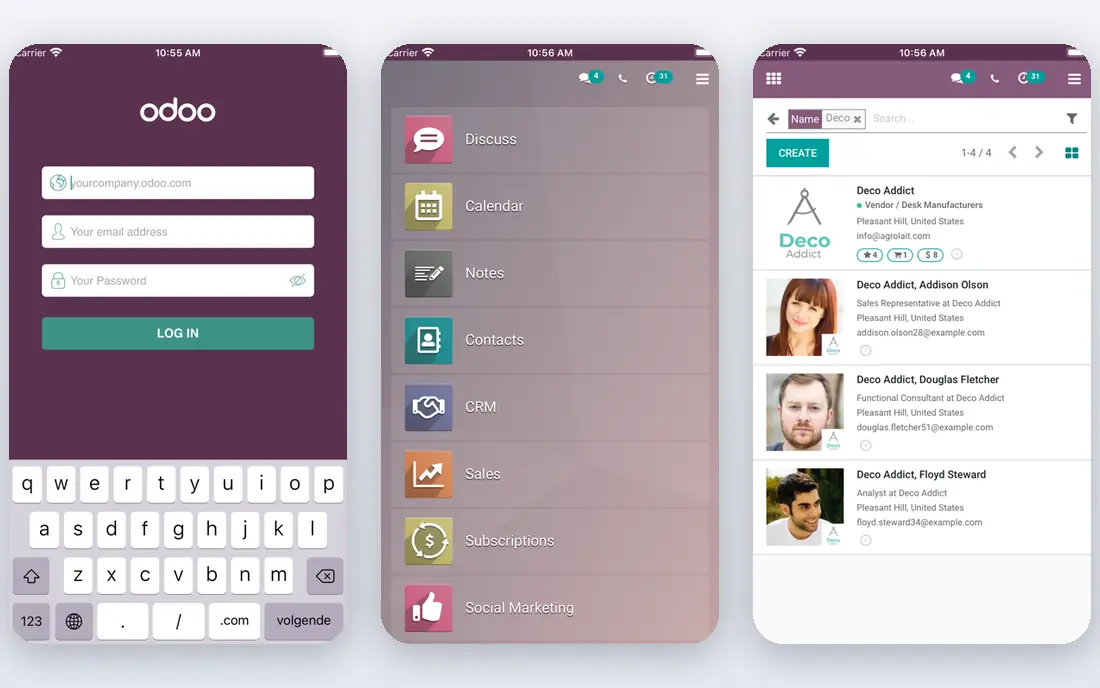
Odoo is our pick for most small and mid-sized firms leaving NetSuite for cost reasons. Its modular design lets you start with accounting, sales and inventory, then add manufacturing, HR or e-commerce later. The entry price is far below a typical NetSuite quote, and the community edition gives technical teams a free starting point.
The catch is that breadth can become complexity. Large Odoo projects still need careful setup, and support quality depends on whether you use Odoo directly or a partner. Firms without in-house technical help should budget for implementation support rather than assuming the low license price is the total cost.
- Very broad module choice
- Low entry price
- One-app free option for small teams
- Support quality varies
- Complex setups still need partner help
Microsoft Dynamics 365 Business Central
Best for: Microsoft-stack companies
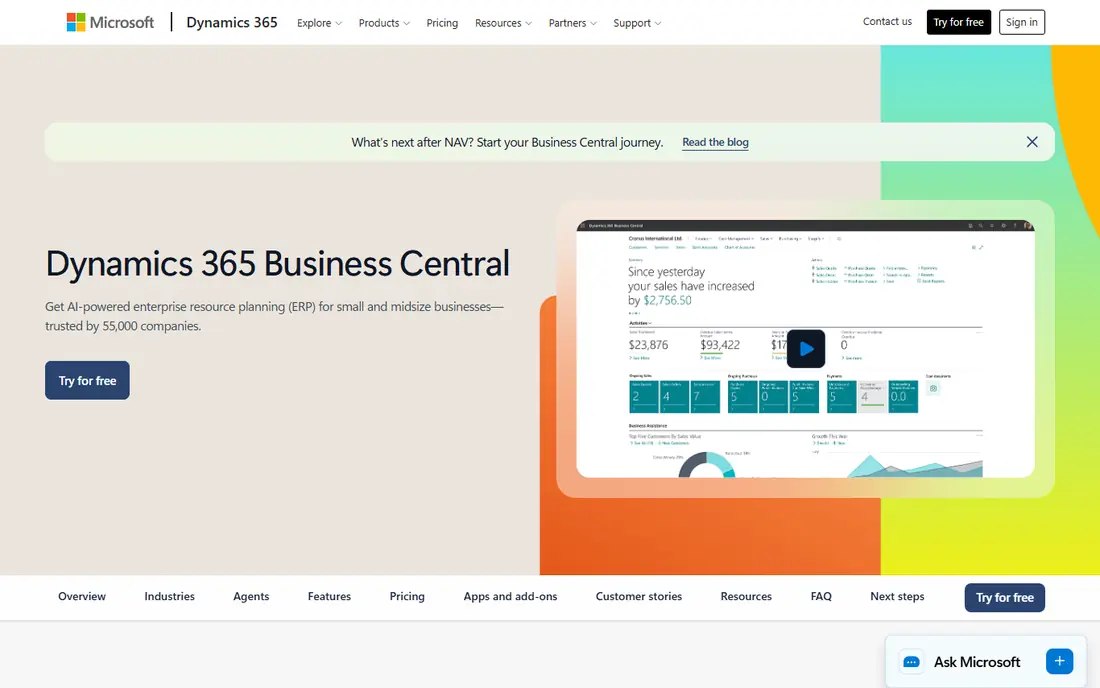
Business Central suits firms already running Microsoft 365, Outlook and Teams. Financials, inventory, sales and purchasing sit in one system, and Power BI reporting fits naturally alongside it. Per-user pricing is also easier to forecast than NetSuite's quote-based model for many firms.
Implementation is the main cost to watch. Most firms need a partner for setup, migration and training, and that work can exceed the first year of licenses. Business Central also rewards firms that commit to the Microsoft stack, so firms on Google Workspace may get less value from the integration.
- Deep Microsoft 365 and Power BI integration
- Predictable per-user pricing
- Strong financials
- Partner setup is often needed
- Licensing can get complex at scale
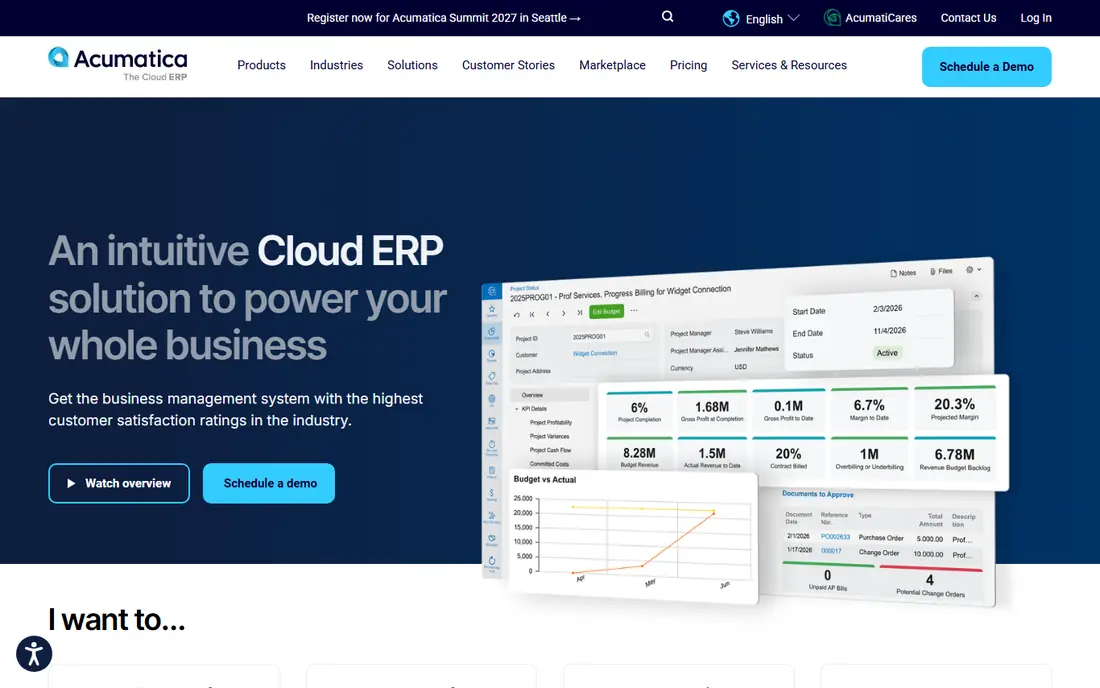
Acumatica is a strong NetSuite alternative for firms with many users but uneven transaction volume. Its consumption-based model charges for resources used rather than for every seat, which helps firms with large seasonal or warehouse teams. Manufacturing, distribution and project accounting are particular strengths.
Pricing is by quote, so you cannot compare it to a per-user price without a formal proposal. Implementation is also partner-led in most cases, which adds time and cost. Acumatica suits firms approaching mid-market scale that want ERP depth without paying for every occasional user.
- Consumption-based pricing with no per-user fees
- Strong manufacturing and distribution
- Modern interface
- Quote-based pricing
- Partner-led implementation adds cost
Sage Intacct is the finance-first pick on this list. Firms with multiple entities, locations or revenue streams get dimensional reporting and consolidation tools that are stronger than most general ERP options. Finance teams often find its close process and audit trails easier to manage than a broader ERP.
The limit is scope. Sage Intacct is not a full manufacturing or warehouse system, so firms that need deep operations may need add-ons or a second system. Pricing is also by quote, which makes early budgeting harder. Choose Sage Intacct when finance is the main problem, not when factory or warehouse control is.
- Excellent multi-entity and dimensional accounting
- Strong reporting
- Cloud-native design
- Not a full operations ERP
- Quote-based pricing
- Limited manufacturing depth
SAP Business One suits smaller manufacturers and distributors that need real ERP depth without moving to SAP S/4HANA. It covers financials, inventory, purchasing, sales and production in one system, and it can run in the cloud or on premise. Firms that plan to grow into larger SAP products also benefit from the shared ecosystem.
Implementation is almost always partner-led, and that adds cost and time. The interface is also less modern than Odoo or Acumatica, which can affect adoption. SAP Business One is best for firms that value manufacturing depth and SAP credibility over a slick interface.
- Deep manufacturing and supply chain tools for smaller firms
- On-premise or cloud options
- SAP ecosystem
- Partner-dependent implementation
- Interface feels older than newer rivals
ERPNext is the lowest-cost full ERP on this list for teams with technical capacity. Self-hosting is free, and the hosted cloud option starts at a low monthly price compared with NetSuite. It covers accounting, inventory, manufacturing, CRM, HR and projects, so small firms do not need to stitch together many tools.
The trade-off is responsibility. You or your partner must handle setup, upgrades, backups and support, and the interface is plain compared with paid rivals. ERPNext suits budget-conscious firms with a developer or a trusted implementation partner. Firms without technical help should look at Odoo or Zoho One instead.
- Full ERP breadth with no license fee for self-hosting
- Open-source code
- All modules included
- Needs technical setup and maintenance
- Interface is functional rather than polished
Zoho One bundles CRM, accounting, HR, projects, mail and many other apps for a single per-user price. Small firms that need a bit of everything often get better value here than from a narrow ERP plus separate tools. Setup is also faster than a full ERP rollout for most small teams.
Depth is the limit. Zoho Books and Zoho Inventory are solid for small firms, but they do not match Acumatica or SAP Business One for complex manufacturing. App quality also varies, so test the apps you will actually use during the trial. Zoho One is a suite first and an ERP second.
- More than 40 apps in one bundle
- Predictable pricing
- Good for small teams
- Depth varies by app
- Not a traditional ERP for complex manufacturing
Epicor Kinetic is the manufacturing specialist on this list. Discrete and make-to-order manufacturers get scheduling, shop-floor control, quality and supply chain tools that general ERP systems often lack. It can run in the cloud or on premise, which suits firms with strict IT rules.
Implementation is heavy and expensive, so Epicor Kinetic only makes sense when manufacturing is central to the business. Non-manufacturers will find it overpowered and costly. Firms that make, assemble or configure products to order should shortlist it early, while service firms should look elsewhere.
- Deep shop-floor, scheduling and manufacturing tools
- Strong for make-to-order firms
- Cloud or on-premise
- Heavy implementation
- Quote-based pricing
- Overkill for non-manufacturers
Cin7, formerly known for DEAR Systems, suits product businesses whose main problem is inventory. It handles multi-channel sales, purchasing, warehousing and production tracking in one place, and it connects well to e-commerce platforms. Setup is usually faster than a full ERP project.
Finance and HR depth are limited compared with NetSuite or Sage Intacct, so larger firms may still need a strong accounting system alongside Cin7. It is best for product firms that need inventory control first and full ERP second. If inventory accuracy is your main pain, Cin7 deserves a trial.
- Purpose-built inventory and order management
- Strong e-commerce and warehouse links
- Faster setup than full ERP
- Limited CRM and HR depth
- Not a full financial ERP for complex firms
How we picked these
We compared vendor pricing pages, module lists and implementation models for ERP and ERP-adjacent platforms that serve firms leaving NetSuite. We favored systems that are still actively sold and supported, cover core finance and operations, and publish at least a starting price or a clear quote model. We did not claim hands-on testing, and we treated partner quotes as estimates to confirm in a proposal.
How to choose a NetSuite alternative
Start by listing the modules you actually use in NetSuite, then rank them by pain. A firm that mainly needs better finance should not buy a manufacturing ERP, and a firm that mainly needs inventory should not buy a finance-only system. Next, count users by type, because per-user and consumption pricing produce very different totals.
Then plan migration as a project, not a purchase. Ask each vendor for implementation time, data migration help, training and ongoing support costs in writing. Run a trial with real data from your current system, including a month-end close and a typical order, before you sign. The cheapest license often becomes the most expensive choice if migration and training are underestimated.
Sources
Frequently asked questions
What is the best alternative to NetSuite for small business?
Odoo is our pick for most small firms because it is modular, affordable and broad. Zoho One suits firms that want many apps in one bundle, while ERPNext suits technical teams that want a free open-source option. The best choice depends on whether you need manufacturing, finance or inventory depth.
Is Odoo cheaper than NetSuite?
Yes, in most cases the license cost is far lower, with Odoo starting at $24.90 per user per month for paid plans. Total cost still depends on implementation, partner help and the modules you choose. Get a full quote including setup before you compare totals.
Can I migrate from NetSuite to another ERP?
Yes, but migration needs planning for chart of accounts, customer and inventory data, open orders and historical reporting. Most vendors and partners offer migration tools or services, but the work still takes time. Test the new system with real data before you switch off NetSuite.
Do NetSuite alternatives support multi-entity accounting?
Sage Intacct is strongest here, and Dynamics 365 Business Central, Acumatica and SAP Business One also support multi-entity work in different ways. Check consolidation, intercompany transactions and reporting for your exact structure during a trial, because multi-entity support varies in depth.
Should I choose a full ERP or a suite like Zoho One?
Choose a full ERP when manufacturing, distribution or complex finance is central to your business. Choose a suite like Zoho One when you are a small team that needs CRM, accounting, HR and projects in one affordable bundle. A suite is faster to adopt, while a full ERP gives more depth in operations.