OpenClaw Alternatives in 2026: 8 Tools Compared
By ToolNimba Editorial Team October 31, 2026 9 min read

- Top pick
 NanoClaw
Safer container-isolated agents
Starting priceFreeCheck out NanoClawRead our review - Runner-up
 Nanobot
Lightweight Python agent gateway
Starting priceFreeCheck out NanobotRead our review - Also great
 ZeroClaw
Low-resource local agents
Starting priceFreeCheck out ZeroClawRead our review
How we researched this
We compared official pricing and feature pages, app store listings, privacy policies and public user reviews. Prices change, so check the provider's site before you pay.
Key takeaways
- OpenClaw is an open-source, self-hosted personal AI assistant that runs as an always-on agent, connects to chat apps, and extends through skills.
- NanoClaw and Nanobot are the closest direct alternatives, since both are open-source agent harnesses with chat channels and automations.
- If you only need a private AI chat interface, Open WebUI and LibreChat are simpler and safer starting points than a full agent.
- Agent tools that can act on your behalf need careful permission control, so check sandboxing and credential handling before you connect accounts.
Quick comparison
| Name | Best for | Starting price | Free plan | |
|---|---|---|---|---|
| NanoClaw | Safer container-isolated agents | Free | Yes | Visit |
| Nanobot | Lightweight Python agent gateway | Free | Yes | Visit |
| ZeroClaw | Low-resource local agents | Free | Yes | Visit |
 PicoClaw | Edge and low-power devices | Free | Yes | Visit |
 TrustClaw | Secure app automation | Free | Yes | Visit |
 Open WebUI | Private web chat with local models | Free | Yes | Visit |
 LibreChat | Multi-provider web chat | Free | Yes | Visit |
 n8n | Deterministic workflow automation | $20 per month | Yes | Visit |
The best OpenClaw alternatives
OpenClaw, formerly known as Clawdbot and Moltbot, is a self-hosted personal AI assistant and agent. It stays running in the background, can be reached through messaging apps such as Telegram and Discord, and can carry out scheduled tasks and actions through skills and connected tools. The alternatives below are not all identical to it: some are close agent replacements, some are safer chat front ends, and one is a workflow tool for jobs where an autonomous agent is too unpredictable.
NanoClaw is the closest alternative if your main concern is safety. Where OpenClaw relies largely on application-level permission controls, NanoClaw keeps a small host process and places each agent group inside a container, which limits what a compromised or mistaken agent can reach. It runs on macOS or Linux, with Windows through WSL2, and Docker is the default runtime.
That isolation comes with setup work. You still need to configure a model provider, channels and credentials, and the community is smaller, so answers to edge cases take longer to find. If you like the OpenClaw idea but want stronger boundaries around each agent, NanoClaw is the first alternative to try.
- Open source and self-hosted
- Runs each agent group in an isolated Linux container
- Built as a direct OpenClaw alternative
- Smaller community than OpenClaw
- Setup needs Docker and some technical comfort
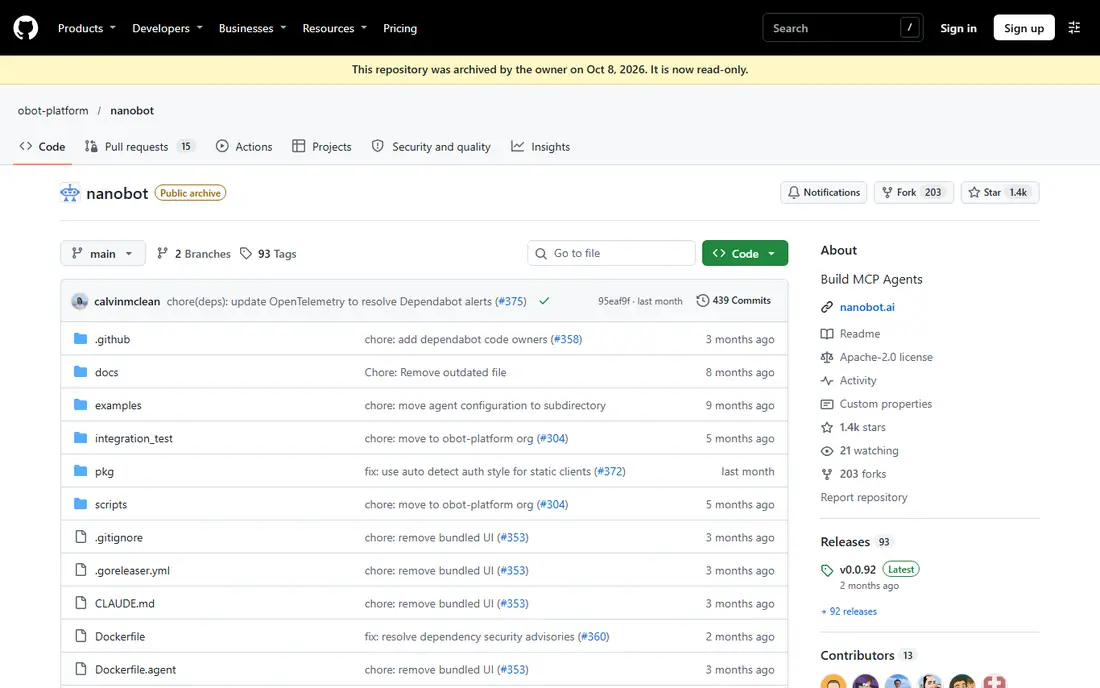
Nanobot is a lightweight, open-source AI assistant inspired by OpenClaw, built around a gateway that stays running in the background. You can talk to it from a browser workbench or a terminal client, link chat channels, and set up scheduled triggers and automations. It also offers a Python SDK and an OpenAI-compatible API, which helps developers build on top of it.
It is not a one-click consumer app. You must choose a hosted or local model, configure channels, and lock down remote access yourself. For a technical user who wants a smaller, Python-based agent harness with a gateway model similar to OpenClaw, Nanobot is a strong and genuinely comparable choice.
- Free and open source
- Gateway keeps channels and automations running
- WebUI and terminal clients included
- Provider and channel configuration required
- Remote access needs explicit security controls
ZeroClaw is a lightweight, open-source local agent framework written in Rust, which gives it a small footprint and fast startup compared with heavier Node-based agents. It suits a personal server, a small VPS or a machine where you do not want a large runtime running all day. The focus is on local agents with low friction, rather than a polished hosted dashboard.
The trade-off is ecosystem size. You will find fewer ready-made skills and integrations than with OpenClaw, and you may need to build more yourself. If you value speed, memory safety and a minimal install over a large skill library, ZeroClaw is a good fit.
- Open source and local-first
- Small Rust runtime with low setup friction
- Lightweight agent framework
- Smaller ecosystem and fewer ready-made skills
- Documentation is thinner than larger projects
PicoClaw is an open-source, edge-focused agent in the same family of OpenClaw-inspired projects, designed to run with under 10 MB of memory in published comparisons and to boot quickly on low-power hardware. That makes it interesting for a Raspberry Pi, a small home server or another device where a full agent stack would be wasteful.
It is not trying to be a complete personal assistant with every channel and skill. The ecosystem is limited, and some tasks are better left to a larger agent on a main machine. Choose PicoClaw when the constraint is hardware, not when you need the widest feature set.
- Open source and edge-focused
- Very low memory use and fast boot
- Suited to small devices
- Limited ecosystem
- Not a full desktop assistant replacement
TrustClaw is an open-source, self-hostable agent focused on secure app automation, with OAuth handling, sandboxing and credential masking highlighted in recent comparisons. That emphasis matters because an agent that touches your apps holds tokens that could do real damage if leaked or misused. Masking credentials and sandboxing execution reduces that risk compared with a plain agent setup.
It is less of a general personal companion than OpenClaw, and its community is smaller, so expect more hands-on configuration. If your main OpenClaw use case is automating apps safely, rather than chatting with an always-on assistant, TrustClaw deserves a serious look.
- Open source and self-hostable
- Credential masking and sandboxed execution
- App automation focus
- Less local control than a fully self-run agent in some setups
- Smaller community
Open WebUI is not a direct agent replacement, and that is worth stating plainly. It is a self-hosted web interface for chatting with AI models, including local models through Ollama, with a polished interface that feels like a consumer chat app. For many people who tried OpenClaw mainly for private AI chat, Open WebUI is simpler, safer and easier to maintain.
What you give up is agency. Open WebUI does not, by itself, live in Telegram, run scheduled tasks in the background or act across your apps the way OpenClaw does. If you need those behaviours, pair it with an agent tool or choose NanoClaw or Nanobot instead. If private chat is the real need, Open WebUI is the better tool.
- Free and open source
- Polished web interface
- Works with Ollama and local models for offline use
- Web chat only, so no messaging channels or autonomous agent behaviour by default
- Setup needs Docker or a local install
LibreChat is another self-hosted chat interface, with a focus on using many AI providers from one place. You can switch models, keep conversations organised, and run it on your own server, which keeps your chats out of a third-party hosted account. That multi-provider flexibility is useful if you compare models or use different providers for different tasks.
Like Open WebUI, it is a chat front end, not an autonomous agent. It will not message you on Telegram or carry out background tasks without extra tooling. For a household or small team that wants a private, multi-model chat hub, LibreChat is a clean alternative to the chat side of OpenClaw.
- Free and open source
- Supports multiple AI providers
- Self-hosted web interface with plugins
- No multi-channel messaging or autonomous agent features by default
- Needs a server or Docker setup
n8n belongs here for a different reason: it is the safe alternative when you do not actually need an autonomous agent. Instead of giving an AI broad freedom to act, you build a visual workflow with fixed steps, triggers and approvals. That predictability is valuable for business tasks, scheduled reports and integrations where a mistake would be costly.
It will not replace OpenClaw as a companion you chat with, and it is not designed for messaging channels in the same way. Use n8n when the job is a repeatable workflow with clear inputs and outputs. Use an agent tool above when the job needs conversation, judgement and open-ended action.
- Visual workflow builder
- Self-hosting available
- Predictable, step-by-step automation instead of open-ended agent actions
- Not a personal AI assistant or chat agent
- Workflow building takes learning for complex jobs
How we picked these
We compared projects described in recent OpenClaw alternative guides and project documentation, favouring open-source, self-hosted tools that are actively available in October 2026. We included close agent replacements first, then chat front ends and a workflow tool, and we labelled each clearly so readers do not mistake a chat interface for a full agent. Prices are starting prices from vendor pages, and most tools here are free to self-host apart from model and server costs.
What to check before you switch
Start by naming the job you actually used OpenClaw for. If it was messaging and background tasks, you need an agent such as NanoClaw, Nanobot or ZeroClaw. If it was private chat, Open WebUI or LibreChat will be simpler. If it was repeatable automation, n8n will be more predictable and easier to audit.
Security comes before features
An agent with access to your messages, files and app tokens is a high-value target, so check sandboxing, credential storage and network exposure before you connect anything. Bind admin interfaces to localhost where possible, require authentication, keep the software updated, and only install skills from sources you trust. Recent guides note security incidents around OpenClaw skills and exposed instances, which is a reminder to treat any agent as a privileged system, not a casual app.
Count the real running cost
Free software is not free to run. You still pay for a server or VPS if it runs all day, plus model tokens for hosted models, and local models need capable hardware. Compare that total against a hosted plan before you assume self-hosting is cheaper.
Sources
- https://composio.dev/content/openclaw-alternatives
- https://www.scriptbyai.com/nanoclaw-openclaw-alternative/
- https://www.sphereinc.com/blogs/openclaw-alternatives-enterprise-guide
- https://dev.to/chisha_d5ceeffee4e27/5-self-hosted-ai-assistant-platforms-worth-trying-in-2026-47lc
- https://www.scriptbyai.com/nanobot-ai-assistant/
- https://github.com/nanoclaw/nanoclaw
- https://github.com/nanobot-ai/nanobot
- https://github.com/zeroclaw/zeroclaw
- https://github.com/picoclaw/picoclaw
- https://github.com/trustclaw/trustclaw
- https://openwebui.com
- https://www.librechat.ai
- https://n8n.io