The Surface Area Formula, Explained for Every Shape
 By Shihab Mia June 20, 2026 9 min read
Quick answer
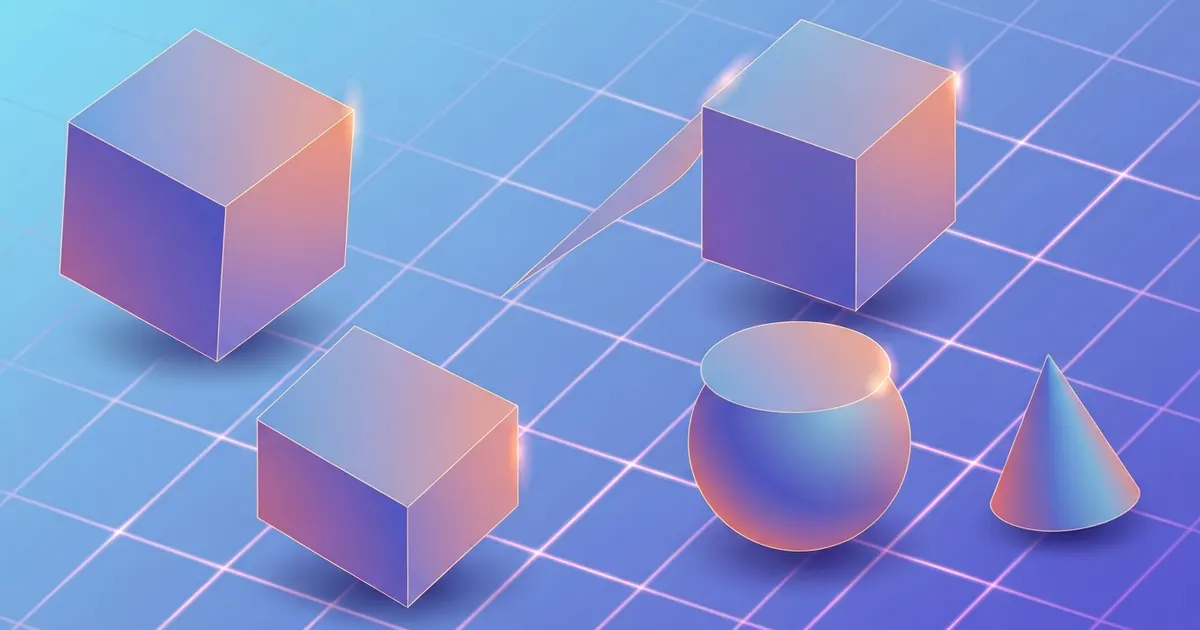
Surface area is the total area of all the faces of a solid added together. The most common formulas are: cube = 6 x side squared, cuboid (box) = 2(lw + lh + wh), and sphere = 4 x pi x r squared. Work out the area of every surface, then add them up.
Surface area answers a simple question: if you could peel a 3D object flat, how much area would the outer skin cover? It is what you need when you are buying paint, wrapping a gift, ordering material for a tank, or working through a geometry assignment. This guide gives you the surface area formula for every common shape, shows where each one comes from, walks through worked examples, and points out the mistakes that quietly ruin an otherwise correct calculation. If you want an answer without any arithmetic, the surface area calculator takes your dimensions and returns the total instantly.
What surface area actually means
Surface area is the total area of every flat face and curved surface on the outside of a 3D object. It is measured in square units (square centimetres, square inches, square metres) because area is always two dimensional, even when it belongs to a solid. This is the key difference from volume, which measures the space inside an object and uses cubic units. Surface area is about the outside skin, volume is about the inside.
For any shape made of flat faces, the method is the same: find the area of each face, then add them together. That single idea, add up every face, is the surface area formula in its purest form. The shape specific formulas below are just shortcuts that do this adding for you. If you only remember one thing, remember that surface area is a sum of areas.
The main surface area formulas
Here are the formulas for the most common solids. In every formula, r is the radius, l is length, w is width, h is height, and pi is about 3.14159. These cover the shapes that appear in nearly every textbook and most real projects.
Surface area formulas for common 3D shapes
| Shape | Surface area formula | What the letters mean |
|---|---|---|
| Cube | 6 x s squared | s is the length of one edge |
| Cuboid (box) | 2(lw + lh + wh) | l, w, h are length, width, height |
| Sphere | 4 x pi x r squared | r is the radius |
| Cylinder | 2 x pi x r x (r + h) | r is radius, h is height |
| Cone | pi x r x (r + L) | r is radius, L is slant height |
Notice that every one of these is built from areas you already know. A cube has six identical square faces, so you find one square and multiply by six. A cuboid has three pairs of matching rectangles. A sphere and the round parts of a cylinder and cone use pi because circles are involved. If a formula ever slips your mind, you can rebuild it by drawing the shape and finding each face one at a time.
Total surface area vs lateral surface area
Total surface area (TSA) counts every surface, including the top and bottom. Lateral surface area (LSA) counts only the sides and leaves off the flat ends. The formulas in the table above are all total surface area. You switch to lateral surface area whenever the ends are open or do not need covering, such as a tube, a lampshade, or the label on a soup can.
The two versions differ only by the area of the ends you drop. Reading the correct one off an exam question or a real job saves you from over-ordering material. This table shows how they compare for the curved shapes, where the distinction matters most.
Total vs lateral surface area for curved solids
| Shape | Total surface area | Lateral (sides only) | When lateral is what you want |
|---|---|---|---|
| Cylinder | 2 x pi x r x (r + h) | 2 x pi x r x h | An open pipe or a can label |
| Cone | pi x r x (r + L) | pi x r x L | A funnel or an ice cream cone with no lid |
| Cuboid | 2(lw + lh + wh) | 2h(l + w) | Painting the four walls of a room but not floor or ceiling |
A sphere has no flat ends to remove, so its total and lateral surface area are the same single value: 4 x pi x r squared. That is one reason it is the easiest curved shape to work with.
Cube and cuboid: the box shapes
A cube is the friendliest shape to start with. Because all six faces are identical squares, the surface area is just six times the area of one face. If one edge is s, each face has area s squared, and the total is 6 x s squared.
Worked example: surface area of a cube
Find the surface area of a cube with edges of 4 cm.
- Find the area of one face: 4 cm x 4 cm equals 16 square cm.
- A cube has 6 identical faces, so multiply: 16 x 6.
- The total surface area is 96 square cm.
A cuboid, or rectangular box, is almost as simple but the faces come in three different sizes. The top and bottom match, the front and back match, and the two ends match. That is why the formula is 2(lw + lh + wh): you find the area of one face from each pair, add those three areas, then double the total. If you would rather not multiply it out by hand, the area calculator handles the faces for you.
Worked example: surface area of a cuboid
Find the surface area of a box that is 5 cm long, 3 cm wide and 2 cm high.
- Find the three distinct face areas: lw is 5 x 3 equals 15, lh is 5 x 2 equals 10, and wh is 3 x 2 equals 6.
- Add them: 15 + 10 + 6 equals 31 square cm.
- Double the sum to count both of each pair: 2 x 31 equals 62 square cm.
Sphere, cylinder and cone: the curved shapes
Curved shapes use pi because their surfaces wrap around circles. The sphere is the cleanest: its surface area is 4 x pi x r squared, which happens to be exactly four times the area of a flat circle with the same radius. For a ball of radius 3 cm, that is 4 x 3.14159 x 9, or about 113 square cm.
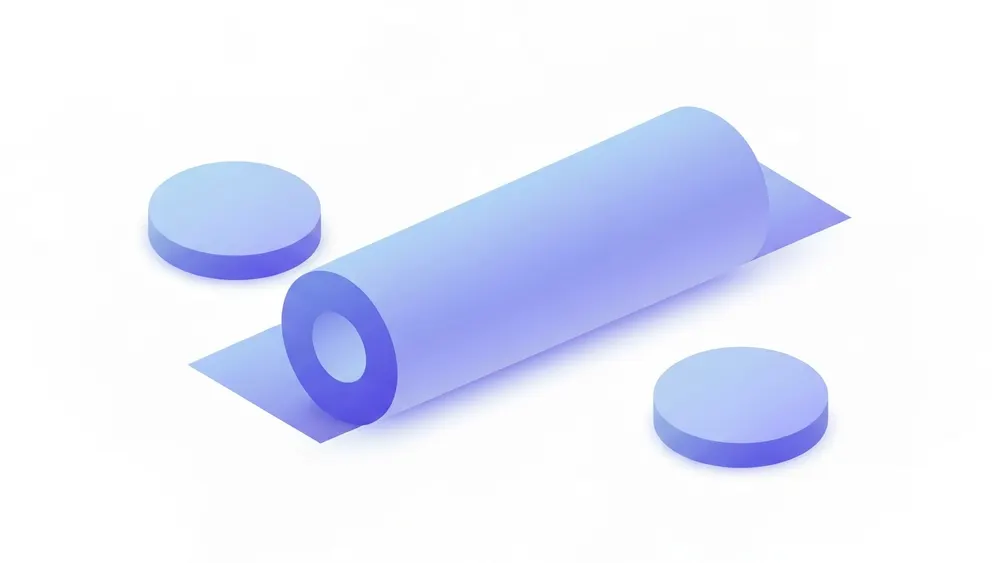
A cylinder is easier than it looks once you unroll it. It has two circular ends, each with area pi x r squared, plus a curved side that unrolls into a rectangle. That rectangle is as tall as the cylinder and as wide as the circle's circumference. Adding the two circles and the side gives 2 x pi x r x (r + h). A cone follows the same logic but uses the slant height L, the distance from the tip down the slope to the edge, giving pi x r x (r + L).
Worked example: surface area of a cylinder
Find the total surface area of a can with radius 3 cm and height 10 cm.
- Find the two ends: pi x r squared is 3.14159 x 9, which is about 28.3 square cm each, so 56.5 square cm for both.
- Find the curved side: 2 x pi x r x h is 2 x 3.14159 x 3 x 10, which is about 188.5 square cm.
- Add them: 56.5 + 188.5 is about 245 square cm total.
If the can were an open tube with no ends, you would use only the lateral part, about 188.5 square cm, and skip step one entirely. The area of a circle guide explains the pi x r squared step in more detail if the circle part is where you get stuck.
Worked example: surface area of a cone
Find the total surface area of a cone with radius 3 cm and slant height 5 cm.
- Find the circular base: pi x r squared is 3.14159 x 9, which is about 28.3 square cm.
- Find the curved side: pi x r x L is 3.14159 x 3 x 5, which is about 47.1 square cm.
- Add them: 28.3 + 47.1 is about 75.4 square cm total.
Watch the slant height here. If you were only given the vertical height, you would first find the slant height with the Pythagorean rule, L equals the square root of (r squared plus h squared), before putting it into the formula. Skipping that step is the single most common cone mistake.
A real-world example: painting a room
Surface area shows up the moment you buy paint. To paint the four walls of a room 5 m long, 4 m wide and 3 m high, you want the lateral surface area of a cuboid, 2h(l + w). That is 2 x 3 x (5 + 4), which is 54 square metres. If a tin of paint covers 12 square metres per coat, you need 54 divided by 12, or 4.5 tins, for a single coat, and double that for two coats.
This is exactly why lateral surface area matters in practice. You do not paint the floor or ceiling with wall paint, so counting all six faces would send you home with far too much. Subtracting the area of doors and windows trims the figure further, which is the same idea as removing the open ends of a tube.
Common mistakes to avoid
Surface area trips people up in a few predictable ways. Watch for these before you trust your answer.
- Mixing up surface area and volume. Surface area is the outside skin in square units. Volume is the inside space in cubic units. If your answer is in cubic units, you found volume by mistake.
- Forgetting a face. A cuboid has six faces, a cylinder has two ends plus the side. Skipping the bottom of a tank or the ends of a tube is the most common error.
- Using diameter instead of radius. The radius is half the diameter. Plugging the full width into a formula that wants r roughly quadruples the rounded result.
- Mixing units. Convert everything to the same unit before you start, or the areas will not add up correctly.
- Confusing slant height and vertical height for a cone. The cone formula needs the slant height L along the slope, not the straight up and down height.
Good to know: where surface area shows up
Surface area is not just a classroom exercise. Painters and decorators use it to estimate how much paint a wall or box will need. Manufacturers use it to work out how much sheet metal, cardboard or fabric a product takes. Engineers care about it because heat escapes through surfaces, so a larger surface area means faster cooling. Even biology leans on it, since cells rely on surface area to absorb nutrients. Any time you deal with the outside of an object rather than the space inside it, surface area is the measurement you want.
If you are comfortable with these ideas, two close cousins are worth a look. The area of a circle underpins every curved surface formula here, and the volume of a cylinder guide shows how the same shapes are measured on the inside instead of the outside.
Calculate surface area instantly
Rather than juggle formulas by hand, enter your measurements below and let the calculator find each face and add them for you. It works for squares, rectangles, circles and more, and shows the result in clear square units.
📐 Try the free tool Area Calculator Free area calculator for rectangles, squares, triangles, circles, trapezoids and parallelograms. Enter dimensions for instant area, the formula used, and full working.Once you see surface area as a simple sum of faces, the formulas stop feeling like a list to memorise and start feeling like common sense. Find each surface, add them up, and you are done. For related geometry, the perimeter formula covers the distance around a flat shape, which is often the first step toward an area calculation.
Frequently asked questions
What is the surface area formula?
Surface area is the total area of all the faces of a solid added together, measured in square units. For a cube it is 6 times the side squared, for a cuboid it is 2(lw + lh + wh), and for a sphere it is 4 x pi x r squared. The general method is to find each face and add them.
What is the difference between surface area and volume?
Surface area measures the outside skin of a 3D object in square units, like square centimetres. Volume measures the space inside it in cubic units, like cubic centimetres. Surface area tells you how much wrapping you need, while volume tells you how much it can hold.
How do you find the surface area of a cube?
A cube has six identical square faces, so find the area of one face by squaring the edge length, then multiply by six. The formula is 6 x side squared. For a cube with 5 cm edges, one face is 25 square cm, and the total surface area is 150 square cm.
What is the surface area formula for a sphere?
The surface area of a sphere is 4 x pi x r squared, where r is the radius and pi is about 3.14159. This equals exactly four times the area of a flat circle of the same radius. For a sphere of radius 2 cm, the surface area is about 50.3 square cm.
Why is surface area measured in square units?
Surface area is a measure of area, and all area is two dimensional, so it uses square units such as square inches or square metres. Even though the surface belongs to a 3D solid, you are still measuring flat coverage, not the space inside, which would use cubic units.
Do I always have to use a formula for surface area?
No. The formulas are shortcuts. For any shape with flat faces, you can simply find the area of each face individually and add them together. The formulas just package that adding into one step for common shapes like cubes, boxes, cylinders and cones.
What is the difference between total and lateral surface area?
Total surface area counts every surface, including the flat top and bottom. Lateral surface area counts only the sides and leaves out the ends. Use total when the whole object is covered, and lateral when the ends are open or do not need covering, such as a pipe, a can label, or the four walls of a room.
How do you find the surface area of a cylinder?
The total surface area of a cylinder is 2 x pi x r x (r + h), which is the two circular ends plus the curved side. For a cylinder with radius 3 cm and height 10 cm, that is about 245 square cm. If the ends are open, use only the lateral part, 2 x pi x r x h, which is about 188.5 square cm.