The Cylinder Volume Formula, Explained Simply
 By Shihab Mia June 20, 2026 8 min read

Quick answer
The cylinder volume formula is V = pi x r squared x h, where r is the radius of the circular base and h is the height. In words: find the area of the circular base (pi x r squared), then multiply by the height. The answer comes out in cubic units, and pi is about 3.14159.
The cylinder volume formula
The volume of a cylinder is given by V = pi x r squared x h. Here V is the volume, r is the radius of the circular base, h is the height (the distance between the two circular ends), and pi is the constant roughly equal to 3.14159. Read as a sentence, pi r squared h means find the circle, then multiply by the height.
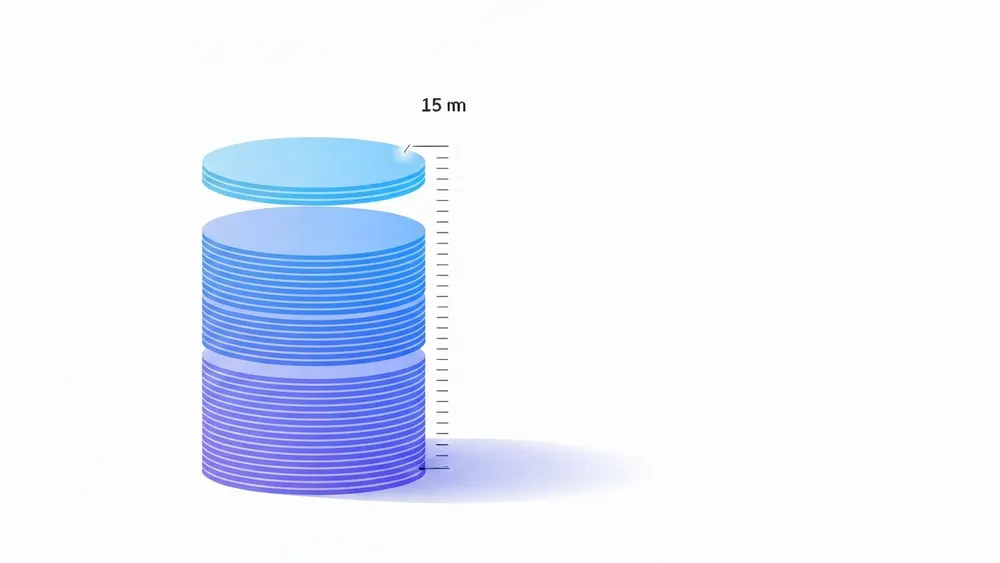
The reason the formula looks the way it does is simple once you break it apart. A cylinder is just a circle that has been stretched straight up into the third dimension. The flat circular base has area pi x r squared, which is the area of a circle. To turn that flat area into a solid volume, you multiply by how tall the shape is. So volume equals base area times height, which is exactly pi x r squared x h.
What each symbol in the cylinder volume formula means
| Symbol | Meaning | Notes |
|---|---|---|
| V | Volume of the cylinder | Measured in cubic units (cm cubed, m cubed, in cubed) |
| pi | The constant pi | About 3.14159; use the pi button on a calculator for accuracy |
| r | Radius of the base | Half of the diameter, measured from center to edge |
| r squared | Radius times itself | Square the radius before multiplying by pi |
| h | Height of the cylinder | The straight distance between the two circular ends |
The single most important detail is that the formula uses the radius, not the diameter. The radius is the distance from the center of the circle to its edge, which is exactly half the diameter. If a can is 8 cm across, its radius is 4 cm. Plugging the diameter into the formula by accident roughly quadruples the answer, because the radius is squared.
If you only have the diameter d, you do not need to find the volume of a cylinder from diameter as a separate formula: just halve it first, or use V = pi x (d divided by 2) squared x h, which simplifies to pi x d squared x h divided by 4. Both versions give the same answer, so use whichever measurement you started with.
The formula also holds for a cylinder that leans to one side (an oblique cylinder), as long as h is the perpendicular distance between the two circular ends, not the slanted side length. Slicing a leaning cylinder into thin horizontal disks produces the same stack of circles as a straight one, so the volume does not change.
How do you find the volume of a cylinder?
To find the volume of a cylinder, measure the radius and height in the same unit, square the radius, multiply by pi to get the base area, then multiply that area by the height. The five steps below cover how to calculate the volume of a cylinder from either the radius or the diameter.
- Measure the radius r. If you only know the diameter, divide it by 2.
- Square the radius: multiply r by itself to get r squared.
- Multiply by pi (about 3.14159). This gives the area of the circular base.
- Multiply that base area by the height h.
- Label the result in cubic units, such as cubic centimetres or cubic inches.
Worked examples
Example 1: the volume of a can
A soup can has a radius of 3 cm and a height of 10 cm. What is its volume?
- Square the radius: 3 x 3 equals 9.
- Multiply by pi: 3.14159 x 9 is about 28.27 square cm (the base area).
- Multiply by the height: 28.27 x 10 equals about 282.7.
- The volume is about 282.7 cubic cm, which is roughly 283 millilitres.
Example 2: a water tank from its diameter
A cylindrical water tank is 2 metres across (diameter) and 3 metres tall. First halve the diameter to get the radius: 2 divided by 2 equals 1 metre. Then apply the formula: pi x 1 squared x 3 equals 3.14159 x 1 x 3, which is about 9.42 cubic metres. Since 1 cubic metre holds 1000 litres, that tank holds about 9,420 litres. If you are sizing an actual storage tank rather than a textbook problem, the tank volume calculator handles cylindrical, rectangular and horizontal tanks directly.
Example 3: water inside a length of pipe
A pipe is a cylinder, so the same formula tells you how much water it holds. Suppose a pipe has an inside radius of 2 cm and a length of 500 cm (5 metres). Square the radius (2 x 2 equals 4), multiply by pi (3.14159 x 4 is about 12.57 sq cm, the cross-section area), then multiply by the length: 12.57 x 500 is about 6,283 cubic cm. Because 1 cubic cm equals 1 millilitre, the pipe holds roughly 6,283 mL, or about 6.28 litres.
If you would rather skip the arithmetic, the volume calculator does every step for you once you enter the radius and height. For a broader walkthrough of solids beyond cylinders, see how to calculate volume.
What is the volume of a hollow cylinder?
A hollow cylinder, like a pipe or a tube, has an outer radius and an inner radius. Its volume is the outer cylinder's volume minus the inner cylinder's volume: V = pi x (R squared minus r squared) x h, where R is the outer radius, r is the inner radius, and h is the length.
- A steel pipe has an outer radius of 5 cm, an inner radius of 4 cm, and a length of 200 cm.
- Subtract the squared radii: 5 x 5 minus 4 x 4 equals 25 minus 16, which is 9.
- Multiply by pi: 3.14159 x 9 is about 28.27 square cm.
- Multiply by the length: 28.27 x 200 is about 5,654.9 cubic cm, or roughly 5.65 litres of steel in the pipe wall.
This distinction matters whenever "volume" could mean either the space inside or the material around it. The inner radius alone gives the liquid capacity, as in the pipe example above, while the outer-minus-inner calculation gives the volume of metal, plastic or concrete that makes up the wall.
Units and handy conversions
Volume is always measured in cubic units because you multiply three lengths together. The trick is keeping every measurement in the same unit before you start. If the radius is in centimetres, the height must be in centimetres too, and the answer will be in cubic centimetres. Mixing centimetres and metres is one of the fastest ways to get a wildly wrong result.
Common volume conversions for cylinder problems
| From | To | Multiply by |
|---|---|---|
| Cubic centimetres (cm cubed) | Millilitres (mL) | 1 (they are equal) |
| Cubic centimetres (cm cubed) | Litres (L) | 0.001 |
| Cubic metres (m cubed) | Litres (L) | 1000 |
| Cubic inches (in cubed) | US gallons | 0.004329 |
| Litres (L) | US gallons | 0.264172 |
These conversions turn a raw geometry answer into something practical. A pipe volume in cubic centimetres becomes millilitres for free, and a tank volume in cubic metres becomes litres just by multiplying by 1000. If you work in US units, the volume converter handles gallons, quarts and litres in one place.
The factors above are exact by definition, not rounded estimates. By international agreement, the inch equals exactly 2.54 centimetres. The US liquid gallon is defined as exactly 231 cubic inches, which is where the cubic-inch and gallon conversions above come from. A litre is defined as exactly one cubic decimetre (1000 cubic centimetres), so the metric conversions are exact too.
How is cylinder volume different from surface area?
Volume measures the space inside a cylinder and is reported in cubic units, using pi x r squared x h. Surface area measures the outside skin and is reported in square units, using 2 x pi x r x (r + h). If your final answer comes out in square units, you have calculated an area, not a volume.
Three different things you can measure on a cylinder
| Measurement | Formula | Units | What it tells you |
|---|---|---|---|
| Volume | pi x r squared x h | Cubic | How much the cylinder holds inside |
| Base area | pi x r squared | Square | The size of one circular end |
| Surface area | 2 x pi x r x (r + h) | Square | The total outside skin |
Surface area tells you how much material wraps the outside of the shape, such as paint, metal sheet or label paper, while volume tells you what fits inside. Keeping the units straight (cubic versus square) is the quickest sanity check there is.
Common mistakes to avoid
Most cylinder volume errors come from a small handful of slips. Watch for these before you trust your answer.
- Using the diameter instead of the radius. Always halve the diameter first. Because the radius is squared, using the full width roughly quadruples the result.
- Forgetting to square the radius. The formula is pi x r squared x h, not pi x r x h. Square the radius before multiplying.
- Mixing units. Convert the radius and height to the same unit before calculating, or the cubic result will be meaningless.
- Rounding pi too early. Using 3 instead of 3.14159 can throw the answer off by several percent. Use the calculator pi button when accuracy matters.
- Reporting the answer in square units. Volume is always cubic. If you wrote square units, you found an area by mistake.
- Treating a pipe as solid. If the shape is hollow, subtract the inner circle's volume from the outer circle's volume instead of using the outer radius alone.
Where is the cylinder volume formula used in real life?
Plumbers, builders, brewers and engineers all use pi x r squared x h to size pipes, footings, tanks and fuel cylinders. Anywhere a round container needs to hold, ship or pour a measured amount, this formula turns its dimensions into a usable capacity.
Plumbers use it to work out how much water a length of pipe holds. Builders use it to estimate concrete for round footings and posts. Brewers and cooks scale recipes to fit cylindrical tanks and pots. Engineers size fuel tanks, hydraulic cylinders and storage silos with it. Any time something round holds a quantity, this is the tool that measures it.
If this clicked for you, a couple of close relatives are worth a look. The area of a circle is the base that the cylinder formula stacks up, and the surface area formula measures the same shapes on the outside instead of the inside.
Rather than square the radius and juggle pi by hand, enter your radius and height into the calculator below and get a clean answer in cubic units instantly.
📦 Try the free tool Volume Calculator Free volume calculator for 3D shapes. Find the volume of a cube, box, sphere, cylinder, cone, or pyramid by entering the dimensions. See the exact formula used.That is the volume of a cylinder explained the simple way: find the base area with pi x r squared, multiply by the height, and label it in cubic units. Once you see a cylinder as a circle stacked to a height, the formula stops being something to memorise and starts feeling obvious.
Frequently asked questions
What is the cylinder volume formula?
The cylinder volume formula is V = pi x r squared x h, where r is the radius of the circular base and h is the height. You find the area of the circular base with pi x r squared, then multiply by the height. The result is in cubic units, and pi is about 3.14159.
Do I use the radius or the diameter for cylinder volume?
Use the radius, which is half the diameter. If you know only the diameter, divide it by 2 first. Because the formula squares the radius, accidentally using the full diameter roughly quadruples the answer, so this is the most important detail to get right.
What units is cylinder volume measured in?
Volume is measured in cubic units, such as cubic centimetres, cubic metres or cubic inches, because you multiply three lengths together. Cubic centimetres equal millilitres, and 1 cubic metre equals 1000 litres, which makes converting a geometry answer into a real capacity easy.
Why does the cylinder volume formula use pi?
Pi appears because the base of a cylinder is a circle, and the area of any circle is pi x r squared. A cylinder is that circle stacked to a height, so multiplying the circular base area by the height carries the pi through into the volume formula.
What is the formula for cylinder volume in terms of diameter instead of radius?
If you know the diameter d instead of the radius, use V = pi x (d divided by 2) squared x h, which simplifies to pi x d squared x h divided by 4. It gives the same result as halving the diameter first and using the radius formula.
What is the volume of a cylinder with a 10 cm diameter and 20 cm height?
Halve the diameter to get a radius of 5 cm. Square it to get 25, multiply by pi (about 78.54 square cm), then multiply by the height of 20 cm. The volume is about 1,570.8 cubic cm, which is roughly 1.57 litres.
How many litres does a cylindrical tank hold?
Calculate the volume in cubic metres using pi x r squared x h, then multiply by 1000, since 1 cubic metre equals 1000 litres. A tank with a 1 metre radius and 3 metre height, for example, holds about 9,420 litres.