Top AI Financial Software in 2026: 9 Tools Compared
By ToolNimba Editorial Team October 31, 2026 11 min read

- Top pick
 Datarails
Excel-based planning and reporting
Starting priceSee websiteCheck out DatarailsRead our review - Runner-up
 AlphaSense
Investment and market research
Starting priceSee websiteCheck out AlphaSenseRead our review - Also great
 Cube
Spreadsheet planning with control
Starting priceSee websiteCheck out CubeRead our review
How we researched this
We compared official pricing and feature pages, app store listings, privacy policies and public user reviews. Prices change, so check the provider's site before you pay.
Key takeaways
- Datarails, Cube, and Planful suit planning teams that want to keep spreadsheet workflows with better control.
- AlphaSense suits research teams that need to search filings, transcripts, and market documents quickly.
- Workiva and MindBridge suit reporting and audit work where accuracy and audit trails matter most.
- No tool here replaces professional judgment, and this guide is not financial advice.
Quick comparison
| Name | Best for | Starting price | Free plan | |
|---|---|---|---|---|
| Datarails | Excel-based planning and reporting | See website | No | Visit |
| AlphaSense | Investment and market research | See website | No | Visit |
| Cube | Spreadsheet planning with control | See website | No | Visit |
 Planful | Enterprise planning and close work | See website | No | Visit |
 Anaplan | Large connected planning | See website | No | Visit |
 Workiva | Reporting and compliance | See website | No | Visit |
 MindBridge | Anomaly detection and audit risk | See website | No | Visit |
 Vic.ai | Accounts payable automation | See website | No | Visit |
 Julius AI | Conversational data analysis | See website | Free trial | Visit |
The best AI financial software tools
Finance teams use AI tools for different jobs, from planning and forecasting to audit checks and investment research. The tools below cover those jobs, and each one suits a different team size and workflow.
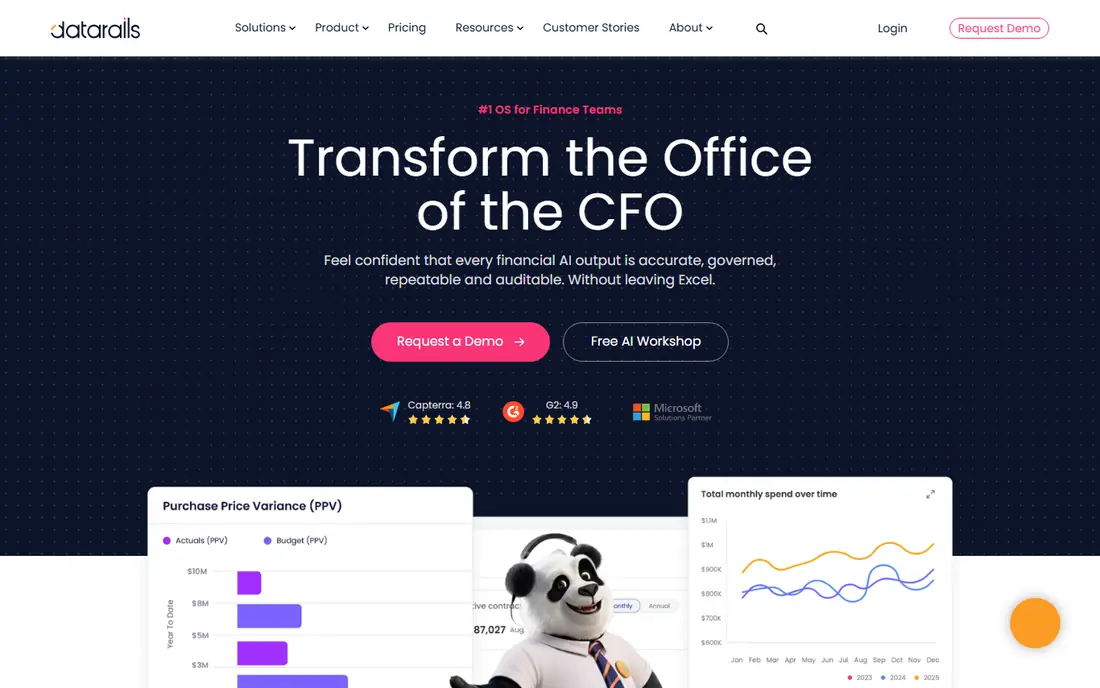
Datarails suits finance teams that live in Excel and want consolidation without rebuilding every model. Datarails is a practical pick for finance teams that need help with a specific job, rather than a general chatbot. It focuses on Excel-native planning, automated consolidation, and AI-assisted analysis, and it fits teams that already work in spreadsheets, ERP systems, or reporting tools. That focus matters, because finance work needs accuracy, audit trails, and consistent data.
In practice, Datarails helps teams cut manual work around data gathering, consolidation, and reporting, while keeping humans in charge of review. Look for how it connects to your general ledger, planning system, or data warehouse, and how it handles permissions and change history. A tool that cannot show its sources or its calculations will slow down review, not speed it up.
- Excel-native planning, automated consolidation, and AI-assisted analysis
- Integrations with common finance tools
- Team controls where offered
- Enterprise pricing is often quoted
- Implementation time varies by system

AlphaSense suits analysts and strategy teams that research companies, markets, and competitors across many documents. AlphaSense is a practical pick for finance teams that need help with a specific job, rather than a general chatbot. It focuses on search across filings, transcripts, and broker research with cited sources, and it fits teams that already work in spreadsheets, ERP systems, or reporting tools. That focus matters, because finance work needs accuracy, audit trails, and consistent data.
In practice, AlphaSense helps teams cut manual work around data gathering, consolidation, and reporting, while keeping humans in charge of review. Look for how it connects to your general ledger, planning system, or data warehouse, and how it handles permissions and change history. A tool that cannot show its sources or its calculations will slow down review, not speed it up.
- Search across filings, transcripts, and broker research with cited sources
- Integrations with common finance tools
- Team controls where offered
- Enterprise pricing is often quoted
- Implementation time varies by system

Cube suits planning teams that want spreadsheet speed with governed data and version control. Cube is a practical pick for finance teams that need help with a specific job, rather than a general chatbot. It focuses on connected planning, forecasting, and reporting from spreadsheet models, and it fits teams that already work in spreadsheets, ERP systems, or reporting tools. That focus matters, because finance work needs accuracy, audit trails, and consistent data.
In practice, Cube helps teams cut manual work around data gathering, consolidation, and reporting, while keeping humans in charge of review. Look for how it connects to your general ledger, planning system, or data warehouse, and how it handles permissions and change history. A tool that cannot show its sources or its calculations will slow down review, not speed it up.
- Connected planning, forecasting, and reporting from spreadsheet models
- Integrations with common finance tools
- Team controls where offered
- Enterprise pricing is often quoted
- Implementation time varies by system
Planful suits mid-size and large finance teams that need structured budgeting, forecasting, and close workflows. Planful is a practical pick for finance teams that need help with a specific job, rather than a general chatbot. It focuses on budgeting, forecasting, close management, and reporting automation, and it fits teams that already work in spreadsheets, ERP systems, or reporting tools. That focus matters, because finance work needs accuracy, audit trails, and consistent data.
In practice, Planful helps teams cut manual work around data gathering, consolidation, and reporting, while keeping humans in charge of review. Look for how it connects to your general ledger, planning system, or data warehouse, and how it handles permissions and change history. A tool that cannot show its sources or its calculations will slow down review, not speed it up.
- Budgeting, forecasting, close management, and reporting automation
- Integrations with common finance tools
- Team controls where offered
- Enterprise pricing is often quoted
- Implementation time varies by system
Anaplan suits large organisations that need connected planning across finance, sales, and operations. Anaplan is a practical pick for finance teams that need help with a specific job, rather than a general chatbot. It focuses on multi-dimensional modelling, scenario planning, and cross-team collaboration, and it fits teams that already work in spreadsheets, ERP systems, or reporting tools. That focus matters, because finance work needs accuracy, audit trails, and consistent data.
In practice, Anaplan helps teams cut manual work around data gathering, consolidation, and reporting, while keeping humans in charge of review. Look for how it connects to your general ledger, planning system, or data warehouse, and how it handles permissions and change history. A tool that cannot show its sources or its calculations will slow down review, not speed it up.
- Multi-dimensional modelling, scenario planning, and cross-team collaboration
- Integrations with common finance tools
- Team controls where offered
- Enterprise pricing is often quoted
- Implementation time varies by system
Workiva suits public companies and regulated teams that need connected reporting for filings and audits. Workiva is a practical pick for finance teams that need help with a specific job, rather than a general chatbot. It focuses on connected reporting, audit trails, and collaboration for regulatory filings, and it fits teams that already work in spreadsheets, ERP systems, or reporting tools. That focus matters, because finance work needs accuracy, audit trails, and consistent data.
In practice, Workiva helps teams cut manual work around data gathering, consolidation, and reporting, while keeping humans in charge of review. Look for how it connects to your general ledger, planning system, or data warehouse, and how it handles permissions and change history. A tool that cannot show its sources or its calculations will slow down review, not speed it up.
- Connected reporting, audit trails, and collaboration for regulatory filings
- Integrations with common finance tools
- Team controls where offered
- Enterprise pricing is often quoted
- Implementation time varies by system
MindBridge suits controllers and auditors who need to scan large transaction sets for unusual patterns. MindBridge is a practical pick for finance teams that need help with a specific job, rather than a general chatbot. It focuses on AI risk scoring across general ledger transactions and audit workflows, and it fits teams that already work in spreadsheets, ERP systems, or reporting tools. That focus matters, because finance work needs accuracy, audit trails, and consistent data.
In practice, MindBridge helps teams cut manual work around data gathering, consolidation, and reporting, while keeping humans in charge of review. Look for how it connects to your general ledger, planning system, or data warehouse, and how it handles permissions and change history. A tool that cannot show its sources or its calculations will slow down review, not speed it up.
- AI risk scoring across general ledger transactions and audit workflows
- Integrations with common finance tools
- Team controls where offered
- Enterprise pricing is often quoted
- Implementation time varies by system
Vic.ai suits finance teams that process many invoices and want faster coding and approval routing. Vic.ai is a practical pick for finance teams that need help with a specific job, rather than a general chatbot. It focuses on invoice processing, expense classification, and approval automation, and it fits teams that already work in spreadsheets, ERP systems, or reporting tools. That focus matters, because finance work needs accuracy, audit trails, and consistent data.
In practice, Vic.ai helps teams cut manual work around data gathering, consolidation, and reporting, while keeping humans in charge of review. Look for how it connects to your general ledger, planning system, or data warehouse, and how it handles permissions and change history. A tool that cannot show its sources or its calculations will slow down review, not speed it up.
- Invoice processing, expense classification, and approval automation
- Integrations with common finance tools
- Team controls where offered
- Enterprise pricing is often quoted
- Implementation time varies by system
Julius AI suits analysts who want to ask questions of spreadsheets and financial data in plain language. Julius AI is a practical pick for finance teams that need help with a specific job, rather than a general chatbot. It focuses on natural language queries, charts, and scheduled reports from data files, and it fits teams that already work in spreadsheets, ERP systems, or reporting tools. That focus matters, because finance work needs accuracy, audit trails, and consistent data.
In practice, Julius AI helps teams cut manual work around data gathering, consolidation, and reporting, while keeping humans in charge of review. Look for how it connects to your general ledger, planning system, or data warehouse, and how it handles permissions and change history. A tool that cannot show its sources or its calculations will slow down review, not speed it up.
- Natural language queries, charts, and scheduled reports from data files
- Integrations with common finance tools
- Team controls where offered
- Enterprise pricing is often quoted
- Implementation time varies by system
How we picked these
We compared official feature pages, pricing pages, app store listings, privacy policies, and public reviews for each product on this list. We kept only products that are live in October 2026 and that fit the topic directly, and we left out products whose pricing or core features we could not verify. Where a vendor does not publish a clear starting price, we say See website rather than guess. We did not claim hands-on testing that we did not do, and we weighed the fit for different users more heavily than brand size alone.
How to choose AI financial software
Start with the job, not the AI label. Planning, reporting, audit, research, and payables are different jobs, and a tool that excels at one may be weak at another. Write down the workflow you want to improve, the systems it touches, and the review steps that must stay human. That short brief makes vendor demos far more useful.
Next, check data controls. Ask where data is stored, who can access it, how long it is kept, and whether outputs can be traced back to sources. Finance teams should also check permissions, change history, and export options, since audit and compliance work depends on those controls. A pilot with real, non-sensitive data often reveals gaps faster than a sales demo.
Finally, measure the pilot honestly. Track time saved, error rates, and review time, not just output speed. If a tool saves drafting time but adds review time, the net gain may be small. Confirm total cost, including implementation and training, and keep a human review step for any output that affects money, filings, or investment choices.