ADP Alternatives in 2026: 9 Tools Compared
By ToolNimba Editorial Team November 12, 2026 10 min read

- Top pick
 Gusto
Small US teams
Starting price$49 per monthCheck out GustoRead our review - Runner-up
 Rippling
HR, payroll, and IT in one place
Starting priceSee websiteCheck out RipplingRead our review - Also great
 Paychex Flex
Mid-market scale and benefits
Starting priceSee websiteCheck out Paychex FlexRead our review
How we researched this
We compared official pricing and feature pages, app store listings, privacy policies and public user reviews. Prices change, so check the provider's site before you pay.
Key takeaways
- Gusto is our pick for small US teams that want clear payroll pricing and a simple setup.
- Rippling suits teams that want HR, payroll, and IT provisioning in one system, but pricing needs a quote.
- Paychex Flex and Paylocity suit mid-market teams that need scale, compliance depth, and benefits administration.
- BambooHR is HR-first, so check its payroll add-on and pricing before assuming it replaces a payroll provider.
- Total the base fee plus the per-person fee for your headcount, since headline prices hide the real monthly cost.
Quick comparison
| Name | Best for | Starting price | Free plan | |
|---|---|---|---|---|
| Gusto | Small US teams | $49 per month | No | Visit |
| Rippling | HR, payroll, and IT in one place | See website | No | Visit |
| Paychex Flex | Mid-market scale and benefits | See website | No | Visit |
 BambooHR | HR-first small to mid teams | See website | Free trial | Visit |
 Paylocity | Mid-market employee experience | See website | No | Visit |
 Justworks | PEO benefits for startups | $50 per month | No | Visit |
 Deel | Global hiring and payroll | See website | No | Visit |
 Workday | Large enterprise HCM | See website | No | Visit |
 OnPay | Simple single-plan payroll | See website | Free trial | Visit |
The best adp alternatives
ADP is a large, established payroll and HR provider, and teams usually leave it for clearer pricing, a simpler interface, or faster support. The alternatives below cover different sizes: small teams, mid-market companies, global teams, and large enterprises. None of them is ADP itself. Prices are shown where a vendor publishes them, and marked "See website" where pricing requires a quote, which is common in this market.
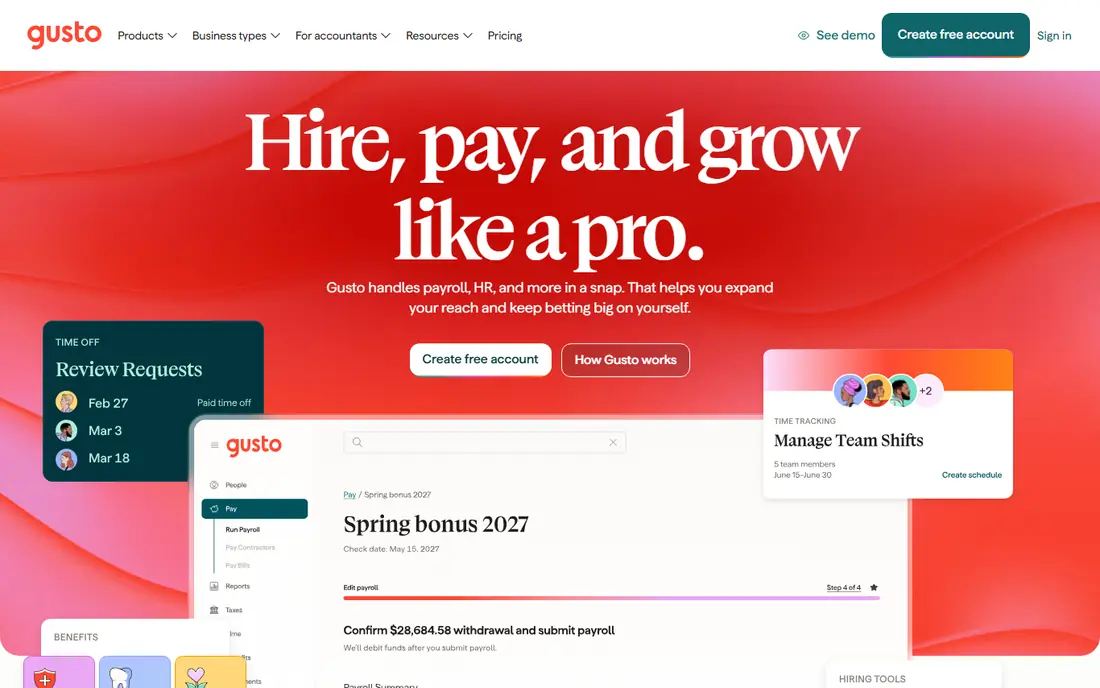
Gusto is the easiest ADP alternative to explain. Its entry plan is published at $49 per month plus $6 per person, payroll runs in a few steps, and contractor payments, benefits, and time tracking sit in the same system. For a founder or a small operations lead who runs payroll themselves, that simplicity is the main selling point, and support is geared to small teams.
The limits appear as you grow. Multi-state payroll sits on higher tiers, and complex HR workflows, advanced reporting, and global payroll need other tools. If you are a US team under about 100 people and payroll is the main job, Gusto is a strong, low-friction pick. If you need enterprise HCM depth, look at Paylocity or Workday.
- Clear published pricing
- Simple payroll setup
- Contractor payments and benefits in one place
- US focused
- Advanced HR workflows are thinner than enterprise HCM tools
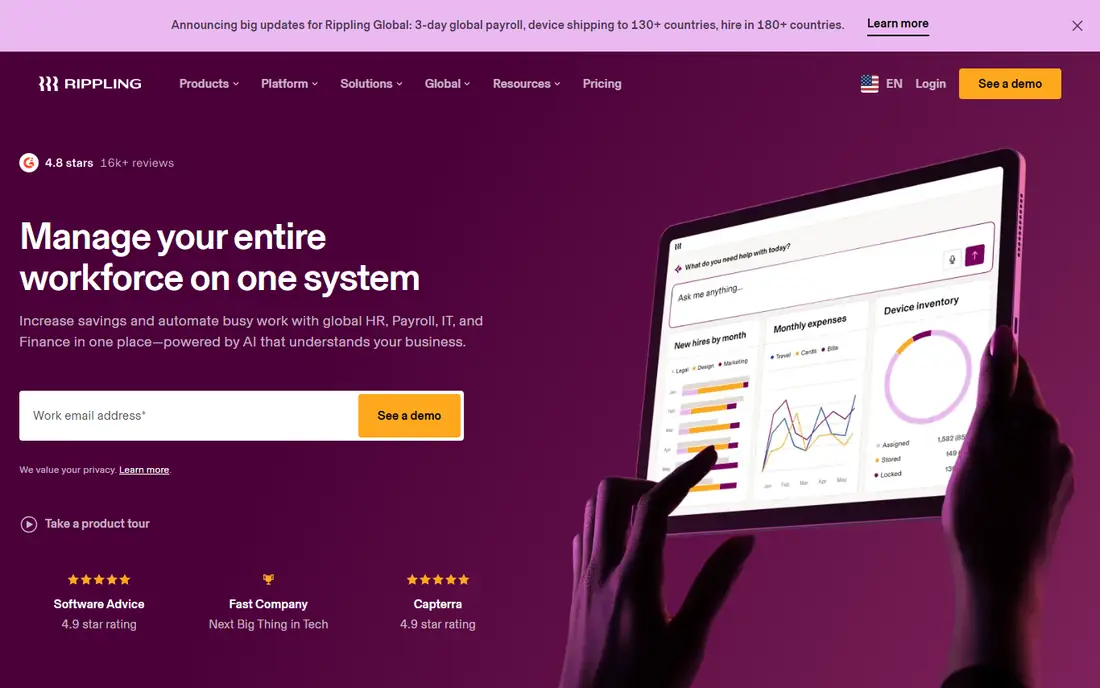
Rippling appeals to teams that want one system for people and devices. When a new hire joins, Rippling can handle payroll, benefits, accounts, and laptop provisioning from the same workflow, which saves the back-and-forth between HR and IT. Automation rules reduce manual onboarding work, and global payroll options help distributed teams.
The catch is price transparency. Entry pricing is often quoted around $8 per employee per month plus a base fee, but the final total depends on modules, so you need a quote for your exact stack. Small teams that only need payroll may find Gusto cheaper and simpler. Teams that value unified HR and IT will find Rippling worth the quote process.
- Unifies HR, payroll, benefits, and IT provisioning
- Strong automation for onboarding
- Global payroll options
- Pricing requires a quote and rises with modules
- Implementation can be heavier than Gusto
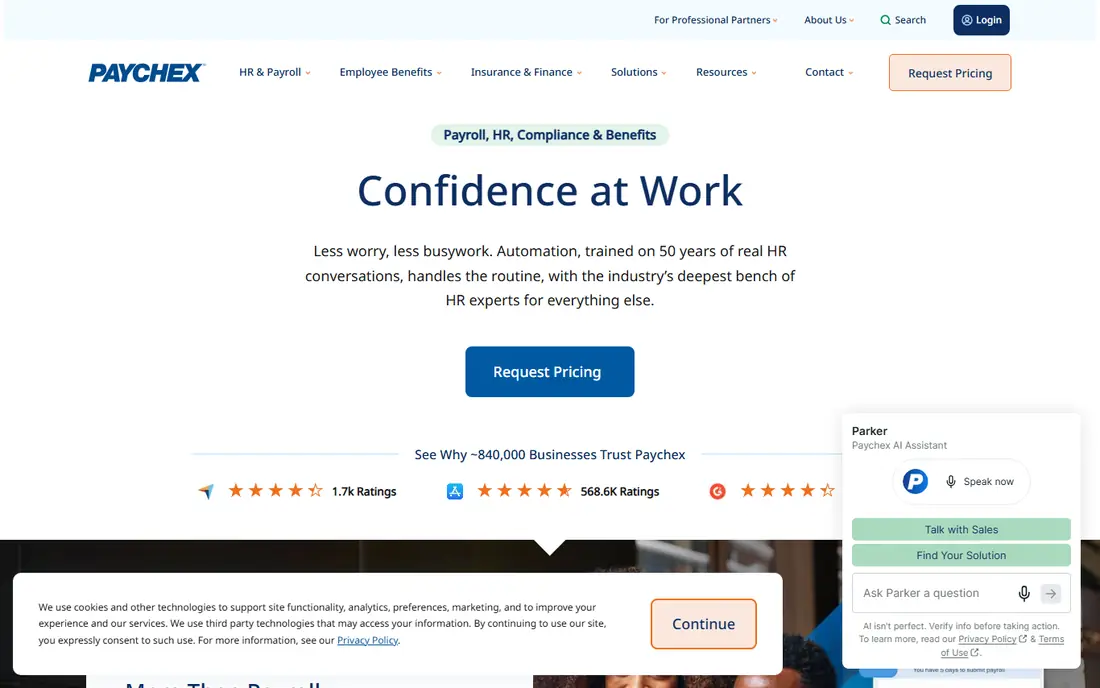
Paychex Flex is a long-established rival that scales without forcing a platform migration as you grow. Payroll, HR, benefits, and retirement administration live together, and its 401(k) administration is a genuine strength for companies that offer retirement plans. A PEO option is available for teams that want co-employment and group benefits.
The buying experience is traditional: pricing generally requires a quote, and the interface is less modern than newer rivals. That matters less for a mid-market HR team that values a dedicated specialist and proven compliance handling. If you want self-serve transparent pricing, Gusto or OnPay will feel easier. If you want scale and benefits depth, Paychex Flex is a serious contender.
- Scales from small to large teams
- Strong 401(k) administration
- PEO option available
- Pricing requires a sales conversation
- Interface feels more traditional than Gusto or Rippling
BambooHR is HR-first, and it shows in the experience. Employee records, onboarding, time off, and performance data are clean and easy to use, which is why many small to mid teams pick it as their system of record for people. Reporting on headcount, turnover, and time off is straightforward, and the interface is friendlier than most enterprise HCM tools.
Payroll is the caveat. It is available as an add-on, quoted separately, and US focused, so a team that needs payroll as the core job should compare the total, not just the HR price. If HR records and onboarding matter most and payroll is secondary, BambooHR is excellent. If payroll is the main job, start with Gusto, Rippling, or Paychex.
- Clean HR records, onboarding, and time off
- Friendly interface
- Good reporting for people data
- Payroll is a separate add-on with its own quote
- Less payroll depth than a payroll-first rival
Paylocity targets mid-market companies that want a modern employee experience without enterprise complexity. Payroll, HR, recruiting, and learning tools sit together, and the employee app and community features aim to keep staff engaged, not just paid. Reporting is strong for a mid-market tool, which helps HR leaders answer finance questions without exporting everything.
Pricing is quote-based, and implementation is heavier than Gusto, so very small teams may find it more than they need. For companies in the 50 to 1,000 range that outgrew a small payroll tool, Paylocity is a natural next step, and it competes directly with ADP Workforce Now on that ground.
- Modern employee experience
- Payroll, HR, and talent tools in one platform
- Strong reporting
- Pricing requires a quote
- Implementation can feel heavy for a very small team
Justworks offers two paths: plain payroll from $50 per month plus $8 per employee, and a PEO option that adds group benefits and shared compliance work. For a startup that cannot negotiate benefits alone, the PEO model is the attraction, since it pools employees for health and other benefits. Payroll itself stays simple, which suits founders who do not want a full HR department yet.
Co-employment is a real commitment, and PEO pricing per person is higher than plain payroll, so the math only works if the benefits value outweighs the fee. If you only need payroll, the plain plan is competitive. If benefits access is the bottleneck, Justworks is one of the clearest PEO options for startups.
- PEO model gives access to group benefits
- Simple payroll pricing published
- Good for remote-first startups
- PEO means co-employment, which some companies avoid
- Per-person PEO pricing is higher than plain payroll
Deel is the pick when your team is not in one country. Its employer of record service lets you hire employees abroad without setting up a local entity, and contractor payments cover many countries from one dashboard. Compliance, contracts, and local payroll rules are handled by Deel's local partners, which removes a large burden for distributed teams.
US-only teams will find Gusto or Rippling simpler and cheaper, since Deel's pricing reflects global complexity. Contractor plans are published at a lower entry point, while employer of record pricing is per employee and higher. If global hiring is your problem, Deel solves it directly. If it is not, you are paying for scope you do not need.
- Hire and pay contractors and employees in many countries
- Employer of record service
- Strong compliance handling
- Pricing varies widely by service
- US-only payroll is not its main strength
Workday is the enterprise end of this list. Human capital management, finance, and planning live in one system, with analytics that suit a large organization with many entities, countries, and reporting needs. Companies that already run Workday for finance often add HCM for consistency, and the platform is proven at a scale smaller tools cannot match.
The cost is implementation time and price, both of which are enterprise-level. A six-month-plus rollout is normal, and small teams will find it disproportionate. If you are a large company replacing ADP at scale, Workday belongs on the shortlist. If you are under a few hundred people, it will slow you down more than it helps.
- Deep enterprise HCM, finance, and planning
- Strong analytics
- Proven at very large scale
- Enterprise pricing and long implementation
- Overkill for teams under about 1,000 people
OnPay keeps payroll simple with one plan that covers payroll, basic HR, and benefits administration, rather than a maze of tiers. That clarity appeals to small businesses that want to know the price without a sales call, and the free trial lets you run payroll before committing. Multi-state payroll and tax filings are included in the core offer for many users.
The trade-off is depth. Advanced talent, learning, and global features are thinner than on larger platforms, and larger companies will outgrow it. For a US small business that wants payroll done correctly without tier confusion, OnPay is a strong, low-drama alternative to ADP.
- Single plan with payroll, HR, and benefits basics
- Clear, simple pricing model
- Free trial available
- Fewer advanced HCM features than Paylocity or Workday
- Less global scope than Deel or Rippling
How we picked these
We compared official feature pages and pricing pages for payroll and HR platforms that serve US teams and, where relevant, global teams, and we favored vendors with a live product, clear payroll coverage, and current pricing or quote process. We did not claim hands-on testing, and we excluded ADP itself, since this is an alternatives list. Where pricing requires a quote, we say so rather than repeating an unverified estimate.
How to choose an ADP alternative
Start with headcount, location, and the real job. A US team under 100 people that mainly needs payroll should shortlist Gusto, OnPay, and Justworks. A mid-market team that needs HR depth should shortlist Paychex Flex, Paylocity, and BambooHR. A global team should shortlist Deel and Rippling. A large enterprise should shortlist Workday.
Next, total the cost for your headcount, including base fee, per-person fee, benefits administration, and any payroll add-on. Ask about implementation time, support hours, tax filing coverage, and how the vendor handles multi-state compliance. Run a parallel payroll for one cycle if you can, and check that reports match your finance team's needs before you switch fully.
Switching without payroll disruption
Do not switch mid-quarter if you can avoid it, and keep the old provider's records and tax filings accessible. Confirm year-to-date totals transfer correctly, test a small payroll run first, and tell employees when pay stubs and benefits access will move. A clean switch is worth more than a small monthly saving.
Sources
Frequently asked questions
What is the best alternative to ADP for small businesses?
Gusto is the most common pick for small US teams, thanks to published pricing and simple payroll. OnPay is a close second for teams that want a single plan without tier confusion.
Is Rippling better than ADP?
Rippling suits teams that want HR, payroll, and IT in one modern system, while ADP suits larger teams that value scale and a long track record. The right choice depends on size, IT needs, and whether you prefer a quote-based or published price.
Does BambooHR replace ADP payroll?
BambooHR is HR-first, with payroll as a separate add-on. It can replace ADP for HR records and onboarding, but you should confirm the payroll add-on price and coverage before treating it as a full payroll replacement.
Which ADP alternative is best for global teams?
Deel is built for global hiring, with employer of record and contractor payments in many countries. Rippling also offers global payroll, and the choice depends on how many countries you hire in.
How much do ADP alternatives cost?
Small-team payroll often starts around $49 to $50 per month plus a per-person fee, while mid-market and enterprise tools use quote-based pricing. Always total base fee plus per-person fee for your headcount.
Can I switch from ADP mid-year?
Yes, but it needs care with year-to-date totals and tax filings. Many teams switch at a quarter or year boundary, run a parallel payroll first, and keep old records accessible for tax season.