Alternatives to Next.js in 2026: 9 Frameworks Compared
By ToolNimba Editorial Team November 9, 2026 10 min read

- Top pick
 React Router
React teams leaving Next.js
Starting priceFreeCheck out React RouterRead our review - Runner-up
 Nuxt
Vue full-stack apps
Starting priceFreeCheck out NuxtRead our review - Also great
 Astro
Content and marketing sites
Starting priceFreeCheck out AstroRead our review
How we researched this
We compared official pricing and feature pages, app store listings, privacy policies and public user reviews. Prices change, so check the provider's site before you pay.
Key takeaways
- Every framework on this list is free and open source, so your main cost is hosting and developer time, not a license fee.
- Astro is our pick for content-heavy sites, because it ships very little JavaScript by default and keeps pages fast.
- React Router is the closest path for React teams that want Next.js style routing without the full Next.js platform.
- Nuxt and SvelteKit are the strongest choices if you prefer Vue or Svelte over React.
- Gatsby and Angular suit different ends of the spectrum, from static marketing sites to large, structured enterprise apps.
Quick comparison
| Name | Best for | Starting price | Free plan | |
|---|---|---|---|---|
| React Router | React teams leaving Next.js | Free | Yes | Visit |
| Nuxt | Vue full-stack apps | Free | Yes | Visit |
| Astro | Content and marketing sites | Free | Yes | Visit |
 SvelteKit | Fast Svelte apps | Free | Yes | Visit |
 Gatsby | Static React sites | Free | Yes | Visit |
 Angular | Large structured apps | Free | Yes | Visit |
 SolidStart | Small, fast Solid apps | Free | Yes | Visit |
 Qwik | Instant-loading pages | Free | Yes | Visit |
 TanStack Start | Type-safe React apps | Free | Yes | Visit |
The best alternatives to Next.js
Next.js is a strong default, but it is not the only way to build a modern web app. The nine frameworks below cover React, Vue, Svelte and Solid, plus a content-first option that can change how much code your visitors download.
React Router grew out of Remix, and it keeps the loader and action model that many React developers liked about Remix. Pages load data on the server, forms submit without a pile of client code, and the framework stays close to web standards. That closeness is a real benefit when you want to host anywhere, including edge platforms and your own servers.
The trade-off is that you give up some of what Next.js bundles for you. Image handling, caching and deployment defaults are less opinionated here, so your team makes more choices early on. For a small team that already knows React, that freedom is welcome. For a team that wants every decision made for them, it can feel like extra work.
- Familiar React routing and data loading
- Flexible hosting
- Strong documentation
- Fewer built-in features than Next.js
- More setup decisions fall on your team
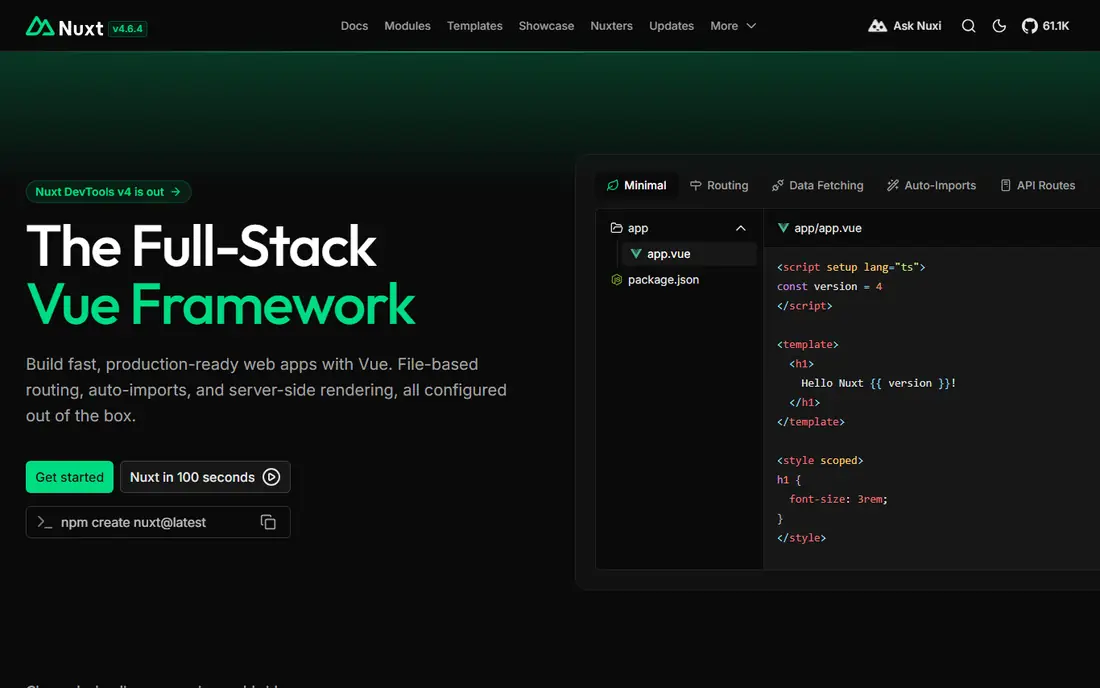
Nuxt is the Vue answer to Next.js, and it covers the same ground: file-based routing, server-side rendering, static generation, API routes and data fetching. Its module system adds common pieces such as content, images, authentication helpers and SEO tools without forcing you to wire each one by hand. Vue developers tend to find the conventions easy to follow, which shortens the first weeks of a project.
The main limit is ecosystem fit. If your team, hiring pool or existing code is React based, Nuxt asks for a switch in language style as well as framework. Within Vue, though, Nuxt is the obvious default, and its documentation and community make it a safe long-term choice for marketing sites, dashboards and full-stack apps alike.
- Full Vue framework with routing and server rendering
- Large module ecosystem
- Clear file-based structure
- Vue only, so React teams must relearn
- Module quality varies
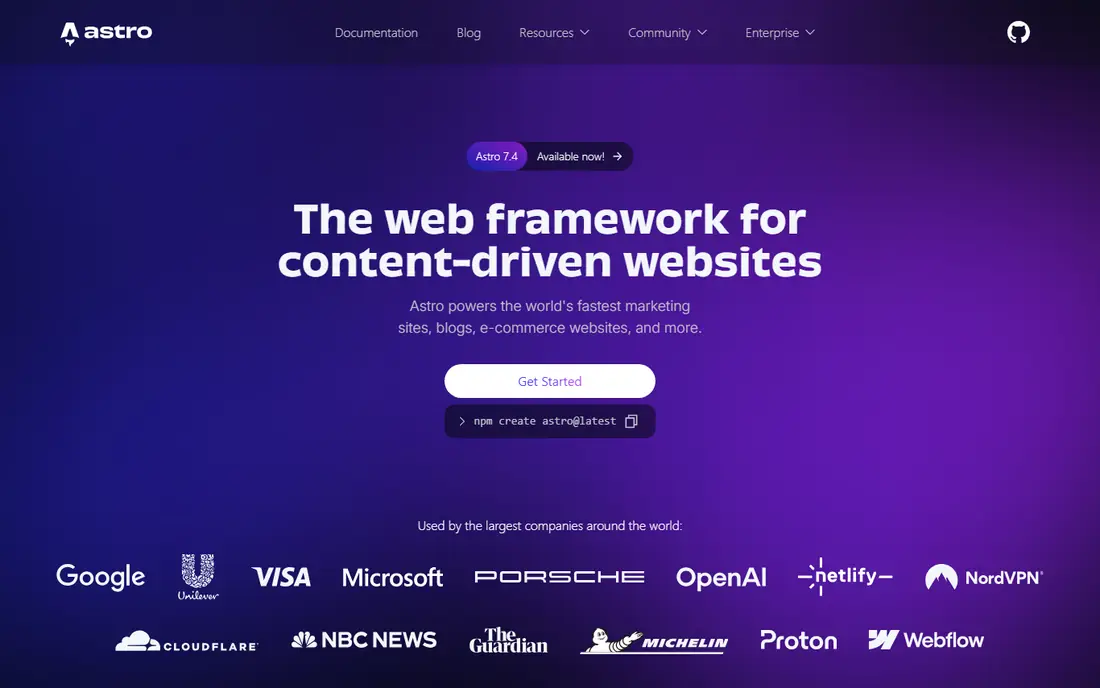
Astro takes a different starting point from Next.js. Instead of sending a JavaScript bundle for every page, it renders pages to HTML and only adds JavaScript where you ask for an interactive island. The result is a site that loads quickly on slow connections and scores well on performance checks, which matters for blogs, docs, portfolios and marketing pages.
You can still use React, Vue, Svelte or other components inside Astro, so you do not have to abandon your preferred UI library. The catch is that a heavily interactive dashboard will need more planning than in a framework built around client-side state from the start. If most of your pages are content with a few interactive parts, Astro is hard to beat on speed per unit of effort.
- Very little JavaScript shipped by default
- Works with React, Vue and Svelte components
- Fast static output
- Less suited to highly interactive apps
- Dynamic features need extra setup
SvelteKit pairs the Svelte compiler with routing, server-side rendering, form actions and adapters for hosts such as Netlify, Cloudflare and Node servers. Because Svelte compiles components away, the code shipped to the browser is often smaller than an equivalent React app, and the component syntax itself is notably short. Developers who try Svelte often praise how little boilerplate a feature needs.
The honest catch is scale of ecosystem. React has a library for almost everything, and Svelte sometimes lags behind or relies on community wrappers. Hiring is also harder in some markets. If your team already likes Svelte, or you are building a product where bundle size and speed matter more than library choice, SvelteKit is a strong Next.js alternative.
- Small bundles and a concise component style
- Server rendering and adapters for many hosts
- Fast development server
- Smaller hiring pool than React or Vue
- Some libraries are React-first
Gatsby builds React sites from data sources such as a headless CMS, Markdown files or APIs, and it has a long history in marketing and documentation sites. Its plugin system handles images, feeds, sitemaps and source data with relatively little custom code, which helps small teams ship polished sites quickly. If your content changes on a publishing schedule rather than in real time, Gatsby fits well.
Where Gatsby shows its age is in dynamic, server-heavy work. It can handle client-side data and server functions, but it was not designed as a full-stack app framework in the way Next.js or Nuxt now are. Very large sites can also see slower builds, so teams with thousands of pages should test build time before committing.
- Strong React static-site tooling
- Large plugin ecosystem
- Good for sites built from a CMS
- Build times can grow on very large sites
- Less focus on dynamic server features
Angular is a full platform rather than a thin framework, and it comes with routing, forms, HTTP, dependency injection and testing tools in the box. Large teams value that consistency, because new developers join a codebase with familiar patterns instead of a custom stack assembled from many libraries. TypeScript is central to Angular, which helps catch errors early in big codebases.
That completeness has a cost. Angular asks you to learn its concepts and structure before you move fast, and a simple landing page will carry more setup than the same page in Astro or SvelteKit. Server-side rendering is available through Angular SSR, but it is an add-on rather than the default path. Choose Angular when structure and scale matter more than speed of first setup.
- Complete, opinionated framework with routing, forms and testing tools
- Strong TypeScript support
- Long-term support
- Steeper learning curve
- More ceremony for small sites
SolidStart is the meta-framework for Solid, and it brings file-based routing, server rendering and server functions to a library known for speed. Solid updates only the exact parts of the page that change, without a virtual DOM, which keeps runtime work low. For performance-minded teams, that model is appealing, and the code often looks close to plain React in structure.
The risk is maturity and ecosystem depth. SolidStart has fewer tutorials, templates and third-party integrations than Next.js, Nuxt or SvelteKit, so your team may solve more problems from first principles. It is a good fit for a team that already uses Solid or wants a lean, fast app and accepts a smaller support network in return.
- Very fast fine-grained reactivity
- Small runtime
- Familiar file-based routing
- Smaller community and library ecosystem
- Fewer production examples than larger frameworks
Qwik is built around resumability, which means the server sends HTML plus small pieces of code that wake up only when a visitor interacts. In practice, pages can feel instant on first load, because the browser does not have to download and run a large bundle before the page works. That is a clear win for storefronts, marketing pages and any site where first-load speed affects conversions.
The model takes some learning. Developers used to hydration in React or Vue need to adjust how they think about state and event handling, and the ecosystem of ready-made components is smaller. Qwik City adds routing and layouts, but you should still expect to check library support early in a project. If load time is your top metric, Qwik deserves a serious trial.
- Resumable pages that load with minimal JavaScript
- Good for e-commerce and content
- Built-in optimization
- Newer mental model to learn
- Ecosystem is still growing
TanStack Start builds on TanStack Router, a type-safe router for React, and pairs it with server functions and the wider TanStack tooling many React teams already use. Routes, search parameters and data loading can be typed end to end, which catches a class of bugs before runtime. It also avoids locking you to one host, which appeals to teams that deploy on their own infrastructure.
Because it is newer than Next.js, its docs and examples are thinner in places, and breaking changes are more likely than in a mature framework. Teams that already use TanStack Query and Router will feel at home quickly. Teams looking for a fully guided, batteries-included experience may prefer React Router or Nuxt until TanStack Start settles further.
- Strong TypeScript and type-safe routing
- Built on TanStack Router and Query
- Flexible deployment
- Newer framework with a changing API
- Less hand-holding than Next.js
How we picked these
We compared official feature pages, documentation, pricing pages and public reviews for frameworks that truly replace Next.js for web apps and sites. We kept only frameworks that are actively maintained and that cover routing plus server rendering or static generation, rather than UI libraries on their own. Prices were checked on vendor sites, and all nine frameworks here are free open source projects, so hosting and developer time are the real costs to compare.
What to decide before you switch
Start with your team, not the feature list. A framework your developers already know will ship faster than a technically better one they must learn under deadline pressure. Next, look at how much of your site is content versus interactive app. Content sites reward Astro, Gatsby or Qwik, while dashboards and full-stack apps reward Nuxt, SvelteKit, React Router or TanStack Start.
Hosting and deployment
Check where you plan to host before you choose. Most of these frameworks offer adapters for common hosts, but the smoothest path varies. Static output works almost anywhere, while server features such as server functions and streaming need a host that supports them. Test a small deployment early, with your real data source, rather than trusting a demo.
Migration cost
Moving a large Next.js app is rarely a weekend job. Routing, data fetching, middleware and image handling all have equivalents, but the details differ. If you have a large codebase, consider migrating one section at a time, or keeping Next.js for the app and using Astro for marketing pages. A mixed setup is often more practical than a full rewrite.
Sources
Frequently asked questions
What is the best alternative to Next.js for React developers?
React Router is the closest fit for most React teams, because it keeps a familiar component model and adds server data loading without a platform lock-in. TanStack Start is a good second choice if type-safe routing matters more to you than a guided setup.
Is Nuxt better than Next.js for Vue developers?
Yes, in practice. Nuxt is built for Vue in the same way Next.js is built for React, with file-based routing, server rendering and a module ecosystem. If your team works in Vue, Nuxt is the natural default and avoids forcing a React switch.
Which Next.js alternative is fastest for a blog or marketing site?
Astro is usually fastest for content sites, because it ships almost no JavaScript unless a component needs it. Qwik is also strong here, especially when pages need interactivity without a large initial bundle.
Are these alternatives really free?
Yes, all nine frameworks are free and open source. You still pay for hosting, domains, databases and developer time, and some hosts charge as traffic grows, so budget for deployment rather than a license fee.
Can I use these frameworks without Vercel?
Yes. All of them support deployment to other hosts, including Netlify, Cloudflare, Fly.io, your own Node server or a static host for static output. Check the adapter for your chosen host before you commit, since server features vary by host.