Best AI Critical Event Management Platforms for 2026
By ToolNimba Editorial Team November 19, 2026 7 min read
We did not test these tools hands-on. Picks are based on vendor documentation and public information. Read our editorial policy and disclosure.

- Top pick
 Everbridge Critical Event Management
Enterprise-wide critical event response
Starting priceSee websiteCheck out Everbridge Critical Event ManagementRead our review - Runner-up
 Dataminr
Real-time threat and risk detection
Starting priceSee websiteCheck out DataminrRead our review - Also great
 AlertMedia
Unified risk intelligence and response
Starting priceSee websiteCheck out AlertMediaRead our review
How we researched this
We compared official pricing and feature pages, app store listings, privacy policies and public user reviews. Prices change, so check the provider's site before you pay.
Direct answer
Everbridge Critical Event Management is the first pick for broad, AI-assisted critical event response across an organization. Dataminr suits teams that need early real-time threat detection, while PagerDuty fits operations and incident workflows. Seven platforms are compared here.
Key takeaways
- Everbridge pairs critical event management with AI to protect people and reduce disruption.
- Dataminr focuses on real-time event, threat and risk intelligence signals.
- AlertMedia centers on unified risk intelligence and faster response and recovery.
- PagerDuty applies an AI-first operations approach to detect, resolve and prevent incidents.
Quick comparison
| Name | Best for | Starting price | Free plan | |
|---|---|---|---|---|
| Everbridge Critical Event Management | Enterprise-wide critical event response | See website | See website | Visit |
| Dataminr | Real-time threat and risk detection | See website | See website | Visit |
| AlertMedia | Unified risk intelligence and response | See website | See website | Visit |
 xMatters | Automated incident and on-call workflows | $15 per user per month | Yes | Visit |
 PagerDuty | AI-first incident operations | $21 per user per month | Yes | Visit |
 Resilience | Biologics and sterile drug manufacturing | See website | See website | Visit |
 LogicManager | Enterprise risk management visibility | See website | See website | Visit |
AI critical event management platforms, one by one
Critical event management platforms use AI to detect threats, coordinate response and keep people safe. ToolNimba compared documented features and vendor pages across seven options to help you shortlist the right fit.
Everbridge Critical Event Management
Best for: Enterprise-wide critical event response
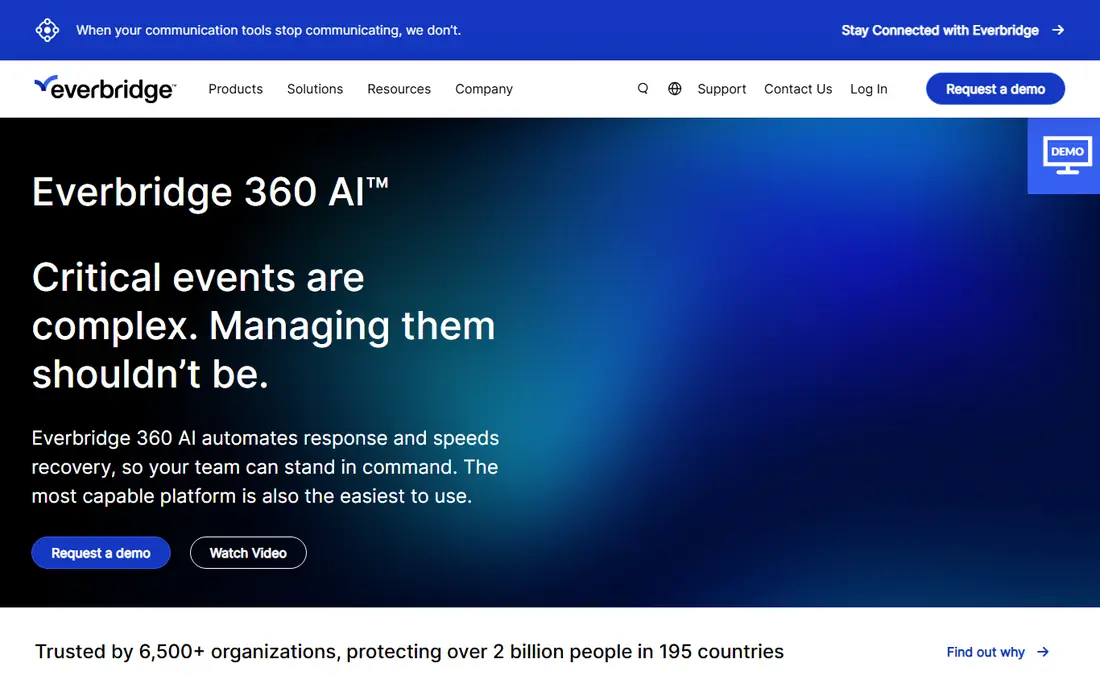
Everbridge presents its 360 AI platform as a critical event management system aimed at protecting people, reducing disruption and speeding response. It is designed for larger organizations that need a coordinated view of risk across locations and functions. Teams seeking one platform to manage alerts, response and recovery across an enterprise should place it high on a shortlist.
Because the platform targets enterprise-scale event management, smaller teams may find the scope broader than they need. Organizations that mainly want automated on-call and incident workflows may prefer a dedicated operations tool. Confirm the modules and integrations that match your response model on the vendor site.
- AI-assisted risk and response tools
- Built to protect people and reduce disruption
- Broad critical event management scope
- Enterprise focus may be heavy for small teams
- Full scope can require configuration effort
Dataminr describes itself as an AI platform for real-time event, threat and risk intelligence. It is built to surface emerging signals quickly so teams can act with clarity. Security, risk and public-sector groups that need early awareness of developing events are the natural audience for this kind of intelligence layer.
Dataminr leans toward detection and intelligence rather than end-to-end response coordination. Teams that want alerting, incident workflows and recovery in one system may pair it with a broader platform. Check how its intelligence output would connect to your existing response processes.
- Real-time event and threat intelligence
- AI-driven signal detection
- Aimed at fast, informed decisions
- Detection focus rather than full response suite
- Intelligence feeds may need workflow integration
AlertMedia positions its platform as unified risk intelligence and response, built to help organizations navigate critical events and recover faster. It suits teams that want risk awareness and response coordination in one place. Organizations focused on keeping control during disruptions should consider it alongside larger event management suites.
The unified approach may duplicate capabilities if you already run a full critical event management platform. Teams with narrow needs, such as purely technical incident response, may find other tools more direct. Review the vendor's feature set to confirm coverage of your specific event types.
- Unified platform for risk and response
- Built for navigating critical events
- Emphasis on maintaining control and recovery
- Scope may overlap with broader suites
- Fit depends on your communication needs
xMatters offers an automated incident management platform for DevOps, SRE and Ops teams. It is built to automate workflows, keep infrastructure available and help teams deliver products at scale. Engineering organizations that need reliable on-call and escalation automation are the clearest fit for this tool.
xMatters is centered on technical operations rather than physical safety or business-wide crisis coordination. Teams managing people-focused critical events may need a broader platform. If your priority is automated engineering workflows, it remains a relevant option to evaluate.
- Automates operational workflows
- Aimed at DevOps, SRE and Ops teams
- Focus on infrastructure availability
- Technical operations focus
- Less oriented to physical safety events
PagerDuty describes an AI-first operations platform that helps teams automate, resolve and prevent critical issues from detection to resolution. It fits engineering and operations teams that want to turn incidents into intelligence. Organizations prioritizing digital service reliability should include it in a shortlist of incident-focused tools.
PagerDuty addresses operational incidents more than physical or enterprise-wide crisis events. Teams that need mass notification and safety coordination may combine it with a critical event management suite. Confirm that its workflow coverage aligns with how your teams handle incidents today.
- AI-first operations platform
- Covers detection to resolution
- Aimed at resolving and preventing issues
- Operations focus rather than safety events
- May need pairing for crisis communications
Resilience is a biologics and sterile drug product CDMO, helping accelerate drug pipelines from first clinical batch to commercial supply. Its relevance here is limited to life-sciences organizations that need manufacturing partners rather than general event management software. Buyers outside that space should look to the other platforms in this comparison.
This is not a critical event management or AI response platform, so it does not fit the core software need. It appears in this list because the name can be confused with resilience software. Most organizations evaluating event management tools should set it aside and focus on the dedicated platforms.
- CDMO for biologics and sterile products
- Supports clinical to commercial supply
- Specialized manufacturing focus
- Not a general critical event platform
- Narrow life-sciences relevance
LogicManager offers enterprise risk management software that connects risks, controls, ownership and action in one platform. It is designed to give leadership a clearer view of exposure and next steps. Risk and compliance teams that want structured oversight of enterprise risk should consider it as a complement to event response tools.
LogicManager centers on risk governance rather than real-time detection and incident response. Teams needing immediate alerting during a crisis may pair it with a dedicated event management platform. Confirm that its risk workflows map to how your organization documents and tracks exposure.
- Connects risks, controls and ownership
- Gives leadership a view of exposure
- Enterprise risk management focus
- Risk management rather than live event response
- May need pairing for alerting workflows
How the list was put together
ToolNimba compared documented features, vendor homepage descriptions and stated limits across the seven platforms listed. We grouped tools by their primary use, such as critical event response, threat intelligence, incident operations and risk management, and noted where scope is narrower. Details can change, so confirm current capabilities on each vendor site. The ordering reflects editorial judgment, not hands-on testing.
What to confirm before you sign up
- Which event types the platform covers, from physical safety to digital incidents
- How AI detection and alerting feed into your existing response workflows
- Integration options with communication, security and operations tools
- The level of configuration and support your team can realistically manage
- How risk reporting and post-event review are handled in the platform
Sources
Official websites of the products reviewed above. Features and prices were checked against these sites when the guide was written, and they can change, so confirm on the vendor site before you buy.
Frequently asked questions
What does an AI critical event management platform do?
It uses AI to detect, assess and coordinate responses to disruptive events, from severe weather to security threats. These platforms help organizations alert people, manage response steps and recover faster. Some focus on enterprise-wide events, while others specialize in threat intelligence or technical incidents.
How is critical event management different from incident management?
Critical event management typically covers broader, organization-wide disruptions that may affect people and locations. Incident management tools such as PagerDuty and xMatters focus more on technical operations and service reliability. Many organizations use both together for full coverage.
Should I pick a detection tool or a full response suite?
Detection tools like Dataminr are strongest for early awareness of emerging threats. Full suites like Everbridge and AlertMedia add coordination, communication and recovery. Choose based on whether you need intelligence inputs or an end-to-end response workflow, or a combination of both.
Where does enterprise risk management fit in?
Risk management platforms such as LogicManager help document exposures, controls and ownership over time. They complement event response tools rather than replace them. Teams that need both live response and long-term risk visibility may pair the two categories.