Best AI Mode Rank Tracker Software in 2026: 9 Tools Compared
By ToolNimba Editorial Team November 11, 2026 11 min read

- Top pick
 Profound
Large enterprise teams
Starting priceSee websiteCheck out ProfoundRead our review - Runner-up
 Peec AI
Competitor benchmarking
Starting price$95 per monthCheck out Peec AIRead our review - Also great
 Otterly.AI
Small budgets
Starting price$29 per monthCheck out Otterly.AIRead our review
How we researched this
We compared official pricing and feature pages, app store listings, privacy policies and public user reviews. Prices change, so check the provider's site before you pay.
Key takeaways
- In this article, "AI mode" means Google AI Mode and similar AI search and answer experiences, not a single vendor feature.
- Otterly.AI is the cheapest clear starting point we found, while Profound suits large teams with formal buying processes.
- Most tools track mentions, citations, and share of voice across several answer engines, but their prompt sets and scores are not directly comparable.
- If you already pay for SE Ranking, Semrush, or Ahrefs, check its AI add-on before buying a separate tracker.
- Start with a small prompt set tied to real buying questions, then expand only when the reports change a decision.
Quick comparison
| Name | Best for | Starting price | Free plan | |
|---|---|---|---|---|
| Profound | Large enterprise teams | See website | Free trial | Visit |
| Peec AI | Competitor benchmarking | $95 per month | Free trial | Visit |
| Otterly.AI | Small budgets | $29 per month | Free trial | Visit |
 Scrunch | Persona and funnel analysis | See website | Free trial | Visit |
 AthenaHQ | Linking visibility to revenue | Free | Yes | Visit |
 SE Ranking | Agencies that also need classic rank tracking | See website | Free trial | Visit |
 Semrush | Teams already using Semrush | $99 per month | Free trial | Visit |
 Ahrefs | Finding prompts you did not plan for | $199 per month | No | Visit |
 Goodie AI | Turning visibility data into fixes | See website | Free trial | Visit |
The best AI mode rank tracker software
We read "AI mode" here as AI search and answer-engine visibility tracking. That covers Google AI Mode and AI Overviews, plus ChatGPT, Gemini, Perplexity, Copilot, and Claude where a tool supports them. A classic rank tracker tells you where a blue link sits. These tools instead check whether an answer names, recommends, or cites your brand.
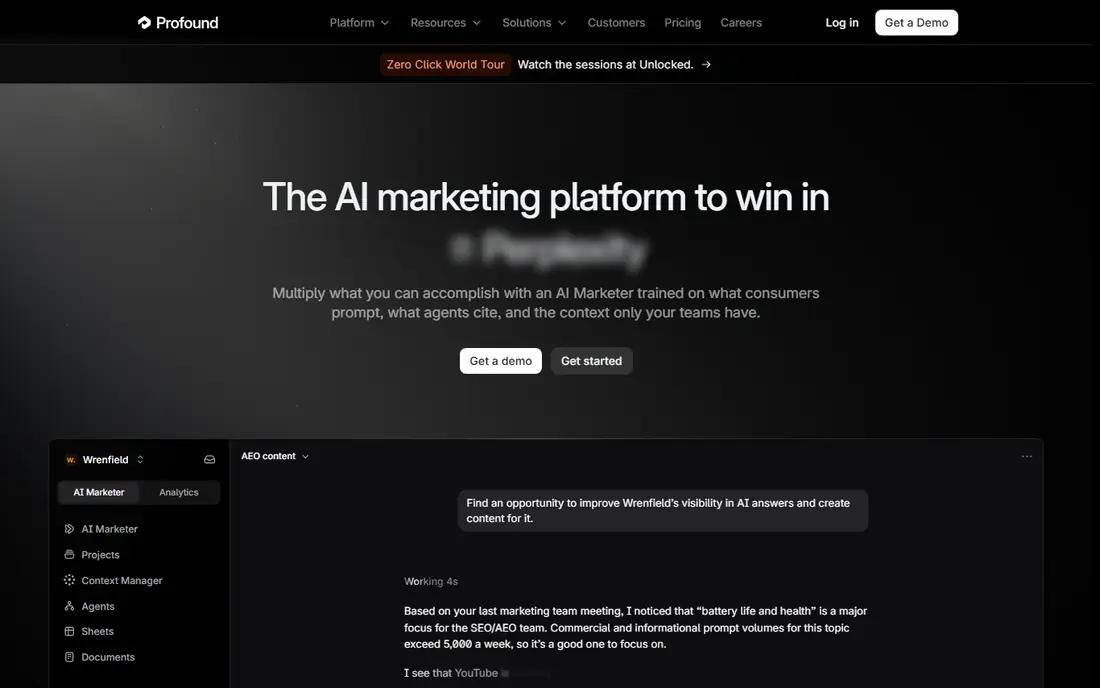
Profound is the enterprise end of this market. It tracks brand presence across major AI search and chat surfaces and breaks results down by prompt, persona, and competitor, which helps a large team explain why one rival keeps appearing in answers. The reporting depth is the point here, and it fits companies that need shared dashboards, controls, and a vendor that can pass procurement checks.
The catch is cost and complexity. Smaller teams may find the setup and the price hard to justify when a cheaper tracker covers their main prompts. If your brand is already mentioned often in AI answers and you need to manage that at scale, Profound is a strong shortlist pick. If you only need a weekly check on a dozen prompts, start cheaper.
- Wide answer-engine coverage
- Detailed reporting
- Built for large teams and security reviews
- Pricing is not published for most plans
- Likely more than a small site needs
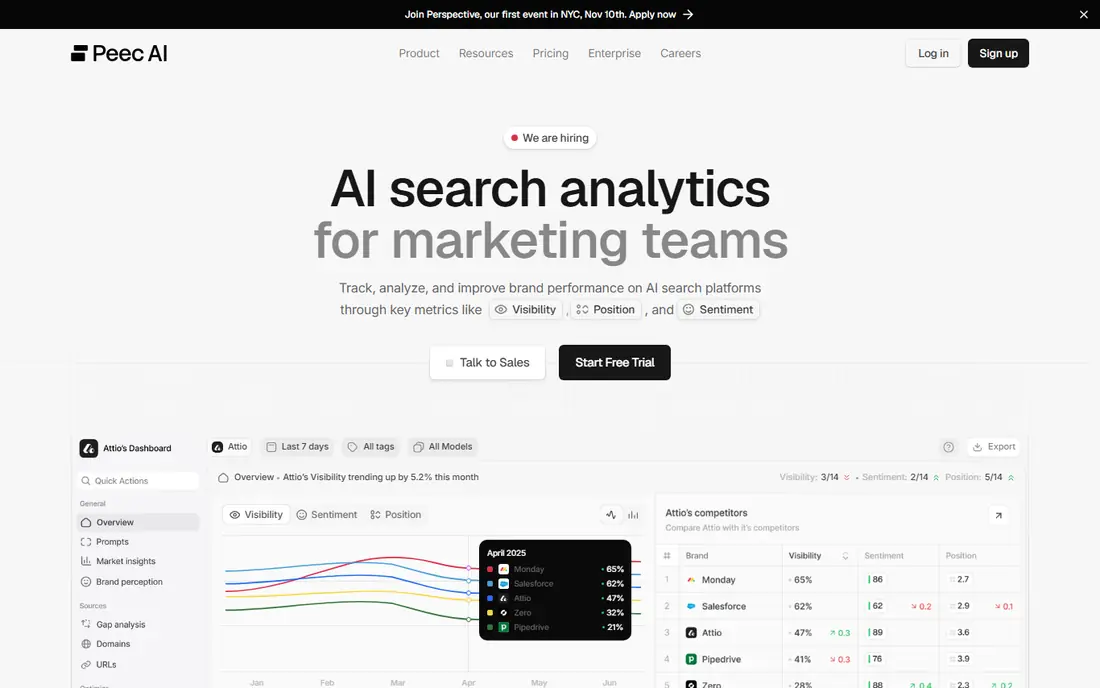
Peec AI gives marketing teams one daily number for AI visibility, then lets them dig into the prompts, citations, and rivals behind it. That simplicity matters, because many trackers bury the answer in charts. Multi-country and multi-language support also makes it useful for brands that sell in more than one market and want the same prompt set measured consistently.
The trade-off is scope at the entry price. You pick a small set of engines to start, and broader coverage costs more. Teams that track many brands or run agency accounts should check the prompt and engine limits before committing. For a single brand that wants clean benchmarking, Peec AI is easy to defend.
- Clear daily visibility score
- Multi-country and multi-language tracking
- Strong competitor views
- Entry plan covers a limited set of engines
- Costs rise as you add prompts and engines
Otterly.AI is our pick for most small teams trying AI visibility tracking for the first time. The entry price is low, the setup is plain, and it covers the surfaces most buyers actually ask about first, including Google AI Mode and AI Overviews. Daily monitoring, mentions, citations, and competitor checks give you enough to spot a drop or a new rival without a large contract.
It is not the deepest tool on this list, and larger teams may outgrow its reporting. But that is a good problem to have, because it means you learned which prompts matter before spending more. If you want to test whether AI answers mention your brand at all, this is the lowest-risk place to start.
- Low entry price
- Covers Google AI Mode, AI Overviews, ChatGPT, and Perplexity
- Simple daily monitoring
- Fewer deep enterprise features
- Paid add-ons may be needed for wider engine coverage
Scrunch organizes its work around three steps: monitor what AI answers say, analyze why, and optimize what you publish next. Its persona modeling stands out, because the same question can produce a different answer for a beginner, a buyer, or a technical evaluator. That helps content teams write pages that match the person behind the prompt, not just the keyword in it.
The honest catch is that this structure takes time to use well. A team that only wants a weekly visibility score may find the extra layers unnecessary. Scrunch fits best when you already have a content program and want AI visibility data to shape what you write next, rather than just to watch a chart move.
- Persona-based prompt modeling
- Funnel-style analysis
- Structured monitor, analyze, and optimize workflow
- Pricing is not published
- May be more structured than a small team needs
AthenaHQ stands out because it tries to connect AI visibility to outcomes, not just mentions. A mention that never leads to a visit or a sale is interesting, but it is not the same as a mention that drives demand. The free plan makes it easy to test that idea before paying, and the paid plans widen engine coverage.
The limit is that attribution is only as good as the data you connect. If your analytics are messy, the revenue view will be messy too. Still, for teams tired of vanity metrics, AthenaHQ is worth a trial, and the free tier removes the usual excuse for not testing it.
- Free plan available
- Links visibility to traffic and sales signals
- Covers several answer engines
- Full engine coverage sits on paid plans
- Revenue links depend on your analytics setup
SE Ranking suits teams that do not want two separate tools. Its AI Results Tracker covers Google AI Overviews, Google AI Mode, Gemini, ChatGPT, and Perplexity, alongside the traditional rankings, audits, and backlink data that agencies already use. That combination keeps reporting in one place and makes it easier to show a client both the old and the new search picture.
The downside is that you pay for a full SEO platform even if you only care about AI answers. If you already use SE Ranking, turning on its AI tracking is the obvious first step. If you do not, compare its total price with a focused tracker like Otterly.AI before you switch.
- Classic rank tracking plus AI results tracking in one platform
- Competitor comparisons
- Agency-friendly reporting
- AI tracking is an addition to a larger SEO suite
- Pricing varies by plan and add-on
Semrush added an AI Visibility Toolkit for teams that already live in its platform. It tracks how a brand appears in AI answers and pairs that with the keyword, traffic, and competitor data Semrush has collected for years. For an in-house team, that context helps separate a real visibility problem from a one-week blip in a single prompt set.
The pricing model needs care. The toolkit is priced per domain, so agencies with many clients should total the cost before assuming it is cheaper than a dedicated tool. If you already pay for Semrush and track one or two domains, it is a sensible add-on. If you track many, a standalone tracker may cost less.
- AI Visibility Toolkit sits inside a mature SEO suite
- Covers several AI surfaces
- Strong competitive data
- AI toolkit pricing is per domain
- Total cost rises quickly for many domains
Ahrefs Brand Radar is built for discovery. Instead of only checking the prompts you wrote down, it helps you find the questions and topics where AI answers mention your brand or your rivals. That matters because buyers ask messy, specific questions, and the prompts you guess in a meeting are rarely the full set.
The price is the barrier. At the AI tier, this is a serious purchase, and teams that only need to watch a small prompt list will get better value elsewhere. It fits research-heavy teams and agencies that already use Ahrefs and want prompt discovery alongside classic SEO data.
- Brand Radar surfaces prompts at scale
- Strong backlink and content data behind it
- Covers several AI engines
- High entry price for the AI feature
- No free plan for this tier
Goodie AI appeals to teams that already know the problem and want the next step. It tracks visibility across a wide set of models and then ranks the fixes that should improve it, rather than leaving you with a long report and no order of work. That action-first design suits small marketing teams with limited time.
Because pricing is not published, you need a demo or a quote to judge value, and you should ask exactly which models and prompt limits a plan includes. If the fix list matches your content capacity, Goodie AI can save time. If you only need monitoring, a cheaper tracker will do the same job for less.
- Tracks many AI models
- Turns visibility gaps into a prioritized fix list
- Clear action focus
- Pricing is not published
- Newer brand than Semrush or Ahrefs, so check case studies carefully
How we picked these
We compared official feature pages, pricing pages, and app and platform listings for tools that track Google AI Mode, AI Overviews, and other answer engines, and we favored tools with a live product, clear engine coverage, and a current pricing or trial page. We did not claim hands-on testing, and we treated each vendor's visibility score as its own measure, since prompt sets differ and scores do not transfer between tools. We also excluded tools that were only a blog post or a waitlist with no usable tracker.
What to check before you pay
Start with your prompt list, not the vendor demo. Write down the questions a buyer would ask before choosing you, including comparison questions, price questions, and problem questions, then check how each tool handles that exact list. A tool that tracks 20 engines but misses your top 30 prompts is less useful than a cheaper tool that covers the prompts that drive revenue.
Next, check the details that change the bill. Ask how many prompts, brands, engines, and regions a plan includes, how often it refreshes, and whether historical data stays available if you downgrade. Also ask where citations come from and whether you can export the raw prompt results. A pretty dashboard is not enough if you cannot show your team the exact answer that mentioned a rival.
A simple trial plan
Run two tools for two weeks on the same prompt set if you can, and judge them on three things: whether the answers match what you see when you ask the same question yourself, whether the report leads to a content change, and whether anyone outside marketing understands it. If a report never changes a page, a pitch, or a budget choice, it is a chart, not a tool. Keep the winner, and revisit the choice when your prompt list doubles.
Sources
Frequently asked questions
What is AI mode rank tracking?
It measures whether Google AI Mode, AI Overviews, and other AI answers name, recommend, or cite your brand for a set of prompts. It is different from classic rank tracking, which measures the position of a blue link on a results page.
Is AI mode the same as Google AI Overviews?
No, but the two are related. AI Overviews appear on a standard results page, while AI Mode is a separate conversational search experience. Good trackers cover both, and you should check which surfaces a plan includes before you buy.
Why do two trackers show different scores for the same brand?
They use different prompts, different times, different locations, and different scoring rules. Treat each score as a trend inside one tool, not as a number you can compare directly with another vendor.
How many prompts should I track at first?
Start with 20 to 50 prompts that match real buyer questions, then add competitor and comparison prompts. A small, honest prompt set beats a large list of generic keywords that no buyer types.
Can AI tracking replace classic SEO rank tracking?
No. Classic rankings still matter for traffic, and many buyers still click links. Use AI tracking alongside classic tracking until you can see, in your own analytics, how much demand now flows through AI answers.
Do I need a paid tool to check AI visibility?
No. You can ask the same questions yourself in Google AI Mode, ChatGPT, Gemini, and Perplexity and record the answers. A paid tool saves time, adds history, and scales the check, but manual checks are a fair starting point.