Best AI Tools for Research in 2026: 9 Tools Compared
By ToolNimba Editorial Team November 4, 2026 9 min read

- Top pick
 Elicit
Structured literature reviews
Starting priceFreeCheck out ElicitRead our review - Runner-up
 Consensus
Evidence-based question answering
Starting priceFreeCheck out ConsensusRead our review - Also great
 Semantic Scholar
Free paper discovery
Starting priceFreeCheck out Semantic ScholarRead our review
How we researched this
We compared official pricing and feature pages, app store listings, privacy policies and public user reviews. Prices change, so check the provider's site before you pay.
Key takeaways
- Elicit is the best pick for structured literature reviews, with extraction tables that turn many papers into comparable data.
- Consensus suits question-first research, giving evidence-based answers with a meter showing where studies agree or disagree.
- Semantic Scholar and ResearchRabbit are the best free starting points for discovery and citation mapping.
- No AI research tool replaces reading the source: always verify key claims, quotes, and numbers against the original paper.
Quick comparison
| Name | Best for | Starting price | Free plan | |
|---|---|---|---|---|
| Elicit | Structured literature reviews | Free | Yes | Visit |
| Consensus | Evidence-based question answering | Free | Yes | Visit |
| Semantic Scholar | Free paper discovery | Free | Yes | Visit |
 SciSpace | Reading and understanding PDFs | Free | Yes | Visit |
 ResearchRabbit | Citation mapping and discovery | Free | Yes | Visit |
 scite | Checking how papers are cited | $20 per month | Free trial | Visit |
 NotebookLM | Synthesizing your own documents | Free | Yes | Visit |
 Perplexity | Broad research with citations | Free | Yes | Visit |
 Scholarcy | Summarizing single papers | $7.99 per month | Yes | Visit |
The best ai tools for research
AI research tools help at different stages: finding papers, reading them faster, extracting comparable data, checking citations, and drafting a synthesis. No single tool does all of those well, so most researchers end up with a small stack rather than one app. We compared tools on paper coverage, citation quality, extraction features, price, and free plans. Use them to speed up discovery and drafting, and verify every important claim against the original source before you cite it.
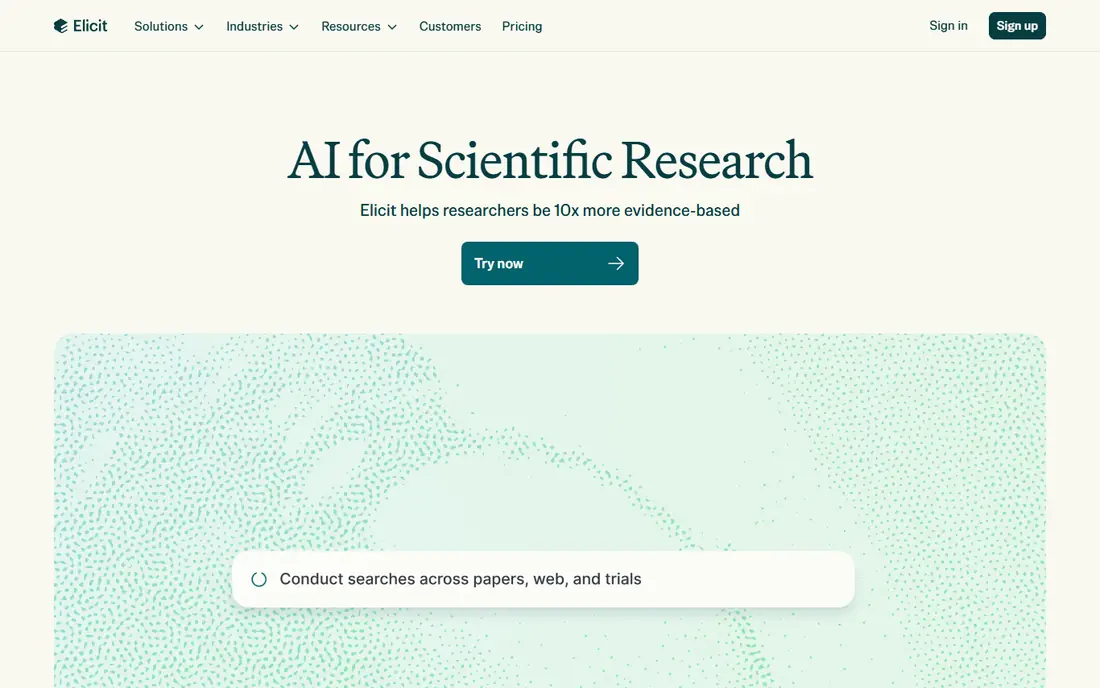
Elicit is our top pick for literature reviews because it turns a research question into a structured workflow. You search across a large paper index, screen results, and extract comparable fields such as methods, outcomes, and sample details into tables. That structure saves hours when a review covers dozens or hundreds of papers.
The free Basic tier is limited in monthly reports, while Plus starts at $11 per user per month billed annually and Pro at $39 per user per month in some listings, so check the current pricing page. Extracted data also needs spot-checking, since AI can misread methods or numbers. For a thesis, systematic review, or evidence synthesis, Elicit is the strongest starting point.
- Searches a large paper index
- Extracts data into structured tables
- Systematic review workflow
- Free tier is limited
- Extracted data still needs human verification
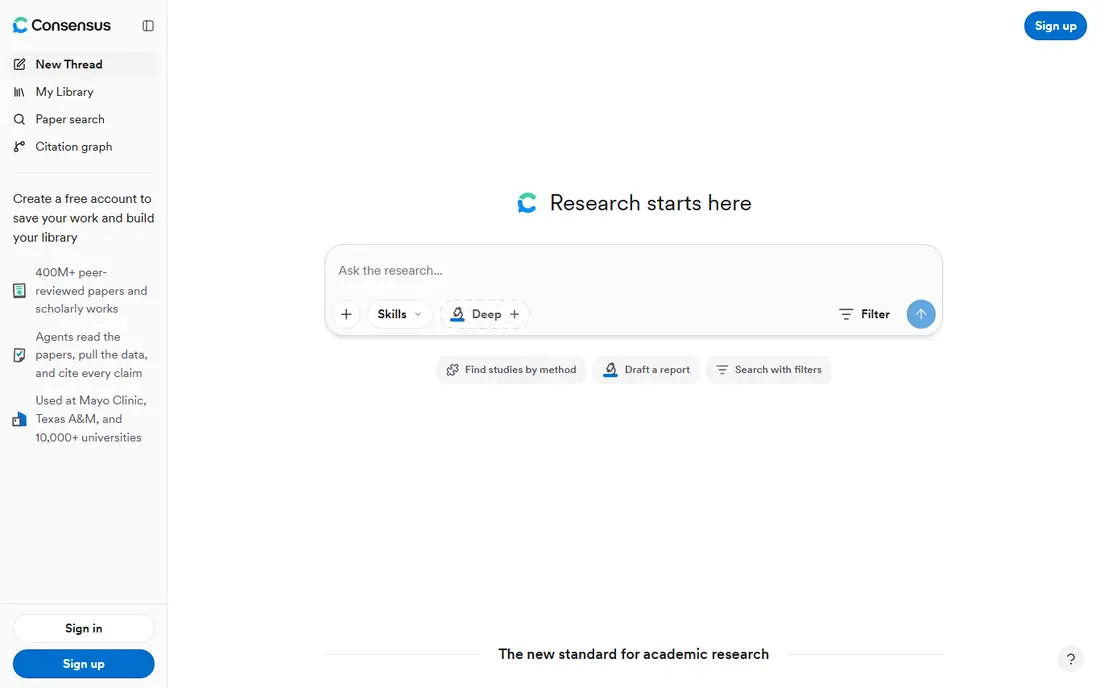
Consensus suits a different question: what does the research actually say? Ask a question in plain language, and it searches published studies, summarizes findings, and shows a meter indicating whether studies agree, disagree, or are mixed. Study quality indicators help you weigh randomized trials against weaker designs.
The limitation is coverage of new or niche questions. If few studies exist, the answer will be thin, and that thinness is itself useful information. Paid plans start around $12 per month billed annually in recent listings, with a free tier for limited use. For evidence-based answers and quick literature checks, Consensus is a strong second tool alongside Elicit.
- Consensus Meter shows agreement across studies
- Evidence synthesis from papers
- Study quality flags
- Best for questions with existing studies
- Paid plans needed for heavier use
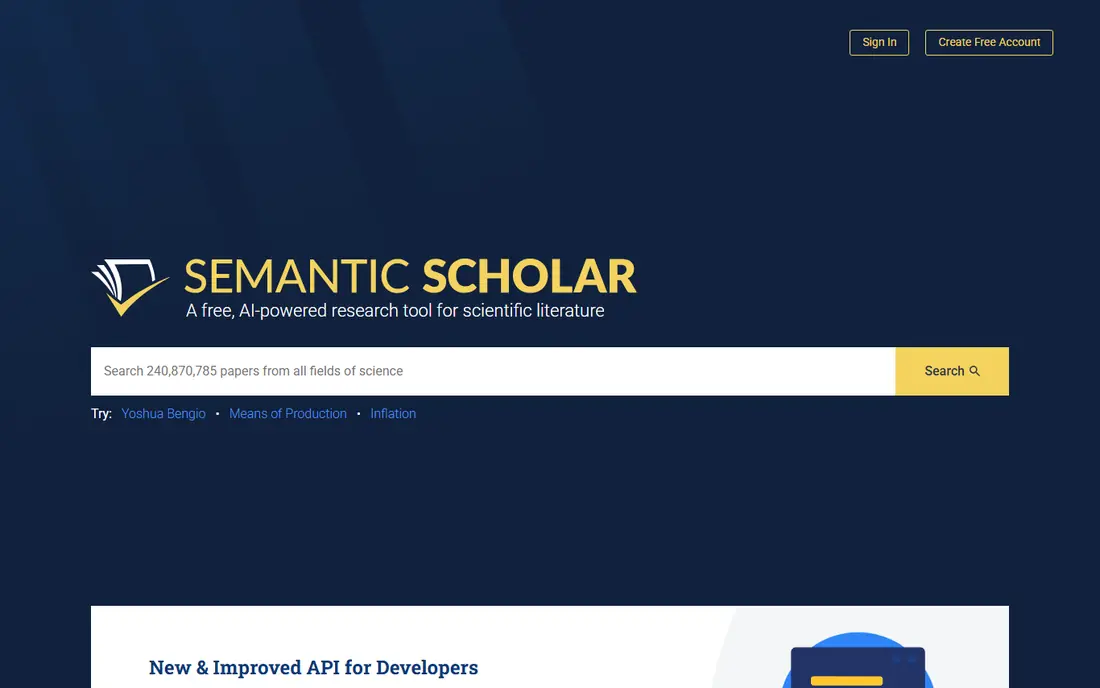
Semantic Scholar is the best free research starting point. It offers free search across hundreds of millions of papers, with short AI summaries, author and venue information, and citation graphs that show how papers connect. Recommendations help you find related work you might otherwise miss.
It does not offer the structured extraction tables of Elicit or the question meter of Consensus, so it fits discovery better than synthesis. For students and budget-conscious researchers, pairing Semantic Scholar with the free tiers of Elicit and Consensus covers most literature review needs at no cost. Always open the full paper before citing a summary.
- Free access to a very large paper index
- TLDR summaries
- Recommendations and citation graphs
- No structured extraction tables
- AI summaries need verification
SciSpace is built for the reading stage: upload a PDF or find a paper, ask questions about it, and get explanations of methods, results, and difficult passages. Its literature review tools help compare papers, and its writing features assist with drafting and paraphrasing from sources. That makes it useful when you have a stack of papers to work through.
The free tier limits some features, and premium plans start around $12 per month billed annually in recent listings, with higher tiers costing more. SciSpace is broader than Elicit, but less focused on systematic extraction. For students who struggle most with reading dense papers, it is a strong pick.
- Chat with PDFs
- Literature review matrices
- Large paper index
- Writing assistance
- Free tier is limited
- Premium pricing climbs on higher tiers
ResearchRabbit helps you find what to read next. Add seed papers, and it maps their citations and references into a visual network, then recommends related papers based on that network. That approach surfaces older foundational work and newer related studies that keyword search alone can miss.
It is not a writing or extraction tool, so pair it with Elicit or SciSpace for the next stage. Sign-up is free, which makes it an easy addition to any research stack. For a researcher starting a new topic or building a reading list, ResearchRabbit is one of the best free tools available.
- Free sign-up
- Visual citation networks
- Personalized paper recommendations
- No full-text extraction tables
- Recommendations depend on your seed papers
scite answers a question other tools skip: has this paper been supported or challenged since publication? Its Smart Citations classify later citations as supporting, mentioning, or contrasting, drawing on an index of more than a billion citations. That helps you avoid building an argument on a paper that later work overturned.
Pricing starts at $20 per month billed annually, with a limited free Connect tier in some listings, so check the current page. scite is not the best discovery tool, but for verifying a foundational claim before you cite it, it is uniquely useful. Use it as a check on key sources, not as your only search tool.
- Smart Citations show supporting or contrasting citations
- Large citation index
- Reference checks
- No free plan beyond a limited tier
- Best value for verification, not discovery
NotebookLM, from Google, is different because it works on documents you provide rather than a paper database. Upload papers, notes, and reports, then ask questions, generate summaries, and create study guides grounded in those sources, with citations back to the passages used. Audio overviews turn a set of sources into a listenable briefing.
The limit is scope: it cannot search a paper index for you, so discovery must happen elsewhere. The free tier has usage limits, with a Plus plan at $19.99 per month in recent listings. For synthesizing a reading set you already own, or preparing for an exam or defense, NotebookLM is a strong and well-grounded tool.
- Grounded answers from your uploaded sources
- Audio overviews
- Study guides from your materials
- Works only on your uploads, not a paper index
- Free tier has usage limits
Perplexity suits broad, fast research across the web and academic sources. Ask a question, get a cited answer with sources you can open, and follow up to narrow the topic. That speed makes it useful at the start of a project, when you are mapping a field, checking definitions, or finding recent news and reports alongside papers.
Citation quality varies, since web sources range from peer-reviewed papers to blogs, so check each source before you rely on it. Pro is listed at $20 per month for higher limits and models, with a free tier for limited use. Use Perplexity for exploration, then move to Elicit, Consensus, or Semantic Scholar for paper-level work.
- Real-time web and academic search
- Cited answers
- Follow-up questions for deeper research
- Citation quality varies by source
- Not a substitute for a paper database
Scholarcy helps when you need to get through one paper at a time. Upload a PDF and it builds a structured summary card covering background, methods, results, and limitations, with key terms and references extracted. Flashcard export helps students revise from those cards later.
It is not built for screening hundreds of papers or building extraction tables at scale, where Elicit fits better. Paid plans start at $7.99 per month in recent listings, with a free tier for limited use. For students who need to read and remember many individual papers, Scholarcy is a practical, focused tool.
- Structured summary cards from PDFs
- Extracts key findings, methods, and limitations
- Flashcard export
- Focused on single papers, not large reviews
- Summary quality varies with paper layout
How we picked these
We compared official product pages, pricing pages, and recent tool comparisons, focusing on AI research tools that are actively offered in 2026 and that cite or link to original sources. We checked paper coverage, extraction and synthesis features, citation quality, free plans, and price, and we favored tools that support academic workflows rather than only general chat. We did not claim hands-on testing, and pricing changes, so confirm current prices on the vendor site before you pay.
How to use AI research tools without weakening your work
Use a clear workflow: discover with Semantic Scholar or ResearchRabbit, answer questions with Consensus, extract with Elicit, read deeply with SciSpace or Scholarcy, and verify key claims with scite. Keep a record of your search terms, inclusion criteria, and which tool produced each summary, since transparency is increasingly expected in academic work.
Then verify before you cite. Open the original paper for any claim that matters to your argument, check numbers and quotes against the source, and note where studies disagree rather than smoothing over the conflict. AI can speed up a literature review a lot, but the judgment about what counts as evidence, and what a study actually shows, stays with you.