Best AI Visibility Tools for B2B Companies in 2026: 9 Tools Compared
By ToolNimba Editorial Team November 11, 2026 10 min read

- Top pick
 Profound
Enterprise prompt volume
Starting price$99 per monthCheck out ProfoundRead our review - Runner-up
 Peec AI
Multi-market tracking
Starting priceSee websiteCheck out Peec AIRead our review - Also great
 Scrunch AI
Agent-readable pages
Starting price$250 per monthCheck out Scrunch AIRead our review
How we researched this
We compared official pricing and feature pages, app store listings, privacy policies and public user reviews. Prices change, so check the provider's site before you pay.
Key takeaways
- AI visibility tools track how ChatGPT, Gemini, Perplexity, Claude, and other AI engines mention, cite, and recommend your brand.
- Profound suits enterprise B2B teams with high prompt volume, while Peec AI suits multi-market teams that need clean daily tracking.
- Scrunch suits teams that want to make pages readable to AI agents, while Brandlight suits enterprise brand and sentiment work.
- AthenaHQ and Otterly suit smaller B2B teams that want a fast start, while Semrush and Ahrefs suit teams already using those SEO suites.
- Prompt design matters more than tool choice at first: track the buying questions your customers actually ask, not generic brand mentions.
Quick comparison
| Name | Best for | Starting price | Free plan | |
|---|---|---|---|---|
| Profound | Enterprise prompt volume | $99 per month | No | Visit |
| Peec AI | Multi-market tracking | See website | Free trial | Visit |
| Scrunch AI | Agent-readable pages | $250 per month | Free trial | Visit |
 Brandlight | Enterprise brand sentiment | See website | No | Visit |
 AthenaHQ | Fast onboarding and citations | Free | Yes | Visit |
 Otterly | Budget AI tracking | $29 per month | Free trial | Visit |
 Semrush AI Visibility Toolkit | Semrush customers | See website | Free trial | Visit |
 Ahrefs Brand Radar | Ahrefs customers | See website | No | Visit |
 Goodie AI | SMB action lists | $399 per month | No | Visit |
The best ai visibility tools for b2b companies
AI search is changing how B2B buyers discover vendors. Instead of clicking ten blue links, buyers ask an AI engine for a shortlist, and the brands cited in that answer win attention first. We compared official pricing and feature pages, plus third-party AI visibility comparisons, and grouped each tool by the B2B team it serves best.
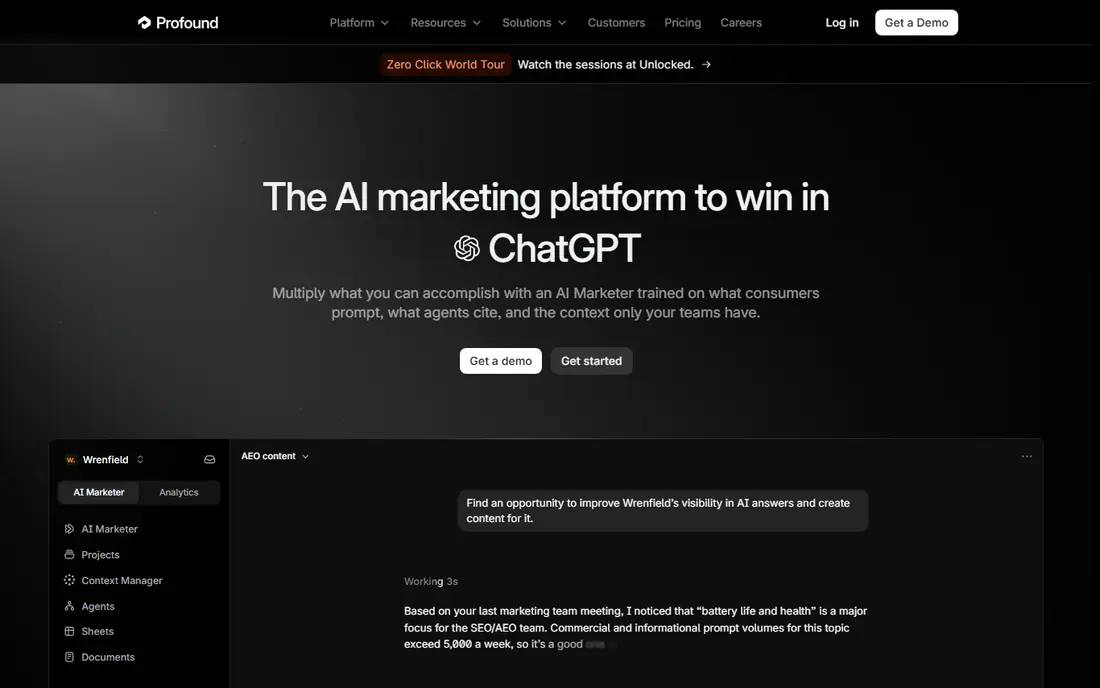
Profound is the best-known name in AI visibility, and it suits enterprise B2B teams that need to track many prompts across many engines. It monitors brand mentions in AI answers, compares competitors, and alerts teams to shifts in how AI engines describe their category. That scale helps large marketing and product teams that report to executives.
Smaller teams may find the entry plan useful for a first read, but enterprise reporting and volume sit on higher tiers. Start with a focused prompt set for your core buying questions, and expand volume only after you know which prompts drive real pipeline interest.
- Broad AI engine coverage
- High prompt volume for enterprises
- Competitive benchmarking and trend alerts
- Enterprise depth can exceed small-team needs
- Higher tiers are quote-based

Peec AI suits B2B teams that sell across markets and need to see AI visibility by country and language. Its dashboards track brand mentions, citations, and sentiment across major AI engines, with workspaces that help agencies manage several clients. That structure helps European and global B2B firms more than a single-market tracker.
Peec AI is mainly a monitoring tool, so teams still need to fix content, schema, and citations themselves. Pair it with a clear content owner who can act on weekly findings, or the dashboard will show problems without changing results.
- Clean daily tracking
- Multi-region and multi-language breakdowns
- Agency and multi-brand workspaces
- Monitoring-focused, with less built-in remediation
- Pricing varies by currency and plan

Scrunch suits B2B teams that want to go beyond tracking and improve how AI agents read their site. Its agent experience platform serves an optimized version of pages to AI crawlers, while its monitoring tools show which sources AI engines cite. That combination helps technical and content teams that already know their pages render poorly for bots.
The entry price is higher than Otterly or AthenaHQ, so smaller teams should test whether agent readability is their real bottleneck. If your pages already load cleanly and cite well, a cheaper tracker may be enough at first.
- Citation and source analysis
- Agent experience platform for AI crawlers
- Persona-based prompt modeling
- Higher entry price than budget trackers
- Setup takes planning for larger sites
Brandlight suits enterprise B2B and brand teams that care about sentiment and narrative, not just mention counts. It tracks how AI engines describe a brand, compares competitors, and supports larger organizations with dashboards and execution help. That focus helps communications teams that report on reputation, not just search traffic.
Because pricing is quote-based and public detail is thinner than for self-serve tools, expect a sales process and a pilot. Ask for a trial prompt set in your exact category, and check whether sentiment scoring matches how your buyers actually talk about vendors.
- Brand sentiment and narrative analysis
- Enterprise dashboards
- Execution support for larger orgs
- Quote-based pricing
- Depth is harder to verify from public pages
AthenaHQ suits B2B teams that want to test AI visibility before committing budget. Its free tier lets a team check citations and brand mentions, while paid plans add deeper tracking and optimization guidance. Its citation engine helps teams see which pages AI engines cite, and where misattribution happens.
Smaller teams should start free, build a prompt set around real buying questions, and upgrade only when the free tier limits prompt volume or reporting. Larger teams should check whether AthenaHQ covers the engines and regions their buyers use most.
- Free tier for testing
- Citation engine that flags sources
- Broad engine coverage in comparisons
- Paid plans start higher than budget rivals
- Execution features vary by plan
Otterly suits solo marketers, startups, and small B2B teams that want a cheap first answer to whether AI engines mention their brand at all. It tracks prompts across ChatGPT and Perplexity in comparisons, shows citation sources, and keeps pricing simple. That low cost makes it easy to justify as a first experiment.
Larger B2B teams may outgrow Otterly when they need Claude, Gemini, and Google AI Mode coverage, plus multi-brand reporting. Use it to prove value, then move to a broader tool when prompt volume and engine coverage become the bottleneck.
- Low entry price
- ChatGPT and Perplexity tracking
- Citation source URLs
- Narrower engine coverage than enterprise tools
- Fewer optimization features
Semrush AI Visibility Toolkit suits B2B teams already using Semrush for SEO. Adding AI tracking to the same dashboard avoids another vendor, another login, and another report format. Teams can compare traditional search rankings with AI mentions in one place, which helps stakeholder reporting.
Purpose-built tools may offer deeper prompt, citation, and sentiment analysis. If AI visibility becomes a core channel, compare Semrush coverage with Profound or Peec AI before relying on the add-on alone.
- AI tracking inside a familiar SEO suite
- Brand and competitor views
- Single dashboard for SEO and AI visibility
- Add-on pricing depends on Semrush plan
- Engine coverage is narrower than purpose-built tools in comparisons
Ahrefs Brand Radar suits B2B teams that already use Ahrefs for SEO and content work. It adds AI brand mention data to a familiar suite, with backlink and content context that helps teams understand why a source gets cited. That integration saves time for SEO-led teams.
Check total cost carefully, because Brand Radar is an add-on and third-party comparisons report a higher all-in cost than the headline figure. Also check refresh frequency and engine coverage, since monthly refreshes suit reporting but not fast-moving campaigns.
- Brand mention data inside Ahrefs
- Strong backlink and SEO context
- Useful for teams already in Ahrefs daily
- Add-on cost can be high in comparisons
- Refresh cadence and engine coverage vary
Goodie AI suits small and mid-size B2B teams that want actions, not just charts. It combines research, monitoring, and optimization guidance, with prioritized lists that tell a team which page to rewrite, which schema to add, or which citation to pursue. Revenue attribution features in comparisons also help teams link AI visibility to pipeline.
The price is higher than Otterly or AthenaHQ free tiers, so it fits teams with a real content owner who will act weekly. If no one owns the action list, a cheaper tracker plus a content plan will deliver more value.
- Research, monitoring, and optimization in one workflow
- Revenue attribution features in comparisons
- Prioritized action lists
- Higher entry price than budget trackers
- Smaller vendor than Profound or Semrush
How we picked these
We compared official pricing and feature pages, plus third-party AI visibility tool lists checked in September 2026, and checked that each homepage loads and matches the product. We favored tools with clear engine coverage, citation sources, prompt tracking, and competitor views, and we kept a mix of enterprise, mid-market, and budget options. We did not claim hands-on testing, and where prices varied across sources we wrote See website.
How to buy an AI visibility tool
Start with prompts, not platforms. A tool that tracks the wrong questions will report clean charts while buyers still miss your brand.
Build a prompt set from real buying questions
List the questions buyers ask before choosing a vendor in your category, such as best tools for a use case, comparisons, pricing, and implementation. Add brand, competitor, and category prompts, plus prompts for each core persona. Track those weekly, not just brand name mentions.
Check engine and region coverage
Confirm which engines the tool covers, including ChatGPT, Gemini, Perplexity, Claude, and Google AI Mode, and whether it breaks results down by region and language. B2B buyers in different markets may see different shortlists, so a single-market view can mislead global teams.
Demand citation sources, not just scores
A visibility score alone does not tell you what to fix. Check which pages AI engines cite, whether citations are accurate, and which competitor sources appear most. Use that source list to guide content updates, PR, and review programs.
Assign an owner and a weekly action
Give one person ownership of AI visibility, with a weekly review of new citations, sentiment shifts, and missed prompts. Without an owner, even the best tool becomes a dashboard no one acts on. Tie actions to content, schema, and third-party pages that AI engines actually cite.
Sources
Frequently asked questions
What is AI visibility for B2B companies?
AI visibility measures how often AI engines mention, recommend, and cite your brand in answers to buyer questions. It covers engines such as ChatGPT, Gemini, Perplexity, and Claude, and it matters because buyers increasingly ask AI tools for shortlists before visiting vendor sites.
Which AI visibility tool is best for a small B2B company?
Otterly and AthenaHQ suit small B2B teams that want a low-cost start, with Otterly offering a low paid entry point and AthenaHQ offering a free tier. Goodie AI suits small teams that want prioritized actions and can act on them weekly.
How is AI visibility different from SEO?
SEO tracks rankings and clicks in traditional search results, while AI visibility tracks mentions, citations, and recommendations inside AI answers. Both matter, because AI answers often cite traditional search sources, but AI visibility adds prompt, sentiment, and citation analysis that SEO tools alone do not cover.
Can AI visibility tools improve my rankings in AI answers?
Tools can show which prompts, citations, and pages drive visibility, but improvement still comes from content, schema, reviews, and third-party coverage. Use the tool to find gaps, then fix the source pages and earned coverage that AI engines cite.
How much do AI visibility tools cost?
Entry prices in comparisons range from free tiers at AthenaHQ, to about $29 per month at Otterly, to $99 per month at Profound, to $250 per month at Scrunch, to quote-based enterprise pricing at Brandlight. Always confirm current pricing, because this new category changes plans often.
Should B2B companies track competitors in AI search?
Yes. Competitor tracking shows which rivals AI engines recommend, which sources they cite, and where your brand is missing. That view helps product marketing decide which comparisons, reviews, and partner pages to build next.